simulate atmospheric pollution near roadways HARMO 13, Paris, 1-4 - - PowerPoint PPT Presentation

simulate atmospheric pollution near
SMART_READER_LITE
LIVE PREVIEW

simulate atmospheric pollution near roadways HARMO 13, Paris, 1-4 - - PowerPoint PPT Presentation

Evaluation of numerical models used to simulate atmospheric pollution near roadways HARMO 13, Paris, 1-4 June 2010 L. Malherbe, L. Ltinois, L. Roul, INERIS A. Wroblewski, Ecole des Mines de Douai Context Growing concern about population


slide-1
SLIDE 1

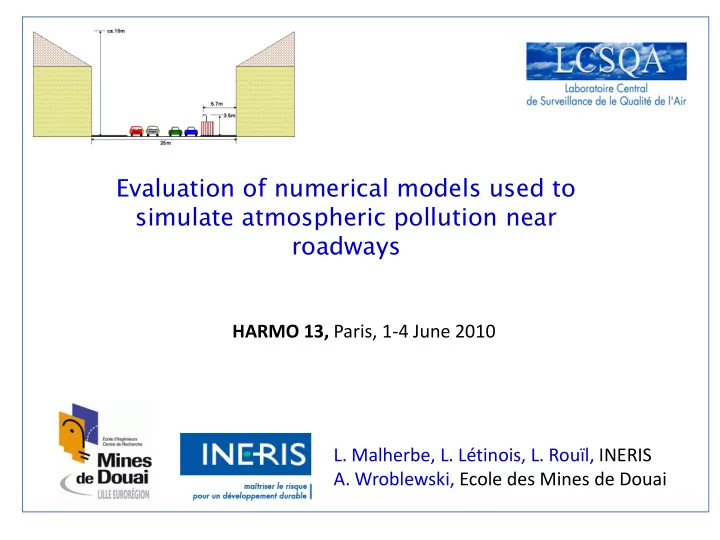
Evaluation of numerical models used to simulate atmospheric pollution near roadways

HARMO 13, Paris, 1-4 June 2010

  • L. Malherbe, L. Létinois, L. Rouïl, INERIS
  • A. Wroblewski, Ecole des Mines de Douai
slide-2
SLIDE 2
  • Growing concern about population exposure near road traffic
  • A large number of monitoring sites for which regulatory thresholds

are exceeded (NO2, PM10) are traffic sites.  Modelling traffic-related pollution can be useful : – to estimate concentrations of pollutants along the main streets and roads; – to represent the concentration increment due to traffic in air quality maps; – to assess and compare the impact of different traffic scenarios

  • n air quality.

Context

slide-3
SLIDE 3
  • Different modelling tools are on the market or available online.
  • Most of them are based on simplified formulations of the dispersion

processes at the street scale.

  • They are generally easy to implement but input data (emissions,

meteorology, background concentrations) and modelling parameters have to be carefully chosen.

Context and objectives

 Purpose of the study constituting an information data bank accessible through Internet to help those involved in air quality monitoring to:

  • evaluate the relevance and reliability of their tools according to

the situation to be modelled,

  • make a proper use of models.
slide-4
SLIDE 4

Website: available information and data

Technical sheets about commonly used models Excel calculation sheet for comparing time series of simulated and measured concentrations and computing statistical scores. Links towards technical reports List of field measurement campaigns carried out near road traffic: description, references, corresponding data files when it is possible. To be published soon: results

  • f

sensitivity tests ; numerical model

  • utputs

Web page accessible through the LCSQA website. Currently restricted to the members of the French national system for air quality monitoring (MEEDDM, ADEME, LCSQA, AASQA).

Campaigns Models Tools Reports

slide-5
SLIDE 5

Website: available information and data

slide-6
SLIDE 6

Implementation of the models

To provide

  • quantitative

results

  • f

comparison between model

  • utputs

and measurements,

  • guidelines about the respective application areas of the models,

several common tools have been implemented for some of the streets included in the list of campaigns :

– 1 street canyon, Berlin, Germany, 45000 veh/day (TRAPOS, 1995) – 1 street canyon, Hanovre, Germany, 30000 veh/day (TRAPOS, 1994) – 1 street canyon, Copenhagen, Denmark, 22000 veh/day (TRAPOS, 1995) – 1 deep street canyon, Nantes, France, 10700 veh/day (AIR PL, 2004-2005) – 1 street canyon, Nantes, France, 27100 veh/day (AIR PL, 2004-2005) – 1 semi-open street, Nantes, France, 43800 veh/day (AIR PL, 2004-2005) – On-going tests: two open streets with intersections (Poitiers, ATMO PC)

slide-7
SLIDE 7

Implementation of the models

Tested models:

– ADMS-Urban (CERC): advanced Gaussian dispersion model with parametrization for street canyons based on OSPM formulation. Can be used at an hourly time step. – CALINE4 (CALTRANS): Gaussian line source dispersion model. Can be used at an hourly time step. – OSPM (NERI): parametrized street canyon model. Combination of a plume model (direct contribution of traffic emissions ) and a box model (recirculating part of pollutants in the street). Can be used at an hourly time step. – SIRANE (LMFA, ECL): street network model based on mass balance in each street . Exchange at the intersections and dispersion above roofs (Gaussian model) are taken into account. Can be used at an hourly time step. – STREET (OXALIS-Ecomobilité, KTT): parametric model using a database of simulation outputs (coming from the 3D CFD MISKAM model). Can only provide statistical annual results.

slide-8
SLIDE 8

Implementation of the models

TRAPOS cases, brief view of the results

Relative difference between modelled and measured annual mean concentrations: NOx: -61% to +58% NO2: -9% to -35% Significant influence of : NOx emissions, background pollution, wind conditions and depending on the model, mixing height. CALINE4: not appropriate for street canyons Data sets:

http://www2.dmu.dk/AtmosphericEnvironment/trapos/

Tested models: ADMS-Urban, CALINE4, OSPM, STREET Pollutants: NOx, NO2

slide-9
SLIDE 9

Implementation of the models

Street canyons of Nantes

Data sets: AIR Pays de la Loire Tested models: ADMS-Urban, OSPM, SIRANE, STREET Pollutants: NOx, NO2, PM10 H/W=0.5 H/W=2.3 H/W=1.2

43810 veh/day

  • Oct. 2004 to end Jan. 2005
  • Dec. 2004 to end Jan. 2005

May 2004 to end April 2005 10650 veh/day 27090 veh/day May 2004 to end April 2005

Measuring side Measuring side Measuring side Measuring side Buildings

slide-10
SLIDE 10

Sensitivity tests

Preliminary sensitivity tests performed with ADMS-Urban, OSPM and SIRANE on about fifteen parameters:

  • Street geometry
  • Background pollution
  • Emissions
  • Street and meteorological site characteristics

ref ref i ref ref i mp i

p p p C C C p C Q ) ( ) ( % %

Test case: Crébillon street. Period: 2004-2005 Sensitivity coefficients were calculated as:

m: applied model p: tested parameter pref: value of parameter p in the reference case pi: modified value of parameter p

C : variation of the average concentration over

the period due to the modification of p

) ( ) (

mp i mp i

Q Mean Q Max

slide-11
SLIDE 11

Sensitivity tests

NO2

ADMS-Urban (Qmean/Qmax) OSPM (Qmean/Qmax) SIRANE (Qmean/Qmax)

Background concentrations 0,877 / 0,879 0,316 / 0,610 0.880 / 0.926 NOx emissions 0,299 / 0,375 0,252 / 0,509 0,341 / 0,449 NO2 /NOx ratio in the emissions 0,082 / 0,082 0,086 / 0,087 0,050 / 0,050 Street canyon height 0,278 / 0,318 0,297 / 0,523 0,093 / 0,183 Street canyon width 0,211 / 0,369 0,121 / 0,155 0,370 / 0,743 Height of wind measurement 0,069 / 0,088 0,368 / 0,526

NOx

ADMS-Urban (Qmean/Qmax) OSPM (Qmean/Qmax) SIRANE (Qmean/Qmax)

Background concentrations 0,443 / 0,443 0,164 / 0,314 0,562/ 0,573 NOx emissions 0,505 / 0,551 0,572 / 0,758 0,491 / 0,518 Street canyon height 0,221 / 0,324 0,402 / 0,627 0,135 / 0,276 Street canyon width 0,360 / 0,687 0,441 / 0,539 0,552 / 1,290 Height of wind measurement 0,088 / 0,109 0,578 / 0,808

Identification of the most decisive parameters for the simulations

Orientation of the street, roughness length, minimum Monin-Obukhov length: weak influence in the tests
slide-12
SLIDE 12

Characteristic results

NO2 Rue de Crébillon

In red: relative difference betwen the simulated and measured annual mean concentrations

(period: 1 May 2004-30 April 3005)

  • 35%

Cor=0.68 Cor=0.40 Cor=0.67

3.7%

  • 34%

100 200 300 400 500 600 700 800 20 40 60 80 100 120 140 160 06/05/04 07/05/04 08/05/04 09/05/04 10/05/04 11/05/04 12/05/04 13/05/04 14/05/04 15/05/04 Emission Concentration

Rue de crébillon NO2

Mesure ADMS_4 ADMS_5 OSPM SIRANE Emissions 100 200 300 400 500 600 700 800 20 40 60 80 100 120 140 14/01/05 15/01/05 16/01/05 17/01/05 18/01/05 19/01/05 20/01/05 21/01/05 22/01/05 23/01/05 Emission Concentration

rue de Crébillon NO2

Mesure ADMS_4 ADMS_5 OSPM SIRANE Emissions

H/W=2.3

7-14 May 2004 15-22 Jan. 2005

slide-13
SLIDE 13

Characteristic results

NO2 Rue de Strasbourg

  • 2.9%

31% 4.1%

ADMS-Urban

Cor=0.77 Cor=0.41 Cor=0.73

200 400 600 800 1000 1200 1400 1600 20 40 60 80 100 120 06/05/04 07/05/04 08/05/04 09/05/04 10/05/04 11/05/04 12/05/04 13/05/04 14/05/04 15/05/04 Emission Concentration

rue de Strasbourg NO2

Mesure ADMS_1 ADMS_2 OSPM SIRANE Emissions 200 400 600 800 1000 1200 1400 1600 20 40 60 80 100 120 14/01/05 15/01/05 16/01/05 17/01/05 18/01/05 19/01/05 20/01/05 21/01/05 22/01/05 23/01/05 Emission Concentration

rue de Strasbourg NO2

Mesure ADMS_1 ADMS_2 OSPM SIRANE Emissions

H/W=1.2

In red: relative difference betwen the simulated and measured annual mean concentrations

(period: 1 May 2004-30 April 3005)

15-22 Jan. 2005 7-14 May 2004

slide-14
SLIDE 14

500 1000 1500 2000 2500 3000 3500 4000 20 40 60 80 100 120 06/01/05 08/01/05 10/01/05 12/01/05 14/01/05 16/01/05 18/01/05 20/01/05 22/01/05 24/01/05 Emission Concentration

Quai de la Fosse, Capitainerie NO2

Mesure ADMS_4 ADMS_5 OSPM SIRANE Emissions

20 40 60 80 100 120 140 160 20 40 60 80 100 120 140 160 Modèle Mesures

SIRANE

Characteristic results

NO2

In red: relative difference betwen the simulated and measured mean concentrations (1.5 month)

  • 9.0%

22%

  • 13%

Quai de la Fosse, open side

Cor=0.82 Cor=0.75 Cor=0.82

H/W=0.5

8-22 Jan. 2005

slide-15
SLIDE 15

Conclusions

  • Detailed and precise input data and a good knowledge of the sites (local expertise) improve

the quality of the results.

  • Better results are obtained in situations for which the models have been more specifically

designed :

  • « classical » street canyons (rue de Strasbourg)
  • pen streets for SIRANE and ADMS-Urban (ex : open side of Quai de la Fosse).
  • NOx: results are more scattered than for NO2.
  • PM10: underestimation that could be partly explained by larger uncertainty on the emissions.
  • In most cases, the relative difference between the modelled and measured annual means is in

compliance with the regulatory quality objectives (<30% for NO2 ; <50% for PM10).

  • The analytical nature of the models is still a limit for precise simulation at a small time step.

However, hourly variations of concentrations appear to be better reproduced when background pollution has significant influence on the model results and the hourly variations of the atmospheric stability are taken into account.

slide-16
SLIDE 16

Future works

  • Completion of the tests concerning the streets of Poitiers
  • Enrichment of the website :
  • Input data sets and numerical results
  • Bibliographical review
  • Summary
  • Exchange meeting with the French local agencies responsible for air quality

monitoring.

slide-17
SLIDE 17

Acknowledgements

  • This study was funded by the French Ministry in charge of the Ecology and

Sustainable Development.

  • The data from the field measurement campaigns carried out in Nantes and Poitiers

were provided by AIR Pays de la Loire and ATMO Poitou-Charentes respectively.