Construction Pollution Insurance Coverage Analyzing Coverage Under - - PowerPoint PPT Presentation

construction pollution insurance coverage
SMART_READER_LITE
LIVE PREVIEW

Construction Pollution Insurance Coverage Analyzing Coverage Under - - PowerPoint PPT Presentation

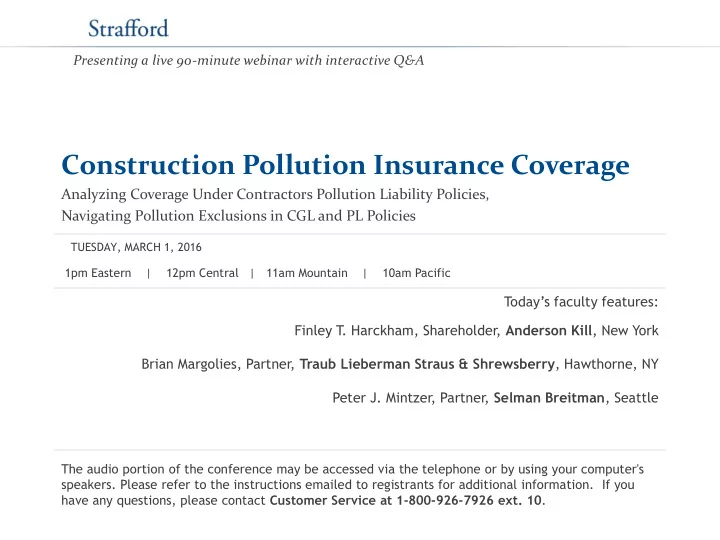
Presenting a live 90-minute webinar with interactive Q&A Construction Pollution Insurance Coverage Analyzing Coverage Under Contractors Pollution Liability Policies, Navigating Pollution Exclusions in CGL and PL Policies TUESDAY, MARCH 1,


slide-1
SLIDE 1

The audio portion of the conference may be accessed via the telephone or by using your computer's

  • speakers. Please refer to the instructions emailed to registrants for additional information. If you

have any questions, please contact Customer Service at 1-800-926-7926 ext. 10.

Presenting a live 90-minute webinar with interactive Q&A

Construction Pollution Insurance Coverage

Analyzing Coverage Under Contractors Pollution Liability Policies, Navigating Pollution Exclusions in CGL and PL Policies

Today’s faculty features:

1pm Eastern | 12pm Central | 11am Mountain | 10am Pacific TUESDAY, MARCH 1, 2016

Finley T . Harckham, Shareholder, Anderson Kill, New York Brian Margolies, Partner, Traub Lieberman Straus & Shrewsberry, Hawthorne, NY Peter J. Mintzer, Partner, Selman Breitman, Seattle

slide-2
SLIDE 2

Tips for Optimal Quality

Sound Quality If you are listening via your computer speakers, please note that the quality

  • f your sound will vary depending on the speed and quality of your internet

connection. If the sound quality is not satisfactory, you may listen via the phone: dial 1-866-871-8924 and enter your PIN when prompted. Otherwise, please send us a chat or e-mail sound@straffordpub.com immediately so we can address the problem. If you dialed in and have any difficulties during the call, press *0 for assistance. Viewing Quality To maximize your screen, press the F11 key on your keyboard. To exit full screen, press the F11 key again.

FOR LIVE EVENT ONLY

slide-3
SLIDE 3

Continuing Education Credits

In order for us to process your continuing education credit, you must confirm your participation in this webinar by completing and submitting the Attendance Affirmation/Evaluation after the webinar. A link to the Attendance Affirmation/Evaluation will be in the thank you email that you will receive immediately following the program. For additional information about continuing education, call us at 1-800-926-7926

  • ext. 35.

FOR LIVE EVENT ONLY

slide-4
SLIDE 4

Program Materials

If you have not printed the conference materials for this program, please complete the following steps:

  • Click on the ^ symbol next to “Conference Materials” in the middle of the left-

hand column on your screen.

  • Click on the tab labeled “Handouts” that appears, and there you will see a

PDF of the slides for today's program.

  • Double click on the PDF and a separate page will open.
  • Print the slides by clicking on the printer icon.

FOR LIVE EVENT ONLY

slide-5
SLIDE 5

Current Issues in Insurance Coverage for Construction-Related Pollution Risks

Presented at Strafford Publications CLE Webinar

March 1, 2016

Peter J. Mintzer Partner Selman Breitman LLP Seattle, Washington pmintzer@selmanlaw.com www.selmanlaw.com

Admitted to Practice in Washington, Oregon, Idaho, Alaska and Hawaii

slide-6
SLIDE 6

Introduction/Overview

  • Scope of Pollution-Related Risks Associated with

Construction Projects

  • Types of Liability Coverages Available
  • Scope of Coverage Afforded Under CGL Policy
  • Pollution Exclusions in CGL Policies
  • Scope of Absolute Pollution Exclusion (“APE”)
  • APE Case Law

6

slide-7
SLIDE 7

Construction Pollution Risks

  • Explosions, Fires; Pipe or Tank Ruptures
  • Spills; Leaks
  • Releases of Fumes from Construction Products
  • Dust; Odors; Nuisance Conditions
  • Non-Hazardous Waste
  • Construction Debris
  • Asbestos, Lead
  • Mold

7

slide-8
SLIDE 8

Types of Liability Policies

  • Comprehensive General Liability (“CGL”) Policies
  • OCIP or Wrap Policies
  • Contractors Pollution Liability (“CPL”) Policies
  • PLL Policies
  • Site Specific; Scheduled Sites, NODs
  • “Package” Policies
  • Cleanup Cost “Cap” Policies
  • Professional Liability Policies

8

slide-9
SLIDE 9

Scope of Coverage Under CGL Policies

  • Broad liability coverage for claims alleging bodily injury or

property damage arising from an “occurrence”

  • Occurrence
  • An accident, or continued or repeated exposure to conditions,

which causes injury or damage unexpected and unintended by the insured.

  • Coverage Damage to “Third Party” Property
  • No Coverage for Damage to “Your Work”

9

slide-10
SLIDE 10

Pollution Exclusions in CGL Policies

  • Absolute Pollution Exclusion
  • Precludes coverage for claims arising from release of Pollutants:
  • At or from premises insured owns, rents or occupies ;
  • At or from any site used by insured or others for handling, storing, or

disposing of waste;

  • Where Pollutants were transported, handled, stored, or processed as

waste by insured or someone for whom insured has liability;

  • At or from site on which insured or its contractors are performing
  • perations, if Pollutants are brought onto site in connection with such
  • perations.

10

slide-11
SLIDE 11

Pollution Exclusions in CGL Policies

  • “Pollutants”
  • Any solid, liquid, gaseous or thermal irritant or contaminant,

including smoke, vapor, soot, fumes, acids, alkalis, chemicals and

  • waste. “Waste” includes materials to be recycled, reconditioned
  • r reclaimed.
  • Governmental Action Exclusion
  • No coverage for loss, cost or expense arising out of any

governmental direction or request to test for, monitor, clean up, remove, contain, treat, detoxify or neutralize Pollutants.

11

slide-12
SLIDE 12

Pollution Exclusions in CGL Policies

  • Total Pollution Exclusion
  • No coverage for Bodily Injury or Property Damage which would

not have occurred, in whole or in part, but for the actual, alleged

  • r threatened discharge, dispersal, seepage, migration, release
  • r escape of Pollutants at any time.

12

slide-13
SLIDE 13

Scope of Absolute Pollution Exclusions

  • Common APE Exceptions
  • Hostile Fires
  • A fire which becomes uncontrollable or breaks out from where it is

intended to be.

  • Carbon Monoxide Releases from HVAC Systems
  • Releases from Mobile Equipment
  • Coverage applies if the pollutants released are for the normal
  • peration of the equipment, such as diesel fuel, motor oil, or

hydraulic fluid, if they escape from a vehicle part designed to hold such pollutants.

13

slide-14
SLIDE 14

Scope of Absolute Pollution Exclusions

  • Case Law Varies Widely Around the Country
  • Traditional v. “Non-Traditional” Pollution Claims
  • Indoor Air Releases
  • Use/Misuse of Products
  • Odors
  • Non-Hazardous Waste (Construction Debris)

14

slide-15
SLIDE 15

APE Case Law

  • Devcon Int’l. Corp. v. Reliance Ins. Co., 609 F.3d 214 (3d Cir.

2010)

  • Dust and exhaust fumes generated from construction project at

an airport was a “pollutant” and claim was excluded by APE.

15

slide-16
SLIDE 16

APE Case Law

  • Cincinnati Specialty Under. Ins. Co. v. Energy Wise Homes,

Inc., 2015 VT 52 (2015)

  • Vermont Supreme Court holds injury from claims arising from

release of chemicals allegedly associated with application of spray-foam insulation in a school building were excluded from coverage based on APE in the installer’s policy.

  • Reversed trial court decision finding coverage and granting

summary judgment to installer.

16

slide-17
SLIDE 17

APE Case Law Chinese Drywall

  • Trend seems to be toward no coverage:
  • Nationwide Mut. Ins. Co. v. The Overlook, LLC, 2011 WL 1988396 (E.D. Va.) (no

duty to defend Chinese drywall complaint - pollution exclusion not limited to traditional environmental pollution, and sulfide gases allegedly emitted from drywall were encompassed by exclusion).

  • General Fidelity Ins. Co. v. Foster, 2011 WL 3962646 (S.D. Fla.) (pollution

exclusion is not limited to environmental and industrial pollution and barred coverage).

  • Compare Builders Mut. v. Parallel Design, 785 F.Supp.2d 535 (E.D. Va. 2011)

(“pollutants” ambiguous in Chinese drywall context).

  • In re Chinese Manufactured Drywall, 759 F.Supp.2d 822 (E.D. La. 2010)

(exclusion did not apply because Chinese drywall complaints did not involve environmental pollution).

17

slide-18
SLIDE 18

APE Case Law

  • Headwaters Resources Inc. v. Illinois Union Ins. Co., 770

F.3d 885 (10th Cir. 2014)

  • Underlying claims brought by homeowners who alleged fly ash

used in construction of golf course devalued their homes and created health risks.

  • The 10th Circuit affirmed the grant of summary judgment by the

District Court , finding the APE clear and unambiguous in this context.

  • APE applied to the insured’s release of fly ash mixture into the

environment.

18

slide-19
SLIDE 19

APE Case Law

  • Meridian Mut. Ins. Co. v. Kellman, 197 F.3d 1178 (6th Cir.

1999)

  • Teacher sued contractor for alleged injuries from exposure to

sealant fumes.

  • 6th Circuit held APE did not bar injuries from toxic substances

confined to general area of intended use.

  • “No reasonable person” could find exclusion unambiguously

applied to injuries when legitimately within vicinity of chemicals.

19

slide-20
SLIDE 20

APE Case Law

  • Fireman’s Ins. Co. v. Kline & Son Cement Repair Inc., 474 F.
  • Supp. 2d 779 (E.D. Va. 2007)
  • Warehouse employee allegedly developed respiratory problems

after application of sealant to concrete floor.

  • Definition of “pollutant” unambiguous.
  • Court found sealant was an “irritant” or “contaminant” within

definition of “pollutant.”

20

slide-21
SLIDE 21

APE Case Law

  • United Fire & Cas. Co. v. Titan Contractors Service, 751 F.3d 880

(8th Cir. 2014)

  • Insured provides construction cleanup services, including cleaning

and sealing concrete floors.

  • Underlying action for injuries sustained by a woman alleging she

was exposed to sealant fumes and sustained various injuries.

  • The District Court held the sealant was not a pollutant and,

therefore, the pollution exclusion did not apply. The 8th Circuit reversed and held the sealant was a pollutant.

  • Court considered whether an ordinary person would consider the

sealant a pollutant.

21

slide-22
SLIDE 22

APE Case Law

  • Saba v. Occidental Fire & Cas. Co. of North Carolina, 2014

WL 7176776 (D. Ariz. Dec. 16, 2014)

  • Plaintiff sued contractor that installed a water heater.
  • Although CO is a pollutant, Court held APE applies to traditional

environmental pollution claims and not bodily injuries suffered by the plaintiff, which resulted from negligent installation of a water heater.

22

slide-23
SLIDE 23

APE Case Law

  • Nautilus Ins. Co. v. Country Oaks Apts. Ltd., 566 F.3d 452

(5th Cir. 2009)

  • Workers blocked vents, causing carbon monoxide to build up in

apartments.

  • Policyholder argued carbon monoxide is a natural substance

humans encounter daily

  • Court found harmful amount at issue clearly involved a

“pollutant.”

23

slide-24
SLIDE 24

APE Case Law

  • Quadrant Corp. v. Am. States Ins. Co., 110 P.3d 733 (Wash.

2005)

  • Tenant exposed to fumes when sealant applied to deck.
  • Sealant composed of toxic irritants, which unambiguously fell

within definition of “pollutant.”

  • Court found it “difficult to see how a reasonable person” could

find the exclusion did not apply.

24

slide-25
SLIDE 25

APE Case Law

  • Belt Painting Corp. v. TIG Ins. Co., 795 N.E.2d 15 (N.Y. 2003)
  • Worker inhaled paint or solvent fumes.
  • NY Court of Appeals found exclusion ambiguous.
  • Exclusion did not unambiguously apply to ordinary paint or

solvent fumes that injured a bystander.

  • Reluctant to … infinitely enlarge the scope of the term

“pollutants.”

25

slide-26
SLIDE 26

APE Case Law

  • Indiana – APE Essentially Unenforceable
  • American States Ins. Co. V. Keiger, 662 N.E.2d. 945 (1996).
  • State Auto Mut. Ins. Co. v. Flexdar, Inc., 964 N.E.2d 845 (Ind.

2012).

  • APE did not preclude coverage for cost of remediating

groundwater contamination caused by the insured’s use of TCE.

26

slide-27
SLIDE 27

APE Case Law

  • Louisiana - Insured Must be an “Active Polluter”
  • Doerr v. Mobil Oil Corp., 774 So.2d 119 (La. 2000)
  • Court found “no history in the development of the exclusion to

suggest it was ever intended to apply to anyone other than an active polluter of the environment.”

  • Court held APE was never intended to be read strictly to exclude

coverage for all interactions with irritants or contaminants of any kind.

27

slide-28
SLIDE 28

Thank You. Questions?

Peter J. Mintzer

Admitted to Practice in Washington, Oregon, Idaho, Alaska & Hawaii

pmintzer@selmanlaw.com

(206) 805.0206

28

slide-29
SLIDE 29

Contractors Pollution Liability Insurance Coverage

Brian Margolies March 1, 2016

slide-30
SLIDE 30

OUTLINE

  • Scope of contractors pollution liability

insurance

  • Determining whether a claim falls

within a general liability or contractors pollution liability policy

  • Takeaways

30

slide-31
SLIDE 31

Scope of CPL Coverage

  • Intended to fill in the gap in coverage in a CGL

policy created by the pollution exclusion

  • Affords coverage for bodily injury and property

damage caused by a pollution event that results from the insured’s operations

  • Also affords coverage for remediation expense,

which can may be a separate coverage or a subset of property damage

  • Often times packaged with other lines of

coverage, such as CGL or E&O

  • May have an excess “other insurance” clause

31

slide-32
SLIDE 32

Scope of CPL Coverage

  • Not a first-party pollution liability

coverage, although some carriers may

  • ffer CPL coverage in combination with

site coverage

  • May extend coverage to NODS and

transportation risks

  • Some forms will place restrictions on the

work or operations insured

32

slide-33
SLIDE 33

Scope of CPL Coverage

  • Can be written on an occurrence basis or claims-

made and reported basis

  • When written on a claims-made basis, there

may be a retro date for when the work was performed

  • May afford coverage for “fringe” pollutants, such

as mold, legionella and other organic pathogens, medical waste, odors, lead, asbestos, noise pollution, light pollution, magnetic fields

  • Additional insureds – can be by definition, by

specific endorsement or by blanket endorsement

33

slide-34
SLIDE 34

Pollution or General Liability?

34

slide-35
SLIDE 35

Pollution or General Liability?

  • Total pollution exclusion applies to:

“bodily injury” or “property damage” which would not have occurred in whole or in part but for the actual, alleged or threatened discharge, dispersal, seepage, migration, release or escape of “pollutants” at any time.

  • Typical pollution policy definition of

pollution event as:

… the discharge, dispersal, release or escape of any solid, liquid, gaseous or thermal irritant

  • r contaminant, including, but not limited to,

smoke, vapors, soot, fumes, acids, alkalis, toxic chemicals, medical waste and waste materials into or upon land or any structure on land, the atmosphere or any watercourse or body of water, including groundwater …

35

slide-36
SLIDE 36

Pollution or General Liability?

  • Limited case law guidance in the context of

pollution-specific policies, but mature body of case law in pollution exclusion context

  • Picerne Military Housing v. AISLIC, 650 F.
  • Supp. 2d 135 (D.R.I. 2009)
  • URS Corp. v. Steadfast Ins. Co., 2014 N.Y. Misc.

LEXIS 222 (N.Y. Sup. Ct. Jan. 16, 2014):

– “Given the close identity between the traditional pollution exclusion provision and Hudson’s pollution coverage provision, it would be logical to conclude that the two clauses share the same purpose and are complementary, with one meant to fill the gap in coverage created by the other.”

36

slide-37
SLIDE 37

Pollution or General Liability?

  • URS Corp. v. Steadfast Ins. Co., 2014 N.Y. Misc.

LEXIS 222 (N.Y. Sup. Ct. Jan. 16, 2014):

– Court relied on New York pollution exclusion case law requiring traditional environmental harm for exclusion to apply – A "pollution condition" was defined as "the discharge, dispersal, release or escape of smoke, vapors, fumes, acids, alkalis, toxic chemicals liquids or gases, waste materials or other irritants, contaminants or pollutants into or upon land, the atmosphere or any watercourse or body of water which results in bodily injury or property damage"

37

slide-38
SLIDE 38

Pollution or General Liability?

  • Colonial Oil Ins. Co. v. Indian Harbor Ins. Co., 2013 U.S.
  • App. LEXIS 12946 (2d Cir. June 25, 2013)

– Delivery of PCB contaminated oil to the proper location – "pollution condition" is defined as "[t]he discharge, dispersal, release, seepage, migration, or escape of POLLUTANTS into

  • r upon land, or structures thereupon, the atmosphere, or any

watercourse or body of water . . ." – … the "reasonable expectations of a businessperson" viewing the contested Policy language would be that it is intended to provide coverage for environmental harm resulting from the disposal or containment of hazardous waste. This case-which merely involves the unwitting introduction and transfer of polluted oil into containers otherwise meant to hold that oil- does not fall within those parameters.

38

slide-39
SLIDE 39

Pollution or General Liability?

Acuity, A Mut. Ins. Co. v. Chartis Spec. Ins. Co., 861 N.W.2d 533 (Wis. Mar. 17, 2015)

  • Natural gas release resulted in explosion, causing

bodily injury and property damage

  • CPL policy issued by AIG insured BI and PD caused

by “pollution conditions,” defined as “the discharge, dispersal, release or escape of any solid, liquid, gaseous or thermal irritant or contaminant, including smoke, vapors, soot, fumes, acids, alkalis, toxic chemicals, medical waste and waste materials into or upon land, or any structure on land, the atmosphere

  • r any watercourse or body of water, including

groundwater, provided such conditions are not naturally present in the environment in the concentration or amounts discovered.”

39

slide-40
SLIDE 40

Pollution or General Liability?

  • GL carrier undertook insured’s defense in

underlying suits

  • “Chartis argues that to fulfill the policy's

causation requirement, it is not enough that a substance capable of acting as a contaminant was the but-for cause of the alleged bodily injury and property damage. Rather, according to Chartis, ‘the contaminating nature of the substance at issue’ must directly cause the alleged bodily injury and property damage.”

40

slide-41
SLIDE 41

Pollution or General Liability?

  • “Chartis explains that the CGL policy

issued by Acuity and the CPL policy issued by Chartis "are essentially the flip side" of each other. Chartis asserts that ‘the Acuity CGL Policy is intended to cover [the insured's] liability for bodily injury or property damage not caused by pollution, and the Chartis Pollution Policy is intended to cover liability for bodily injury

  • r property damage caused by pollution.’”

41

slide-42
SLIDE 42

Pollution or General Liability?

  • Court disagreed, noting that the policy,
  • n its face, covers any BI or PD resulting

from pollution, “nothing more, nothing less”

  • Distinguished URS decision on basis

that “Wisconsin cases have not interpreted pollution exclusion clauses as dealing solely with broadly dispersed environmental pollution.”

42

slide-43
SLIDE 43

Takeaways

– CPL and CGL coverage may not be complete mirror images of each other – Controlling law matters – There can be overlapping coverage for certain types of non-traditional environmental harms

43

slide-44
SLIDE 44

Thank You

Brian Margolies Traub Lieberman Straus & Shrewsberry Hawthorne, NY bmargolies@traublieberman.com

44

slide-45
SLIDE 45

Construction Pollution Insurance Coverage

Finley T. Harckham

03/01/2016

slide-46
SLIDE 46
  • III. RISK ALLOCATION FOR POLLUTION LIABILITY

ARISING FROM SUBCONTRACTOR’S ACTIONS

Different perspectives:

  • Owner
  • General contractor
  • Subcontractor

03/01/2016 46

slide-47
SLIDE 47

Owner’s Perspective:

  • 1. Allocate liability for subcontractor’s acts to

the general contractor.

  • Liability does not automatically flow to the G.C. under

principle/agent law.

– In some jurisdictions

  • Indemnification from G.C. for liability from

subcontractor’s actions.

– Ideally uncapped

47 03/01/2016

slide-48
SLIDE 48

Owner’s Perspective:

  • 2. Require that G.C. obtain pollution coverage.
  • Coverage should be clearly defined.

– NOT, e.g., “general liability, including pollution”

  • Owner should be an additional insured.

– With separate limits

  • Additional insured coverage should be primary and

noncontributory.

– To protect the limits and deductibles under the owner’s insurance program

03/01/2016 48

slide-49
SLIDE 49

General Contractor’s Perspective:

  • 1. Try to limit or cap G.C.’s indemnification of
  • wner.
  • 2. Obtain broad indemnification from

subcontractor.

  • Preferably uncapped
  • 3. In some states a G.C. cannot be indemnified

for it’s own negligence.

03/01/2016 49

slide-50
SLIDE 50

General Contractor’s Perspective:

  • 4. Insurance requirements.
  • CIP Programs

– Potential problems: » Shared limits » OCIP

  • Owner controls insurance, But
  • Contractor bears the liability risk

03/01/2016 50

slide-51
SLIDE 51

General Contractor’s Perspective:

  • 4. Insurance requirements, cont’d.
  • Clearly define pollution coverage requirements.

– There are many options

  • The CGL “Occurrence” issue.

– May warrant requiring a separate pollution policy

03/01/2016 51

slide-52
SLIDE 52

General Contractor’s Perspective:

  • The G.C. should be an additional insured.
  • The subcontractor’s policy should be primary

and noncontributory.

– To avoid eroding G.C.’s own coverage/deductible

  • “Excess of Wrap” coverage.

52 03/01/2016

slide-53
SLIDE 53

Thank You

Finley T. Harckham Anderson Kill fharckham@andersonkill.com

53 03/01/2016