Simply Stated Systematic and intentional undergraduate exploration - - PowerPoint PPT Presentation

simply stated
SMART_READER_LITE
LIVE PREVIEW

Simply Stated Systematic and intentional undergraduate exploration - - PowerPoint PPT Presentation

2/3/2017 Simply Stated Systematic and intentional undergraduate exploration of purpose, calling, and This Lilly Endowment initiative: invited c0lleges and universities to develop programs to vocation foster campus conversations about


slide-1
SLIDE 1

2/3/2017 1

Simply Stated

Systematic and intentional undergraduate exploration of purpose, calling, and vocation

  • produces a pattern of examined living

and positive engagement with others

  • that renews faculty and staff, and
  • increases the odds that emerging adults

will flourish after they graduate from college.

This Lilly Endowment initiative:

  • invited c0lleges and universities to develop programs to

foster campus conversations about questions of meaning and purpose, and in particular their religious underpinnings, the theology of vocation.

  • asked applicants to draw from their own campus’ tradition

and to be creative in their programming

  • received 400 applications, funded 88 between 2000-8
  • 26 campuses studied
  • 284 students & alumni interviewed
  • 274 faculty & staff interviewed
  • 60 students: panel interviews
  • 65 comparison student panel interviews
  • 2111 respondent web survey

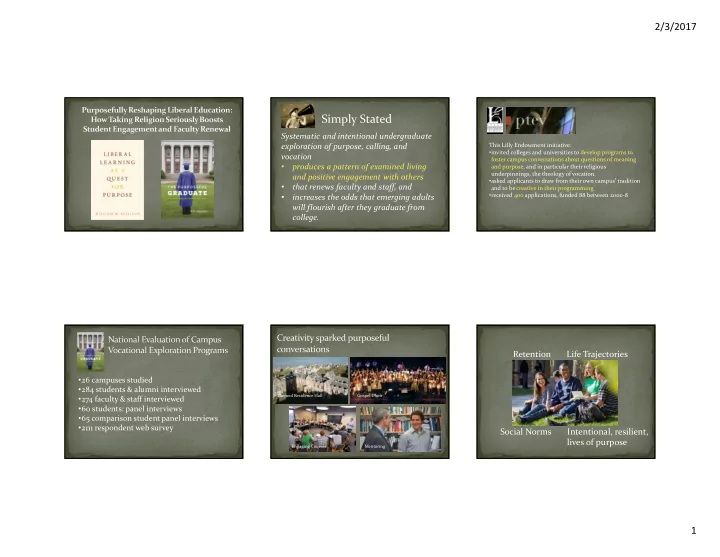
Themed Residence Hall Gospel Choir Engaging Courses Mentoring

Retention Life Trajectories Social Norms Intentional, resilient, lives of purpose

slide-2
SLIDE 2

2/3/2017 2

 84% confirmed that discussion, reflection, or

reading about purpose or calling had been “helpful” or “very helpful” to them

 74% reported that they had a faculty or staff

advisor with whom they had valuable “conversations about my vocation, calling, or purpose”

 By contrast, just 41% of graduating seniors answering

HERI’s 2014 College Senior Survey responded that faculty frequently provided them with emotional support and encouragement, and 46% said one faculty member had taken “an interest in their development.”  81% reported that their campus’ purpose

exploration programming “encouraged me to see and serve the needs of others”

 67% credited exploration programs with helping

them “identify [their] skills and talents”

 34% indicated that exploration programs led them

“to alter [their] life plans”

 N=1,340  Alumni comment:

“Although I had given some thought to questions

  • f vocation prior to [college], it was my [college]

community that nurtured these inchoate thoughts and aspirations and gave me a place to think broadly and deeply about where my abilities match up best with the world’s needs. Playing a central role in this reflection was my participation in [a purpose exploration program] and my informal conversations with [staff member name] and [two faculty names]”

Overall, those who spent time exploring purpose or calling: 1) Voiced longer-term perspectives 2) Showed less concern for how their lives compared to their peers’ lives 3) Sought out the advice of mentors and older adults 4) Demonstrated more resilience to setbacks, and maintained

  • ther-directed goals (i.e., “Holy Grit”)

5) Expressed more realistic expectations about life after college 6) Made decisions which moved them closer to their longer- term goals (e.g., got married, enrolled in additional schooling, selected work intentionally) 7) Demonstrated more balance in their everyday lives (i.e., work/school, family, and goals for the future)

What happened with faculty and staff?

Not sure if he can “do more with less” much longer …

slide-3
SLIDE 3

2/3/2017 3

 To reach students, programs for the exploration of

purpose had to involve faculty & staff

 Various approaches:

retreats, ranging from 1 day to 2 weeks new employee orientation programs reading groups 10 week seminars curriculum & program development grants lecture series mini-grants

 Faculty & staff said this exploration of purpose was as

relevant to them as it was to students Cheryl Johnson, Associate Dean of Students: “The greatest thrill is working with students, helping them discover this [exploration] program, and then . . . seeing how the program affects their lives. I mean, for some of them, this is the catalyst that gets them connected to the academics, that gives them a reason or purpose to be here, to discover themselves, [and to] start thinking about the future. That’s been extremely rewarding.”

Rick Simpson, Professor of Communications “It’s going to be incumbent upon college communities to figure out how to relate to students in the richest, most meaningful kinds of

  • ways. What [the Journey Center] can do well and [must] continue

to do well is to give faculty and staff a vocabulary and resources to foster those relationships as they relate to matters of life of the mind, life of the spirit, life of the quest—however that shakes out. Because the students are going to keep coming, and I think the worst thing that we could do is to throw up our hands and say that those questions don’t have a place at a college campus . . . [to] say, ‘Well, we don’t speak that language.’ Our students want to talk that language, and I think it’s incumbent upon our community to try to understand it and keep the conversation going.”  86% of faculty participants said purpose exploration

programs “have positively impacted my own work at [this school].” 90% of staff participants said likewise

 85% of faculty said these programs “deepened my

appreciation for the mission of [this school].” 93% of staff said likewise

 75% of faculty said their participation “helped me

hone my own sense of ‘vocation,’ ‘calling,’ or ‘purpose’.” 84% of staff said likewise

 N=595

Discuss with seatmate: Where you would place yourself, your department or work unit, and your campus as a whole with respect to the following continuums:

Never Daily Frequency of Workplace Conversations about Religious Belief, Value, or Practice Never Daily Frequency of Workplace Conversations about Vocation, Purpose, or Calling

Most colleges take a supply-side approach to student well- being, prioritizing students who are a lot like their faculty and staff, mentoring 2-3% per campus (i.e., poster alums). But one-half of incoming college students report “find[ing] my purpose in life” is a “very important” reason for attending college! Thus, there are many students who will eagerly participate in creative, campus-based purpose exploration programming, and apply what they learn to launch post-graduation lives of impact.