Significance of acute effusion Knee exam case #1: Inspection Intra - - PDF document

significance of acute effusion knee exam case 1 inspection
SMART_READER_LITE
LIVE PREVIEW

Significance of acute effusion Knee exam case #1: Inspection Intra - - PDF document

7/23/2013 Learning objectives: Common Knee Problems: in 50 minutes you will be able to What You Kneed to Know 1. List the organizational scheme for any musculoskeletal work up 2. List the 3 key knee history questions 3. Generate a


slide-1
SLIDE 1

7/23/2013 1

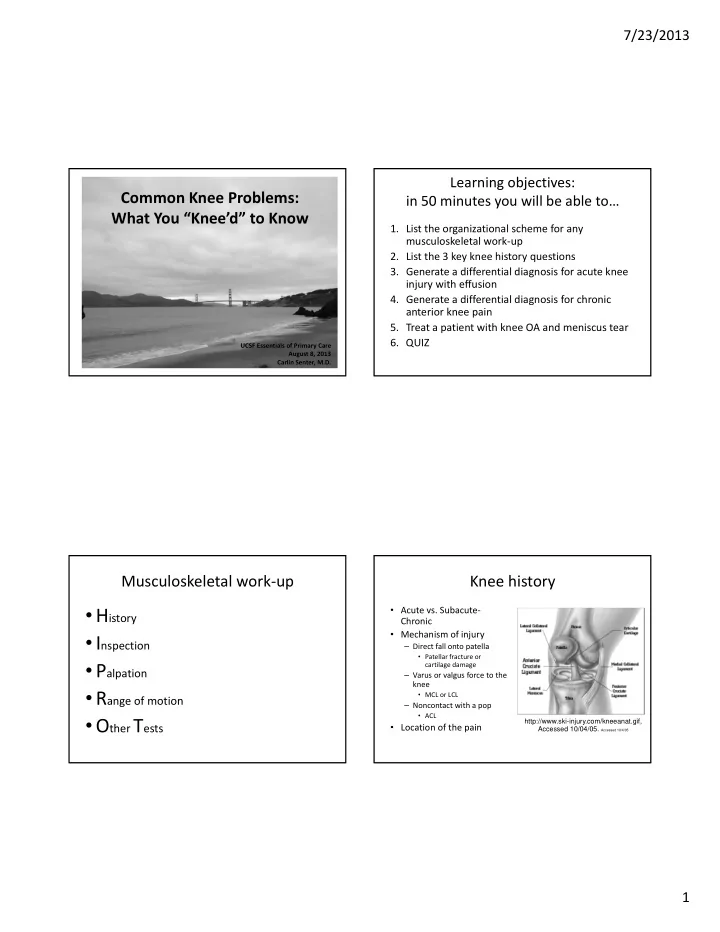
Common Knee Problems: What You “Knee’d” to Know

UCSF Essentials of Primary Care August 8, 2013 Carlin Senter, M.D.

Learning objectives: in 50 minutes you will be able to…

  • 1. List the organizational scheme for any

musculoskeletal work‐up

  • 2. List the 3 key knee history questions
  • 3. Generate a differential diagnosis for acute knee

injury with effusion

  • 4. Generate a differential diagnosis for chronic

anterior knee pain

  • 5. Treat a patient with knee OA and meniscus tear
  • 6. QUIZ

Musculoskeletal work‐up

  • History
  • Inspection
  • Palpation
  • Range of motion
  • Other Tests

Knee history

  • Acute vs. Subacute‐

Chronic

  • Mechanism of injury

– Direct fall onto patella

  • Patellar fracture or

cartilage damage

– Varus or valgus force to the knee

  • MCL or LCL

– Noncontact with a pop

  • ACL
  • Location of the pain

http://www.ski-injury.com/kneeanat.gif, Accessed 10/04/05. Accessed 10/4/05

slide-2
SLIDE 2

7/23/2013 2

3 key knee injury questions

  • 1. Locking = meniscus or intra‐articular loose

body

  • 2. Instability = ligament
  • 3. Swelling = intra‐articular derangement
  • 1. Immediate: due to blood (ACL, fracture, patellar

dislocation)

  • 2. Subacute: 8‐24 hours, due to synovial

inflammation (meniscus, MCL)

Case #1: House of Air

  • 35 y/o woman on trampoline half‐pipe.

Jumped down and felt a pop with immediate knee pain and swelling.

  • Went to ER: placed in knee immobilizer and

given Vicodin for pain relief.

  • Now, 3d later, has posterior pain and tightness

with bending.

  • Knee feels unstable if not in the brace.

Ddx acute traumatic knee injury with effusion

  • Intra‐articular

derangement

– (+) instability  ligament – (+) locking  meniscus – Dislocation

  • Patella
  • Knee

– Cartilage damage – Patellar or quad tendon rupture

http://www.ski-injury.com/kneeanat.gif, Accessed 10/04/05. Accessed 10/4/05

Musculoskeletal exam order

  • History
  • Inspection
  • Palpation
  • ROM
  • Other
  • Tests
slide-3
SLIDE 3

7/23/2013 3

Knee exam case #1: Inspection Significance of acute effusion

  • Intra‐articular derangement
  • You will likely be ordering xray +/‐ MRI
  • The patient will not be returning to sport

today

Knee exam case #1: Palpation Ballottement Palpation: patellar facet

Video courtesy of Dr. Anthony Luke

slide-4
SLIDE 4

7/23/2013 4

Knee exam case #1: Palpation

  • Supine, knee fully extended

– Ballotement to evaluate for effusion – Medial patellar facet (patellar dislocation) – Patellar apprehension (patellar dislocation)

  • Straight leg raise intact

– If not ‐ Quad tendon or patellar tendon rupture ‐> urgent ortho

  • Knee flexed to 90 degrees

– Joint line (meniscus) – Lateral femoral condyle (patellar dislocation) – Above and below medial and lateral joint lines (MCL, LCL)

  • Our patient: tender medial joint line, can do straight leg

raise

– Rules out patellar dislocation, LCL, tendon rupture

Knee exam case #1

  • ROM: 5‐90, limited due

to pain (normal 0‐135)

– Determine if knee is locking or if ROM is limited due to effusion – Locking: think bucket handle meniscus.

  • Urgent xrays, MRI
  • Urgent referral to sports

surgeon for arthroscopy

Knee exam case #1

  • Strength 5/5 hip flexion, knee extension, PF,

DF.

– (+) active knee extension rules out quad or patellar tendon rupture

  • 2+ dorsalis pedis pulses bilaterally
  • Sensation intact to light touch over legs

bilaterally

  • Reflexes 2+ at patella and achilles bilaterally

Other Tests: Lachman to evaluate ACL

Video courtesy of Dr. Anthony Luke

slide-5
SLIDE 5

7/23/2013 5

PCL: Sag sign PCL: Posterior Drawer

Video courtesy of Dr. Anthony Luke

MCL and LCL

Video courtesy of Dr. Anthony Luke

Meniscus: McMurray

Sensitivity medial 65%, Specificity medial 93%

Magee, DJ. Orthopaedic Physical Assessment, 5th ed. 2008.

slide-6
SLIDE 6

7/23/2013 6

Meniscus: Thessaly

Video courtesy of Dr. Anthony Luke

Meniscus: squat Case #1 special tests

  • (+) pain with medial McMurray, (‐) lateral
  • (+) Thessaly – medial pain
  • (+) Squat – medial pain
  • (‐) laxity to varus or valgus at 0 and 30
  • (+) Lachman without endpoint
  • (‐) Posterior drawer

Case #1 diagnosis

  • 1. Patellar tendon

rupture

  • 2. Quad tendon

rupture

  • 3. PCL tear
  • 4. ACL tear
  • 5. MCL tear
  • 6. Fracture
  • 7. Meniscus tear

http://www.ski-injury.com/kneeanat.gif, Accessed 10/04/05. Accessed 10/4/05

slide-7
SLIDE 7

7/23/2013 7

Case #1 treatment

  • Knee brace +/‐ crutches

depending on pain and instability

  • Xrays to r/o fracture
  • MRI to confirm diagnosis
  • Pain medication
  • PT to restore normal

ROM, decrease swelling, strengthen quad

  • Orthopaedic surgery

referral to discuss +/‐ reconstruction

Segond fracture – avulsion of lateral tibial plateau in ACL tear

Traumatic knee effusion red flags  urgent ortho referral

  • Locked knee: unable to fully extend compared

to other side

– Bucket handle meniscus – Make non weight bearing w/crutches

  • Fracture (tibial plateau, patella)
  • Unable to extend knee against gravity

– Patellar or quadriceps tendon rupture – Needs urgent surgical repair

Case #2: Sketcher Shape‐Ups

40 y/o woman presents with sharp anterior knee pain x 1 month. Might have some swelling. No locking but the knee is popping. Feels unstable when walking down stairs. Pain worse up/down stairs. Painful when gets up from

  • sitting. Exercise: started a walking program for

New Year’s resolution, wearing new Sketcher Shape‐Up shoes. No squats/lunges. Doesn’t wear orthotics.

Subacute knee history

  • 3 key questions

– Swelling – Locking – Instability

  • Exercise and activity history: squats, lunges,

new training program, marathon?

  • Shoes: how old, what type
  • Orthotics: how old, why wearing them
slide-8
SLIDE 8

7/23/2013 8 Ddx subacute‐chronic anterior knee pain

  • 1. Patellofemoral pain syndrome
  • 2. Patellar chondromalacia
  • 3. Osteochondral lesion
  • 4. Osteoarthritis of patellofemoral joint

Case #2: Inspection

Patellofemoral pain syndrome: miserable malalignment syndrome

  • Femoral anteversion

(inward rotation of femur)

  • Squinting patella
  • Patella alta
  • Increased Q‐angle
  • Excessive outward tibial

rotation

http://www.gla.ac.uk/ibls/US/fab/tutorial/biomech/akp3.html

Palpation

  • Effusion: none
  • Joint line, patellar facets

– Tender medial and lateral patellar facets

http://www.kneeguru.co.uk/KNEEnotes/node/763

slide-9
SLIDE 9

7/23/2013 9

ROM

  • 0‐135
  • (+) crepitus with flexion and extension as

patella moves across articular surface of femur

Other tests

  • Ligaments

– Lachman – Posterior drawer – MCL – LCL

  • Meniscus

– McMurray

Other tests: identify tightness and weakness

  • Ober (too tight?)
  • Hip abduction strength (weak?)
  • One‐legged standing squat (weak? Pain?)

Ober part 1

Passive hip abduction and extension. Hip extension  ITB positioned over greater trochanter of femur.

http://www.youtube.com/watch?v=A0C0WBw4l4s&feature=player_detailpage

slide-10
SLIDE 10

7/23/2013 10

Ober part 2

Lower the upper limb. If tight ITB then hip will not adduct past neutral. Compare side to side.

http://www.youtube.com/watch?v=A0C0WBw4l4s&feature=player_detailpage

Hip abduction strength

http://www.youtube.com/watch?v=9Iy‐QrcuGno&feature=player_detailpage

One‐legged standing squat

  • Patient standing on unaffected leg
  • Do 3 slow 1‐legged squats
  • Watch for stability, valgus angulation of knee,

ask about pain

  • Switch and perform on affected leg
  • Sign of weak hip abductors, weak core
  • Can bring out pain of patellofemoral pain

One‐legged standing squat

slide-11
SLIDE 11

7/23/2013 11

One‐legged standing squat

Case #2: Sketcher Shape‐Ups Physical exam

  • Valgus angulation of the knees
  • No effusion
  • Tender medial and lateral patellar facets
  • ROM 0‐135, crepitus
  • No laxity with lachman, posterior drawer, varus
  • r valgus at 0 and 30 degrees
  • (+) Ober bilaterally
  • 4/5 hip abductor strength bilaterally
  • Unstable 1‐legged squat with valgus knee

angulation

Case #2 diagnosis

  • 1. Patellofemoral pain syndrome
  • 2. Patellar chondromalacia
  • 3. Osteochondral lesion
  • 4. Osteoarthritis

Case #2 treatment

  • Physical therapy rx

– Strengthen hip abductors – Strengthen quadriceps – Stretch ITB, quads, hamstrings

  • Correct alignment: consider OTC orthotics

with arch support if pes planus

  • Activity: avoid running, squats, lunges, stair‐

running, downhill hiking until improved.

slide-12
SLIDE 12

7/23/2013 12

Case #3

  • 55 y/o man with R knee h/o lateral meniscus

surgery.

  • Lateral‐sided pain and swelling of the R knee

since hiking last week.

  • No locking, no instability
  • Exam: effusion, tender lateral joint line and

above/below lateral joint line, (+) lateral knee irritation with lateral McMurray, (+) lateral pain with squat and Thessaly, no ligamentous laxity

  • He brings with him xrays and MRI for your review

Radiographs MRI

Lateral Medial Lateral Medial

Diagnosis

  • A. Lateral meniscus tear
  • B. ACL tear
  • C. Osteoarthritis
  • D. Patellar dislocation
  • E. Septic arthritis
slide-13
SLIDE 13

7/23/2013 13

Initial treatment

  • A. Refer for arthroscopic debridement of

meniscus tear and lavage

  • B. Nonoperative knee OA program
  • C. Refer for total knee arthroplasty

Interventions

  • Control

– PT: 1 hour/week x 12 weeks – Home ex program 2x/day – Instruction on ADLs – Self management arthritis education reading + videotape – Medications (APAP, NSAIDs, hyaluronic acid injections)

  • Arthroscopic surgery

– Irrigation with at least 1 L saline – 1 or more of the following:

  • Debridement or excision
  • f degenerative meniscus

tears

  • Removal loose bodies,

chondral flaps, bone spurs

– Optimal medial and physical therapy as above

Kirkley et al. A Randomized Trial of Arthroscopic Surgery for Osteoarthritis of the Knee, NEJM, 2008.

Results

Kirkley et al. A Randomized Trial of Arthroscopic Surgery for Osteoarthritis of the Knee, NEJM, 2008.

slide-14
SLIDE 14

7/23/2013 14

Interventions

  • Control (PT)

– Usually 6 weeks – 3‐stage program

  • APAP, NSAIDs,

intraarticular steroid injections as needed

  • Arthroscopic partial

meniscectomy (APM)

– Trim damaged meniscus back to stable rim – Remove loose cartilage and bone

  • PT protocol
  • APAP, NSAIDs,

intraarticular steroid injections as needed

Katz JN et al. Surgery versus physical therapy for a meniscal tear and osteoarthritis. N Engl J Med. 2013 May 2;368(18):1675‐84.

Results

Katz JN et al. Surgery versus physical therapy for a meniscal tear and osteoarthritis. N Engl J Med. 2013 May 2;368(18):1675‐84.

slide-15
SLIDE 15

7/23/2013 15

Results

Katz JN et al. Surgery versus physical therapy for a meniscal tear and osteoarthritis. N Engl J Med. 2013 May 2;368(18):1675‐84.

Conclusions

  • 30% crossed over from PT to APM at 6mo

– These people had WOMACs that didn’t improve until crossover

  • No sig difference in adverse events
  • PT and APM are reasonable options with similar
  • utcomes for these patients (with allowed cross
  • ver if not achieving relief with PT)
  • Starting with conservative approach is reasonable

Katz JN et al. Surgery versus physical therapy for a meniscal tear and osteoarthritis. N Engl J Med. 2013 May 2;368(18):1675‐84.

Meniscus tears are common if ≥ 50 years old

  • Seen in 35% of all people

– 66% medial, 24% lateral, 10% both

  • Increased prevalence with increased age
  • 82% of people with OA had meniscus tears
  • 2/3 of patients with meniscus tears had no

symptoms in the prior month

Englund M et al. Incidental meniscal findings on knee MRI in middle‐aged and elderly

  • persons. N Engl J Med. 2008 Sep 11;359(11):1108‐15.

Osteoarthritis with meniscus tear

  • Meniscus tear is part of the natural history of
  • steoarthritis
  • Treat as osteoarthritis initially
  • Consider arthroscopic meniscus surgery if PT not

helping

http://www.weddingbee.com/2009/07/20/rock‐paper‐scissors‐shoot/

slide-16
SLIDE 16

7/23/2013 16

Caveats: Who to Refer

  • Younger patients
  • Bucket handle meniscus tears

– Knee locked due to meniscus blocking joint movement

  • Mechanical symptoms: locking, catching
  • Failure of nonoperative knee OA treatment

Quiz

Learning objectives: in 1 hour you will be able to…

  • 1. List the organizational scheme for any

musculoskeletal work‐up

  • 2. List the 3 key knee history questions
  • 3. Generate a differential diagnosis for acute knee

injury with effusion

  • 4. Generate a differential diagnosis for chronic

anterior knee pain

  • 5. Treat a patient with knee OA and meniscus tear

List the organizational scheme for any musculoskeletal work‐up

  • History
  • Inspection
  • Palpation
  • Range of motion
  • Other Tests
slide-17
SLIDE 17

7/23/2013 17

3 key knee history questions

  • 1. Locking
  • 2. Instability
  • 3. Swelling

Ddx acute traumatic knee injury with effusion

  • Intra‐articular

derangement

– (+) instability  ligament – (+) locking  meniscus – Dislocation

  • Patella
  • Knee

– Cartilage damage – Patellar or quad tendon rupture

http://www.ski-injury.com/kneeanat.gif, Accessed 10/04/05. Accessed 10/4/05

Ddx chronic anterior knee pain

  • 1. Patellofemoral pain syndrome
  • 2. Patellar chondromalacia
  • 3. Osteochondral lesion
  • 4. Osteoarthritis of patellofemoral joint

Treat a patient with knee OA and meniscus tear

  • 1. Physical therapy
  • 1. Manual therapy
  • 2. Strengthening
  • 3. Home ex program
  • 2. Offer APAP, NSAIDs, intraarticular steroid

injections

  • 3. Patient education (www.arthritis.org)
  • 4. Consider surgical consult if pain and function

not improving with above

slide-18
SLIDE 18

7/23/2013 18

Thank you!