Welcome to the Webinar We will begin at 11:00am (PT) / 2:00pm (ET). - - PowerPoint PPT Presentation

welcome to the webinar
SMART_READER_LITE
LIVE PREVIEW

Welcome to the Webinar We will begin at 11:00am (PT) / 2:00pm (ET). - - PowerPoint PPT Presentation

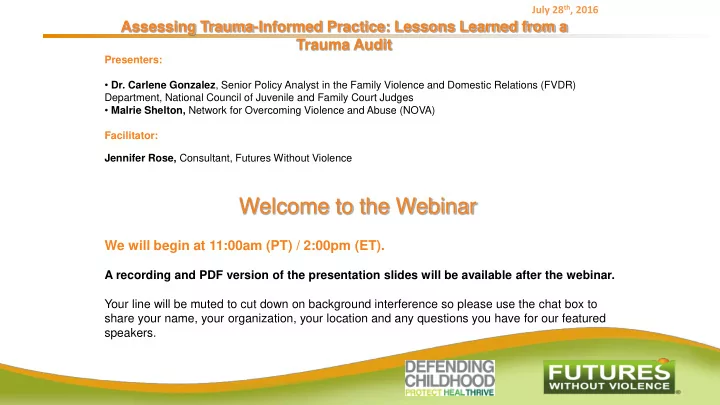
July 28 th , 2016 Assessing Trauma-Informed Practice: Lessons Learned from a Trauma Audit Presenters: Dr. Carlene Gonzalez , Senior Policy Analyst in the Family Violence and Domestic Relations (FVDR) Department, National Council of Juvenile


slide-1
SLIDE 1

We will begin at 11:00am (PT) / 2:00pm (ET).

A recording and PDF version of the presentation slides will be available after the webinar. Your line will be muted to cut down on background interference so please use the chat box to share your name, your organization, your location and any questions you have for our featured speakers.

Welcome to the Webinar

Presenters:

  • Dr. Carlene Gonzalez, Senior Policy Analyst in the Family Violence and Domestic Relations (FVDR)

Department, National Council of Juvenile and Family Court Judges

  • Malrie Shelton, Network for Overcoming Violence and Abuse (NOVA)

Facilitator: Jennifer Rose, Consultant, Futures Without Violence

Assessing Trauma-Informed Practice: Lessons Learned from a Trauma Audit

July 28th, 2016

slide-2
SLIDE 2

2

slide-3
SLIDE 3

Federal ederal Coo

  • ordinati

rdination

  • n
  • US Department of

Justice

– Office of the Attorney General – Office of Justice Programs

  • Office of Juvenile

Justice and Delinquency Prevention

  • Office for Victims of

Crime

  • National Institute of

Justice

– Office on Violence Against Women – Office of Community Oriented Policing – Executive Office of US Attorneys

  • US Department of Health

and Human Services

  • US Department of

Education

3

slide-4
SLIDE 4

4

Go Goal als s of

  • f th

the Defending ending Childhoo ildhood d In Init itiat iativ ive

  • Prevent children’s exposure to violence.
  • Mitigate the negative effects experienced by

children exposed to violence.

  • Develop knowledge about and spread

awareness of this issue.

slide-5
SLIDE 5

Over vervie view w of

  • f St

Strat rategy egy

  • Research and Evaluation
  • Direct Action in Communities

– Comprehensive Demonstration Project – Safe Start Program (www.safestartcenter.org) – OVW Children Exposed to Violence grants

  • Training and Technical Assistance
  • Attorney General’s Task Force on Children Exposed to

Violence (www.justice.gov/defendingchildhood/cev-rpt-full.pdf)

  • Action Partnerships with Professional Organizations

5

slide-6
SLIDE 6

How to use this technology

AUDIO:

  • You can choose to connect via computer OR via telephone.
  • Should you choose to dial in, please follow the audio

instructions on the screen or in the audio pop up:

  • Dial: 1-877-647-3411
  • Enter the Participant Code: 914571#

OR

  • Dial: 1-719-867-0497
  • Enter the Participant Code: 914571#
  • Closed Captioning is provided in today’s presentation
  • There will be time for Q & A at the end of the presentation.
  • Please enter any questions you have in the Public Text Chat box.
  • For Adobe Tech Support, please dial:
  • 1-800-422-3623
slide-7
SLIDE 7

Assessing Trauma-Informed Practice

Carlene Gonzalez, Ph.D. Senior Policy Analyst, Family Violence and Domestic Relations Malrie Shelton, MSSW, LCSW Defending Childhood Initiative (DCI)

slide-8
SLIDE 8

Objectives

 To discuss how trauma impacts the lives of children, youth and

families

 To describe how the National Council of Juvenile and Family

Court Judges (NCJFCJ) has assessed the courts for trauma- informed practice

 To share resources on trauma-informed practice (including an

info-graphic developed in collaboration with Futures Without Violence)

slide-9
SLIDE 9

Poll Question #1: Who is joining us today?

Responses:

Anti-Trafficking Agency

Defending Childhood Site

Child Protection

K-12 Education

Early Childhood Education

Public Heath/Health

Justice (e.g., Law Enforcement, Lawyer, Court)

Community-based Agency

Domestic Violence/Sexual Assault

Research

National Policy Organization

Tribal Government/Administration

Tribal Community Organization

Tribal Program

City/County/State Government

State Territory Coalition

Federal Agency

Student

Other

slide-10
SLIDE 10

Poll Question #2: Have you ever participated in a trauma training?

Response:

 Yes  No

slide-11
SLIDE 11

Stress

 Although stress and trauma are related…

 Stress can be positive  Stress can be tolerable

 When stress becomes toxic or overloads a system… we see

trauma.

slide-12
SLIDE 12

Defining Trauma

 Experiencing a serious injury to yourself or witnessing a serious

injury to or the death of someone else

 Facing imminent threats of serious injury or death to yourself or

  • thers

 Experiencing a violation of personal physical integrity

Result = Overwhelming feelings of terror, horror, or hopelessness.

slide-13
SLIDE 13

Types of Trauma

Acute Chronic Complex Historical Secondary

slide-14
SLIDE 14

Traumatic Events

 Definition: An experience that

causes physical, emotional, psychological distress or harm.

 Types of Potentially Traumatic

Events

 Abuse and Neglect  Domestic Violence  Community Violence  Accidents  Natural Disasters  War or Terrorism

slide-15
SLIDE 15

Trauma stress occurs when someone is exposed to traumatic events, and when this exposure

  • verwhelms his/her ability to cope with what has

been experienced. I Quit!

slide-16
SLIDE 16

Implications for Human Development

e.g., brain becomes wired for fight, flight, or freeze e.g., disrupted attachment and poor emotional regulation e.g., hostile attribution bias, disengagement, sense of foreshortened future

slide-17
SLIDE 17

What we observe… The rest of the story…

Adversity involves potentially traumatic events that can have negative, lasting effects on one’s health and well-being

slide-18
SLIDE 18

What do we know about juvenile-justice involved youth?

 Compared to the general youth population, juvenile-justice involved

youth have higher prevalence rates of trauma and adversity.

 1/3 of juvenile justice-involved youth reported exposure to multiple

forms of trauma each year

 Juvenile offenders with higher Adverse Childhood Experiences

(ACEs) scores demonstrated more…

 Substance abuse  Self-harm behaviors and  School-related problems

slide-19
SLIDE 19

Background about NCJFCJ’s Trauma Audits

 The National Council of Juvenile and Family Court Judges (NCJFCJ)

recognizes that juvenile and dependency courts are uniquely positioned to help identify traumatized child, youth, and families, as well as ensure provision of appropriate intervention services.

 Over the last few years, the NCJFCJ has offered guidance to judicial

  • fficers and stakeholders on the importance of trauma-informed care and

services through publications such as:

 Ten Things Every Juvenile Court Judge Should Know about Trauma

and Delinquency

 NCTSN’s Bench Card for the Trauma-Informed Judge and for Court-

Orders Trauma-Informed Mental Health Evaluation of Child

slide-20
SLIDE 20

10 Things Every Juvenile Court Judge Should Know About Trauma and Delinquency

 A traumatic experience is an event that threatens someone’s life,

safety or well-being.

 Child traumatic stress can lead to Post Traumatic Stress Disorder

(PTSD).

 Trauma impacts a child’s development and health throughout his

  • r her life.

 Complex trauma is associated with risk of delinquency.  Traumatic exposure, delinquency, and school failure are related.

slide-21
SLIDE 21

10 Things (cont’)

 Trauma assessments can reduce misdiagnosis, promote outcomes,

and maximize resource.

 There are mental health treatments that are effective in helping youth

who are experiencing child traumatic stress.

 There is a compelling need for effective family involvement.  Youth are resilient.  Next steps: The juvenile justice system needs to be trauma-informed

at all levels.

slide-22
SLIDE 22

NCTSN Bench Card for the Trauma-Informed Judge

 Asking trauma-informed questions can help identify children who

need assistance.

 Have I considered whether or not trauma has played a role in the child’s

behavior?

 It is critical to have complete information from all systems the

that are working with the child and family.

 Developmental delays?  History of out-of-home placement?  Previous court contact?  Behavioral health history?

slide-23
SLIDE 23

NCTSN Bench Card for the Trauma-Informed Judge

 Am I considering trauma as a I decide where a child is going to

live and with whom?

 Placement risks?  Disclosure?  Maintaining positive relationships?

 What should mental health assessments include?

slide-24
SLIDE 24

Who participates in a trauma audit?

 NCJFCJ staff – varied expertise

 Consultants – Clinical psychologists and other experts in the field

 Court Team

 Judicial officers and court staff  Court stakeholders Case workers, Probation officers, Attorneys, GALs, Domestic

Violence Advocates, Court Appointed Special Advocates, etc.

 Time Commitment

 On-site approximately three days  Focus groups, interviews, and training sessions

slide-25
SLIDE 25

What information is collected?

Part I. Stakeholder Surveys (Off-Site) Objective: To evaluate stakeholder knowledge and attitudes about trauma, as well as court processes and collaborative dynamics between stakeholders. This survey gauged the following topics:

  • Understanding and/or attitudes

regarding trauma,

  • Organizational policies,
  • Current practices, and
  • Overall impressions of the

courthouse environment.

slide-26
SLIDE 26

What information is collected? (cont’)

Part I. Stakeholder Surveys (Off-Site) Part II. Environment Rating Sheet (On-Site) Objective: To evaluate stakeholder knowledge and attitudes about trauma, as well as court processes and collaborative dynamics between stakeholders. This survey gauged the following topics:

  • Understanding and/or attitudes

regarding trauma,

  • Organizational policies,
  • Current practices, and
  • Overall impressions of the

courthouse environment. Objective: To evaluate the physical environment of the courthouse (including courtrooms). Some of these features include:

  • Noise level,
  • Lighting,
  • Temperature,
  • Cleanliness,
  • Traffic,
  • Safety, and
  • Child-friendly space.
slide-27
SLIDE 27

What information is collected? (cont’)

Part I . Stakeholder Surveys (Off-Site) Part II. Environment Rating Sheet (On-Site) Part III. Court Observations (On-Site) Objective: To evaluate stakeholder knowledge and attitudes about trauma, as well as court processes and collaborative dynamics between stakeholders. This survey gauged the following topics:

  • Understanding and/or attitudes

regarding trauma,

  • Organizational policies,
  • Current practices, and
  • Overall impressions of the

courthouse environment. Objective: To evaluate the physical environment of the courthouse (including courtrooms). Some of these features include:

  • Noise level,
  • Lighting,
  • Temperature,
  • Cleanliness,
  • Traffic,
  • Safety, and
  • Child-friendly space.

Objective: To evaluate stakeholder interactions during court hearings. Engagement was gauged on whether the:

  • Purpose of the hearing was

explained,

  • Parents were addressed by

name, spoken to directly, given the opportunity to be heard, schedules were taken into account for the next hearing, etc.

  • Next steps in the court process

were discussed. Treatment of colleagues, Use of non- technical language during hearings, and Acknowledgment of family strengths were also examined.

slide-28
SLIDE 28

Common recommendations?

Overall Court Environment and Procedures

 Renovate signage in the courthouse.  Size of signs  Multiple Languages  Designate a separate space for alleged perpetrators of domestic violence,

especially when an active temporary protection order exists.

slide-29
SLIDE 29

Overall Court Environment and Procedures (cont’)

 Staff Information Desks during peak hours (i.e., early morning, early

afternoon).

 Can improve consumer engagement and assist in decreasing consumer’s stress

levels.

 Explain the purpose of hearings in both delinquency and dependency

court.

 Explaining the court process from multiple perspectives can improve retention.  Use non-technical language when communicating with children, youth, and

families.

slide-30
SLIDE 30

Common recommendations?

Trauma-Specific

 Adopt the universal precautions model

 Presume that all individuals associated with the judicial system are injured in

some way.

 Develop environments, practices and policies that:  Limit unnecessary arousal – be cognizant of trauma triggers

 Develop a shared meaning on trauma and trauma-informed practice.

 What does a trauma-responsive court look like? What practices and policies

should be implemented?

 Can these practices be integrated and sustained on a long-term basis.

slide-31
SLIDE 31

Trauma-Specific (cont’)

 Implement a system-wide trauma screening protocol and/or tool.

 This tool could identify the families most in need of services and support.  All inter-agency staff would learn how to administer and interpret a universal

screening tool, as well as understand when children, youth, and family would need to be re-assessed.

 Develop a list of trauma-informed and evidence-based (EB) treatment

services, as well as referral information needed for these services.

 Increase court consumers knowledge of community providers who are

trained in EB treatments.

slide-32
SLIDE 32

Why a Trauma Audit in Shelby County?

 Shelby County is the largest county in

Tennessee

 In both population and geographic area  Includes Memphis and surrounding

suburbs

 Population: 926, 000  In 2015, more than 11,000 children and

youth made contact with Memphis Shelby County Juvenile Court (MSCJC)

slide-33
SLIDE 33

Driving Forces

 Memorandum of Agreement (2012) – Shelby County, JC and

Department of Justice (MOA)

 Due Process

 Equal Protection – Disproportionate Minority Contact (DMC)  Protection From Harm/Detention Center  Newly Elected Judge (2015) – Champion  Partnerships, collaborations – DCI, NCJFCJ, JDAI

slide-34
SLIDE 34

Recommendations for Shelby County

 Universal precautions  Trauma Education and Training – all staff  Environmental Changes  Process to describe to stakeholders the vision of a trauma informed court

slide-35
SLIDE 35

Activities/Outcomes

 Leverage federal funds to support recommendations on trauma

education/training – DCI, FWV

 Grant Opportunity – community partners support, develop proposal to

address juvenile justice

 Expansion of partnerships – UT, DCI  DCI Public Awareness Campaign - Engage JC in campaign, allows

process for them to roll out their vision

slide-36
SLIDE 36

Race and Culture

 Candid conversations about implicit bias

 Explicit bias is a conscious preference (positive or negative) for a social

category.

 Implicit bias is a preference (positive or negative) for a social category that

  • perates outside of our awareness.

 Trainings, resources, and publications offered on the topic

 The Lens of Implicit Bias (Marsh, 2009)

 http://www.ncjfcj.org/sites/default/files/the%20lens%20of%20implicit%20bias.pdf

 Video: Racial disparities and implicit bias (Marsh, 2016)

 http://www.ncjfcj.org/racial-disparities-and-implicit-bias

slide-37
SLIDE 37

Cultural and Linguistic Competency (CLC)

 Identify and Understand your Service Population  Promote Workforce Cultural Competence and Diversity

 Attracting and Keeping the Right Staff  Cross-cultural awareness  Ensuring Accountability

 Allocate Budgetary Resources to Support CLC  Develop a Shared Language about Trauma

 Focus on Collaboration

Resources: National Child Traumatic Stress Network www.nctsn.org/resources/topics/culture-and-trauma

slide-38
SLIDE 38

Helpful Resources

 NCJFCJ has voiced commitment to trauma-informed court reform by offering

continued training, technical assistance, and research support to judges and court stakeholders (Marsh & Bickett, 2015).

 Preparing for a Trauma Consultation in Your Juvenile and

Family Court (Marsh, et al., 2015)

 NCTSN’s Service System Briefs

 Creating Trauma-Informed Child-Serving Systems  Creating Trauma-Informed Law Enforcement Systems

slide-39
SLIDE 39

Info-Graphic

 What can Juvenile and Family Courts do

to Respond to Trauma?

 Promote: Safety, Healing, Self-determination, and

pro-social connections

Improve systems Seek to understand the whole story Identify environmental triggers Create a safe courthouse Be thoughtful about services Nurture voice and choice

slide-40
SLIDE 40

Questions?

Carlene Gonzalez, PhD Cgonzalez@ncjfcj.org Malrie Shelton, MSSW, LCSW Malrie.Shelton@shelbycountytn.gov

slide-41
SLIDE 41

Please take a moment to take a short survey regarding today’s webinar and future webinars.

https://www.surveymonkey.com/r/TQ2T26S

July 28th, 2016

This project was supported by Grant No. 2011-MU-MU-K011 awarded by the Office of Juvenile Justice and Delinquency Prevention, Office of Justice Programs, U.S. Department of Justice. Points of view in this document are those of the authors and do not necessarily reflect the official positions or policies of the U.S. Department of Justice.

Assessing Trauma-Informed Practice: Lessons Learned from a Trauma Audit