
SLIDE 1
Sigma Hulls for Gaussian Belief Space Planning for Imprecise - - PowerPoint PPT Presentation
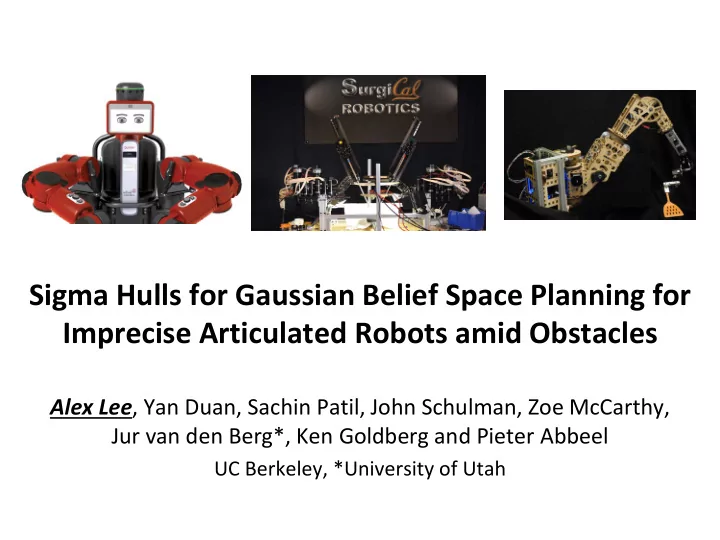
Sigma Hulls for Gaussian Belief Space Planning for Imprecise Articulated Robots amid Obstacles Alex Lee , Yan Duan, Sachin Patil, John Schulman, Zoe McCarthy, Jur van den Berg*, Ken Goldberg and Pieter Abbeel UC Berkeley, *University of Utah
Imprecise actuation mechanisms – serial elastic actuators,
Inaccurate sensors – encoders, gyros, accelerometers
Presenter: Alex Lee (UC Berkeley)
Planning under motion and sensing uncertainty is a POMDP in
Intractable in general Compute locally optimal solutions
Bry et al (ICRA 2011), Li et al (IJC 2007), van den Berg et al (IJRR
Presenter: Alex Lee (UC Berkeley)
Presenter: Alex Lee (UC Berkeley)
[Example from Platt, T edrake, Kaelbling, Lozano-Perez, 2010]
start goal
Problem Setup
State space plan
Presenter: Alex Lee (UC Berkeley)
[Example from Platt, T edrake, Kaelbling, Lozano-Perez, 2010]
State space plan
Presenter: Alex Lee (UC Berkeley)
[Example from Platt, T edrake, Kaelbling, Lozano-Perez, 2010] Belief space plan
Gaussian belief state in joint space: 𝑐𝑢 =
mean square root of covariance
Presenter: Alex Lee (UC Berkeley)
Gaussian belief state in joint space: 𝑐𝑢 =
Optimization problem:
mean square root of covariance
Unscented Kalman Filter dynamics Reach desired end-effector pose Control inputs are feasible
Presenter: Alex Lee (UC Berkeley)
𝑐𝑢+1 = belief_dynamics 𝑐𝑢, 𝑣𝑢 𝜈𝑈 = goal 𝑣𝑢 ∈ 𝑉 min 𝐷 𝑐0, … , 𝑐𝑈, 𝑣0, … , 𝑣𝑈−1
Gaussian belief state in joint space: 𝑐𝑢 =
Optimization problem: Non-convex optimization – Can be solved using sequential
mean square root of covariance
Unscented Kalman Filter dynamics Reach desired end-effector pose Control inputs are feasible
Presenter: Alex Lee (UC Berkeley)
𝑐𝑢+1 = belief_dynamics 𝑐𝑢, 𝑣𝑢 𝜈𝑈 = goal 𝑣𝑢 ∈ 𝑉 min 𝐷 𝑐0, … , 𝑐𝑈, 𝑣0, … , 𝑣𝑈−1
Want to include probabilistic collision avoidance constraints
Presenter: Alex Lee (UC Berkeley)
Want to include probabilistic collision avoidance constraints Prior work approximates robot geometry as point/spheres
Presenter: Alex Lee (UC Berkeley)
𝑦1 𝑦2 𝑦1 𝑦2 𝑦1 𝑦2
Want to include probabilistic collision avoidance constraints Prior work approximates robot geometry as point/spheres How do you formulate the constraint for a robot link?
Presenter: Alex Lee (UC Berkeley)
𝑦1 𝑦2 𝑦1 𝑦2 𝑦1 𝑦2 𝜄1 𝜄2 𝜄1 𝜄2
Presenter: Alex Lee (UC Berkeley)
𝜄1 𝜄2 𝜄1 𝜄2 𝜄1 𝜄2 𝑦 = 𝜄1 𝜄2 𝒴 = 𝑦 𝑦 𝑦 𝑦 𝑦 + 𝜇 0 Σ − Σ
Presenter: Alex Lee (UC Berkeley)
𝜄1 𝜄2 𝜄1 𝜄2 𝜄1 𝜄2 𝑦 = 𝜄1 𝜄2 𝒴 = 𝑦 𝑦 𝑦 𝑦 𝑦 + 𝜇 0 Σ − Σ
Presenter: Alex Lee (UC Berkeley)
𝜄1 𝜄2 𝜄1 𝜄2 𝜄1 𝜄2 𝑦 = 𝜄1 𝜄2 𝒴 = 𝑦 𝑦 𝑦 𝑦 𝑦 + 𝜇 0 Σ − Σ
Presenter: Alex Lee (UC Berkeley)
𝜄1 𝜄2 𝜄1 𝜄2 𝜄1 𝜄2 𝑦 = 𝜄1 𝜄2 𝒴 = 𝑦 𝑦 𝑦 𝑦 𝑦 + 𝜇 0 Σ − Σ Sigma hull of link 1
Presenter: Alex Lee (UC Berkeley)
𝜄1 𝜄2 𝜄1 𝜄2 𝜄1 𝜄2 𝑦 = 𝜄1 𝜄2 𝒴 = 𝑦 𝑦 𝑦 𝑦 𝑦 + 𝜇 0 Σ − Σ Sigma hull of link 1 Sigma hull of link 2
Presenter: Alex Lee (UC Berkeley)
𝑃 𝑃 𝑗,𝑢 𝑗,𝑢
Use convex-convex collision detection (GJK and EPA algorithm)
Computes signed distance of convex hull efficiently
Use convex-convex collision detection (GJK and EPA algorithm)
Computes signed distance of convex hull efficiently
Sigma hulls should stay at least distance 𝑒safe from other objects
Presenter: Alex Lee (UC Berkeley)
𝑒safe Signed Distance
Use convex-convex collision detection (GJK and EPA algorithm)
Computes signed distance of convex hull efficiently
Sigma hulls should stay at least distance 𝑒safe from other objects Use analytical gradients for the signed distance
Presenter: Alex Lee (UC Berkeley)
𝑒safe Signed Distance
Discrete collision avoidance can lead to trajectories that collide
Presenter: Alex Lee (UC Berkeley)
Discrete collision avoidance can lead to trajectories that collide
Use convex hull of sigma hulls between consecutive time steps
Presenter: Alex Lee (UC Berkeley)
Discrete collision avoidance can lead to trajectories that collide
Use convex hull of sigma hulls between consecutive time steps Advantages:
Solutions are collision-free
Discretized trajectory can
Presenter: Alex Lee (UC Berkeley)
Gaussian belief state in joint space: 𝑐𝑢 =
Optimization problem: Non-convex optimization – Can be solved using sequential
mean square root of covariance
Unscented Kalman Filter dynamics Reach desired end-effector pose Control inputs are feasible
Presenter: Alex Lee (UC Berkeley)
𝑐𝑢+1 = belief_dynamics 𝑐𝑢, 𝑣𝑢 pose 𝑦𝑈 = target_pose 𝑣𝑢 ∈ 𝑉 min 𝐷 𝑐0, … , 𝑐𝑈, 𝑣0, … , 𝑣𝑈−1
Probabilistic collision avoidance
Gaussian belief state in joint space: 𝑐𝑢 =
Optimization problem: Non-convex optimization – Can be solved using sequential
mean square root of covariance
Unscented Kalman Filter dynamics Reach desired end-effector pose Control inputs are feasible
Presenter: Alex Lee (UC Berkeley)
𝑐𝑢+1 = belief_dynamics 𝑐𝑢, 𝑣𝑢 pose 𝑦𝑈 = target_pose 𝑣𝑢 ∈ 𝑉 min 𝐷 𝑐0, … , 𝑐𝑈, 𝑣0, … , 𝑣𝑈−1
sd sigma_hull𝑗(𝑐𝑢), 𝑃 ≥ 𝑒safe ∀ 𝑗, 𝑃 Probabilistic collision avoidance
During execution, re-plan after every belief state update Update the belief state based on the actual observation Effective feedback control, provided one can re-plan
Presenter: Alex Lee (UC Berkeley)
Problem setup
Presenter: Alex Lee (UC Berkeley)
Presenter: Alex Lee (UC Berkeley)
Presenter: Alex Lee (UC Berkeley)
Presenter: Alex Lee (UC Berkeley)
Open-loop execution Feedback linear policy Re-planning (MPC)
Presenter: Alex Lee (UC Berkeley)
Presenter: Alex Lee (UC Berkeley)
Presenter: Alex Lee (UC Berkeley)
Planning in uncertain environments Multi-modal belief spaces Physical experiments with the Raven surgical robot
Presenter: Alex Lee (UC Berkeley)
Efficient trajectory optimization in Gaussian
Prior work approximates robot geometry as a
Pose collision constraints using signed distance
Sigma hulls never explicitly computed – use fast
Iterative re-planning in belief space (MPC)
Presenter: Alex Lee (UC Berkeley)
Code available upon request Contact: alexlee_gk@berkeley.edu
Presenter: Alex Lee (UC Berkeley)