
SLIDE 1
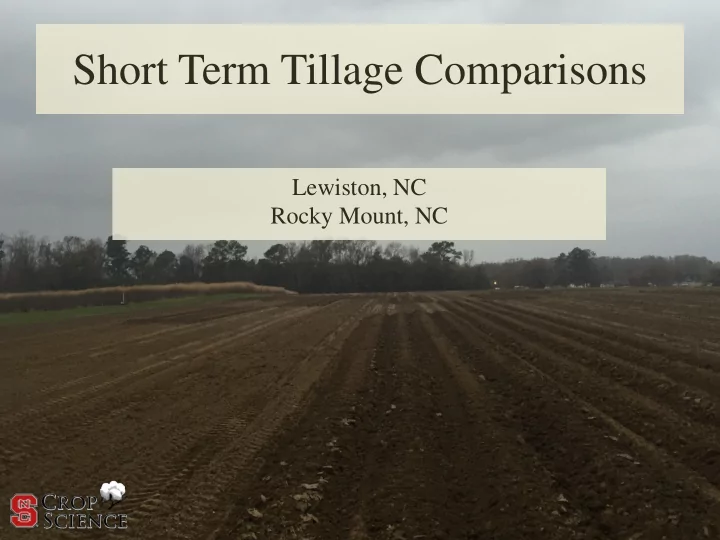
Short Term Tillage Comparisons Lewiston, NC Rocky Mount, NC Cotton - - PowerPoint PPT Presentation
Short Term Tillage Comparisons Lewiston, NC Rocky Mount, NC Cotton lint yield in conventional* and strip tillage cotton Lint yield Economic return Tillage 2012 2013 2012 2013 2012 + 2013 _____________ lbs/acre ______________
Lint yield Economic return Tillage 2012 2013 2012 2013 2012 + 2013
_____________lbs/acre ______________ ______________$/acre ________________
Conventional 1049 753 313 83 396 Strip 1045 496* 312
184 *
Conventional was bedded.
Tillage System Fall Tillage Spring Tillage 1
2 Strip
Bed
5
6 Bed Strip Everything was ripped
Lewiston Rocky Mount Tillage May 5 May 28 May 9 May 29
Conventional (spring bed) 0.506 0.885 bc 0.281 bc 0.321 Fall strip (flat) 0.441 0.717 c 0.358 abc 0.437 Fall bed 0.598 0.983 bc 0.244 c 0.477 Spring strip at-plant (flat) 0.536 0.838 c 0.253 c 0.380 Spring strip pre-plant (flat) 0.604 1.424 a 0.429 a 0.381 Fall bed + Spring strip 0.568 1.150 ab 0.390 ab 0.513 LSD
0.120
different according to Fisher’s Protected LSD at p ≤ 0.05
Lewiston Rocky Mount Tillage May 6 May 21 May 8 May 22
Conventional (spring bed) 0.497 bc 0.451 c 0.384 0.625 Fall strip 0.392 c 0.181 d 0.304 0.494 Fall bed 0.577 ab 0.641 b 0.352 0.620 Spring strip at-plant 0.671 a 0.648 b 0.364 0.727 Spring strip pre-plant 0.681 a 0.895 a 0.413 0.780 Fall bed + Spring strip 0.617 a 0.482 bc 0.396 0.536 LSD 0.108 0.187
different according to Fisher’s Protected LSD at p ≤ 0.05
weeks before planting.
Lewiston Rocky Mount Tillage May 5 May 28 May 9 May 29
Conventional (spring bed) 1767 b 1812 ab 1871 1122 b Fall strip (flat) 1927 a 1291 d 1815 1359 a Fall bed 1962 a 1628 c 1822 1366 a Spring strip at-plant (flat) 1897 ab 1740 bc 1823 1262 ab Spring strip pre-plant (flat) 2018 a 1923 a 1815 1364 a Fall bed + Spring strip 1905 ab 1882 ab 1841 1176 b LSD 154 150
*Means followed by the same letter within each column are not significantly different according to Fisher’s Protected LSD at p ≤ 0.05
Everything was ripped
Tillage Lewiston Rocky Mount
Conventional (spring bed) 1341 1253 ab Fall strip (flat) 1303 1198 b Fall bed 1226 1244 ab Spring strip at-plant (flat) 1354 1375 a Spring strip pre-plant (flat) 1223 1331 ab Fall bed + Spring strip 1277 1363 a LSD
*Means followed by the same letter within each location are not significantly different according to Fisher’s Protected LSD at p ≤ 0.05
Everything was ripped
highest yield or was not different than the highest yielding treatment.
Tillage System Initial Fall 2013 Tillage Annual Tillage Fall Rip/Bed
Fall Bed Rip/Bed Fall Bed No-Till Rip/Bed
Conventional
1- Fall rip/bed 2- Fall bed after initial rip/bed in fall 2013 3- No-till after initial rip/bed in fall 2013 4- No-till 5- Strip (rip) till 6- Conventional rip/bed
1650 1700 1750 1800 1850 1900 1950 2000 1 2 3 4 5 6
Yield (lbs lint/A) Tillage
ab* ab b b a a
*Means followed by the same letter not significantly different at p < 0.05 according to Fisher’s protected LSD.
Soil Depth (cm) Tillage 0-5 5-10 10-15 15-20 20-25 25-30
Fall rip/bed 0.172 0.363 bc 0.915 b 1.246 b 1.609 2.710 Fall Bed (2013 rip&bed) 0.131 0.295 bc 0.675 bc 0.869 b 1.506 1.649 No-Till (2013 rip&bed) 0.213 0.499 bc 0.727 bc 1.161 b 2.305 2.981 No-Till 0.274 0.872 a 2.319 a 2.829 a 3.314 1.683 Strip-Till 0.137 0.544 b 0.889 b 0.927 b 1.425 2.577 Conventional 0.120 0.234 c 0.363 c 0.678 b 1.170 1.934 LSD
0.423 0.891
different according to Fisher’s Protected LSD at p ≤ 0.05
Tillage 2014 2015
Fall rip/bed 2092 ab 1085 Fall Bed (2013 rip&bed) 2085 ab 1027 No-Till (2013 rip&bed) 2206 a 972 No-Till 1982 b 978 Strip-Till 1982 b 1029 Conventional 2180 a 1083 LSD 138
different according to Fisher’s Protected LSD at p ≤ 0.05
Table 2. Effect of input treatments on lint yield of cotton in Edgecombe County in 2015. Treatment Lint Yield (kg ha-1) 1-Base Extension Recommendation 1012 ab* 2-Base + 150% Soil Fertility 1082 a 3-Base + In-Furrow Fungicide (Ridomil Gold 106 ml ha-1) 917 b 4-Base + In-Furrow Insecticide (Admire Pro 672 ml ha-1) 1001 ab 5-Base + Foliar Fungicide (Quadris 584 ml ha-1) 998 ab 6-Base + Potassium Nitrate (50lb/A total, 5 applications) 1073 a 7-Base + “Kitchen Sink” (Inputs 2-6) 1098 a LSD 113
Table 3. Lint Yield Gain and Return by Additional Input Above Current Extension Recommendations
Treatment Yield Gain above Base (kg ha-1) Net Return Above Base ($)† Cost per kg lint gained ($) 1-Base Extension Recommendation
70
1.71 3-Base + In-Furrow Fungicide (Ridomil Gold 106 ml ha-1)
(Admire Pro 672 ml ha-1)
(Quadris 584 ml ha-1)
(50lb/A total, 5 applications) 61 28.78 1.07 7-Base + “Kitchen Sink” (Inputs 2-6) 86
3.93
Treatment Yield Gain above Base (lbs lint/A) Net Return Above Base ($)†
Price per lb lint gained ($)
1-Base Extension Recommendation
40
1.21 3-Base + In-Furrow Fungicide (Ridomil Gold 106 ml ha-1) 32 15.14 0.23 4-Base + In-Furrow Insecticide (Admire Pro 672 ml ha-1) 52 24.44 0.23 5-Base + Foliar Fungicide (Quadris 584 ml ha-1) 14
3.05 6-Base + Potassium Nitrate (50lb/A total, 5 applications) 26
1.01 7-Base + “Kitchen Sink” (Inputs 2-6) 104
1.32
†Based on cotton priced at $0.70 lb-1 and costs of inputs obtained December 2014, does not include application costs
Year Rainfall Rainfall + Irrigation Non-Irrigated Yield Irrigated Yield
2001 21.84 35.05 900 1140* 2002 33.02 46.99 515 1010* 2003 48.01 61.98 941 952 2004 63.25 80.77 1030 1131 2005 30.99 46.48 952 1456* 2006 49.53 70.61 907 963 2007 29.21 54.10 521 1138* 2008 35.05 64.01 432 935* 2011 50.55 99.31 538 898* 2012 45.97 67.79 1529 1622 2013 50.29 55.27 1605 1671 2014 67.31 84.63 1299 1238 2015 32.72 64.97 534 1054* Mean 42.90 64.00 900 1170
*Significance at p≤0.05 within each year
=square =white bloom =boll
Vegetative Squaring Bloom Early Bloom Strategy Vegetative Squaring Bloom Low Rate Multiple Strategy ? Planting May 1 Vegetative Squaring Bloom 1st square June 10 1st bloom July 1 Last effect bloom
Modified Early Bloom Strategy
?
Vegetative Squaring Bloom Early Bloom Strategy Vegetative Squaring Bloom Low Rate Multiple Strategy ? Planting May 1 Vegetative Squaring Bloom 1st square June 10 1st bloom July 1 Last effect bloom
Modified Early Bloom Strategy
?