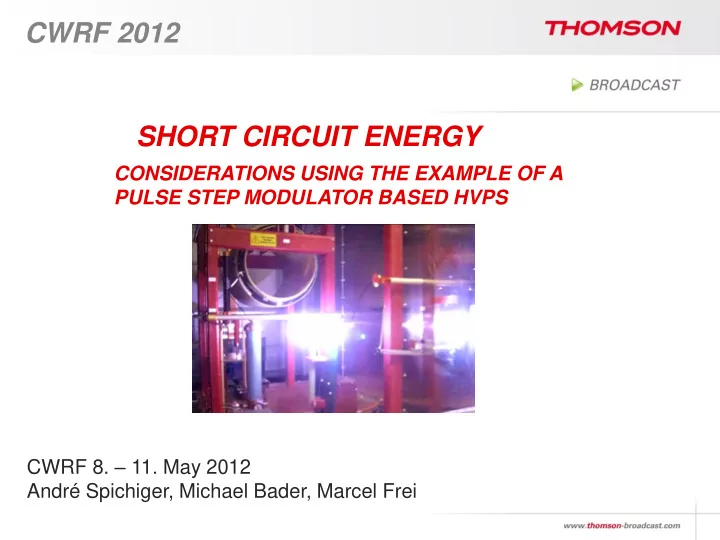
SHORT CIRCUIT ENERGY CONSIDERATIONS USING THE EXAMPLE OF A PULSE - - PowerPoint PPT Presentation

short circuit energy
SMART_READER_LITE
LIVE PREVIEW

SHORT CIRCUIT ENERGY CONSIDERATIONS USING THE EXAMPLE OF A PULSE - - PowerPoint PPT Presentation

CWRF 2012 SHORT CIRCUIT ENERGY CONSIDERATIONS USING THE EXAMPLE OF A PULSE STEP MODULATOR BASED HVPS CWRF 8. 11. May 2012 Andr Spichiger, Michael Bader, Marcel Frei SHORT CIRCUIT ENERGY Content Motivation: Why this topic? Tube


slide-1
SLIDE 1

CWRF 2012 SHORT CIRCUIT ENERGY

CWRF 8. – 11. May 2012 André Spichiger, Michael Bader, Marcel Frei CONSIDERATIONS USING THE EXAMPLE OF A PULSE STEP MODULATOR BASED HVPS

slide-2
SLIDE 2

SHORT CIRCUIT ENERGY

2 5/11/2012

Content Motivation: Why this topic? Tube Specifications How can the arc energy be measured or calculated HVPS Stored Energy Energy dissipation / arc energy Reduction of arc energy Inverse Voltage- System Summary

slide-3
SLIDE 3

MOTIVATION

3 5/11/2012

Why this topic? Questions during bids and acceptance tests Increasing filter / ripple requirements  what are the limitations? Frequently discussed issue: Cable length between the supply and the tube Important for a safe tube operation To give an idea / feeling about the figures

slide-4
SLIDE 4

SPECIFICATIONS

4 5/11/2012

Arc energy specifications Usually in the region of 10..20 Joule 15 Joule corresponds to 15 bars of chocolate lifted 1m.

What is the energy dissipated in a load (tube) arc?

slide-5
SLIDE 5

VERIFICATION

5 5/11/2012

slide-6
SLIDE 6

VERIFICATION

6 5/11/2012

Measuring the arc energy

Simple test with a wire as proposed in tube Datasheets Using a real fuse I2t value Accurate Current measurement is possible (e.g. pearson coil, coaxial shunt) Accurate Arc Voltage measurement is not easy to do We proposal: Measuring the current and post-calculating the energy dissipation with a defined arc Model

Calculating the arc energy

Arc Model Proposal for vacuum tubes: Series connection of DC Voltage source 100V and Resistor 200mOhm. Simulations provide good basis for later verification System optimization can be easily done in simulations

slide-7
SLIDE 7

BASIC MODEL

7 5/11/2012

slide-8
SLIDE 8

STORED ENERGY

8 5/11/2012

Basic model with a 2 – pole RLC filter network System parameter 35kV / 3.5A, a rather small system. ARC energy specifications 15 Joule Stored energy is much higher

Parameter Value Stored Energy Filter Inductor 16 mH 5 mH 0.1 Joule / 6 Joule 0.03 Joule / 15 Joule Filter Capacitor 200nF 123 Joule High Voltage Power Supply 60 modules 57 Joule / module 3420 Joule Cable 100 pF / meter 0.06 Joule / meter

slide-9
SLIDE 9

ENERGY DISSIPATION

9 5/11/2012

Where is the energy dissipated in case of a short?

What happens with the stored energy in the filter QL QC? Simulation model parameters: Turn off delay 10 us Voltage drop in the diodes: 2V / Diode Short circuit model: 100V / 0.2 Ohm

slide-10
SLIDE 10

SIMULATION MODEL

10 5/11/2012

R10 10k

  • ut

U5 TOPEN = 100u 1 2 V6 35000Vdc V_ARC 100Vdc Dbreak D2 200n IC = -35k RFilter 200 LFilter 5m 1 2 ARC TCLOSE = 90u TTRAN = 0.1u RCLOSED = 0.001 ROPEN = 1Meg 1 2 R_ARC 0.2 R6 0.72 V8 120Vdc

HV-Supply FILTER ARC LOAD

slide-11
SLIDE 11

SIMULATION: 5 MH FILTER INDUCTANCE

11 5/11/2012 Time 100us 150us 200us 250us 300us 350us 400us 51us S(W(R_ARC)+W(V_ARC)) 2.0 4.0 I(RFilter) I(ARC:1) I(LFilter) 100A 200A 2A SEL>>

Discharge of filter cap Inductance current

slide-12
SLIDE 12

SIMULATION: 5 MH FILTER INDUCTANCE

12 5/11/2012

Time 0.20ms 0.40ms 0.60ms 0.80ms 1.00ms 1.20ms 1.40ms 1.60ms 1.80ms 0.05ms S(W(R_ARC)+W(V_ARC)) 4.0 8.0 I(RFilter) I(ARC:1) I(LFilter) 0A 100A 200A SEL>>

about 7 Joule

slide-13
SLIDE 13

SIMULATION: 16 MH FILTER INDUCTANCE

13 5/11/2012 Time 80.0us 120.0us 160.0us 200.0us 240.0us 280.0us 320.0us 55.3us 353.2us S(W(R_ARC)+W(V_ARC)) 1.0 2.0 I(RFilter) I(ARC:1) I(LFilter) 0A 50A 100A 150A SEL>>

slide-14
SLIDE 14

SIMULATION: 16 MH FILTER INDUCTANCE

14 5/11/2012

Time 0.200ms 0.400ms 0.600ms 0.800ms 1.000ms 1.200ms 1.400ms 1.600ms 1.800ms 0.053ms 1.996ms S(W(R_ARC)+W(V_ARC)) 2.0 4.0 I(RFilter) I(ARC:1) I(LFilter) 0A 50A 100A 150A SEL>>

about 3.3 Joule

slide-15
SLIDE 15

SIMULATION: WITH CABLE

15 5/11/2012 Time 80us 100us 120us 140us 160us 180us 200us 220us 240us 260us 280us 300us S(W(R_ARC_Cab)+W(V_ARC_cab)) 1.0 2.0 I(RFilter) I(ARC_Cab:1) I(LFilt_Cab) 0A 400A

  • 225A

705A SEL>>

100 METER CABLE ADDED TO THE SIMULATION

big oscillation

slide-16
SLIDE 16

SIMULATION: WITH CABLE AND SNUBBER

16 5/11/2012

ARC FILTER HV-Supply

R8 10k

  • ut_cab

LOAD SNUBBER

RSnubber 50 LSnubber 100uH 1 2 U4 TOPEN = 100u 1 2 V5 35000Vdc V_ARC_Cab 100Vdc Dbreak D1

LOSSY

T3 LEN = 100 L = 250n C = 100p G = 10p R = 0.1m 200n IC = -35k RFilt_Cab 200 LFilt_Cab 16m 1 2 ARC_Cab TCLOSE = 90u TTRAN = 0.1u RCLOSED = 0.001 ROPEN = 1Meg 1 2 R_ARC_Cab 0.2 R4 0.72 V4 120Vdc

slide-17
SLIDE 17

SIMULATION: WITH CABLE AND SNUBBER

17 5/11/2012 Time 80.0us 100.0us 120.0us 140.0us 160.0us 180.0us 200.0us 220.0us 240.0us 260.0us S(W(R_ARC_Cab)+W(V_ARC_cab)) 0.5 1.0 1.5 I(RFilter) I(ARC_Cab:1) I(LFilt_Cab) 0A 125A 250A 375A SEL>>

smaller peak, no oscillation

slide-18
SLIDE 18

ENERGY DISSIPATION SUMMARY

18 5/11/2012

Where is the energy dissipated in case of a short?

Filter Capacitor: Almost everything is dissipated in the filter resistor Filter Inductance: Before shutdown of the PSM the L is charged  Energy After PSM shutdown the energy is dissipated in the short and the diodes of the PSM Cable snubber are reducing oscillations and Arc Energy

slide-19
SLIDE 19

OPTIMIZATION

19 5/11/2012

How can the energy be reduced, measures?

Filter can be optimized according operating point. More complex filters instead a simple RLC network. Tradeoff: Filter vs. Energy Using Cable Snubbers for long cables Thomson patented Inverse voltage Operation Mode

slide-20
SLIDE 20

KGP5: INVERSE VOLTAGE OPERATION

20 5/11/2012

Application example: KGP5 Test stand for Tubes

160 kV / 3.2 MW CW Higher power in pulsed mode 5 us Rise time Arc energy can be set between 2 Joule and 20 Joule This specifications required new solution: Inverse Voltage Operation Mode

slide-21
SLIDE 21

21 5/11/2012

KGP5: INVERSE VOLTAGE OPERATION

Principle

slide-22
SLIDE 22

22 5/11/2012

KGP5: INVERSE VOLTAGE OPERATION

Short Circuit Current Simulations

Green: output current without inverse voltage operation Red: output current with inverse voltage operation

Time 0s 0.5ms 1.0ms 1.5ms 2.0ms 2.5ms i(v2)

  • 0.2KA

0A 0.2KA 0.4KA 0.6KA 0.8KA 1.0KA Time 0s 10us 20us 30us 40us 50us 60us 70us 80us 90us 100us i(v2)

  • 0.5KA

0A 0.5KA 1.0KA

slide-23
SLIDE 23

23 5/11/2012

KGP5: INVERSE VOLTAGE OPERATION

Short circuit Test on Tube teststand

Adjustable arc energy 2 – 20J Main Issue with IVO was the 20J not the 2J  2Point Regulation implemented Top Trace: Vout = 102kV; Energy Setting = 2.5J Charge Measured 29mAs (2.9J @100V) Bottom Trace: Two point regulation until energy is reached

slide-24
SLIDE 24

24 5/11/2012

KGP5: INVERSE VOLTAGE OPERATION

Two point regulation for a defined Q

slide-25
SLIDE 25

SUMMARY

25 5/11/2012

Summary

Bigger capacitors or inductors des not necessarily mean more energy in the arc. Considering the whole system is important! Degrees of freedom allow optimization  therefore it is important to know the real requirements. May be an iterative process together with the customer. Thomson’s Inverse Voltage Supplies can reduce the energy to a minimum.

slide-26
SLIDE 26

THANK YOU