Shoe-Turf Interaction, Injury Risk, and Performance of Elite - - PDF document

shoe turf interaction injury risk and performance of
SMART_READER_LITE
LIVE PREVIEW

Shoe-Turf Interaction, Injury Risk, and Performance of Elite - - PDF document

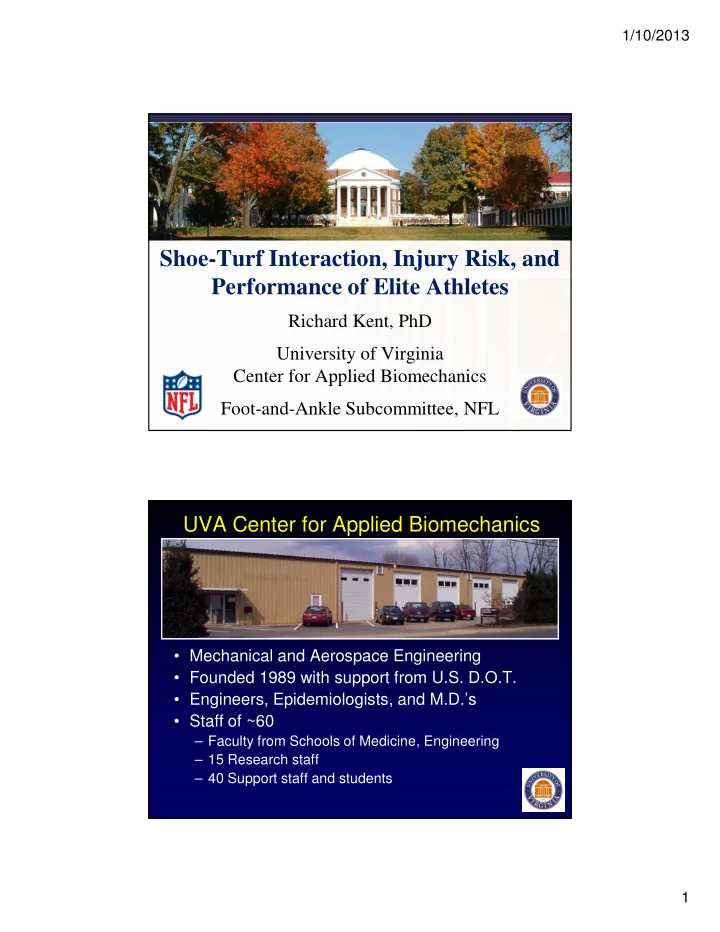
1/10/2013 Shoe-Turf Interaction, Injury Risk, and Performance of Elite Athletes Richard Kent, PhD University of Virginia Center for Applied Biomechanics Foot-and-Ankle Subcommittee, NFL UVA Center for Applied Biomechanics Mechanical and


slide-1
SLIDE 1

1/10/2013 1

Shoe-Turf Interaction, Injury Risk, and Performance of Elite Athletes

Richard Kent, PhD University of Virginia Center for Applied Biomechanics Foot-and-Ankle Subcommittee, NFL

UVA Center for Applied Biomechanics

  • Mechanical and Aerospace Engineering
  • Founded 1989 with support from U.S. D.O.T.
  • Engineers, Epidemiologists, and M.D.’s
  • Staff of ~60

– Faculty from Schools of Medicine, Engineering – 15 Research staff – 40 Support staff and students

slide-2
SLIDE 2

1/10/2013 2

UVA Center for Applied Biomechanics

  • Mechanical and Aerospace Engineering
  • Founded 1989 with support from U.S. D.O.T.
  • Engineers, Epidemiologists, and M.D.’s
  • Staff of ~60

– Faculty from Schools of Medicine, Engineering – 15 Research staff – 40 Support staff and students

CENTER for APPLIED BIOMECHANICS

slide-3
SLIDE 3

1/10/2013 3

CENTER for APPLIED BIOMECHANICS

Fundamental Research Applied Research

Characterize Shoe-Turf Interaction Mechanics (BEAST) Measure mechanics

  • f NFL players

during performance Determine loads and toe angle that cause turf toe Determine loads and foot deformations that cause Lisfranc injuries Determine mechanisms of syndesmotic ankle sprains Develop Recommended Practices (RPs) for NFL Surfaces

  • Gait laboratory study
  • Literature review
  • Video analysis
  • Cadaver experiments
  • Relate to NFL players
  • Literature review
  • Determine next steps

Literature Existing practices New research

CENTER for APPLIED BIOMECHANICS

Fundamental Research – How do injuries happen?

slide-4
SLIDE 4

1/10/2013 4

CENTER for APPLIED BIOMECHANICS

Applied Research and Testing

Implementation – Equipment Recommendations, Practices

slide-5
SLIDE 5

1/10/2013 5

CENTER for APPLIED BIOMECHANICS

Turf toe (Sprain of 1st metatarsophalangeal joint)

Cadaver tests

slide-6
SLIDE 6

1/10/2013 6

0.0 0.1 0.2 0.3 0.4 0.5 0.6 0.7 0.8 0.9 1.0 20 40 60 80 100 120 140 160 Probability of Injury Peak Angle (deg)

θ skin

Survival analysis (Weibull distribution) (n=15 cadaver tests)

50% risk at 108 deg. “weakest” injured at 101 deg. “strongest” uninjured at 132 deg.

9 Players Run, cut (outside

foot), cut (inside foot), jump, land, start, walk

Maximum big toe

joint angle measured

slide-7
SLIDE 7

1/10/2013 7

0.0 0.1 0.2 0.3 0.4 0.5 0.6 0.7 0.8 0.9 1.0 20 40 60 80 100 120 140 160 Probability Peak Angle (deg)

θ skin

Probability of attaining that angle while running

Cumulative normal distribution (n=8 players)

not 0.0 0.1 0.2 0.3 0.4 0.5 0.6 0.7 0.8 0.9 1.0 20 40 60 80 100 120 140 160 Probability Peak Angle (deg)

θ skin

Probability of injury in a cadaver Probability of attaining that angle while running

Cumulative normal distribution (n=9 players) Survival analysis (Weibull distribution) (n=15 cadaver tests)

not

slide-8
SLIDE 8

1/10/2013 8

0.0 0.1 0.2 0.3 0.4 0.5 0.6 0.7 0.8 0.9 1.0 20 40 60 80 100 120 140 160 Probability Peak Angle (deg)

θ skin

Probability of injury in a cadaver Probability of attaining that angle while running

Cumulative normal distribution (n=9 players) Survival analysis (Weibull distribution) (n=15 cadaver tests)

Design Design Space Space

not

Lisfranc (First tarsometatarsal joint)

slide-9
SLIDE 9

1/10/2013 9

Lisfranc (First tarsometatarsal joint)

0% 10% 20% 30% 40% 50% 60% 70% 80% 90% 100%

Film Analysis Summary

At Initiation During General

slide-10
SLIDE 10

1/10/2013 10

20 40 60 0.2 0.4 0.6 0.8 1 0.1 0.2 0.3 0.4 0.5 0.6 0.7 0.8 0.9 1

Probability of Lisfranc Injury

Axial force Twist Angle P(I)

Cuneiform Coordinates

Cuneiform

Cuneiform

slide-11
SLIDE 11

1/10/2013 11

Second Metatarsal Coordinates \

Medial Cuneiform 2nd Metatarsal

slide-12
SLIDE 12

1/10/2013 12

  • 0.03
  • 0.02
  • 0.01

0.01 0.02 0.03 1 2 3 M1_C1_X_load&rot M1_C1_Y_load&rot M1_C1_Z_load&rot M2_C1_X_load&rot M2_C1_Y_load&rot M2_C1_Z_load&rot

Motion of 1st and 2nd Metatarsals

Distance (m) 0⁰ 40⁰ 0⁰

CENTER for APPLIED BIOMECHANICS

Syndesmotic (“High”) Ankle Sprains

slide-13
SLIDE 13

1/10/2013 13

CENTER for APPLIED BIOMECHANICS

Syndesmotic (“High”) Ankle Sprains

CENTER for APPLIED BIOMECHANICS

Applied Research – Shoe-Turf Interaction

Torg et al., 1974 Heidt et al., 1996 Livesay et al., 2006 Shorten and Himmelsbach---Biomechanica 2002

slide-14
SLIDE 14

1/10/2013 14

CENTER for APPLIED BIOMECHANICS

  • Test Type 1 – Start from Stop (Translation)

170 psi cylinder pressure 2.8-kN (630 lb)

static preload applied to bearing track Imposed F(t)

Inputs: Vertical force and pressure in actuator Outputs: Does shoe break free? If so, how far and fast does it move?

CENTER for APPLIED BIOMECHANICS

  • Test 2 – Stop/Cut (Drop)

(37.5 kg, 82.5 lb.) 1.5 m/s

then release and drop

(2 5/8”, 6.7 cm)

Inputs: Mass, drop height, speed over ground Outputs: Does shoe snag? Vertical force, lateral force, and inversion bending moment.

slide-15
SLIDE 15

1/10/2013 15

CENTER for APPLIED BIOMECHANICS

  • Test 3 – Twist (Rotation)

2.8-kN (630 lb) static

preload applied to bearing track

95 psi cylinder pressure Inputs: Vertical force and pressure in actuator Outputs: Does shoe break free? If so, how far and fast does it rotate?

CENTER for APPLIED BIOMECHANICS

BioCore Elite Athlete Shoe-turf Tester (B.E.A.S.T.)

slide-16
SLIDE 16

1/10/2013 16

CENTER for APPLIED BIOMECHANICS

Nike Air Zoom Vapor Jet Detachable cleat Molded cleat Nike Air Zoom Merciless Destroyer Turf shoe

CENTER for APPLIED BIOMECHANICS

BioCore Elite Athlete Shoe-turf Tester (B.E.A.S.T.)

slide-17
SLIDE 17

1/10/2013 17

CENTER for APPLIED BIOMECHANICS

  • SELECTED RESULTS: Start from Stop Test

Comparison Across 5 Turfs

  • 50

50 100 150 200 250 0.0 0.2 0.4 0.6 0.8 1.0 Time (s) Horizontal Displacement (mm)

BEAST33: Baltimore Ravens, Shoe VJTD2 BEAST45: NY Giants Grass, Shoe VJTD3 BEAST62: NY Giants Turf, Shoe VJTD3 BEAST74: Atlanta Falcons, Shoe VJTD3 BEAST90: Carolina Panthers, Shoe VJTD3

Cleat “snags” Cleat moves Cleat catches, then releases

Displacement

CENTER for APPLIED BIOMECHANICS

  • SELECTED RESULTS : Start from Stop

Comparison Across 5 Turfs

  • 50

50 100 150 200 250 0.0 0.2 0.4 0.6 0.8 1.0 Time (s) Horizontal Displacement (mm)

BEAST33: Baltimore Ravens, Shoe VJTD2 BEAST45: NY Giants Grass, Shoe VJTD3 BEAST62: NY Giants Turf, Shoe VJTD3 BEAST74: Atlanta Falcons, Shoe VJTD3 BEAST90: Carolina Panthers, Shoe VJTD3

Infill manuf 2 Infill manuf 2 Old Bermuda Grass Old Bermuda Grass New Bluegrass Infill manuf 1

Displacement

slide-18
SLIDE 18

1/10/2013 18

CENTER for APPLIED BIOMECHANICS

Interaction Between Shoe and Turf

Nike Air Zoom Vapor Jet Nike Air Zoom Merciless Destroyer

CENTER for APPLIED BIOMECHANICS

  • RESULTS: Start from Stop (Translation)

Displacement

  • 50

50 100 150 200 250 0.0 0.1 0.2 0.3 0.4 0.5 0.6 Time (s) Horizontal Displacement (mm) Molded on Grass Molded on Fieldturf Turf shoe on Fieldturf Turf shoe on Momentum turf Artificial Turf Artificial Turf Artificial Turf

slide-19
SLIDE 19

1/10/2013 19

  • Goal: Policies and procedures based on technically

rigorous research (i.e., knowledge) rather than marketing, historical precedent, or rules of thumb

Recommendations for

Field Performance

Evaluation Rubric for

Cleats and Shoes

Based on Research NFL “university” 10+ Scientific Papers on

Foot-Ankle in 5 Years

Regular Dissemination

to Equipment and Field Managers