shell program that runs other programs on behalf of the - - PowerPoint PPT Presentation

shell
SMART_READER_LITE
LIVE PREVIEW

shell program that runs other programs on behalf of the - - PowerPoint PPT Presentation

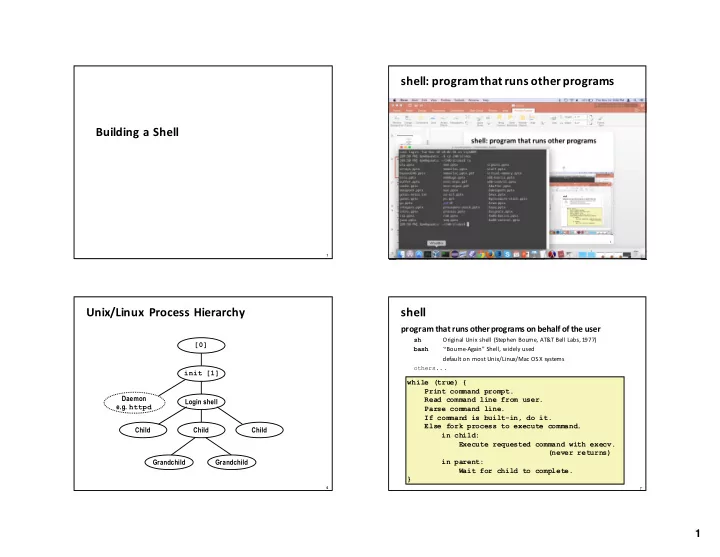
shell: program that runs other programs Building a Shell 1 5 Unix/Linux Process Hierarchy shell program that runs other programs on behalf of the user Original Unix


slide-1
SLIDE 1

1

1

Building ¡a ¡Shell

5

shell: ¡program ¡that ¡runs ¡other ¡programs

6

Unix/Linux ¡ Process ¡Hierarchy

Login shell Child Child Child Grandchild Grandchild [0] Daemon e.g. httpd init [1]

7

shell

program ¡that ¡runs ¡other ¡programs ¡on ¡behalf ¡of ¡the ¡user

sh Original ¡Unix ¡shell ¡(Stephen ¡Bourne, ¡AT&T ¡Bell ¡Labs, ¡1977) bash “Bourne-­‑Again” ¡Shell, ¡widely ¡used default ¡on ¡most ¡Unix/Linux/Mac ¡OS ¡X ¡systems

  • thers...

while (true) { Print command prompt. Read command line from user. Parse command line. If command is built-in, do it. Else fork process to execute command. in child: Execute requested command with execv. (never returns) in parent: Wait for child to complete. }

slide-2
SLIDE 2

2

8

terminal ≠ ¡shell

User ¡interface ¡ to ¡shell ¡and ¡ other ¡programs.

Graphical ¡(GUI) ¡vs. ¡command-­‑line ¡ (CLI)

Command-­‑line ¡ terminal ¡ (emulator):

Input ¡(keyboard) Output ¡(screen)

9

Background ¡vs. ¡Foreground

Users ¡generally ¡ run ¡one ¡command ¡ at ¡a ¡time

Type ¡command, ¡read ¡output, ¡type ¡another ¡command

Some ¡programs ¡ run ¡“for ¡a ¡long ¡time” A ¡“background” ¡ job ¡is ¡a ¡process ¡we ¡don't ¡want ¡to ¡wait ¡for

$ emacs fizz.txt # shell stuck until emacs exits. $ emacs boom.txt & # emacs runs in background [1] 9073 # while shell is... $ gdb ./umbrella # immediately ready for next command don't ¡do ¡this ¡with ¡emacs unless ¡using ¡X ¡windows ¡version

10

Managing ¡Background ¡Jobs

Shell ¡waits ¡for ¡and ¡reaps ¡foreground ¡jobs. Background ¡jobs ¡become ¡zombies ¡when ¡they ¡terminate.

Shell ¡might ¡run ¡for ¡a ¡really ¡long ¡time! Kernel ¡may ¡run ¡out ¡of ¡memory! fork() ¡returns ¡-­‑1 ¡if ¡per-­‑user ¡process ¡quota ¡exceeded

Shell ¡must ¡explicitly ¡reap ¡background ¡jobs.

One ¡way: ¡check/reap ¡any ¡completed ¡background ¡jobs ¡before ¡every ¡prompt. OK, ¡assuming ¡foreground ¡jobs/user ¡inactivity ¡are ¡not ¡too ¡long. Another ¡way: ¡OS ¡delivers ¡signal via ¡exceptional ¡control ¡flow ¡when ¡child ¡ends. OK ¡to ¡respond ¡by ¡reaping, ¡but ¡complicated ¡concurrency ¡ makes ¡it ¡tricky.

$ ulimit -u # bash syntax 1024

12

Signals

Signal: ¡small ¡message ¡notifying ¡a ¡process ¡of ¡event ¡in ¡system

like ¡exceptions ¡and ¡interrupts sent ¡by ¡kernel, ¡sometimes ¡at ¡request ¡of ¡another ¡process ID ¡is ¡entire ¡message

ID Name Corresponding ¡Event Default ¡Action Can ¡ Override? 2 SIGINT Interrupt ¡(Ctrl-­‑C) T erminate Yes 9 SIGKILL Kill ¡process ¡(immediately) T erminate No 11 SIGSEGV Segmentation ¡violation T erminate ¡ & ¡Dump Yes 14 SIGALRM Timer ¡signal T erminate Yes 15 SIGTERM Kill ¡process ¡(politely) T erminate Yes 17 SIGCHLD Child ¡stopped ¡or ¡terminated Ignore Yes 18 SIGCONT Continue ¡stopped ¡process Continue ¡(Resume) No 19 SIGSTOP Stop ¡process ¡(immediately) Stop ¡(Suspend) No 20 SIGTSTP Stop ¡process ¡(politely) Stop ¡(Suspend) Yes

slide-3
SLIDE 3

3

13

Sending/Receiving ¡a ¡Signal

Kernel ¡sends (delivers) ¡ a ¡signal ¡ to ¡a ¡destination ¡ process by ¡updating ¡ state ¡ in ¡the ¡context ¡ of ¡the ¡destination ¡ process. Reasons:

System ¡event, ¡e.g. ¡segmentation ¡fault ¡(SIGSEGV) Another ¡process ¡ used ¡kill system ¡call: explicitly ¡request ¡the ¡kernel ¡send ¡a ¡signal ¡to ¡the ¡destination ¡process

Destination ¡ process ¡receives signal when ¡ kernel ¡ forces ¡ it ¡to ¡react. Reactions:

Ignore the ¡signal ¡(do ¡nothing) Terminate the ¡process ¡(with ¡optional ¡core ¡dump) Catch the ¡signal ¡by ¡executing ¡a ¡user-­‑level ¡function ¡called ¡signal ¡handler Like ¡an ¡impoverished ¡Java ¡exception ¡handler

15

Signals ¡ Handlers ¡as ¡Concurrent ¡Flows

Signal ¡handlers ¡run ¡concurrently ¡with ¡main ¡program (in ¡same ¡process).

Process ¡ A ¡ while (1) ; Process ¡ A handler(){ … } Process ¡ B

Time

16

Another ¡View ¡of ¡Signal ¡ Handlers ¡ as ¡ Concurrent ¡ Flows

Signal ¡delivered Signal ¡received Process ¡A Process ¡B

user ¡ code ¡(main) kernel ¡ code user ¡ code ¡(main) kernel ¡ code user ¡ code ¡(handler) context ¡ switch context ¡ switch kernel ¡ code user ¡ code ¡(main) Icurr Inext

17

Pending ¡and ¡Blocked ¡Signals

A ¡signal ¡is ¡pending if ¡sent ¡but ¡not ¡yet ¡received

<= ¡1 ¡pending ¡signal ¡per ¡type ¡per ¡process No ¡Queue! ¡ ¡Just ¡a ¡bit ¡per ¡signal ¡type. Signals ¡of ¡type ¡S ¡discarded ¡while ¡process ¡has ¡S ¡signal ¡pending.

A ¡process ¡can ¡block the ¡receipt ¡of ¡certain ¡signals

Receipt ¡delayed ¡until ¡the ¡signal ¡is ¡unblocked

A ¡pending ¡signal ¡is ¡received ¡at ¡most ¡once Let's ¡draw ¡a ¡picture...

slide-4
SLIDE 4

4

19

Process ¡Groups

Every ¡ process ¡belongs ¡to ¡exactly ¡ one ¡process ¡group ¡ (default: ¡ parent's ¡ group)

Fore-­‑ ground job Back-­‑ ground job ¡#1 Back-­‑ ground job ¡#2 Shell Child Child

pid=10 pgid=10

Foreground ¡ process ¡ group ¡ 20 Background process ¡ group ¡ 32 Background process ¡ group ¡ 40

pid=20 pgid=20 pid=32 pgid=32 pid=40 pgid=40 pid=21 pgid=20 pid=22 pgid=20

getpgrp() Return ¡process ¡group ¡of ¡current ¡process setpgid() Change ¡process ¡group ¡of ¡a ¡process

20

Sending ¡Signals ¡from ¡the ¡Keyboard

Shell: ¡Ctrl-­‑C ¡sends ¡SIGINT ¡(Ctrl-­‑Z ¡sends ¡SIGTSTP) to ¡every ¡job ¡in ¡the ¡foreground ¡process ¡group.

SIGINT ¡– default ¡action ¡is ¡to ¡terminate ¡each ¡process ¡ SIGTSTP ¡ – default ¡action ¡is ¡to ¡stop ¡(suspend) ¡each ¡process

Fore-­‑ ground job Back-­‑ ground job ¡#1 Back-­‑ ground job ¡#2 Shell Child Child

pid=10 pgid=10

Foreground ¡ process ¡ group ¡20 Background process ¡ group ¡32 Background process ¡ group ¡40

pid=20 pgid=20 pid=32 pgid=32 pid=40 pgid=40 pid=21 pgid=20 pid=22 pgid=20

21

Signal ¡demos

Ctrl-­‑C Ctrl-­‑Z kill kill(pid, SIGINT);

32

A ¡Program ¡That ¡Reacts ¡to Externally ¡Generated ¡Events ¡(Ctrl-­‑c)

#include <stdlib.h> #include <stdio.h> #include <signal.h> void handler(int sig) { safe_printf("You think hitting ctrl-c will stop me?\n"); sleep(2); safe_printf("Well..."); sleep(1); printf("OK\n"); exit(0); } main() { signal(SIGINT, handler); /* installs ctrl-c handler */ while(1) { } }

external.c

> ./external <ctrl-c> You think hitting ctrl-c will stop me? Well...OK >
slide-5
SLIDE 5

5

33

A ¡Program ¡That ¡Reacts ¡to ¡Internally ¡ Generated ¡Events

#include <stdio.h> #include <signal.h> int beeps = 0; /* SIGALRM handler */ void handler(int sig) { safe_printf("BEEP\n"); if (++beeps < 5) alarm(1); else { safe_printf("DING DING!\n"); exit(0); } } main() { signal(SIGALRM, handler); alarm(1); /* send SIGALRM in 1 second */ while (1) { } } > ./internal BEEP BEEP BEEP BEEP BEEP DING DING! >

internal.c

42

Signal ¡summary

Signals ¡ provide ¡process-­‑level ¡exception ¡handling

Can ¡generate ¡from ¡user ¡programs Can ¡define ¡effect ¡by ¡declaring ¡signal ¡handler

Some ¡caveats

Very ¡high ¡overhead >10,000 ¡clock ¡cycles Only ¡use ¡for ¡exceptional ¡conditions Not ¡queued Just ¡one ¡bit ¡for ¡each ¡pending ¡signal ¡type Many ¡more ¡complicated ¡details ¡we ¡have ¡not ¡discussed. Book ¡goes ¡into ¡too ¡much ¡gory ¡detail.