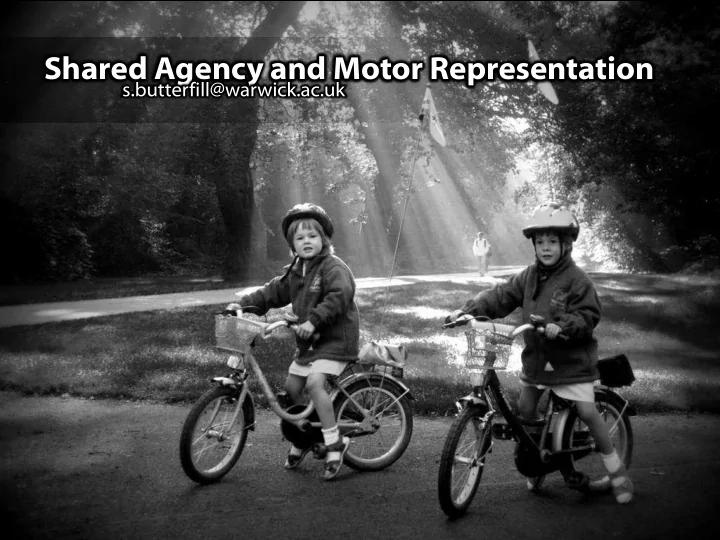
SLIDE 1 Shared Agency and Motor Representation
s.butterfill@warwick.ac.uk
SLIDE 2
Two sisters cycling to school together. Two strangers cycling the same route side-by-side. (cf. Gilbert 1990) Shared Agency Parallel but Individual Agency
SLIDE 3
Members of a flash mob simultaneously open their newspapers noisily Onlookers simultaneously open their newspapers noisily Two sisters cycling to school together. Two strangers cycling the same route side-by-side. (cf. Searle 1990: 92) (cf. Gilbert 1990) Shared Agency Parallel but Individual Agency
SLIDE 4
What is the relation between a purposive action and the goal or goals to which it is directed? joint
SLIDE 5
What is the relation between a purposive action and the goal or goals to which it is directed? joint
SLIDE 6
act action joint joint What is the relation between a purposive action and the goal or goals to which it is directed? free alarm amuse smash
SLIDE 7
act action joint joint What is the relation between a purposive action and the goal or goals to which it is directed? free alarm amuse smash
SLIDE 8
free alarm amuse smash scratch wave act reach grasp action joint joint What is the relation between a purposive action and the goal or goals to which it is directed?
SLIDE 9
free alarm amuse smash scratch wave act reach grasp action joint joint shared intention or social motor representation What is the relation between a purposive action and the goal or goals to which it is directed?
SLIDE 10
free alarm amuse smash scratch wave act reach grasp action joint joint shared intention or social motor representation What is the relation between a purposive action and the goal or goals to which it is directed? coordinates
SLIDE 11
free alarm amuse smash scratch wave act reach grasp action joint joint shared intention or social motor representation What is the relation between a purposive action and the goal or goals to which it is directed? coordinates
SLIDE 12
free alarm amuse smash scratch wave act reach grasp action joint joint shared intention or social motor representation What is the relation between a purposive action and the goal or goals to which it is directed? coordinates ‘the key property of joint action lies in its internal component [...] in the participants’ having a “collective” or “shared” intention.’ (Alonso 2009, pp. 444-5)
SLIDE 13
free alarm amuse smash scratch wave act reach grasp action joint joint shared intention or social motor representation What is the relation between a purposive action and the goal or goals to which it is directed? coordinates ‘the key property of joint action lies in its internal component [...] in the participants’ having a “collective” or “shared” intention.’ (Alonso 2009, pp. 444-5)
SLIDE 14
G is a distributive goal: it is an outcome to which each agent’s actions are individually directed and it is possible that: all actions succeed relative to this outcome.
SLIDE 15
Members of a flash mob simultaneously open their newspapers noisily Onlookers simultaneously open their newspapers noisily Two sisters cycling to school together. Two strangers cycling the same route side-by-side. (cf. Searle 1990: 92) (cf. Gilbert 1990) Shared Agency Parallel but Individual Agency G is a distributive goal: it is an outcome to which each agent’s actions are individually directed and it is possible that: all actions succeed relative to this outcome.
SLIDE 16
G is a distributive goal: it is an outcome to which each agent’s actions are individually directed and it is possible that: all actions succeed relative to this outcome.
SLIDE 17 G is a collective goal (a) it is a distributive goal; (b) the actions are coordinated; and (c) coordination of this type would normally facilitate occurrences of
G is a distributive goal: it is an outcome to which each agent’s actions are individually directed and it is possible that: all actions succeed relative to this outcome.
SLIDE 18 G is a distributive goal: it is an outcome to which each agent’s actions are individually directed and it is possible that: all actions succeed relative to this outcome. G is a collective goal (a) it is a distributive goal; (b) the actions are coordinated; and (c) coordination of this type would normally facilitate occurrences of
SLIDE 19
SLIDE 20 G is a distributive goal: it is an outcome to which each agent’s actions are individually directed and it is possible that: all actions succeed relative to this outcome. G is a collective goal (a) it is a distributive goal; (b) the actions are coordinated; and (c) coordination of this type would normally facilitate occurrences of
SLIDE 21 premise: Some joint actions are facilitated by the agents engaging in reciprocal, parallel agent-neutral motor planning for outcomes whose realisation would normally involve action on the part
where the resulting plans are identical (or similar enough).
SLIDE 22 premise: Some joint actions are facilitated by the agents engaging in reciprocal, parallel agent-neutral motor planning for outcomes whose realisation would normally involve
- ne’s own and another’s (or others’) actions.
where the resulting plans are identical (or similar enough).
SLIDE 23 premise: Some joint actions are facilitated by the agents engaging in reciprocal, parallel agent-neutral motor planning for outcomes whose realisation would normally involve
- ne’s own and another’s (or others’) actions.
SLIDE 24 premise: Some joint actions are facilitated by the agents engaging in reciprocal, parallel agent-neutral motor planning for outcomes whose realisation would normally involve
- ne’s own and another’s (or others’) actions.
SLIDE 25 premise: Some joint actions are facilitated by the agents engaging in reciprocal, parallel agent-neutral motor planning for outcomes whose realisation would normally involve
- ne’s own and another’s (or others’) actions.
SLIDE 26 premise: Some joint actions are facilitated by the agents engaging in reciprocal, parallel agent-neutral motor planning for outcomes whose realisation would normally involve
- ne’s own and another’s (or others’) actions.
SLIDE 27 premise: Some joint actions are facilitated by the agents engaging in reciprocal, parallel agent-neutral motor planning for outcomes whose realisation would normally involve
- ne’s own and another’s (or others’) actions.
SLIDE 28 premise: Some joint actions are facilitated by the agents engaging in reciprocal, parallel agent-neutral motor planning for outcomes whose realisation would normally involve
- ne’s own and another’s (or others’) actions.
SLIDE 29
Move it from there to here
SLIDE 30
Move it from there to here reach grasp move arrive grasp move place release reach release get it move it position it hand-1 hand-2
SLIDE 31
Move it from there to here reach grasp move arrive grasp move place release reach release get it move it position it hand-1 hand-2
SLIDE 32
Move it from there to here reach grasp move arrive grasp move place release reach release get it move it position it hand-1 hand-2
SLIDE 33 Move it from there to here reach grasp move arrive grasp move place release reach release get it move it position it hand-1 hand-2 s i m i l a r t i m i n g p r
l e m
SLIDE 34 s i m i l a r t i m i n g p r
l e m Move it from there to here reach grasp move arrive grasp move place release reach release get it move it position it hand-1 hand-2 s a m e p l a n n i n g
SLIDE 35 Move it from there to here reach grasp move arrive grasp move place release reach release get it move it position it hand-1 hand-2 s a m e p l a n n i n g prevention needed s i m i l a r t i m i n g p r
l e m
SLIDE 36 G is a distributive goal: it is an outcome to which each agent’s actions are individually directed and it is possible that: all actions succeed relative to this outcome.
representation of G;
- 2. we are each disposed to
inhibit some (not all) of the resulting planning or actions;
- 3. we each expect that if G
- ccurs, we will all be agents
- f it; and
- 4. (1) and (2) because (3)
shared motor action G is a collective goal (a) it is a distributive goal; (b) the actions are coordinated; and (c) coordination of this type would normally facilitate occurrences of
SLIDE 37
free alarm amuse smash scratch wave act reach grasp action joint joint shared intention or social motor representation What is the relation between a purposive action and the goal or goals to which it is directed? coordinates
SLIDE 38
< different content >
SLIDE 39 Take RER B and get out at the Luxembourg station, from there it's less than 5 minutes walk. Head southeast on Rue Cujas toward Rue Victor Cousin. Turn right onto Rue Saint-
< different content > < different format >
SLIDE 40 Head southeast on Rue Cujas toward Rue Victor Cousin. Turn right onto Rue Saint-
= ?
SLIDE 41
The Interface Problem:
SLIDE 42
The Interface Problem: Some joint actions involve both shared intention and shared motor representation
SLIDE 43 The Interface Problem: Shared motor representations:
- i. represent outcomes;
- ii. ground the
purposiveness of some joint actions Some joint actions involve both shared intention and shared motor representation
SLIDE 44 The Interface Problem: Two outcomes, A and B, match in a particular context just if, in that context, either the occurrence of A would normally constitute or cause, at least partially, the
- ccurrence of B or vice versa.
Shared motor representations:
- i. represent outcomes;
- ii. ground the
purposiveness of some joint actions Some joint actions involve both shared intention and shared motor representation
SLIDE 45 The Interface Problem: How are non-accidental matches possible? Two outcomes, A and B, match in a particular context just if, in that context, either the occurrence of A would normally constitute or cause, at least partially, the
- ccurrence of B or vice versa.
Shared motor representations:
- i. represent outcomes;
- ii. ground the
purposiveness of some joint actions Some joint actions involve both shared intention and shared motor representation
SLIDE 46 The Interface Problem: How are non-accidental matches possible? Shared motor representations:
- i. represent outcomes;
- ii. ground the
purposiveness of some joint actions; and
- iii. differ in format from
(the constituent attitudes
Two outcomes, A and B, match in a particular context just if, in that context, either the occurrence of A would normally constitute or cause, at least partially, the
- ccurrence of B or vice versa.
Some joint actions involve both shared intention and shared motor representation
SLIDE 47 The Interface Problem: How are non-accidental matches possible? Two outcomes, A and B, match in a particular context just if, in that context, either the occurrence of A would normally constitute or cause, at least partially, the
- ccurrence of B or vice versa.
Shared motor representations:
- i. represent outcomes;
- ii. ground the
purposiveness of some joint actions; and
- iii. differ in format from
(the constituent attitudes
Some joint actions involve both shared intention and shared motor representation
SLIDE 48 Shared motor representations:
- i. represent outcomes;
- ii. ground the
purposiveness of some joint actions; and
- iii. differ in format from
(the constituent attitudes
Some joint actions involve both shared intention and shared motor representation The Interface Problem: How are non-accidental matches possible? Two outcomes, A and B, match in a particular context just if, in that context, either the occurrence of A would normally constitute or cause, at least partially, the
- ccurrence of B or vice versa.
SLIDE 49 Head southeast on Rue Cujas toward Rue Victor Cousin. Turn right onto Rue Saint-
= ?
SLIDE 50
Follow that route
= ?
SLIDE 51
Follow that route
= ?
SLIDE 52
Do that
= ?
SLIDE 53 Shared motor representations:
- i. represent outcomes;
- ii. ground the
purposiveness of some joint actions; and
- iii. differ in format from
(the constituent attitudes
Some joint actions involve both shared intention and shared motor representation The Interface Problem: How are non-accidental matches possible? Two outcomes, A and B, match in a particular context just if, in that context, either the occurrence of A would normally constitute or cause, at least partially, the
- ccurrence of B or vice versa.
SLIDE 54 Shared motor representations:
- i. represent outcomes;
- ii. ground the
purposiveness of some joint actions; and
- iii. differ in format from
(the constituent attitudes
Some joint actions involve both shared intention and shared motor representation The Interface Problem: How are non-accidental matches possible? Two outcomes, A and B, match in a particular context just if, in that context, either the occurrence of A would normally constitute or cause, at least partially, the
- ccurrence of B or vice versa.
SLIDE 55
SLIDE 56 Kourtis et al., subm.
Planning Others’ Actions (slides from Natalie Sebanz)
SLIDE 57 Kourtis et al., subm.
SLIDE 58 Joint Planning
Kourtis et al., subm.
SLIDE 59 Joint Planning
Kourtis et al., subm.
SLIDE 60 Joint Planning
Kourtis et al., subm.
SLIDE 61 Kourtis et al., subm.
SLIDE 62 Kourtis et al., subm.
SLIDE 63
SLIDE 64 140 cm
Joint jumping task (performance): „Land at the same time!“
140 cm 105 cm 70 cm 35 cm 105 cm 70 cm 35 cm
50 100 150 200 250 300 350 Relative jump duration (ms) closer individual joint
*
Planning others’ actions can inform planning for one’s own (slides from Cordula Vesper)
SLIDE 65 Imagery
Joint jumping imagery Task: “Imagine to jump while landing at the same time as another person on the other side
Measurement: Self- reported duration of imagined jump
SLIDE 66 EXPERIMENT 1: IMAGERY
100 200 300 400 500 600 Relative jump duration (ms) 35 cm 70 cm 105 cm closer farther Distance difference individual joint individual joint
*
Imagery
SLIDE 67
SLIDE 68
In some joint actions, the agents have a single representation of the whole outcome (slides from Natalie Sebanz)
SLIDE 69
Experimental paradigm is based on the phenomenon of ‘perception-action matching’: Observing an action creates a tendency to perform this action. That is, individual action plans are activated based on the observation of individual actions. As a consequence, performing an action that is similar to the observed action is easy while performing an action that is opposite to the observed action is more difficult (e.g., Brass et al., 2001).
Group-level action planning?
SLIDE 70 If co-actors form group-level action plans, then observing joint action should create a tendency to perform joint actions (perception-action matching at an inter-group level). It should be more difficult to perform joint actions when
- bserving individual actions.
Group-level action planning?
SLIDE 71
SLIDE 72
SLIDE 73
SLIDE 75
SLIDE 77
SLIDE 79
SLIDE 81
SLIDE 83
SLIDE 85
SLIDE 86 (ms)
Tsai, Sebanz, & Knoblich, 2011, Cognition
SLIDE 87 (ms)
Tsai, Sebanz, & Knoblich, 2011, Cognition
SLIDE 88 (ms)
Tsai, Sebanz, & Knoblich, 2011, Cognition
SLIDE 89 Tsai, Sebanz, & Knoblich, 2011, Cognition
SLIDE 90
Perception-action matching at an inter-group level. Observing actions being performed simultaneously by two agents activates a corresponding action plan. This action plan specifies an agent´s own action in relation to their co-actor´s action (possibly in terms of perceptual events). Performing an individual action in response to an observed joint action is difficult, because the joint action plan activated through joint action observation needs to be replaced by an individual action plan.
Evidence for…
SLIDE 91