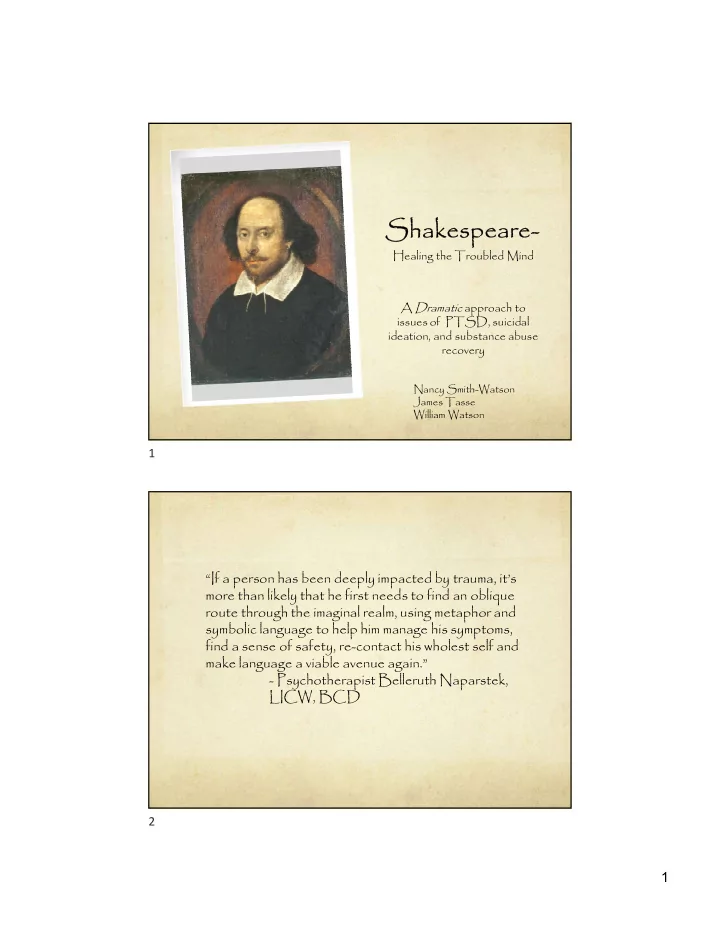
Shakespeare- Healing the Troubled Mind A Dramatic approach to - - PDF document

shakespeare
SMART_READER_LITE
LIVE PREVIEW

Shakespeare- Healing the Troubled Mind A Dramatic approach to - - PDF document

Shakespeare- Healing the Troubled Mind A Dramatic approach to issues of PTSD, suicidal ideation, and substance abuse recovery Nancy Smith-Watson James Tasse William Watson 1 If a person has been deeply impacted by trauma, its more


slide-1
SLIDE 1

1

Shakespeare-

Healing the Troubled Mind A Dramatic approach to issues of PTSD, suicidal ideation, and substance abuse recovery

Nancy Smith-Watson James Tasse William Watson

“If a person has been deeply impacted by trauma, it’s more than likely that he first needs to find an oblique route through the imaginal realm, using metaphor and symbolic language to help him manage his symptoms, find a sense of safety, re-contact his wholest self and make language a viable avenue again.”

  • Psychotherapist Belleruth Naparstek,

LICW, BCD

1 2

slide-2
SLIDE 2

2

The Feast of Crispian

This day is called the Feast of Crispian He that outlives this day and comes safe home Will stand a tiptoe when this day is named. He that shall see this day and live old age Will yearly on the vigil feast his neighbors And say, Tomorrow is Saint Crispian.’ Then will he strip his sleeve and show his scars And say, ‘These wounds I had on Crispin’s day This story shall the good man teach his son And Crispin Crispian shall ne’er go by From this day to the ending of the world But we in it shall be remembered. We few, we happy few, we band of brothers.

  • Henry V Act 4, scene 3

The triune (three part) brain

3 4

slide-3
SLIDE 3

3

Trauma in the brain:

  • Amygdala: perceives threat
  • Prefrontal Cortex is taken offline
  • Stress hormone released
  • Vagus Nerve sends message to the body
  • Cascade of effects: extra oxygen for fight or flight, eyes

widen, digestion stops, etc.

  • PTSD: stress response stuck in the “on” position

Moving from stuck to full brain function:

Top down regulation: Top down regulation relies on strengthening the [prefrontal cortex’s] ability to monitor the bodies sensations. Mindfulness meditation Yoga Bottom up regulation: Bottom up regulation involves recalibrating the autonomic nervous system… through breath, movement, or touch.

  • Dr. Bessel van der Kolk

5 6

slide-4
SLIDE 4

4

Meaningful Language

Communicate the impact of war

Articulate Thoughts and Feelings

Begin the process of expressing one’s own feelings

Be Heard and Seen

Seeing and Being seen Hearing and Being heard

Work Collaboratively with Commitment

Safe Rigorous Keep open the “Window of Tolerance”

Window of Tolerance

7 8

slide-5
SLIDE 5

5

Foster a sense of accomplishment

Having an experience

Utilize the power of story and metaphor

Tools to understand and communicate personal experience

Explore and perform texts

Tools to understand and communicate personal experience

Teach a practice of emotional awareness

Skills in calming traumatic activation More satisfying participation in personal relationships

DRAMA

  • To Communicate Experience
  • To Re-enact Experience
  • To Re-experience Experience

Acting = Real Experience in the service of Fictional Circumstances

9 10

slide-6
SLIDE 6

6

WHY ACTING?

Shielded While Revealed

Safe Space to Experience Feeling Allows contact with and communication of traumatic experience Accesses Obliquely – spirals up bit by bit Masks specifically personal with fictional otherness Is met by praise and applause

Why Shakespeare?

The Properties of the Language 11 12

slide-7
SLIDE 7

7

Spoken

Vibration of Sound

Somatic primarily – Ideational Secondarily

  • Personal Experience – Activation of sensation in the body
  • Connective Experience –

To Self – through vibration in own body To Another – through vibration in other’s body To Both through activation of Physical/Somatic control centers of the brain

Dramatic Text

Modern Text – The way we use language in our lives Function – To Hide the truth of experience

Ideational Action oriented Informational

13 14

slide-8
SLIDE 8

8

Dramatic Text

Pre-Modern Text – Language as a path to knowing Function–To reveal the truth of experience

Lyrical – Verse text Somatic primarily – Ideational Secondarily Big Language – Holds big feeling Imagistic, Metaphoric, Hyperbolic

Metaphor –

The Language of Experience

Language – An incomplete Symbol system

“I Feel so guilty” “O full of scorpions is my mind, dear wife!”

  • Macbeth III.ii

Factual language is not “true” to experience The incompatibility of language and sensation Metaphor is a more authentic and honest expression of experience than Factual language

15 16

slide-9
SLIDE 9

9

  • -S. Lacey, R. Stilla and K. Sathian. Metaphorically Feeling: Comprehending

Textural Metaphors Activates Somatosensory Cortex. Brain & Language. (2012)

Poetic Text - Verse

Meter – Pathway into deeper experience

Rhythmic – Somatic Iambic – stress, unstress pattern Pentameter – five “heartbeats” (metric feet) to the line 1 breath per line = one thought

17 18

slide-10
SLIDE 10

10

The Technique

Collective Experience - “Small Unit Tactics”

Group Work “Walkabout” – Seeing and being seen Vocal explorations – breath and voice Physical Mindfulness – Tai-chi – “Dancing the scene” Partnered, Supported Scene Work Feeding In Dropping In

After Action Reports

“He’s scary, he’s spooky, he knows our stories”

19 20