Sewage Sludge Drying with Microwave Irradiation: Guray Saliholu*, - - PowerPoint PPT Presentation

sewage sludge drying with microwave irradiation
SMART_READER_LITE
LIVE PREVIEW

Sewage Sludge Drying with Microwave Irradiation: Guray Saliholu*, - - PowerPoint PPT Presentation

1 Sewage Sludge Drying with Microwave Irradiation: Guray Saliholu*, Sibel Yenikaya, N. Kamil Saliholu, Gokhan Yenikaya *D epartment of Environmental Engineering, University of Uludag, Bursa, 16059, Turkey Department of Electrical-Electronic


slide-1
SLIDE 1

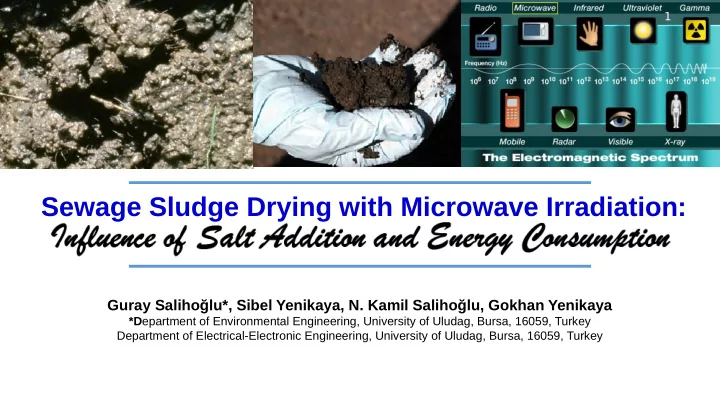
Sewage Sludge Drying with Microwave Irradiation:

Guray Salihoğlu*, Sibel Yenikaya, N. Kamil Salihoğlu, Gokhan Yenikaya

*Department of Environmental Engineering, University of Uludag, Bursa, 16059, Turkey Department of Electrical-Electronic Engineering, University of Uludag, Bursa, 16059, Turkey

1

slide-2
SLIDE 2

2

01 03 02 04

  • Sludge

Dewatering & Drying

Introduction Materials & Methods

  • Impact of the Factors on

Drying

Results & Discussion Conclusions

Content

  • Microwave Modeling
slide-3
SLIDE 3

3

Sludge Management

Additional fuel ?

Sludge Management Mechanica l Dewaterin g

  • Large amounts

and high moisture content

  • WWTP Exit: 1-

4% DS

Cement plant co- incineration

  • Cement plants use

dried sewage sludge as a substitute for fossil fuel

  • Co-incineration in

cement plants is possible

Drying

  • Increased calorifjc

value

  • Easy handling
  • Reduced volume

Microwave Drying

  • Can be a preferred

step in sludge management

  • Heats the material

rapidly

  • Instant on/ofg control
  • Increase the calorifjc

value

  • 20-35 % DS
slide-4
SLIDE 4
  • T
  • investigate the effjciency of

microwave technology as a sludge drying method

Objectives

  • T
  • compare the energy

consumption with that of electrical heating

  • T
  • investigate the infmuence of the

addition of ionic species such as salt to the drying performance

4

slide-5
SLIDE 5

Materials & Methods

Mechanically dewatered sludge

  • Characterization

experiments: Composition, dielectric constants

  • Salt addition : 5%

Microwave Drying

  • 2.45 GHz : Resonance

frequency of water molecules

  • Fixed & Rotary modes
  • Power: 900 W
  • Time intervals: 1-10

minutes

  • Air cure : 10 minutes

Monitoring

  • Moisture contents,
  • Evaporation rates,
  • Drying

performances

  • Hot and cold

regions

  • Energy

consumption

  • Thermal camera

images Electrical drying to compare the energy consumption levels

5

slide-6
SLIDE 6

Results & Discussion

7TH INTERNATIONAL CONFERENCE ON SUSTAINABLE SOLID WASTE MANAGEMENT, 26-29 June 2019, Heraklion, Crete Island, Greece

arison of moisture losses in fjxed and rotary operation modes

fjxed mode

> rotary

mode Fixed mode provided concentrated heating and more evaporation

slide-7
SLIDE 7

Results & Discussion

7TH INTERNATIONAL CONFERENCE ON SUSTAINABLE SOLID WASTE MANAGEMENT, 26-29 June 2019, Heraklion, Crete Island, Greece

arison of moisture losses in sludge with salt and without salt

Salt addition resulted in a lower level

  • f moisture

loss without salt

> with

slide-8
SLIDE 8

Results & Discussion

7TH INTERNATIONAL CONFERENCE ON SUSTAINABLE SOLID WASTE MANAGEMENT, 26-29 June 2019, Heraklion, Crete Island, Greece

arison of temperatures in sludge with salt and without salt Higher temperatur e levels with salt with salt : 75.62±4.51

  • C

without salt: 65.19 ±4.06oC Low evaporation?

slide-9
SLIDE 9

Results & Discussion

7TH INTERNATIONAL CONFERENCE ON SUSTAINABLE SOLID WASTE MANAGEMENT,26-29 June 2019, Heraklion, Crete Island, Greece

Low evaporation with salt added sludge although temperature levels are high?

ε’ ε’’

ε’’/ε’

(×10-3)

Sludge without salt

76.22 10.18 0.134

Sludge with salt

58.18 18.90 0.325

Dielectric constant (Relative permittivity): The ability to store the energy Relative dielectric loss factor: Conversion ability of the energy into heat Loss Tangent High loss tangent is an indication of the use of microwave power transferred into heat

Dielectric characteristics of the sludge studied

Measured by Network analyzer (Agilent, E506 1B)

Salt addition to the sludge decreased the dielectric constant and increased the dielectric loss factor , thus increased the dissipation

Salt addition might have changed the molecular structure of the sludge limiting the evaporation. Salt might have associated with sludge water, thereby might have decreased the free water and converted it into bound water (capillary or particle).

slide-10
SLIDE 10

10

Electric fjeld distribution

Maximum intensity

when the oven is empty when the sewage sludge sample was ins

tric fjeld is stronger near the walls of the oven

  • The distribution is symmetrical relative

to the XZ plane

  • When the sample was placed,

electromagnetic waves were refmected from the oven walls and the sample surface.

  • Therefore the electric fjeld was dense on

the corner points of the tray

7TH INTERNATIONAL CONFERENCE ON SUSTAINABLE SOLID WASTE MANAGEMENT,26-29 June 2019, Heraklion, Crete Island, Greece

slide-11
SLIDE 11

11

Energy Consumption: Electrical ∼Microwave

Less time and less energy with microwave 30% moisture loss duration Microwave : 10 min. Electrical: 30 min. 30% moisture loss energy consumption Microwave : 0.231 kW Electrical: 0.444 kW

slide-12
SLIDE 12

12

Conclusions

7TH INTERNATIONAL CONFERENCE ON SUSTAINABLE SOLID WASTE MANAGEMENT,26-29 June 2019, Heraklion, Crete Island, Greece

Moisture loss Fixed mode > rotary mode

Concentrated heating in the fixed mode

Salt addition

  • Decreased the moisture loss
  • Decreased the dielectric constant
  • Increased uniform heat distribution

Evaporation continued during air cure after drying. Electric field was dense on the corner points of the tray, more evaporation Electrical drying consumed more energy for a certain moisture loss targeted in sludge. Less Time and Less Energy with Microwave

slide-13
SLIDE 13

13

7TH INTERNATIONAL CONFERENCE ON SUSTAINABLE SOLID WASTE MANAGEMENT,26-29 June 2019, Heraklion, Crete Island, Greece

slide-14
SLIDE 14

14

7TH INTERNATIONAL CONFERENCE ON SUSTAINABLE SOLID WASTE MANAGEMENT,26-29 June 2019, Heraklion, Crete Island, Greece

References

  • 1. Yu, Q., Lei, H.Y

., Yu, G.W., Feng, X., Li, Z.X., Wu, Z.C.: Infmuence of microwave irradiation

  • n sludge dewaterability. Chem Eng J 155(1-2), 88-93 (2009).

doi:10.1016/j.cej.2009.07.010

  • 2. Gil, A., Siles, J.A., Martin, M.A., Chica, A.F

., Estevez-Pastor, F .S., T

  • ro-Baptista, E.: Efgect
  • f microwave pretreatment on semi-continuous anaerobic digestion of sewage sludge.

Renewable Energy 115, 917-925 (2018). doi:10.1016/j.renene.2017.07.112

  • 3. Kumar, S., Kumar, R., Mehrotra, S.P

.: Infmuence of granulated blast furnace slag on the reaction, structure and properties of fmy ash based geopolymer. J Mater Sci 45(3), 607-615 (2010). doi:10.1007/s10853-009-3934-5

  • 4. Mawioo, P

.M., Garcia, H.A., Hooijmans, C.M., Velkushanova, K., Simonic, M., Mijatovic, I., Brdjanovic, D.: A pilot-scale microwave technology for sludge sanitization and drying. Science of the T

  • tal Environment 601-602, 1437-1448 (2017).
  • 5. Domínguez, A., Menéndez, J.A., Inguanzo, M., Pis, J.J.: Sewage sludge drying using

microwave energy and characterization by IRTF . Afjnidad 61(512), 280-285 (2004).

  • 6. Bennamoun, L., Chen, Z., Afzal, M.T.: Microwave drying of wastewater sludge:

Experimental and modeling study. Drying T echnology 34(2), 235-243 (2016).

  • 7. Jinping, L., Jinhua, G., Jieqiong, J., Ni, W.: Study on New Thermal Drying Methods for

Sewage Sludge Using Microwave and its Mechanism. Aer Adv Eng Res 30, 1103-1108 (2015).

  • 8. T

yagi, V.K., Lo, S.L.: Microwave irradiation: A sustainable way for sludge treatment and resource recovery. Renew Sust Energ Rev 18, 288-305 (2013).