
SLIDE 1
13/06/2014 1
Oxfordshire Maths Conference 12th June 2014
Dr Rachel Marks r.g.marks@brighton.ac.uk
Session Objectives
- To critically unpick some of the classic
implications of ability-grouping
- To develop awareness of some unintended
impacts of grouping, both pedagogic and affective
- To consider ways forward within the context
- f current practice
The Research Study
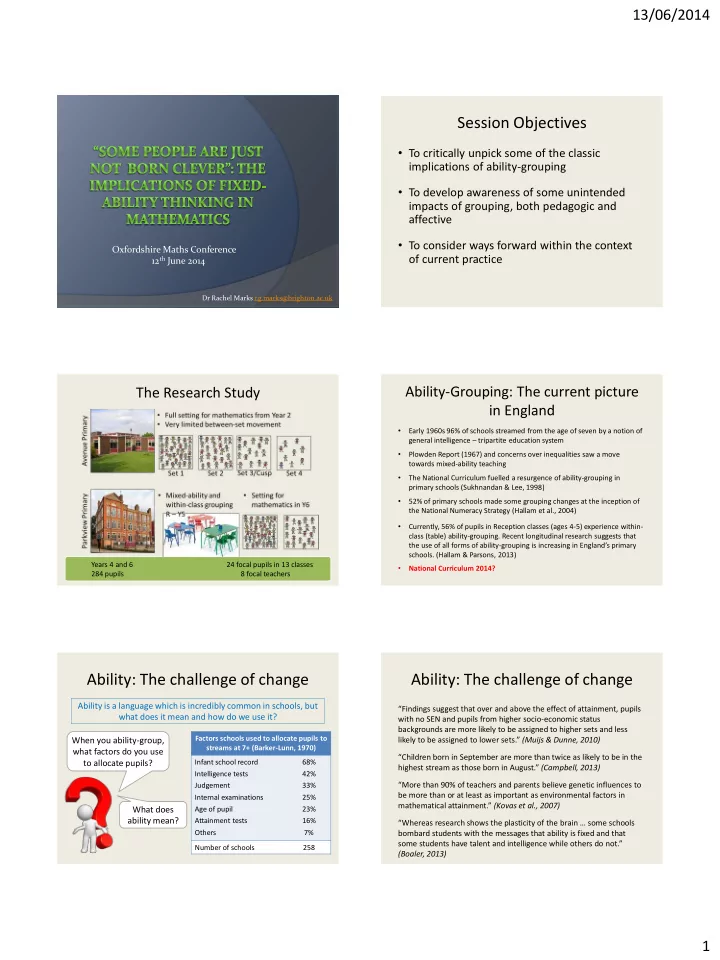
Years 4 and 6 24 focal pupils in 13 classes 284 pupils 8 focal teachers
Ability-Grouping: The current picture in England
- Early 1960s 96% of schools streamed from the age of seven by a notion of
general intelligence – tripartite education system
- Plowden Report (1967) and concerns over inequalities saw a move
towards mixed-ability teaching
- The National Curriculum fuelled a resurgence of ability-grouping in
primary schools (Sukhnandan & Lee, 1998)
- 52% of primary schools made some grouping changes at the inception of
the National Numeracy Strategy (Hallam et al., 2004)
- Currently, 56% of pupils in Reception classes (ages 4-5) experience within-
class (table) ability-grouping. Recent longitudinal research suggests that the use of all forms of ability-grouping is increasing in England’s primary
- schools. (Hallam & Parsons, 2013)
- National Curriculum 2014?
Ability: The challenge of change
Ability is a language which is incredibly common in schools, but what does it mean and how do we use it? What does ability mean? When you ability-group, what factors do you use to allocate pupils?
Factors schools used to allocate pupils to streams at 7+ (Barker-Lunn, 1970) Infant school record Intelligence tests Judgement Internal examinations Age of pupil Attainment tests Others 68% 42% 33% 25% 23% 16% 7% Number of schools 258