Session #5.3 Public Right-of-Way Difficult Aint Infeasible - - PDF document

session 5 3
SMART_READER_LITE
LIVE PREVIEW

Session #5.3 Public Right-of-Way Difficult Aint Infeasible - - PDF document

8/22/2015 Session #5.3 Public Right-of-Way Difficult Aint Infeasible Mid-Atlantic ADA Center Leadership Network Joe Ellis DelDOT ADA Construction Compliance Manager Linda Osiecki , M.E., P.E. DelDOT ADA Compliance Design Review Who


slide-1
SLIDE 1

8/22/2015 1

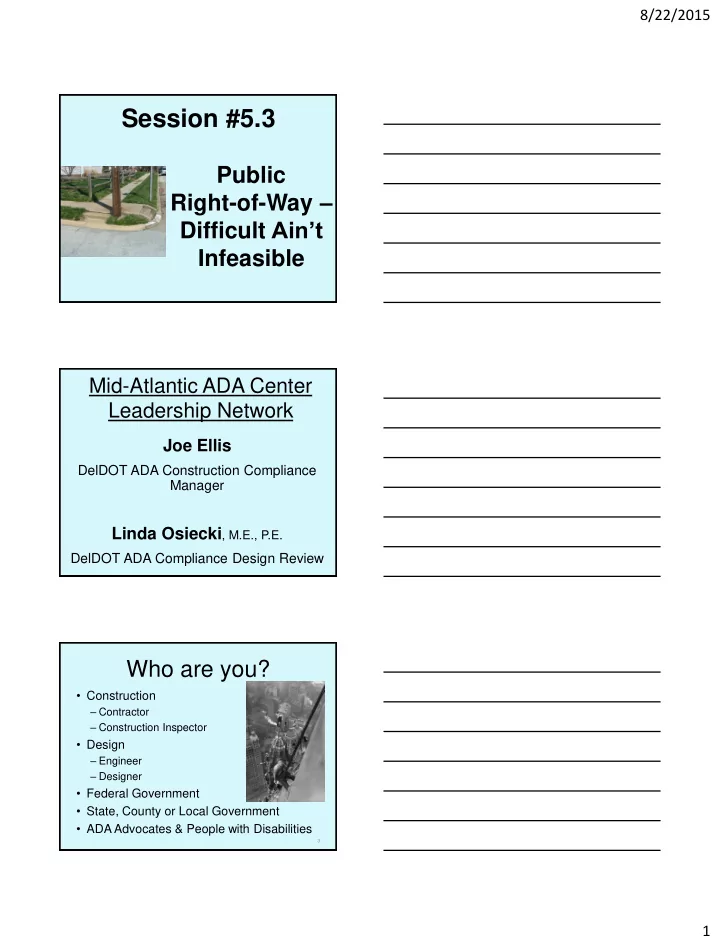
Session #5.3

Public Right-of-Way – Difficult Ain’t Infeasible

Mid-Atlantic ADA Center Leadership Network

Joe Ellis

DelDOT ADA Construction Compliance Manager

Linda Osiecki, M.E., P.E.

DelDOT ADA Compliance Design Review

Who are you?

  • Construction

– Contractor – Construction Inspector

  • Design

– Engineer – Designer

  • Federal Government
  • State, County or Local Government
  • ADA Advocates & People with Disabilities

3

slide-2
SLIDE 2

8/22/2015 2

Why do people with disabilities use pedestrian facilities in the public right-of-way?

  • Work
  • School
  • Shopping/Eating
  • ut
  • Medical Appt.
  • Transit (bus,

train, etc.)

  • Recreation
  • The same

reasons everyone else does

4

ADA Compliance is important

Curb Ramps

5

Sidewalks

ADA Compliance is important

6

slide-3
SLIDE 3

8/22/2015 3

Driveways

ADA Compliance is important

7

Bus Stops

ADA Compliance is important

8

Safety

Other Considerations

9

slide-4
SLIDE 4

8/22/2015 4

Other Users

Other Considerations

10

Drainage

Other Considerations

11

Acronyms

  • ADA = Americans with Disabilities Act
  • ADAAG = Americans with Disabilities Act

Accessibility Guidelines –1991, 2002, 2004/2010

  • PAR = Pedestrian Access Route
  • MUTCD = Manual of Uniform Traffic Control

Devices

12

slide-5
SLIDE 5

8/22/2015 5

Acronyms

  • ROW = Right-of-Way
  • PROW = Public Right-of-Way
  • PROWAG = Public Right-of-Way Accessibility

Guidelines – 2005, 2011 – FHWA 2006 memo:

  • “recommended best practices”
  • “the state of the practice”
  • “consistent with the ADA’s requirement that all new

facilities (and altered facilities to the maximum extent feasible) be designed and constructed to be accessible to and useable by people with disabilities”

13 14 15

slide-6
SLIDE 6

8/22/2015 6

Directions

Throughout this presentation, assume for aerial views and maps that north is up.

16

2 5

Basic Elements for PROW Pedestrian Facilities +

2  Layout

1.Landings 2.Crossings

slide-7
SLIDE 7

8/22/2015 7

  • 2% x 2% max. in both directions
  • 5’ x 5’

19

intersection of one or more pedestrian paths where people may turn

20

where people need to stop and wait before crossing

21

slide-8
SLIDE 8

8/22/2015 8

At bottom of stairs

22

adjacent to pedestrian pushbutton

23

2” < 10” OK

24

slide-9
SLIDE 9

8/22/2015 9

30”>10” NG

25

Sometimes, bigger is not better!!

26

Landing Not Defined By Joints

  • Without clearly defined joints,

concrete finishing can result in surfaces that are: –Non-planar –Exceed 2% because blended with adjacent ramp

27

slide-10
SLIDE 10

8/22/2015 10

Clearly defined joints

28

Crossing the road is a potential area of conflict between vehicles and pedestrians

Rutland, MA – July of 2015

29

Avoid skewed crossings

30

slide-11
SLIDE 11

8/22/2015 11

  • Increased length of

crossing

  • Resulting increased

time needed for pedestrian phase

  • Makes orientation

difficult to impossible for people with vision impairments

31

Be mindful

  • f

pedestrian destinations

32

Crossings: Be mindful of pedestrian destinations

33

slide-12
SLIDE 12

8/22/2015 12

Be mindful

  • f

pedestrian destinations

Seaside Park, N.J.

Ocean Bay 25 mph max. except along bay

34 35 36

slide-13
SLIDE 13

8/22/2015 13

37

X

38

Do not unnecessarily increase the number of times a person has to cross the street

39

slide-14
SLIDE 14

8/22/2015 14

Basic Layout

Landing(s) + Crossing(s)

41

Pedestrian Access Route

1.Width 2.Cross Slope 3.Running Slope 4.Vertical Differences 5.Horizontal Openings

slide-15
SLIDE 15

8/22/2015 15

Resource

  • Old Access

Board Accessible Rights of Way Guide

43 44 45

slide-16
SLIDE 16

8/22/2015 16

46

Think about barriers in the PAR.

47

Width Width

48

slide-17
SLIDE 17

8/22/2015 17

49

Width

50

Resource

  • Anthropometry
  • f Wheeled

Mobility Project

–2010 for the Access Board

51

slide-18
SLIDE 18

8/22/2015 18

Unoccupied Mobility Devices

  • Up to 38.1”

52

Clear Floor Width (Occupied Mobility Devices)

  • Up to 39.7”

53

Comparison of Widths

ADAAG Pinch Point ADAAG Min. Width PROWAG Min. Width PROWAG Preferred Width 32” 36” 48”

60”

54

slide-19
SLIDE 19

8/22/2015 19

Cross Slope Cross Slope

55 56

Cross slope

57

slide-20
SLIDE 20

8/22/2015 20

Running Slope

58

Vertical Differences

59

Horizontal Openings

60

slide-21
SLIDE 21

8/22/2015 21

61

Basic Construction Project Process

  • Site visits during

scoping & design

  • Questions during

scoping & design

  • Plan Reviews
  • Questions before

and during construction

  • ADA Inspection

after completion

62

Inspection by Construction Personnel

  • Proactive v. Passive/Reactive

–Review layout with contractor –Check Forms –Ask questions before pouring/installation

63

slide-22
SLIDE 22

8/22/2015 22

Be sure before you pour.

64

ADA Inspection

  • Curb ramps
  • Sidewalks
  • Driveways
  • Bus Stops
  • Pedestrian Signals
  • Crossings

65

Barriers to Compliance

  • Lack of enforcement
  • Lack of awareness and education of the

disabled community

  • Lack of public involvement

– Requests – Complaints – Contacting legislators and other public

  • fficials

66

slide-23
SLIDE 23

8/22/2015 23

Barriers to Compliance

  • Lack of design and coordination before

construction

  • Decision-making without knowledge and

training by administrators, designers and construction personnel

  • Institutional Inertia – “The way we’ve

always done it”

  • Maintenance (or lack thereof)

67

Growing Awareness

68

Questions?

69

slide-24
SLIDE 24

8/22/2015 24

2004 ADAAG 202.3 Alterations. Where existing elements or spaces are altered, each altered element or space shall comply with the applicable requirements of Chapter 2.

EXCEPTIONS: ….

  • 2. In alterations, where compliance with

applicable requirements is technically

infeasible, the alteration shall comply with the

requirements to the maximum extent

feasible.

70

DOJ 2010 ADA Standards for Accessible Design

(c) To the maximum extent feasible. The phrase "to the maximum extent feasible," as used in this section, applies to the occasional case where the nature of an existing facility makes it virtually impossible to comply fully with applicable accessibility standards through a planned

  • alteration. In these circumstances, the alteration shall

provide the maximum physical accessibility feasible. Any altered features of the facility that can be made accessible shall be made accessible. If providing accessibility in conformance with this section to individuals with certain disabilities (e.g., those who use wheelchairs) would not be feasible, the facility shall be made accessible to persons with

  • ther types of disabilities (e.g., those who use crutches,

those who have impaired vision or hearing, or those who have other impairments).

71

DOJ 2010 ADA Standards for Accessible Design

…[if] the nature of an existing facility makes it virtually impossible to comply fully with applicable accessibility standards through a planned alteration. …provide the maximum physical accessibility feasible.

72
slide-25
SLIDE 25

8/22/2015 25

DOJ 2010 ADA Standards for Accessible Design

Any altered features

  • f the facility that can

be made accessible shall be made accessible.

73

DOJ 2010 ADA Standards for Accessible Design

If providing accessibility in conformance with this section to individuals with certain disabilities (e.g., those who use wheelchairs) would not be feasible, the facility shall be made accessible to persons with other types of

disabilities (e.g., those who use crutches,

those who have impaired vision or hearing, or those who have other impairments).

74

DOJ 2010 ADA Standards for Accessible Design [The proposed work is] Technically Infeasible …[if] existing physical … constraints prohibit modification … [to] full and strict compliance

75

slide-26
SLIDE 26

8/22/2015 26

PROWAG R202.3 Alterations. Where existing elements,

spaces, or facilities are altered, each altered element, space, or facility within the scope of the project shall comply

with the applicable requirements for new construction.

76

PROWAG R202.3.1 Existing Physical Constraints.

Where existing physical constraints make it impracticable … to fully comply with the requirements for new construction, compliance is required to the extent practicable …

77

Technically Infeasible

For alterations Comply with the requirements for new construction…

to the maximum extent feasible.

78

slide-27
SLIDE 27

8/22/2015 27

PROW Barriers

79

General Curb Ramp Layout

80

Public Right-of-Way – Difficult Ain’t Infeasible

81

slide-28
SLIDE 28

8/22/2015 28

Structures

82 83 84

slide-29
SLIDE 29

8/22/2015 29

85 86 87

slide-30
SLIDE 30

8/22/2015 30

88

Stairs

89 90

slide-31
SLIDE 31

8/22/2015 31

91

Cross Slope

92 93

slide-32
SLIDE 32

8/22/2015 32

94 95

Equipment & Utilities

96

slide-33
SLIDE 33

8/22/2015 33

97 98 99

slide-34
SLIDE 34

8/22/2015 34

100 101 102

slide-35
SLIDE 35

8/22/2015 35

Drainage & Steep Grades

103 104 105

slide-36
SLIDE 36

8/22/2015 36

106

8%

107 108

slide-37
SLIDE 37

8/22/2015 37

109

Driveway

110 111

slide-38
SLIDE 38

8/22/2015 38

112 113 114

slide-39
SLIDE 39

8/22/2015 39

  • Sidewalk Cross Slope: 6%>>2%
  • Apron: 28% >> 10%

OUCH!!!! OUCH!!!!

115 116 117

slide-40
SLIDE 40

8/22/2015 40

118 119 120

slide-41
SLIDE 41

8/22/2015 41

121 122 123

slide-42
SLIDE 42

8/22/2015 42

Shared Use Path

124 125 126

slide-43
SLIDE 43

8/22/2015 43

Curb Ramps

127 128 129

slide-44
SLIDE 44

8/22/2015 44

130 131

Difficult Ain’t Infeasible

132

slide-45
SLIDE 45

8/22/2015 45

Please share with us your

  • wn example locations and

how you tackled the challenges.

133

Joe Ellis Office 302-760-2184 Cell 302-382-0424 Joseph.Ellis@state.de.us Linda Osiecki Office 302-760-2342 Cell 302-388-0757 Linda.Osiecki@state.de.us

Questions? Thank you.

135