SENSORY EVALUATION OF WINE QUALITY 11 th International Scientific - - PowerPoint PPT Presentation

sensory evaluation of wine quality
SMART_READER_LITE
LIVE PREVIEW

SENSORY EVALUATION OF WINE QUALITY 11 th International Scientific - - PowerPoint PPT Presentation

TERRACOTTA VESSELS AND THE RESPECT TO THE OLD AND TRADITIONAL WINE MAKING SENSORY EVALUATION OF WINE QUALITY 11 th International Scientific Conference Biotechnology and Quality of Raw Materials and Foodstuffs ngel A. Carbonell-Barrachina,


slide-1
SLIDE 1

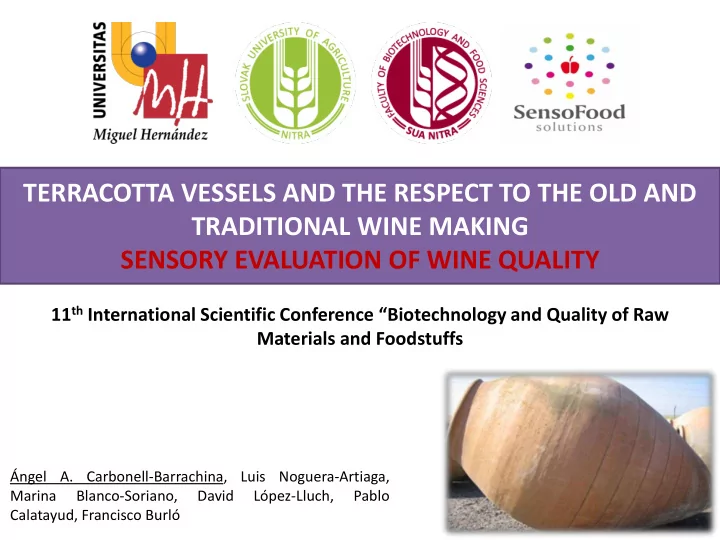
TERRACOTTA VESSELS AND THE RESPECT TO THE OLD AND TRADITIONAL WINE MAKING SENSORY EVALUATION OF WINE QUALITY

11th International Scientific Conference “Biotechnology and Quality of Raw Materials and Foodstuffs

Ángel A. Carbonell-Barrachina, Luis Noguera-Artiaga, Marina Blanco-Soriano, David López-Lluch, Pablo Calatayud, Francisco Burló

slide-2
SLIDE 2

UNIVERSIDAD MIGUEL HERNÁNDEZ DE ELCHE ORIHUELA, ALICANTE (SPAIN)

slide-3
SLIDE 3

INNOFOOD I+D+I

PRIVATE COMPANIES

slide-4
SLIDE 4

PRIVATE COMPANIES

slide-5
SLIDE 5

QUALITY

  • Effects of units operation & farming

practices

  • n

quality (functionality, consumer, …) of fruits & vegetables:

  • 1. Pomegranate juice.
  • 2. Nuts: pistachio, almond.
  • 3. Olive, olive oil.
  • 4. Turrón/nougat/torrone.
  • Application of sensory evaluation of

food in the agro-food industry:

  • 1. Wine and rum.
  • 2. Chocolate, and confections.
  • 3. Ice-cream.
  • 4. Vegetables & fruits (juices).

SAFETY

Occurrence

  • f

chemical pollutants (arsenic) in foods:

  • 1. Vegetables from polluted areas

(India).

  • 2. Infant foods.
  • 3. Food for celiac consumers.

FOOD QUALITY AND SAFETY, CSA

slide-6
SLIDE 6

FOOD QUALITY AND SAFETY, CSA

ARSENIC in rice products PANEL TRAINING WINE quality

slide-7
SLIDE 7
  • 1. Sensory evaluation of wine

INDEX

Introduction Objectives Materials & Methods Results & Discussion Conclusions

  • 2. Clay amphorae wine
slide-8
SLIDE 8

TERRACOTTA VESSELS AND THE RESPECT TO THE OLD AND TRADITIONAL WINE MAKING SENSORY EVALUATION OF WINE QUALITY

11th International Scientific Conference “Biotechnology and Quality of Raw Materials and Foodstuffs

Ángel A. Carbonell-Barrachina, Luis Noguera-Artiaga, Marina Blanco-Soriano, David López-Lluch, Pablo Calatayud, Francisco Burló

slide-9
SLIDE 9

9/47

http://www.bocopa.com

TRAINI NING NG OF SENS NSOR ORY Y PANEL ELS

slide-10
SLIDE 10

http://www.vinosalicantedop.org/

ISO 17065 65

DOP ALICANTE

TRAINED NED PANEL NELS: S: PDO WINES S OF ALICAN CANTE TE

slide-11
SLIDE 11

Phases Order

R&D M&M Intro

Fondillón Lexicon Panels

slide-12
SLIDE 12

Lexicon

Avoid poetry: body??? Definition and … Provide reference materials for each attribute. Scale used from 0 to 10 (not 15)

slide-13
SLIDE 13

Lexicon

Sourness: Basic tasted associated to water or hydro-alcoholic solutions of tartaricacid. Reference:  0,05 % Tartaric acid solution = 2.5  0,08 % Tartaric acid solution = 4,0  0,20 % Tartaric acid solution = 10,0

Bibliography: Spectrum (Meilgaard et al., 2007) and Pickering y Demiglio 2008)

Rose: Floral aroma commonly associated to roses. Reference: Geraniol

  • 10 µg/L= 6

Odor Threshold (detection)= 4-75 µg/L (Burdock, 2010) Range in wine= 1-221 µg/L Imbalance: Attribute or attributes predominating over the rest, breaking the balance of the wine. Reference:

  • None = 0
  • Sourness: 2 g tartaric acid/L = 6
  • Astringency: 4.0 g commercial tannin/L = 6
  • Bitterness: 0.03 g quinine sulfate/L = 6
  • Alcohol: 60 mL ethanol/L = 6

Bibliography: Etaio et al. (2010).

slide-14
SLIDE 14

Color

R&D M&M Intro

Fondillón Lexicon Panels

slide-15
SLIDE 15

Volatile Compounds

slide-16
SLIDE 16

5.0 10.0 15.0 20.0 25.0 30.0 35.0 40.0 0.00 0.25 0.50 0.75 1.00 1.25 (x10,000,000)

Volatile Compounds

slide-17
SLIDE 17

Wine Aroma

Le Nez du Vin, Jean Lenoir Low cost, low difficulty references

slide-18
SLIDE 18

Classification

slide-19
SLIDE 19

http://www.vinosalicantedop.org/

FONDI DILL LLÓN

DOP ALICANTE

R&D M&M Intro

Fondillón Lexicon Panels

slide-20
SLIDE 20

http://www.vinosalicantedop.org/

FONDI DILLÓN LLÓN

At least, 10 years of ageing. One of the oldest wines in the world. The Count of Monte Cristo used to drink Alicante wine, fondillón.

FONDI DILL LLÓN

slide-21
SLIDE 21

Fase

  • lfativa

Fase visual y global Fase gustativa

FONDI DILL LLÓN

Sensory profile Volatile composition

slide-22
SLIDE 22

TERRACOTTA VESSELS AND THE RESPECT TO THE OLD AND TRADITIONAL WINE MAKING SENSORY EVALUATION OF WINE QUALITY

11th International Scientific Conference “Biotechnology and Quality of Raw Materials and Foodstuffs

Ángel A. Carbonell-Barrachina, Luis Noguera-Artiaga, Marina Blanco-Soriano, David López-Lluch, Pablo Calatayud, Francisco Burló

slide-23
SLIDE 23

INTRODUCTION

TRENDS for Spanish wine

Spain needs to produce less volume of wine, especially of bulk wine, but of HIGHER QUALITY. Wines with their own personality are needed. This could be the case of the wines elaborated and/or aged in CLAY JARS. An example of this type of wines is the Georgian Kvevris.

slide-24
SLIDE 24

INTRODUCTION

The success of the Georgian Kvevris wine is due to:

  • Respect to the tradition & culture:
  • This wine is done by burying clay vessels since 4000 BC.
  • Use of local grape varieties.

These wines express:

  • The sensory attributes of the local grapes without any extra

artefact.

slide-25
SLIDE 25

INTRODUCTION

Besides, this is nothing new in Spain. Castilla-La Mancha region has a long tradition of using these clay containers. So, why not to explore this type of wine and see how they behave… but let’s make a real scientific approach to the topic.

slide-26
SLIDE 26
  • 1. INTRODUCTION
slide-27
SLIDE 27

INTRODUCTION

In ancient times, various types and forms of amphorae (or jars) were used for storage of foods: wine, olive oil, table olives, etc. In the Mediterranean sea, many amphorae have been found in ancient shipwrecks. In amphorae excavated archaeological sites have been identified containing fish, grape seeds, cereal grains, and resins.

History

R&D M&M Intro

Fondillón Lexicon Panels

slide-28
SLIDE 28

INTRODUCTION

Vessel type & wine storage & ageing Why not? What do you think?

slide-29
SLIDE 29

INTRODUCTION

CLAY VESSELS & wine ageing Wine ageing can be considered as a series of complex chemical reactions affecting the chemical composition of wine.

  • Inert
  • Color
  • Structure
  • Phenolics
  • Aroma
  • Store
  • Transport
  • Serve

Ageing technic: clay vessels (amphorae) Objective: reproduce the oxygen exchange happening in

  • ak barrels but without the transfer of vanillin, tannins,

and toasted notes. Wines: different, with a clearer and more pronounced mineral and fresh characteristics There is no scientific literature studying the effects of this type of wine ageing and comparing it with the traditional

  • r current processes
slide-30
SLIDE 30

INTRODUCTION

Winery Celler del Roure

dragonfly tadpole

slide-31
SLIDE 31

INTRODUCTION

This winery reopened “the deep winery (bodega fonda)”, which is a typical structure of this geographic area “terres dels Alforins”, where the clay vessels are buried in the ground and located in caves.

Celler del Roure

slide-32
SLIDE 32
  • 2. OBJECTIVES
slide-33
SLIDE 33

OBJECTIVES

The aim of this work is to evaluate the potential use of two different types of containers (oak barrels & underground clay vessels) for the aging of wine. To achieve this aim, the following parameters are being controlled: pH. Acidity:

  • Total.
  • Volatile.

Free and total sulfur dioxide. Reducing sugars. Volatile profile. Minerals. Antioxidant activity. Total polyphenols. Hydroxycinnamic acids. Flavonols. Tannins. Sensory evaluation. Consumer studies.

I PHYSICO-CHEMICAL II FUNCTIONAL III SENSORY

slide-34
SLIDE 34
  • 3. MATERIALS & METHODS
slide-35
SLIDE 35

Wine comparison

Parotet (terracotta wine) Control

  • Same wine but stored in oak

barrels MATERIALS & METHODS

R&D M&M Intro

Fondillón Lexicon Panels

slide-36
SLIDE 36

MATERIALS & METHODS

Wine Winery Sampling Garnacha tintorera Ageing Celler del Roure

OAK BARRELS: 31 October 2014 CLAY VESSELS: 31 October 2014 PRODUCT LAUNCH: January 2016

  • 27 July, 2015 (M1): 9 months.
  • 10 August, 2015 (M2).
  • 7 September, 2015 (M3)
  • 21 September, 2015 (M4)
  • 5 October, 2015 (M5).
  • 31 January, 2016 (M6): 15 months.

STILL NOT FINISHED ONGOING …

slide-37
SLIDE 37

Physico-chemical analyses

Volatile compounds

GC Shimadzu GC-17A, GC-MS QP-5050

MATERIALS & METHODS

SPME

Will the volatile profile of clay wines be too simple as compared to that of oak wines?

slide-38
SLIDE 38

Acid digestion using concentrated HNO3

Atomic absorption-emission spectrometry, Unicam Solaar 969

Ca Mg Cu Fe Mn Zn K Na Emission Absorption

MATERIALS & METHODS

Physico-chemical analyses

Minerals Will contact with clay increase the contents of minerals in the wine?

slide-39
SLIDE 39

Functional Analyses Antioxidant capacity

DPPH ●

ABTS+

FRAP

DIRECT METHODS INDIRECT METHOD

MATERIALS & METHODS

Will aeration (contact with O2) in clay vessels decrease the AA of the wine?

slide-40
SLIDE 40

Affective sensory analysis Triangle test, consumers (30, M5) The judges received a set of 3 samples and were informed that 2 of the samples were the same and 1 was different.

MATERIALS & METHODS

slide-41
SLIDE 41

Descriptive analysis Sensory profile, trained panelists (7, M5)

MATERIALS & METHODS

slide-42
SLIDE 42
  • 4. RESULTS & DISCUSSION
slide-43
SLIDE 43

RESULTS & DISCUSSION

Physico-chemical Analyses

PHYSICO-CHEMICAL ANALYSES pH Total acidity Volatile acidity Free SO2 Total SO2 Reducing sugars ANOVA TEST+ Container NS NS NS NS NS NS Time NS NS NS * * NS TUKEY TESTǂ CONTAINER Clay jars 3,57 5,35 0,56 14,1 43,2 3,15 Oak barrel 3,54 5,35 0,61 14,5 45,7 3,40 TIME M1 3,55 5,35 0,60 15,2 a 39,2 b 3,25 M5 3,56 5,35 0,62 13,1 b 48,3 a 3,40

† NS, not significant Fratio (p≤0,05). * difference significant at p≤0,05. ǂ Values followed by the same letter, within the same factor, were not statistically different (p≤0,05).
pH, total acidity (g tartaric acid/L), volatile acidity (g acetic acid/L), free SO2 (mg/L), total SO2 (mg/L) and reducing sugars (g/L)

slide-44
SLIDE 44

VOLATILE COMPOSITION (µg/L) CONTAINER TIME ANOVA+ Barrel Jar ANOVA+ M1 M2 M3 M4 M5 (µg/L) (µg/L) Acetato de etilo NS 255 294 NS 253 360 222 248 290 Etanol NS 4737 5137 NS 6822 4288 2478 4393 6707 Etil butirato NS 4,6 6,2 NS 5,0 7,0 4,5 4,5 6,0 Etil 2 metilbutirato NS 2,4 2,2 NS 2,0 2,5 2,0 1,5 3,5 Etil isovalerato NS 2,6 3,0 NS 3,0 3,5 2,5 2,0 3,0 Ácido propiónico NS 6,6 10,4 NS 7,0 10,0 6,5 9,0 10,0 Isoamyl acetate * 33,6 bǂ 54,4 a NS 35,5 63,0 40,5 35,5 45,5 Alcohol isoamílico NS 622 764 NS 746 810 499 607 804 Etil n-caproato NS 76,0 98,0 NS 82,0 115,0 79,0 64,0 95,0 Hexyl acetate * 1,0 b 2,2 a NS 1,5 2,5 1,5 1,0 1,5 Etil heptanoato NS 1,8 2,0 NS 2,0 2,0 2,0 1,5 2,0 1-octen-3-ol NS 1,4 4,8 NS 5,5 2,5 2,0 3,0 5,0 Etil lactato NS 41,2 46,8 NS 64,0 35,0 21,0 39,5 64,0 1-Hexanol NS 11,8 15,4 NS 13,5 17,5 10,5 11,5 15,0 Octil acetato NS 0,3 0,6 NS 1,5 0,1 0,3 0,1 0,4 Metil octanoato NS 22,8 23,7 NS 1,1 2,0 1,8 1,1 2,6 Etil caprilato NS 625 685 NS 735 657 636 501 749 Ácido acético NS 63,9 57,4 NS 68,6 58,5 34,1 54,6 87,6 Decilaldehído NS 2,5 5,6 NS 6,6 2,5 4,9 2,7 3,5 Indefinido NS 11,8 11,0 NS 17,5 9,2 11,3 9,4 9,9 n-Octanol NS 3,4 4,8 NS 3,8 4,9 3,6 3,6 4,6 Etil decanoato NS 310 313 NS 347 269 316 233 392 Nonanol NS 5,9 5,0 NS 7,4 4,2 6,5 3,6 5,8 Ácido butanedioico NS 161 150 NS 183 169 118 118 189 Etil 9-decenoato NS 11,9 8,3 NS 11,0 9,5 9,1 6,9 14,0 Fenetil acetato NS 9,9 10,8 NS 11,3 10,4 7,8 8,9 13,3 Etil laurinato NS 20,1 16,8 NS 19,9 15,5 21,1 14,7 21,0 Ácido hexanoico NS 6,1 8,1 NS 3,1 9,2 6,9 5,9 10,6 Etil 3-metilbutil succinato NS 12,2 8,8 NS 11,5 10,3 8,2 8,4 14,2 Fenetil alcohol NS 376 416 NS 399 441 313 309 519 Dodecanol NS 0,9 1,3 NS 1,8 0,9 0,8 0,9 1,4 Nerolidol NS 2,1 1,8 NS 2,0 1,5 2,0 1,6 2,9 Ácido octanoico NS 57,9 54,2 NS 58,1 61,1 48,7 41,6 70,8 Ácido decanoico NS 22,9 23,4 NS 23,9 25,2 20,4 18,7 27,8

Isoamyl acetate Hexyl acetate

RESULTS & DISCUSSION

Physico-chemical Analyses

† NS, not significant Fratio (p≤0,05). * difference significant at p≤0,05. ǂ Values followed by the same letter, within the same factor, were not statistically different (p≤0,05).

slide-45
SLIDE 45

MINERAL COMPOSITION (µg/L) Micro-nutrients (µg/L) Macro-nutrients (µg/L) Fe Cu Mn Zn Mg K Ca Na ANOVA TEST+ Container NS NS NS NS NS * * NS Time ** NS NS NS ** *** *** *** TEST TUKEYǂ CONTAINER Clay jar 2,3 0,27 0,48 0,57 116 774 a 55,6 a 31,9 Oak barrel 2,1 0,26 0,46 0,56 113 709 b 50,1 b 30,8 TIME M1 2,1 a 0,21 0,48 0,52 106,8 b 649 b 51,3 b 29,8 b M2 2,5 a 0,23 0,46 0,54 103,8 b 737 b 61,3 a 23,6 b M3 2,6 a 0,29 0,45 0,55 101,5 b 917 a 68,4 a 24,0 b M4 1,6 b 0,25 0,51 0,59 133,6 a 714 b 47,6 b 40,6 a M5 1,5 b 0,24 0,43 0,60 120,2 a 689 b 48,1 b 38,9 a

RESULTS & DISCUSSION

K

Ca Mg Fe Zn

Cu Mg

Clay jar Physico-chemical Analyses

† NS, not significant Fratio (p≤0,05). * difference significant at p≤0,05. ǂ Values followed by the same letter, within the same factor, were not statistically different (p≤0,05).

slide-46
SLIDE 46

ANTIOXIDANT CAPACITY (mmol) ABTS DPPH FRAP FACTOR ANOVA+ Container NS NS NS Time NS NS NS TUKEY’s TESTǂ CONTAINER Clay jar 2,92 0,126 0,92 Oak barrel 2.85 0.124 0.89 TIME M1 2.66 0.133 0.90 M2 2.65 0.134 0.94 M3 2.81 0.131 0.91 M4 3.09 0.131 0.92 M5 3.22 0.131 0.85

Functional analyses

RESULTS & DISCUSSION

R&D M&M Intro

Fondillón Lexicon Panels

† NS, not significant Fratio (p≤0,05). * difference significant at p≤0,05. ǂ Values followed by the same letter, within the same factor, were not statistically different (p≤0,05).

slide-47
SLIDE 47

TOTAL POLYPHENOLS (mg/L) TPC FACTOR ANOVA TEST+ Container NS Time NS TUKEY TESTǂ CONTAINER Clay jar 251 Oak barrel 262 TIME M1 269 M2 243 M3 268 M4 263 M5 240

Functional analyses

ÁCIDOS HIDROXICINÁMICOS (mg/L) FACTOR ANOVA TEST+ Container NS Time NS TUKEY TESTǂ CONTAINER Clay jar 39,0 Oak barrel 38,9 TIME M1 37,1 M2 38,9 M3 37,8 M4 40,0 M5 38,6

RESULTS & DISCUSSION

† NS, not significant Fratio (p≤0,05). * difference significant at p≤0,05. ǂ Values followed by the same letter, within the same factor, were not statistically different (p≤0,05).

slide-48
SLIDE 48

FLAVONOLS (mg/L) FACTOR ANOVA TEST+ Container NS Time NS TEST TUKEYǂ CONTAINER Clay jar 11,6 Oak barrel 11,5 TIME M1 11,43 M2 11,90 M3 11,85 M4 11,65 M5 10,85 TANNINS (mg/L) FACTOR ANOVA TEST+ Container NS Time NS TEST TUKEYǂ CONTAINER Clay jar 2,9 Oak barrel 3,1 TIME M1 3,0 M2 2,9 M3 3,0 M4 3,2 M5 3,0

RESULTS & DISCUSSION

Functional analyses

† NS, not significant Fratio (p≤0,05). * difference significant at p≤0,05. ǂ Values followed by the same letter, within the same factor, were not statistically different (p≤0,05).

slide-49
SLIDE 49

Sensory Analyses Triangle test: 16 right answers out of 40 panelists

NS

RESULTS & DISCUSSION

slide-50
SLIDE 50

Sensory Analyses

SENSORY PROFILE ANOVA+ Oak barrel Clay jar Odor Alcohol NS 2,4 2,5 Fruity NS 3,1 3,2 Floral NS 2,4 2,6 Vegetal NS 2,1 2,1 Spicy NS 2,5 2,6 Toasted NS 2,0 1,9 Flavor Alcohol NS 2,7 2,9 Fruity NS 2,6 2,8 Floral NS 2,5 2,3 Vegetal NS 2,4 2,2 Spicy * 2,8 aǂ 2,4 b Toasted NS 2,1 1,9 Sweet NS 2,0 2,2 Sour * 2,4 b 2,7 a Bitter NS 2,7 2,5 Astringent NS 3,3 3,4 Global Aftertaste * 3,2 b 3,5 a Appearance Limpidity NS 4,2 4,1 Color intensity NS 3,7 3,8 Off-flavors NS NO NO

RESULTS & DISCUSSION

† NS, not significant Fratio (p≤0,05). * difference significant at p≤0,05. ǂ Values followed by the same letter, within the same factor, were not statistically different (p≤0,05).

slide-51
SLIDE 51
  • 5. CONCLUSIONS
slide-52
SLIDE 52

CONCLUSIONS

  • Wineries really have a need to include sensory evaluation in their

quality systems. Thus, there is a need of sensory professionals to develop proper lexicons and to implement routine systems of quality control.

  • Spain needs to change their global strategy regarding wine,

reducing the global production especially of bulk wine, but increasing the quality of the wine (as previously done by Italy and France).

  • Wine prepared in clay jars or terracotta vessels could be one of the

several strategies to improve the quality of Spanish wine by preparing wines reflecting the main sensory profiles of the local grape varieties and not being masked by wood notes.

slide-53
SLIDE 53

SensoFood Solutions

http://www.sensofoodsolutions.com

slide-54
SLIDE 54