Senate Document 19-16 Proposal: Establish a baccalaureate degree - - PowerPoint PPT Presentation

senate document 19 16 proposal establish a baccalaureate
SMART_READER_LITE
LIVE PREVIEW

Senate Document 19-16 Proposal: Establish a baccalaureate degree - - PowerPoint PPT Presentation

Senate Document 19-16 Proposal: Establish a baccalaureate degree requirement for civics literacy. The EPCs proposed resolution reflects the recommendation of the Civics Literacy Working Group: Establish a baccalaureate degree requirement


slide-1
SLIDE 1

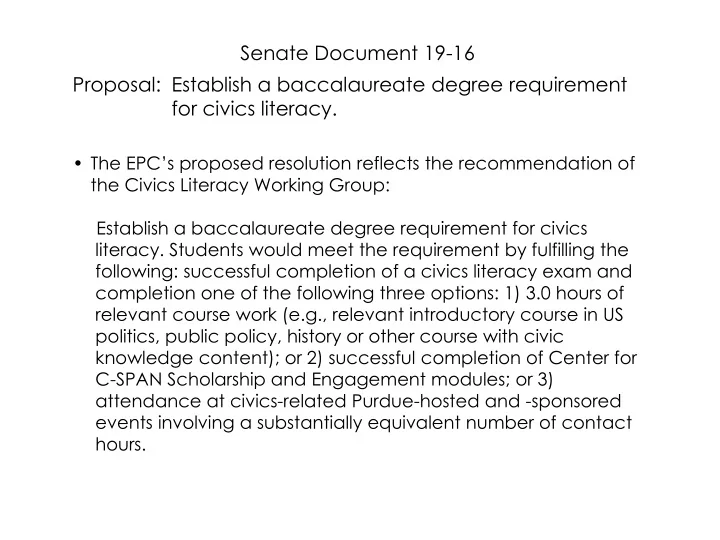
Senate Document 19-16 Proposal: Establish a baccalaureate degree requirement for civics literacy.

  • The EPC’s proposed resolution reflects the recommendation of

the Civics Literacy Working Group: Establish a baccalaureate degree requirement for civics

  • literacy. Students would meet the requirement by fulfilling the

following: successful completion of a civics literacy exam and completion one of the following three options: 1) 3.0 hours of relevant course work (e.g., relevant introductory course in US politics, public policy, history or other course with civic knowledge content); or 2) successful completion of Center for C-SPAN Scholarship and Engagement modules; or 3) attendance at civics-related Purdue-hosted and -sponsored events involving a substantially equivalent number of contact hours.

slide-2
SLIDE 2

Justification of Civics Literacy Requirement at Purdue (from Civics Literacy Working Group report)

  • Results of the most recent Grade 12 National Assessment of

Educational Progress in civics indicated that only 24% of 12th graders scored at the ‘proficient’ level and that 36% scored below even a ‘basic’ level of civic literacy.

  • A report commissioned by the U.S Department of Education, the

National Task Force on Civic Learning and Democratic Engagement, an initiative of the Association of American Colleges and Universities made an urgent call to higher education institutions in the United States to make civic literacy, inquiry, and action part of the educational objectives to be achieved, by every college graduate.

slide-3
SLIDE 3

Evolution of Civics Literacy Requirement at Purdue

  • January 2019, President Daniels proposed a requirement of

passage of a civics test (based on the naturalization test) to earn a degree from Purdue University.

  • Spring 2019, through a campus-wide survey and town hall, the

University Senate determined a baseline of civics knowledge for new Purdue undergraduate students was needed.

  • Summer 2019, the Chair of the University Senate convened a

working group of disciplinary experts to explore how a civics literacy requirement might be employed at Purdue.

  • February 2020, Civics Working Group delivered a

recommendation for a civics literacy requirement to the EPC, which had many questions about the feasibility of implementing the recommendation.

slide-4
SLIDE 4

Evolution of Civics Literacy Requirement at Purdue

  • March 2020, Civics Working Group provided an Addendum to

their report outlining a plan to implement the recommended civics literacy requirement:

  • The Provost will convene a group of key stakeholders and

experts from across campus to work together on the logistics and details with a planned implementation as soon as Fall 2021.

  • The Provost has assured the working group that the necessary

resources to implement the graduation requirement will be

  • allocated. Support has also been noted by the President and

Board of Trustees.

  • 40% of students are already meeting the requirement by taking

a civics-related course, and that number could increase to 60% with AP credits.

  • More work is necessary to develop online instrumentation that is

psychometrically valid and academically rigorous and technology needs to be developed to attest to the authenticity of non-credit learning via civics-related events.

slide-5
SLIDE 5

EPC’s Rationale for proposing a Civics Literacy Requirement

  • Good justification and most EPC members felt that an education

component in civics would increase the value of a Purdue degree.

  • Since the requirement does not require an additional class (it is
  • nly an option), it need not disrupt current core class

requirements adopted by departments and colleges across campus (a concern of several EPC members).

  • Though many of the details of implementation are yet to be

worked out, similar programs are already in place at other universities.

  • With the Provost's assurance, technical/operational feasibility

issues should not be problem.

  • In its comprehensive and complex nature, the proposal is similar

to that of the now successful core curriculum administered by the Undergraduate Curriculum Council, which has returned to the senate many times (including today) with updates.

  • The proposed resolution is too important to die in committee. It is

worthy of debate and vote by the entire University Senate.