Self-similar scaling limits of Markov chains on the positive - - PowerPoint PPT Presentation

self similar scaling limits of markov chains on the
SMART_READER_LITE
LIVE PREVIEW

Self-similar scaling limits of Markov chains on the positive - - PowerPoint PPT Presentation

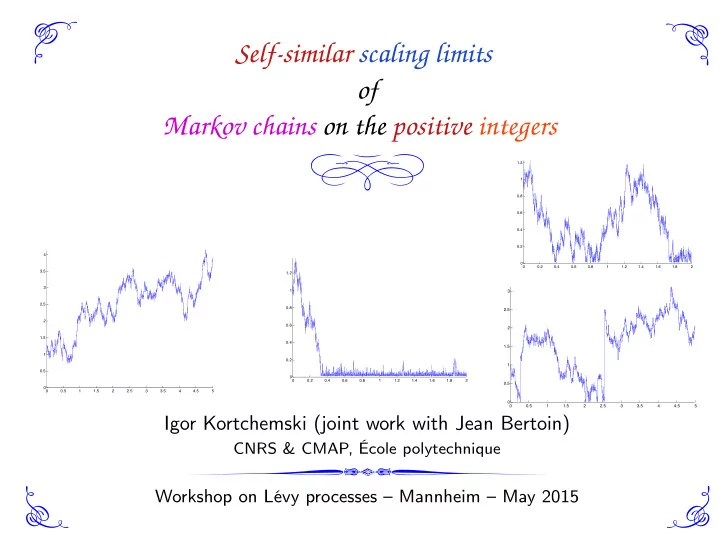
Self-similar scaling limits of Markov chains on the positive integers 1.2 1 0.8 0.6 0.4 0.2 4 0 0 0.2 0.4 0.6 0.8 1 1.2 1.4 1.6 1.8 2 3.5 1.2 3 1 3 2.5 0.8 2.5 2 0.6 2 1.5 0.4 1.5 1 0.2 1 0.5 0 0 0.2 0.4


slide-1
SLIDE 1

Self-similar scaling limits

  • f

Markov chains on the positive integers

Igor Kortchemski (joint work with Jean Bertoin)

CNRS & CMAP, École polytechnique

Workshop on Lévy processes – Mannheim – May 2015

0.5 1 1.5 2 2.5 3 3.5 4 4.5 5 0.5 1 1.5 2 2.5 3

0.2 0.4 0.6 0.8 1 1.2 1.4 1.6 1.8 2 0.2 0.4 0.6 0.8 1 1.2 0.2 0.4 0.6 0.8 1 1.2 1.4 1.6 1.8 2 0.2 0.4 0.6 0.8 1 1.2 0.5 1 1.5 2 2.5 3 3.5 4 4.5 5 0.5 1 1.5 2 2.5 3 3.5 4

slide-2
SLIDE 2

Goals and motivation Transient case Recurrent case Positive recurrent case

Outline

  • I. Goals and motivation
  • II. Transient case
  • III. Recurrent case
  • IV. Positive recurrent case

Igor Kortchemski Scaling limits of Markov chains on the positive integers

slide-3
SLIDE 3

Goals and motivation Transient case Recurrent case Positive recurrent case

  • I. Goals and motivation
  • II. Transient case
  • III. Recurrent case
  • IV. Positive recurrent case

Igor Kortchemski Scaling limits of Markov chains on the positive integers

slide-4
SLIDE 4

Goals and motivation Transient case Recurrent case Positive recurrent case

Goal and motivation

Goal: give explicit criteria for Markov chains on the positive integers starting from large values to have a functional scaling limit.

Igor Kortchemski Scaling limits of Markov chains on the positive integers

slide-5
SLIDE 5

Goals and motivation Transient case Recurrent case Positive recurrent case

Goal and motivation

Goal: give explicit criteria for Markov chains on the positive integers starting from large values to have a functional scaling limit. Motivations and applications:

  • 1. extend a result of Haas & Miermont ’11 concerning non-increasing

Markov-chains,

Igor Kortchemski Scaling limits of Markov chains on the positive integers

slide-6
SLIDE 6

Goals and motivation Transient case Recurrent case Positive recurrent case

Goal and motivation

Goal: give explicit criteria for Markov chains on the positive integers starting from large values to have a functional scaling limit. Motivations and applications:

  • 1. extend a result of Haas & Miermont ’11 concerning non-increasing

Markov-chains,

  • 2. recover a result of Caravenna & Chaumont ’08 concerning invariance

principles for random walks conditioned to remain positive,

Igor Kortchemski Scaling limits of Markov chains on the positive integers

slide-7
SLIDE 7

Goals and motivation Transient case Recurrent case Positive recurrent case

Goal and motivation

Goal: give explicit criteria for Markov chains on the positive integers starting from large values to have a functional scaling limit. Motivations and applications:

  • 1. extend a result of Haas & Miermont ’11 concerning non-increasing

Markov-chains,

  • 2. recover a result of Caravenna & Chaumont ’08 concerning invariance

principles for random walks conditioned to remain positive,

  • 3. study Markov chains with asymptotically zero drift,

Igor Kortchemski Scaling limits of Markov chains on the positive integers

slide-8
SLIDE 8

Goals and motivation Transient case Recurrent case Positive recurrent case

Goal and motivation

Goal: give explicit criteria for Markov chains on the positive integers starting from large values to have a functional scaling limit. Motivations and applications:

  • 1. extend a result of Haas & Miermont ’11 concerning non-increasing

Markov-chains,

  • 2. recover a result of Caravenna & Chaumont ’08 concerning invariance

principles for random walks conditioned to remain positive,

  • 3. study Markov chains with asymptotically zero drift,
  • 4. obtain limit theorems for the number of fragments in a

fragmentation-coagulation process,

Igor Kortchemski Scaling limits of Markov chains on the positive integers

slide-9
SLIDE 9

Goals and motivation Transient case Recurrent case Positive recurrent case

Goal and motivation

Goal: give explicit criteria for Markov chains on the positive integers starting from large values to have a functional scaling limit. Motivations and applications:

  • 1. extend a result of Haas & Miermont ’11 concerning non-increasing

Markov-chains,

  • 2. recover a result of Caravenna & Chaumont ’08 concerning invariance

principles for random walks conditioned to remain positive,

  • 3. study Markov chains with asymptotically zero drift,
  • 4. obtain limit theorems for the number of fragments in a

fragmentation-coagulation process,

  • 5. study separating cycles in large random maps (joint project with Jean

Bertoin & Nicolas Curien, which motivated this work)

Igor Kortchemski Scaling limits of Markov chains on the positive integers

slide-10
SLIDE 10

Goals and motivation Transient case Recurrent case Positive recurrent case

Goal

Let (pi,j; i > 1) be a sequence of non-negative real numbers such that P

i>1 pi,j = 1 for every i > 1.

Igor Kortchemski Scaling limits of Markov chains on the positive integers

slide-11
SLIDE 11

Goals and motivation Transient case Recurrent case Positive recurrent case

Goal

Let (pi,j; i > 1) be a sequence of non-negative real numbers such that P

i>1 pi,j = 1 for every i > 1.

Let (Xn(k); k > 0) be the discrete-time homogeneous Markov chain started at state n such that the probability transition from state i to state j is pi,j for i, j > 1.

Igor Kortchemski Scaling limits of Markov chains on the positive integers

slide-12
SLIDE 12

Goals and motivation Transient case Recurrent case Positive recurrent case

Goal

Let (pi,j; i > 1) be a sequence of non-negative real numbers such that P

i>1 pi,j = 1 for every i > 1.

Let (Xn(k); k > 0) be the discrete-time homogeneous Markov chain started at state n such that the probability transition from state i to state j is pi,j for i, j > 1. y Goal: find explicit conditions on (pn,k) yielding the existence of a sequence an ! 1 and a càdlàg process Y such that the convergence ✓Xn(bantc) n ; t > 0 ◆

(d)

  • !

n→1

(Y(t); t > 0) holds in distribution

Igor Kortchemski Scaling limits of Markov chains on the positive integers

slide-13
SLIDE 13

Goals and motivation Transient case Recurrent case Positive recurrent case

Goal

Let (pi,j; i > 1) be a sequence of non-negative real numbers such that P

i>1 pi,j = 1 for every i > 1.

Let (Xn(k); k > 0) be the discrete-time homogeneous Markov chain started at state n such that the probability transition from state i to state j is pi,j for i, j > 1. y Goal: find explicit conditions on (pn,k) yielding the existence of a sequence an ! 1 and a càdlàg process Y such that the convergence ✓Xn(bantc) n ; t > 0 ◆

(d)

  • !

n→1

(Y(t); t > 0) holds in distribution (in the space of real-valued càdlàg functions D(R+, R) on R+ equipped with the Skorokhod topology).

Igor Kortchemski Scaling limits of Markov chains on the positive integers

slide-14
SLIDE 14

Goals and motivation Transient case Recurrent case Positive recurrent case

Simple example

If p1,2 = 1 and pn,n±1 = ± 1

2 for n > 2:

0.5 1 1.5 2 2.5 3 0.2 0.4 0.6 0.8 1 1.2 1.4 1.6

0.5 1 1.5 2 2.5 3 0.5 1 1.5 2

Figure: Linear interpolation of the process ⇣

Xn(bn2tc) n

; 0 6 t 6 3 ⌘ for n = 50 and n = 5000.

Igor Kortchemski Scaling limits of Markov chains on the positive integers

slide-15
SLIDE 15

Goals and motivation Transient case Recurrent case Positive recurrent case

Simple example

If p1,2 = 1 and pn,n±1 = ± 1

2 for n > 2:

0.5 1 1.5 2 2.5 3 0.2 0.4 0.6 0.8 1 1.2 1.4 1.6

0.5 1 1.5 2 2.5 3 0.5 1 1.5 2

Figure: Linear interpolation of the process ⇣

Xn(bn2tc) n

; 0 6 t 6 3 ⌘ for n = 50 and n = 5000.

The scaling limit is reflected Brownian motion.

Igor Kortchemski Scaling limits of Markov chains on the positive integers

slide-16
SLIDE 16

Goals and motivation Transient case Recurrent case Positive recurrent case

Description of the limiting process

y It is well-known (Lamperti ’60) that self-similar processes arise as the scaling limit of general stochastic processes.

Igor Kortchemski Scaling limits of Markov chains on the positive integers

slide-17
SLIDE 17

Goals and motivation Transient case Recurrent case Positive recurrent case

Description of the limiting process

y It is well-known (Lamperti ’60) that self-similar processes arise as the scaling limit of general stochastic processes. y In the case of Markov chains, one naturally expects the Markov property to be preserved after convergence: the scaling limit should belong to the class of self-similar Markov processes on [0, ∞).

Igor Kortchemski Scaling limits of Markov chains on the positive integers

slide-18
SLIDE 18

Goals and motivation Transient case Recurrent case Positive recurrent case

Nonnegative self-similar Markov processes

Let (ξ(t))t>0 be a Lévy process with characteristic exponent Φ(λ) = −1 2σ2λ2 + ibλ + Z 1

−1

  • eiλx − 1 − iλx

|x|61

  • Π(dx),

λ ∈ R

Igor Kortchemski Scaling limits of Markov chains on the positive integers

slide-19
SLIDE 19

Goals and motivation Transient case Recurrent case Positive recurrent case

Nonnegative self-similar Markov processes

Let (ξ(t))t>0 be a Lévy process with characteristic exponent Φ(λ) = −1 2σ2λ2 + ibλ + Z 1

−1

  • eiλx − 1 − iλx

|x|61

  • Π(dx),

λ ∈ R i.e. E ⇥ eiλξ(t)⇤ = etΦ(λ) for t > 0, λ ∈ R.

Igor Kortchemski Scaling limits of Markov chains on the positive integers

slide-20
SLIDE 20

Goals and motivation Transient case Recurrent case Positive recurrent case

Nonnegative self-similar Markov processes

Let (ξ(t))t>0 be a Lévy process with characteristic exponent Φ(λ) = −1 2σ2λ2 + ibλ + Z 1

−1

  • eiλx − 1 − iλx

|x|61

  • Π(dx),

λ ∈ R i.e. E ⇥ eiλξ(t)⇤ = etΦ(λ) for t > 0, λ ∈ R. Set I1 = Z 1 eγξ(s) ds ∈ (0, 1].

Igor Kortchemski Scaling limits of Markov chains on the positive integers

slide-21
SLIDE 21

Goals and motivation Transient case Recurrent case Positive recurrent case

Nonnegative self-similar Markov processes

Let (ξ(t))t>0 be a Lévy process with characteristic exponent Φ(λ) = −1 2σ2λ2 + ibλ + Z 1

−1

  • eiλx − 1 − iλx

|x|61

  • Π(dx),

λ ∈ R i.e. E ⇥ eiλξ(t)⇤ = etΦ(λ) for t > 0, λ ∈ R. Set I1 = Z 1 eγξ(s) ds ∈ (0, 1]. It is known that: – I1 < 1 a.s. if ξ drifts to −1 (i.e. limt→1 ξ(t) = −1 a.s.), .

Igor Kortchemski Scaling limits of Markov chains on the positive integers

slide-22
SLIDE 22

Goals and motivation Transient case Recurrent case Positive recurrent case

Nonnegative self-similar Markov processes

Let (ξ(t))t>0 be a Lévy process with characteristic exponent Φ(λ) = −1 2σ2λ2 + ibλ + Z 1

−1

  • eiλx − 1 − iλx

|x|61

  • Π(dx),

λ ∈ R i.e. E ⇥ eiλξ(t)⇤ = etΦ(λ) for t > 0, λ ∈ R. Set I1 = Z 1 eγξ(s) ds ∈ (0, 1]. It is known that: – I1 < 1 a.s. if ξ drifts to −1 (i.e. limt→1 ξ(t) = −1 a.s.), – I1 = 1 a.s. if ξ drifts to +1 or oscillates.

Igor Kortchemski Scaling limits of Markov chains on the positive integers

slide-23
SLIDE 23

Goals and motivation Transient case Recurrent case Positive recurrent case

The Lamperti transform

Fix γ > 0. For every t > 0, set τ(t) = inf

  • u > 0;

Z u eγξ(s)ds > t

  • Igor Kortchemski

Scaling limits of Markov chains on the positive integers

slide-24
SLIDE 24

Goals and motivation Transient case Recurrent case Positive recurrent case

The Lamperti transform

Fix γ > 0. For every t > 0, set τ(t) = inf

  • u > 0;

Z u eγξ(s)ds > t

  • (with the convention inf ∅ = 1).

Igor Kortchemski Scaling limits of Markov chains on the positive integers

slide-25
SLIDE 25

Goals and motivation Transient case Recurrent case Positive recurrent case

The Lamperti transform

Fix γ > 0. For every t > 0, set τ(t) = inf

  • u > 0;

Z u eγξ(s)ds > t

  • (with the convention inf ∅ = 1). The Lamperti transform of ξ is defined by

Y(t) = eξ(τ(t)) for 0 6 t < I1, Y(t) = 0 for t > I1.

Igor Kortchemski Scaling limits of Markov chains on the positive integers

slide-26
SLIDE 26

Goals and motivation Transient case Recurrent case Positive recurrent case

The Lamperti transform

Fix γ > 0. For every t > 0, set τ(t) = inf

  • u > 0;

Z u eγξ(s)ds > t

  • (with the convention inf ∅ = 1). The Lamperti transform of ξ is defined by

Y(t) = eξ(τ(t)) for 0 6 t < I1, Y(t) = 0 for t > I1. The process Y hits 0 in finite time almost surely if, and only if, ξ drifts to −1.

Igor Kortchemski Scaling limits of Markov chains on the positive integers

slide-27
SLIDE 27

Goals and motivation Transient case Recurrent case Positive recurrent case

The Lamperti transform

Fix γ > 0. For every t > 0, set τ(t) = inf

  • u > 0;

Z u eγξ(s)ds > t

  • (with the convention inf ∅ = 1). The Lamperti transform of ξ is defined by

Y(t) = eξ(τ(t)) for 0 6 t < I1, Y(t) = 0 for t > I1. The process Y hits 0 in finite time almost surely if, and only if, ξ drifts to −1. By construction, the process Y is a self-similar Markov process of index 1/γ started at 1.

Igor Kortchemski Scaling limits of Markov chains on the positive integers

slide-28
SLIDE 28

Goals and motivation Transient case Recurrent case Positive recurrent case

The Lamperti transform

Fix γ > 0. For every t > 0, set τ(t) = inf

  • u > 0;

Z u eγξ(s)ds > t

  • (with the convention inf ∅ = 1). The Lamperti transform of ξ is defined by

Y(t) = eξ(τ(t)) for 0 6 t < I1, Y(t) = 0 for t > I1. The process Y hits 0 in finite time almost surely if, and only if, ξ drifts to −1. By construction, the process Y is a self-similar Markov process of index 1/γ started at 1. We will write that Y is a pSSMP(γ)

1

(σ, b, Π).

Igor Kortchemski Scaling limits of Markov chains on the positive integers

slide-29
SLIDE 29

Goals and motivation Transient case Recurrent case Positive recurrent case Igor Kortchemski Scaling limits of Markov chains on the positive integers

slide-30
SLIDE 30

Goals and motivation Transient case Recurrent case Positive recurrent case

Main notation

Let Π⇤

n be the law of ln(Xn(1)/n)

Igor Kortchemski Scaling limits of Markov chains on the positive integers

slide-31
SLIDE 31

Goals and motivation Transient case Recurrent case Positive recurrent case

Main notation

Let Π⇤

n be the law of ln(Xn(1)/n), which is the probability measure on R

Π⇤

n(dx) =

X

k>1

pn,k · δln(k/n)(dx).

Igor Kortchemski Scaling limits of Markov chains on the positive integers

slide-32
SLIDE 32

Goals and motivation Transient case Recurrent case Positive recurrent case

Main notation

Let Π⇤

n be the law of ln(Xn(1)/n), which is the probability measure on R

Π⇤

n(dx) =

X

k>1

pn,k · δln(k/n)(dx). Let (an)n>0 be a sequence of positive real numbers with regular variation of index γ > 0

Igor Kortchemski Scaling limits of Markov chains on the positive integers

slide-33
SLIDE 33

Goals and motivation Transient case Recurrent case Positive recurrent case

Main notation

Let Π⇤

n be the law of ln(Xn(1)/n), which is the probability measure on R

Π⇤

n(dx) =

X

k>1

pn,k · δln(k/n)(dx). Let (an)n>0 be a sequence of positive real numbers with regular variation of index γ > 0, meaning that abxnc/an → xγ as n → 1 for every fixed x > 0.

Igor Kortchemski Scaling limits of Markov chains on the positive integers

slide-34
SLIDE 34

Goals and motivation Transient case Recurrent case Positive recurrent case

Main notation

Let Π⇤

n be the law of ln(Xn(1)/n), which is the probability measure on R

Π⇤

n(dx) =

X

k>1

pn,k · δln(k/n)(dx). Let (an)n>0 be a sequence of positive real numbers with regular variation of index γ > 0, meaning that abxnc/an → xγ as n → 1 for every fixed x > 0. Let Π be a measure on R\{0} such that Z 1

−1

(1 ∧ x2) Π(dx) < 1.

Igor Kortchemski Scaling limits of Markov chains on the positive integers

slide-35
SLIDE 35

Goals and motivation Transient case Recurrent case Positive recurrent case

  • I. Goals and motivation
  • II. Transient case
  • III. Recurrent case
  • IV. Positive recurrent case
  • V. Applications

Igor Kortchemski Scaling limits of Markov chains on the positive integers

slide-36
SLIDE 36

Goals and motivation Transient case Recurrent case Positive recurrent case

(A1). As n → ∞, vaguely on R\{0}, an · Π∗

n(dx) (v)

− →

n→∞

Π(dx).

Igor Kortchemski Scaling limits of Markov chains on the positive integers

slide-37
SLIDE 37

Goals and motivation Transient case Recurrent case Positive recurrent case

(A1). As n ! 1, vaguely on R\{0}, an · Π∗

n(dx) (v)

  • !

n→1

Π(dx). This means that an · E  f ✓Xn(1) n ◆

  • !

n→1

Z

R

f(ex) Π(dx) for every continuous function f with compact support in [0, 1]\{1}, i.e. a jump of the process Xn/n from 1 to x occurs with a small rate

1 an exp Π(dx).

Igor Kortchemski Scaling limits of Markov chains on the positive integers

slide-38
SLIDE 38

Goals and motivation Transient case Recurrent case Positive recurrent case

(A1). As n → 1, vaguely on R\{0}, an · Π∗

n(dx) (v)

− →

n→1

Π(dx). (A2). The following two convergences holds: an· Z 1

−1

x Π∗

n(dx)

− →

n→1

b, an· Z 1

−1

x2 Π∗

n(dx)

− →

n→1

σ2+ Z 1

−1

x2 Π(dx) for some b ∈ R and σ2 > 0.

Igor Kortchemski Scaling limits of Markov chains on the positive integers

slide-39
SLIDE 39

Goals and motivation Transient case Recurrent case Positive recurrent case

(A1). As n → 1, vaguely on R\{0}, an · Π∗

n(dx) (v)

− →

n→1

Π(dx). (A2). The following two convergences holds: an· Z 1

−1

x Π∗

n(dx)

− →

n→1

b, an· Z 1

−1

x2 Π∗

n(dx)

− →

n→1

σ2+ Z 1

−1

x2 Π(dx) for some b ∈ R and σ2 > 0. (Conditions very close to those giving convergence of infinitely divisible distributions)

Igor Kortchemski Scaling limits of Markov chains on the positive integers

slide-40
SLIDE 40

Goals and motivation Transient case Recurrent case Positive recurrent case

(A1). As n ! 1, vaguely on R\{0}, an · Π∗

n(dx) (v)

  • !

n→1

Π(dx). (A2). The following two convergences holds: an· Z 1

−1

x Π∗

n(dx)

  • !

n→1

b, an· Z 1

−1

x2 Π∗

n(dx)

  • !

n→1

σ2+ Z 1

−1

x2 Π(dx) for some b 2 R and σ2 > 0. Assume that (A1) and (A2) hold, and that ξ 6! −1. Then ✓Xn(bantc) n ; t > 0 ◆

(d)

  • !

n→1

(Y(t); t > 0) holds in distribution in D(R+, R), where Y is a pSSMP(γ)

1

(σ, b, Π). Theorem (Bertoin & K. ’14 — transient case).

Igor Kortchemski Scaling limits of Markov chains on the positive integers

slide-41
SLIDE 41

Goals and motivation Transient case Recurrent case Positive recurrent case

0.5 1 1.5 2 2.5 3 3.5 4 4.5 5 0.5 1 1.5 2 2.5 3 3.5 4

Figure: Illustration of the transient case.

Igor Kortchemski Scaling limits of Markov chains on the positive integers

slide-42
SLIDE 42

Goals and motivation Transient case Recurrent case Positive recurrent case

Idea of the proof

y Embed Xn in continuous time: let Nn be an independent Poisson process

  • f parameter an.

Igor Kortchemski Scaling limits of Markov chains on the positive integers

slide-43
SLIDE 43

Goals and motivation Transient case Recurrent case Positive recurrent case

Idea of the proof

y Embed Xn in continuous time: let Nn be an independent Poisson process

  • f parameter an.

y Construct a continuous-time Markov process Ln such that the following equality in distribution holds ✓ 1 nXn(Nn(t)); t > 0 ◆

(d)

= (exp(Ln(τn(t))); t > 0) ,

Igor Kortchemski Scaling limits of Markov chains on the positive integers

slide-44
SLIDE 44

Goals and motivation Transient case Recurrent case Positive recurrent case

Idea of the proof

y Embed Xn in continuous time: let Nn be an independent Poisson process

  • f parameter an.

y Construct a continuous-time Markov process Ln such that the following equality in distribution holds ✓ 1 nXn(Nn(t)); t > 0 ◆

(d)

= (exp(Ln(τn(t))); t > 0) , where τn is a Lamperti-type time change of Ln.

Igor Kortchemski Scaling limits of Markov chains on the positive integers

slide-45
SLIDE 45

Goals and motivation Transient case Recurrent case Positive recurrent case

Idea of the proof

y Embed Xn in continuous time: let Nn be an independent Poisson process

  • f parameter an.

y Construct a continuous-time Markov process Ln such that the following equality in distribution holds ✓ 1 nXn(Nn(t)); t > 0 ◆

(d)

= (exp(Ln(τn(t))); t > 0) , where τn is a Lamperti-type time change of Ln. Strategy: 1) Ln converges in distribution to ξ (characterization of functional convergence

  • f Feller processes by generators)

Igor Kortchemski Scaling limits of Markov chains on the positive integers

slide-46
SLIDE 46

Goals and motivation Transient case Recurrent case Positive recurrent case

Idea of the proof

y Embed Xn in continuous time: let Nn be an independent Poisson process

  • f parameter an.

y Construct a continuous-time Markov process Ln such that the following equality in distribution holds ✓ 1 nXn(Nn(t)); t > 0 ◆

(d)

= (exp(Ln(τn(t))); t > 0) , where τn is a Lamperti-type time change of Ln. Strategy: 1) Ln converges in distribution to ξ (characterization of functional convergence

  • f Feller processes by generators)

2) τn converges in distribution towards τ (the time changes do not explode).

Igor Kortchemski Scaling limits of Markov chains on the positive integers

slide-47
SLIDE 47

Goals and motivation Transient case Recurrent case Positive recurrent case

Idea of the proof

y Embed Xn in continuous time: let Nn be an independent Poisson process

  • f parameter an.

y Construct a continuous-time Markov process Ln such that the following equality in distribution holds ✓ 1 nXn(Nn(t)); t > 0 ◆

(d)

= (exp(Ln(τn(t))); t > 0) , where τn is a Lamperti-type time change of Ln. Strategy: 1) Ln converges in distribution to ξ (characterization of functional convergence

  • f Feller processes by generators)

2) τn converges in distribution towards τ (the time changes do not explode). Hence ✓Xn(bantc) n ; t > 0 ◆

(d)

  • !

n→∞

(exp(ξ(τ(t))); t > 0) = Y

Igor Kortchemski Scaling limits of Markov chains on the positive integers

slide-48
SLIDE 48

Goals and motivation Transient case Recurrent case Positive recurrent case

Difference with the approach of Haas & Miermont ’11

In the case where the Markov chain is non-increasing, Haas & Miermont:

Igor Kortchemski Scaling limits of Markov chains on the positive integers

slide-49
SLIDE 49

Goals and motivation Transient case Recurrent case Positive recurrent case

Difference with the approach of Haas & Miermont ’11

In the case where the Markov chain is non-increasing, Haas & Miermont: – Establish tightness,

Igor Kortchemski Scaling limits of Markov chains on the positive integers

slide-50
SLIDE 50

Goals and motivation Transient case Recurrent case Positive recurrent case

Difference with the approach of Haas & Miermont ’11

In the case where the Markov chain is non-increasing, Haas & Miermont: – Establish tightness, – Analyze weak limits of convergent subsequences via martingale problems.

Igor Kortchemski Scaling limits of Markov chains on the positive integers

slide-51
SLIDE 51

Goals and motivation Transient case Recurrent case Positive recurrent case

Details

The process Ln is designed in the following way:

Igor Kortchemski Scaling limits of Markov chains on the positive integers

slide-52
SLIDE 52

Goals and motivation Transient case Recurrent case Positive recurrent case

Details

The process Ln is designed in the following way: if n exp(Ln) = j > 1, then it waits a random time distributed as an exponential random variable of parameter aj and then jumps to state k > 1 with probability pj,k.

Igor Kortchemski Scaling limits of Markov chains on the positive integers

slide-53
SLIDE 53

Goals and motivation Transient case Recurrent case Positive recurrent case

Details

The process Ln is designed in the following way: if n exp(Ln) = j > 1, then it waits a random time distributed as an exponential random variable of parameter aj and then jumps to state k > 1 with probability pj,k. If τn(t) = inf

  • u > 0;

Z u an exp(Ln(s)) an ds > t

  • ,

then ✓ 1 nXn(Nn(t)); t > 0 ◆

(d)

= (exp(Ln(τn(t))); t > 0)

Igor Kortchemski Scaling limits of Markov chains on the positive integers

slide-54
SLIDE 54

Goals and motivation Transient case Recurrent case Positive recurrent case

Details

The process Ln is designed in the following way: if n exp(Ln) = j > 1, then it waits a random time distributed as an exponential random variable of parameter aj and then jumps to state k > 1 with probability pj,k. If τn(t) = inf

  • u > 0;

Z u an exp(Ln(s)) an ds > t

  • ,

then ✓ 1 nXn(Nn(t)); t > 0 ◆

(d)

= (exp(Ln(τn(t))); t > 0), and 1) Ln converges in distribution to ξ

Igor Kortchemski Scaling limits of Markov chains on the positive integers

slide-55
SLIDE 55

Goals and motivation Transient case Recurrent case Positive recurrent case

Details

The process Ln is designed in the following way: if n exp(Ln) = j > 1, then it waits a random time distributed as an exponential random variable of parameter aj and then jumps to state k > 1 with probability pj,k. If τn(t) = inf

  • u > 0;

Z u an exp(Ln(s)) an ds > t

  • ,

then ✓ 1 nXn(Nn(t)); t > 0 ◆

(d)

= (exp(Ln(τn(t))); t > 0), and 1) Ln converges in distribution to ξ (characterization of functional convergence

  • f Feller processes by generators, no boundary issues)

Igor Kortchemski Scaling limits of Markov chains on the positive integers

slide-56
SLIDE 56

Goals and motivation Transient case Recurrent case Positive recurrent case

Details

The process Ln is designed in the following way: if n exp(Ln) = j > 1, then it waits a random time distributed as an exponential random variable of parameter aj and then jumps to state k > 1 with probability pj,k. If τn(t) = inf

  • u > 0;

Z u an exp(Ln(s)) an ds > t

  • ,

then ✓ 1 nXn(Nn(t)); t > 0 ◆

(d)

= (exp(Ln(τn(t))); t > 0), and 1) Ln converges in distribution to ξ (characterization of functional convergence

  • f Feller processes by generators, no boundary issues)

2) τn converges in distribution to τ(t) = inf

  • u > 0;

Z u eγξ(s)ds > t

  • Igor Kortchemski

Scaling limits of Markov chains on the positive integers

slide-57
SLIDE 57

Goals and motivation Transient case Recurrent case Positive recurrent case

Details

The process Ln is designed in the following way: if n exp(Ln) = j > 1, then it waits a random time distributed as an exponential random variable of parameter aj and then jumps to state k > 1 with probability pj,k. If τn(t) = inf

  • u > 0;

Z u an exp(Ln(s)) an ds > t

  • ,

then ✓ 1 nXn(Nn(t)); t > 0 ◆

(d)

= (exp(Ln(τn(t))); t > 0), and 1) Ln converges in distribution to ξ (characterization of functional convergence

  • f Feller processes by generators, no boundary issues)

2) τn converges in distribution to τ(t) = inf

  • u > 0;

Z u eγξ(s)ds > t

  • (the time changes do not explode since I1 = 1).

Igor Kortchemski Scaling limits of Markov chains on the positive integers

slide-58
SLIDE 58

Goals and motivation Transient case Recurrent case Positive recurrent case

  • I. Goals and motivation
  • II. Transient case
  • III. Recurrent case
  • IV. Positive recurrent case

Igor Kortchemski Scaling limits of Markov chains on the positive integers

slide-59
SLIDE 59

Goals and motivation Transient case Recurrent case Positive recurrent case

What happens when ξ drifts to −∞, in which case I∞ < ∞ and Y is absorbed in 0 ?

Igor Kortchemski Scaling limits of Markov chains on the positive integers

slide-60
SLIDE 60

Goals and motivation Transient case Recurrent case Positive recurrent case

y First step: understand the behavior of the Markov chain until it reaches a “neighborhood” of 0.

Igor Kortchemski Scaling limits of Markov chains on the positive integers

slide-61
SLIDE 61

Goals and motivation Transient case Recurrent case Positive recurrent case

y First step: understand the behavior of the Markov chain until it reaches a “neighborhood” of 0. Fix K > 1 such that the set {1, 2, . . . , K} is accessible by Xn for every n > 1

Igor Kortchemski Scaling limits of Markov chains on the positive integers

slide-62
SLIDE 62

Goals and motivation Transient case Recurrent case Positive recurrent case

y First step: understand the behavior of the Markov chain until it reaches a “neighborhood” of 0. Fix K > 1 such that the set {1, 2, . . . , K} is accessible by Xn for every n > 1 (meaning that inf{i > 0; Xn(i) 6 K} < ∞ with positive probability for every n > 1).

Igor Kortchemski Scaling limits of Markov chains on the positive integers

slide-63
SLIDE 63

Goals and motivation Transient case Recurrent case Positive recurrent case

y First step: understand the behavior of the Markov chain until it reaches a “neighborhood” of 0. Fix K > 1 such that the set {1, 2, . . . , K} is accessible by Xn for every n > 1 (meaning that inf{i > 0; Xn(i) 6 K} < ∞ with positive probability for every n > 1). Let X†

n be the Markov chain Xn stopped at its first visit to {1, 2, . . . , K}

Igor Kortchemski Scaling limits of Markov chains on the positive integers

slide-64
SLIDE 64

Goals and motivation Transient case Recurrent case Positive recurrent case

y First step: understand the behavior of the Markov chain until it reaches a “neighborhood” of 0. Fix K > 1 such that the set {1, 2, . . . , K} is accessible by Xn for every n > 1 (meaning that inf{i > 0; Xn(i) 6 K} < ∞ with positive probability for every n > 1). Let X†

n be the Markov chain Xn stopped at its first visit to {1, 2, . . . , K}, that is

X†

n(·) = Xn(· ∧ A(K) n ), where A(K) n

= inf{k > 1; Xn(k) 6 K}.

Igor Kortchemski Scaling limits of Markov chains on the positive integers

slide-65
SLIDE 65

Goals and motivation Transient case Recurrent case Positive recurrent case

y First step: understand the behavior of the Markov chain until it reaches a “neighborhood” of 0. Fix K > 1 such that the set {1, 2, . . . , K} is accessible by Xn for every n > 1 (meaning that inf{i > 0; Xn(i) 6 K} < ∞ with positive probability for every n > 1). Let X†

n be the Markov chain Xn stopped at its first visit to {1, 2, . . . , K}, that is

X†

n(·) = Xn(· ∧ A(K) n ), where A(K) n

= inf{k > 1; Xn(k) 6 K}. y First step: study scaling limits of X†

n(bantc)

n ; t > 0 ! .

Igor Kortchemski Scaling limits of Markov chains on the positive integers

slide-66
SLIDE 66

Goals and motivation Transient case Recurrent case Positive recurrent case

(A3). There exists β > 0 such that lim sup

n→1 an ·

Z 1

1

eβx Π∗

n(dx) < 1.

Igor Kortchemski Scaling limits of Markov chains on the positive integers

slide-67
SLIDE 67

Goals and motivation Transient case Recurrent case Positive recurrent case

(A3). There exists β > 0 such that lim sup

n→1 an ·

Z 1

1

eβx Π∗

n(dx) < 1.

Assume that (A1), (A2), (A3) hold and that the Lévy process ξ drifts to −1. Then the convergence X†

n(bantc)

n ; t > 0 !

(d)

  • !

n→1

(Y(t); t > 0) holds in distribution in D(R+, R). Theorem (Bertoin & K. ’14 — Recurrent case).

Igor Kortchemski Scaling limits of Markov chains on the positive integers

slide-68
SLIDE 68

Goals and motivation Transient case Recurrent case Positive recurrent case

(A3). There exists β > 0 such that lim sup

n→1 an ·

Z 1

1

eβx Π∗

n(dx) < 1.

Assume that (A1), (A2), (A3) hold and that the Lévy process ξ drifts to −1. Then the convergence X†

n(bantc)

n ; t > 0 !

(d)

  • !

n→1

(Y(t); t > 0) holds in distribution in D(R+, R). Theorem (Bertoin & K. ’14 — Recurrent case). (established by Haas & Miermont ’11 in the non-increasing case)

Igor Kortchemski Scaling limits of Markov chains on the positive integers

slide-69
SLIDE 69

Goals and motivation Transient case Recurrent case Positive recurrent case

0.2 0.4 0.6 0.8 1 1.2 0.2 0.4 0.6 0.8 1 1.2

?

Figure: Illustration of the recurrent case.

Igor Kortchemski Scaling limits of Markov chains on the positive integers

slide-70
SLIDE 70

Goals and motivation Transient case Recurrent case Positive recurrent case

Proof of the recurrent case

y How does the process behave when reaching low values (when the time change explodes) ?

Igor Kortchemski Scaling limits of Markov chains on the positive integers

slide-71
SLIDE 71

Goals and motivation Transient case Recurrent case Positive recurrent case

Proof of the recurrent case

y How does the process behave when reaching low values (when the time change explodes) ? y One has to check that the Markov chain will likely be absorbed before reaching “high” values (of order n) when started from “low” values (of order ✏n).

Igor Kortchemski Scaling limits of Markov chains on the positive integers

slide-72
SLIDE 72

Goals and motivation Transient case Recurrent case Positive recurrent case

Idea: use Foster-Lyapounov techniques

If X is irreducible, it is recurrent if and only if

Igor Kortchemski Scaling limits of Markov chains on the positive integers

slide-73
SLIDE 73

Goals and motivation Transient case Recurrent case Positive recurrent case

Idea: use Foster-Lyapounov techniques

If X is irreducible, it is recurrent if and only if there exists a function f : N ! R+ s.t. for every K > 1, the set {i > 1; f(i) 6 K} is finite

Igor Kortchemski Scaling limits of Markov chains on the positive integers

slide-74
SLIDE 74

Goals and motivation Transient case Recurrent case Positive recurrent case

Idea: use Foster-Lyapounov techniques

If X is irreducible, it is recurrent if and only if there exists a function f : N ! R+ s.t. for every K > 1, the set {i > 1; f(i) 6 K} is finite and there exists a finite set S0 ⇢ N s.t. for every i 62 S0, X

j>1

pi,jf(j) 6 f(i).

Igor Kortchemski Scaling limits of Markov chains on the positive integers

slide-75
SLIDE 75

Goals and motivation Transient case Recurrent case Positive recurrent case

Idea: use Foster-Lyapounov techniques

If X is irreducible, it is recurrent if and only if there exists a function f : N ! R+ s.t. for every K > 1, the set {i > 1; f(i) 6 K} is finite and there exists a finite set S0 ⇢ N s.t. for every i 62 S0, X

j>1

pi,jf(j) 6 f(i). y Foster–Lyapounov functions allow to construct nonnegative supermartingales

Igor Kortchemski Scaling limits of Markov chains on the positive integers

slide-76
SLIDE 76

Goals and motivation Transient case Recurrent case Positive recurrent case

Idea: use Foster-Lyapounov techniques

If X is irreducible, it is recurrent if and only if there exists a function f : N ! R+ s.t. for every K > 1, the set {i > 1; f(i) 6 K} is finite and there exists a finite set S0 ⇢ N s.t. for every i 62 S0, X

j>1

pi,jf(j) 6 f(i). y Foster–Lyapounov functions allow to construct nonnegative supermartingales, and the criterion may be interpereted as a stochastic drift condition in analogy with Lyapounov’s stability criteria for ordinary differential equations.

Igor Kortchemski Scaling limits of Markov chains on the positive integers

slide-77
SLIDE 77

Goals and motivation Transient case Recurrent case Positive recurrent case

Idea: use Foster-Lyapounov techniques

If X is irreducible, it is recurrent if and only if there exists a function f : N ! R+ s.t. for every K > 1, the set {i > 1; f(i) 6 K} is finite and there exists a finite set S0 ⇢ N s.t. for every i 62 S0, X

j>1

pi,jf(j) 6 f(i). y Foster–Lyapounov functions allow to construct nonnegative supermartingales, and the criterion may be interpereted as a stochastic drift condition in analogy with Lyapounov’s stability criteria for ordinary differential equations. y In our case, we take f(x) = xβ0.

Igor Kortchemski Scaling limits of Markov chains on the positive integers

slide-78
SLIDE 78

Goals and motivation Transient case Recurrent case Positive recurrent case

Idea: use Foster-Lyapounov techniques

If X is irreducible, it is recurrent if and only if there exists a function f : N ! R+ s.t. for every K > 1, the set {i > 1; f(i) 6 K} is finite and there exists a finite set S0 ⇢ N s.t. for every i 62 S0, X

j>1

pi,jf(j) 6 f(i). y Foster–Lyapounov functions allow to construct nonnegative supermartingales, and the criterion may be interpereted as a stochastic drift condition in analogy with Lyapounov’s stability criteria for ordinary differential equations. y In our case, we take f(x) = xβ0. y In particular, if (A1), (A2), (A3) hold and ξ ! −1 almost surely, A(K)

i

< 1 for every i > 1.

Igor Kortchemski Scaling limits of Markov chains on the positive integers

slide-79
SLIDE 79

Goals and motivation Transient case Recurrent case Positive recurrent case

When starting from “low” values (of order ✏n), these Foster–Lyapounov techniques allows to show that indeed the Markov chain will likely be absorbed before reaching “high” values (of order n).

Igor Kortchemski Scaling limits of Markov chains on the positive integers

slide-80
SLIDE 80

Goals and motivation Transient case Recurrent case Positive recurrent case

When starting from “low” values (of order ✏n), these Foster–Lyapounov techniques allows to show that indeed the Markov chain will likely be absorbed before reaching “high” values (of order n). Foster–Lyapounov techniques also allow to estimate the absorption time A(K)

n

= inf{k > 1; Xn(k) 6 K}:

Igor Kortchemski Scaling limits of Markov chains on the positive integers

slide-81
SLIDE 81

Goals and motivation Transient case Recurrent case Positive recurrent case

When starting from “low” values (of order ✏n), these Foster–Lyapounov techniques allows to show that indeed the Markov chain will likely be absorbed before reaching “high” values (of order n). Foster–Lyapounov techniques also allow to estimate the absorption time A(K)

n

= inf{k > 1; Xn(k) 6 K}: Assume that (A1), (A2), (A3) hold and that the Lévy process ⇠ drifts to −1. Then A(K)

n

an

(d)

− →

n→1

Z 1 eγξ(s)ds. Theorem (Bertoin & K. ’14 — Convergence of absorption time).

Igor Kortchemski Scaling limits of Markov chains on the positive integers

slide-82
SLIDE 82

Goals and motivation Transient case Recurrent case Positive recurrent case

When starting from “low” values (of order ✏n), these Foster–Lyapounov techniques allows to show that indeed the Markov chain will likely be absorbed before reaching “high” values (of order n). Foster–Lyapounov techniques also allow to estimate the absorption time A(K)

n

= inf{k > 1; Xn(k) 6 K}: Assume that (A1), (A2), (A3) hold and that the Lévy process ⇠ drifts to −1. Then A(K)

n

an

(d)

− →

n→1

Z 1 eγξ(s)ds. Theorem (Bertoin & K. ’14 — Convergence of absorption time). (established by Haas & Miermont ’11 in the non-increasing case)

Igor Kortchemski Scaling limits of Markov chains on the positive integers

slide-83
SLIDE 83

Goals and motivation Transient case Recurrent case Positive recurrent case

  • I. Goals and motivation
  • II. Transient case
  • III. Recurrent case
  • IV. Positive recurrent case

Igor Kortchemski Scaling limits of Markov chains on the positive integers

slide-84
SLIDE 84

Goals and motivation Transient case Recurrent case Positive recurrent case

Let Ψ be the Laplace exponent of ξ: Ψ(λ) = Φ(−iλ) = 1 2σ2λ2 + bλ + Z 1

−1

  • eλx − 1 − λx

|x|61

  • Π(dx),

Igor Kortchemski Scaling limits of Markov chains on the positive integers

slide-85
SLIDE 85

Goals and motivation Transient case Recurrent case Positive recurrent case

Let Ψ be the Laplace exponent of ξ: Ψ(λ) = Φ(−iλ) = 1 2σ2λ2 + bλ + Z 1

−1

  • eλx − 1 − λx

|x|61

  • Π(dx),

so that E h eλξ(t)i = etΨ(λ).

Igor Kortchemski Scaling limits of Markov chains on the positive integers

slide-86
SLIDE 86

Goals and motivation Transient case Recurrent case Positive recurrent case

(A4). There exists β0 > γ s.t. lim sup

n→1 an ·

Z 1

1

eβ0x Π∗

n(dx) < 1

and Ψ(β0) < 0.

Igor Kortchemski Scaling limits of Markov chains on the positive integers

slide-87
SLIDE 87

Goals and motivation Transient case Recurrent case Positive recurrent case

(A4). There exists β0 > γ s.t. lim sup

n→1 an ·

Z 1

1

eβ0x Π∗

n(dx) < 1

and Ψ(β0) < 0. (A5). For every n > 1, we have E ⇥ Xn(1)β0⇤ = X

k>1

kβ0 · pn,k < 1.

Igor Kortchemski Scaling limits of Markov chains on the positive integers

slide-88
SLIDE 88

Goals and motivation Transient case Recurrent case Positive recurrent case

(A4). There exists β0 > γ s.t. lim sup

n→1 an ·

Z 1

1

eβ0x Π∗

n(dx) < 1

and Ψ(β0) < 0. (A5). For every n > 1, we have E ⇥ Xn(1)β0⇤ = X

k>1

kβ0 · pn,k < 1. Assume that (A1), (A2), (A4), and (A5) hold. Then the convergence ✓Xn(bantc) n ; t > 0 ◆

(d)

  • !

n→1

(Y(t); t > 0) holds in distribution in D(R+, R). Theorem (Bertoin & K. ’14 — Positive recurrent case).

Igor Kortchemski Scaling limits of Markov chains on the positive integers

slide-89
SLIDE 89

Goals and motivation Transient case Recurrent case Positive recurrent case

(A4). There exists β0 > γ s.t. lim sup

n→1 an ·

Z 1

1

eβ0x Π∗

n(dx) < 1

and Ψ(β0) < 0. (A5). For every n > 1, we have E ⇥ Xn(1)β0⇤ = X

k>1

kβ0 · pn,k < 1. Assume that (A1), (A2), (A4), and (A5) hold. Then the convergence ✓Xn(bantc) n ; t > 0 ◆

(d)

  • !

n→1

(Y(t); t > 0) holds in distribution in D(R+, R). Theorem (Bertoin & K. ’14 — Positive recurrent case). (established by Haas & Miermont ’11 in the non-increasing case)

Igor Kortchemski Scaling limits of Markov chains on the positive integers

slide-90
SLIDE 90

Goals and motivation Transient case Recurrent case Positive recurrent case

0.2 0.4 0.6 0.8 1 1.2 1.4 1.6 1.8 2 0.2 0.4 0.6 0.8 1 1.2

Figure: Illustration of the positive recurrent case.

Igor Kortchemski Scaling limits of Markov chains on the positive integers

slide-91
SLIDE 91

Goals and motivation Transient case Recurrent case Positive recurrent case

Foster-Lyapounov is back

y First step: show that E h A(K)

n

i an − →

n→1

E Z 1 eγξ(s)ds

  • =

1 |Ψ(γ)|.

Igor Kortchemski Scaling limits of Markov chains on the positive integers

slide-92
SLIDE 92

Goals and motivation Transient case Recurrent case Positive recurrent case

Foster-Lyapounov is back

y First step: show that E h A(K)

n

i an − →

n→1

E Z 1 eγξ(s)ds

  • =

1 |Ψ(γ)|. (N.B. This does not necessarily hold in the recurrent but not positive recurrent case).

Igor Kortchemski Scaling limits of Markov chains on the positive integers

slide-93
SLIDE 93

Goals and motivation Transient case Recurrent case Positive recurrent case

Foster-Lyapounov is back

y First step: show that E h A(K)

n

i an − →

n→1

E Z 1 eγξ(s)ds

  • =

1 |Ψ(γ)|. (N.B. This does not necessarily hold in the recurrent but not positive recurrent case). y Second step: show that that this implies that the maximum of an excursions starting from {1, 2, . . . , K} cannot be of order n.

Igor Kortchemski Scaling limits of Markov chains on the positive integers

slide-94
SLIDE 94

Goals and motivation Transient case Recurrent case Positive recurrent case

Questions

Igor Kortchemski Scaling limits of Markov chains on the positive integers

slide-95
SLIDE 95

Goals and motivation Transient case Recurrent case Positive recurrent case

Is it true that the “recurrent” case remains valid if (A3) is replaced with the condition inf{i > 1; Xn(i) 6 K} < ∞ almost surely for every n > 1? Question.

Igor Kortchemski Scaling limits of Markov chains on the positive integers

slide-96
SLIDE 96

Goals and motivation Transient case Recurrent case Positive recurrent case

Is it true that the “recurrent” case remains valid if (A3) is replaced with the condition inf{i > 1; Xn(i) 6 K} < ∞ almost surely for every n > 1? Question. Is it true that the “positive recurrent” case remains valid if (A4) is replaced with the condition that E [inf{i > 1; Xn(i) 6 K}] < ∞ for every n > 1? Question.

Igor Kortchemski Scaling limits of Markov chains on the positive integers

slide-97
SLIDE 97

Goals and motivation Transient case Recurrent case Positive recurrent case

Is it true that the “recurrent” case remains valid if (A3) is replaced with the condition inf{i > 1; Xn(i) 6 K} < ∞ almost surely for every n > 1? Question. Is it true that the “positive recurrent” case remains valid if (A4) is replaced with the condition that E [inf{i > 1; Xn(i) 6 K}] < ∞ for every n > 1? Question. Assume that (A1) , (A2) (A3) hold, and that there exists an integer 1 6 n 6 K such that E [inf{i > 1; Xn(i) 6 K}] = ∞. Question.

Igor Kortchemski Scaling limits of Markov chains on the positive integers

slide-98
SLIDE 98

Goals and motivation Transient case Recurrent case Positive recurrent case

Is it true that the “recurrent” case remains valid if (A3) is replaced with the condition inf{i > 1; Xn(i) 6 K} < ∞ almost surely for every n > 1? Question. Is it true that the “positive recurrent” case remains valid if (A4) is replaced with the condition that E [inf{i > 1; Xn(i) 6 K}] < ∞ for every n > 1? Question. Assume that (A1) , (A2) (A3) hold, and that there exists an integer 1 6 n 6 K such that E [inf{i > 1; Xn(i) 6 K}] = ∞. Under what conditions

  • n the probability distributions X1(1), X2(1), . . . , XK(1) does the Markov

chain Xn have a continuous scaling limit (in which case 0 is a continuously reflecting boundary)? A discontinuous càdlàg scaling limit (in which case 0 is a discontinuously reflecting boundary)? Question.

Igor Kortchemski Scaling limits of Markov chains on the positive integers

slide-99
SLIDE 99

Goals and motivation Transient case Recurrent case Positive recurrent case

0.2 0.4 0.6 0.8 1 1.2 1.4 1.6 1.8 2 0.2 0.4 0.6 0.8 1 1.2

0.5 1 1.5 2 2.5 3 3.5 4 4.5 5 0.5 1 1.5 2 2.5 3

Figure: Illustration of the null recurrent case with different behavior near the boundary.

Igor Kortchemski Scaling limits of Markov chains on the positive integers