Self-regulated star formation Andreas Burkert C. Dobbs, E. - - PowerPoint PPT Presentation

self regulated star formation
SMART_READER_LITE
LIVE PREVIEW

Self-regulated star formation Andreas Burkert C. Dobbs, E. - - PowerPoint PPT Presentation

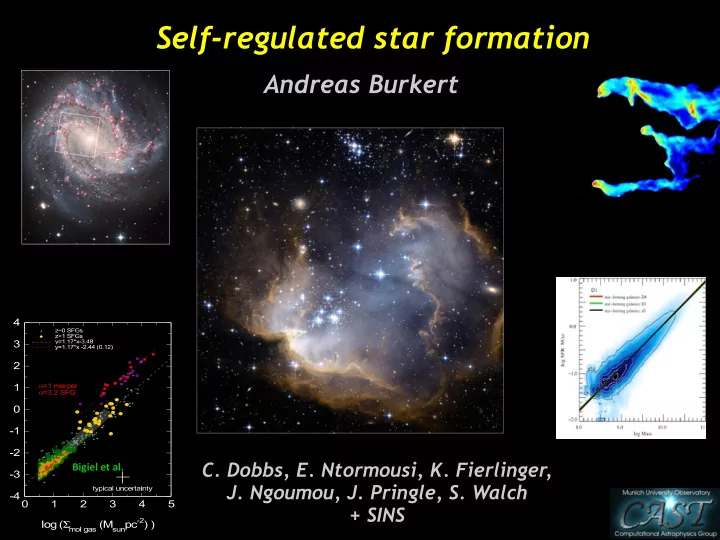
Self-regulated star formation Andreas Burkert C. Dobbs, E. Ntormousi, K. Fierlinger, Bigiel et al. J. Ngoumou, J. Pringle, S. Walch + SINS Munich Santa Cruz Evidence for self-regulation SFR = M H 2 with sf 1 2 10


slide-1
SLIDE 1

Self-regulated star formation

Bigiel ¡et ¡al. ¡

Andreas Burkert

  • C. Dobbs, E. Ntormousi, K. Fierlinger,
  • J. Ngoumou, J. Pringle, S. Walch

+ SINS

slide-2
SLIDE 2

Munich

slide-3
SLIDE 3

Santa Cruz

slide-4
SLIDE 4

Evidence for self-regulation

  • Gas depletion timescale 50 times

greater than local free-fall timescale.

SFR = M H2 τ sf with τ sf ≈ 1− 2 ⋅109 yrs

  • τ sf is almost independent of redshift

τ ff  τ sf < τ Hubble

continuous replenishment

Bouché et al. 07, McKee & Ostriker 08, Genzel et al. 10,11, Daddi et al. 10

Genzel et al. 11

slide-5
SLIDE 5

Turbulence in the ISM

(Dib, Bell & Burkert 2006) (Genzel et al. 10,11)

z=2 z=0

σ km / s

[ ]

SFR/Area

slide-6
SLIDE 6

Numerical simulations of the molecular web

( Dobbs, Burkert & Pringle 11a,b)

  • 3d SPH simulations (Bate et al. 95)
  • Fixed galactic gravitational potential (stellar disk + halo)
  • Calculations with and without an additional 2 or 4 armed spiral potential
  • Self-gravity of the gas component included
  • Heating (supernovae + FUV background)
  • Cooling: radiative + gas-grain energy transfer + recombination on grains
  • Stars form when a local molecular region collapses

and its density exceeds

ncrit = 250cm−3

  • A fraction ε of the gas is assumed to turn into stars that

heat the environment with an energy (winds and SN) of

ESN = ε M dense 160M ⋅1051ergs

ε ≈ 2 − 5%

slide-7
SLIDE 7

Calculation with 5 % efficiency

Dobbs, Burkert & Pringle 11a,b

slide-8
SLIDE 8

Filamentary interarm features (spurs)

Dobbs, Burkert & Pringle 11a,b

slide-9
SLIDE 9

Feedback puffs up disks

Dobbs, Burkert & Pringle 11a,b

slide-10
SLIDE 10

Star formation timescale

τ sf

SFR = M H2 τ sf with τ sf ≈ 1− 2 ⋅109 yrs

slide-11
SLIDE 11

Gas mass fraction and volume filling factor: 5% efficiency

slide-12
SLIDE 12
  • 1. Collisions by local gravitational instability and irregular gas

motions generate massive clouds and drive internal turbulence

slide-13
SLIDE 13
  • 2. Stellar feedback disperses clouds and drives irregular gas

motions in the molecular web.

slide-14
SLIDE 14

The molecular web

Schneider et al. 2010

slide-15
SLIDE 15

Gravitational instabilities and star formation timescale

+

n(t)

ρ  ρ0 exp t /τ

( ) with τ = 2⋅107 yrs

slide-16
SLIDE 16

(Toomre 1964; Goldreich & Lynden-Bell 65; Elmegreen 94; Kim & Ostriker 01, 06)

Gravitational disk instabilities

Gaseous disks will self-regulate themselves into a state of marginal stability

(Dekel et al. 09; Bournaud et al. 09; Krumholz & Burkert 10; Elmegreen & Burkert 10;

Genzel et al. 10, Burkert et al. 11; Dobbs et al. 11a,b)

Q ≡ κσ πGΣ ≈ 0.68...1

κ = 2Ω

slide-17
SLIDE 17

τToomre = σ πGΣ = κ −1 = 2Ω

( )

  • 1 → τ Toomre = 0.1⋅τ orb ≈ 2 ⋅107 yrs

Q = 1

τ orb  Rvir Vvir  H −1

Growth rate of gravitational instabilities:

τ SF ≈ 109 yrs ≈ 50 ⋅τToomre ≈ τToomre / ε

Gravitational instabilities affect galactic disk evolution

What determines the star formation efficiency?

slide-18
SLIDE 18

Gas velocity dispersion

SN driven Gravity driven SN driven Gravity driven

slide-19
SLIDE 19

What determines the star formation efficiency?

SN driven Gravity driven SN driven Gravity driven

slide-20
SLIDE 20

Higher gas surface densities/gas fractions

The gravity driven mode becomes more dominant for higher gas fractions. Gravity driven SN driven Gravity driven

Q = 1 → σ / vrot  fgas

slide-21
SLIDE 21
  • Very high molecular gas fractions

Tacconi et al. (2010)

Properties of z=2 fast rotating disk galaxies

  • Dominated by massive clumps
  • High velocity dispersions
slide-22
SLIDE 22

Gravity driven mode: formation of giant clumps

slide-23
SLIDE 23

Fraction of retrograde clouds

supernova driven Q driven

slide-24
SLIDE 24
  • 1

1 2 3 4 x

  • 11
  • 10
  • 9
  • 8
  • 7

y

2 kpc Genzel et al. (2011)

High-z disks: Q-driven mode?

slide-25
SLIDE 25
  • 1

1 2 3 4 x

  • 2
  • 1

1 2 z

Genzel et al. (2011)

Rotationally supported minidisks

vrot ≈ 200km / s

Expected:

vrot ≈ 10 − 40km / s

Observed:

  • 1

1 2 3 4 x

  • 11
  • 10
  • 9
  • 8
  • 7

y

2 kpc

High-z disks: Q-driven mode?

slide-26
SLIDE 26

Summary

  • The molecular web is regulated by gravitational instabilities and

stellar feedback.

  • The star formation timescale is set by the timescale of global disk

instabilities and the efficiency of star formation.

  • In the gravity-driven mode turbulence is regulated by Q≈1 leading to

massive, rotating cloud complexes and massive star clusters

  • In the feedback-driven mode turbulence is regulated by stellar feedback

leading to Q>1 and a power-spectrum of cloud masses, with highly turbulent clouds and negligible rotation. Galaxies might prefer to live in the transition region from gravity-driven to stellar feedback driven turbulence star formation efficiency