Self-Employment Tax and NIIT for LLCs and Higher Income Individuals: - - PowerPoint PPT Presentation

self employment tax and niit for llcs and higher income
SMART_READER_LITE
LIVE PREVIEW

Self-Employment Tax and NIIT for LLCs and Higher Income Individuals: - - PowerPoint PPT Presentation

Self-Employment Tax and NIIT for LLCs and Higher Income Individuals: Navigating the Complex Interplay .)-*/-,01 2 2


slide-1
SLIDE 1
  • !"#!"$ %& &&$ '()

*$+,-.

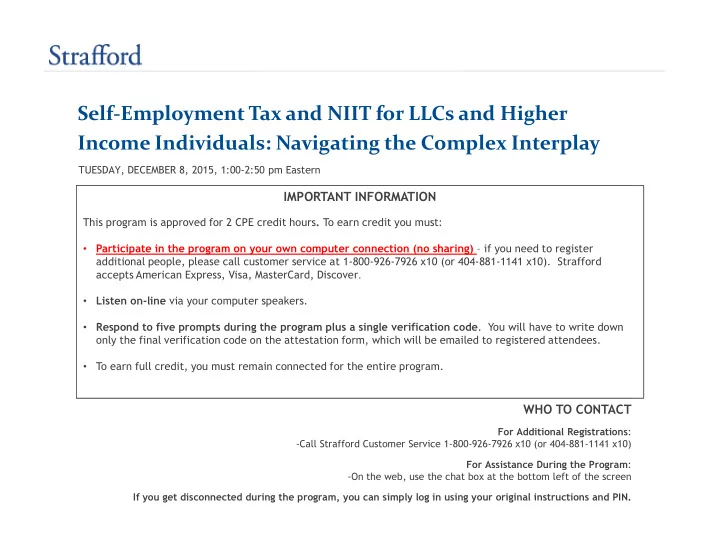
Self-Employment Tax and NIIT for LLCs and Higher Income Individuals: Navigating the Complex Interplay

.)-*/-,01 2 2 !!" )) !"#!"$ %& &&$ ' # 3455$5 $!!!%"""! *$+,-.

  • &'"6(
  • !$(!""($!(/444

445(

  • (
slide-2
SLIDE 2

Tips for Optimal Quality

  • 768

48 ( 98:5(

FOR LIVE EVENT ONLY

98:5( 45(

  • $;<665($

<6(

slide-3
SLIDE 3
  • ( 2

Self-Employment Tax and NIIT for LLCs and Higher Income Individuals

=1(04 )5> ?(54:5( @)( 7A60A>/ :4654(

slide-4
SLIDE 4

Notice

*B/*C*-+99B@9)3,,.B9*93B9)B39BB--31719B0/ @)*A1)D<91,)30.)-*B-*BB30.)-0/*E9B31*B/ 3@11)3B31B9/<31@.13)3<%'*+39-9BFB*E9)@* ,*/09,3)-3B*B/*C*/131%'13,39BF,*1A9BF31 13,,B-9BF3*B3@1*1/*B/,*1)*--1))-@19B(

/%' 4$$5 545 $$( 5 5?(*55 4$(

slide-5
SLIDE 5

Cameron Hess

Jim Browne

Cameron Hess

WAGNER KIRKMAN BLAINE KLOMPARENS & YOUMANS LLP Mather, CA 916.920-5286 x810 chess@wkblaw.com

Jim Browne

STRASBURGER & PRICE, LLP Dallas, TX 214.651.4420 jim.browne@strasburger.com December 8, 2015

slide-6
SLIDE 6

Agenda Agenda

Introduction Self-employment tax implications for LLC members Treatment of limited partners under 3.8% taxes Planning opportunities Planning opportunities Proposals and changes on the horizon

6

slide-7
SLIDE 7
  • 7
slide-8
SLIDE 8

Introduction Introduction

Supplemental Taxes (before 2013)

FICA/SET Employment tax on wages (“FICA”)

15.3% on base amount (indexed)*; 2.9% on excess Paid ½ by employer and ½ by employee Paid ½ by employer and ½ by employee

Tax on earnings from self-employment (“SET”)

15.3% on base amount (indexed and adjusted for wages); 2.9% on excess

Investment income

No supplemental tax

*$110,100 for 2012 8

slide-9
SLIDE 9

Introduction Introduction

Supplemental Taxes (current law 2013)

FICA/SET/Medicare/NII Employment tax on wages (“FICA”)

15.3% on base amount (indexed)*; 2.9% on excess Paid ½ by employer and ½ by employee

Additional 0.9% employee tax on excess wages of high-income

Additional 0.9% employee tax on excess wages of high-income

individuals

Tax on earnings from self-employment (“SET”)

15.3% on base amount (indexed and adjusted for wage income); 2.9% on

excess

Additional 0.9% tax on excess self-employment earnings of high-income

individuals

Investment income

3.8% tax on net investment income of certain high-income taxpayers*

*$118,500 for 2015 9

slide-10
SLIDE 10

Introduction Introduction

Application of FICA and SET additional tax

Affected (high-income) taxpayers

Individuals with wages and/or self-employment income in excess of:

$250,000 joint

$250,000 joint

$125,000 separate $200,000 individual and other

Additional tax applies only to the aggregate wages and self-

employment income in excess of the specified amounts

Thresholds are not indexed for inflation Corporations, estates, and trusts are exempt

Additional tax is subject to withholding or estimated tax

payments along with regular FICA or SET

10

slide-11
SLIDE 11

Introduction Introduction -

  • NII “basics”

NII “basics”

Additional Tax – Starting 1/1/2013. Applies to: individuals, estates and trusts

and: Sch K-1 entity reporting

Compute 3.8% Additional Tax x the lesser of: Compute 3.8% Additional Tax x the lesser of:

(1)

Total NII (net investment income), or

(2)

Excess MAGI*

*Excess MAGI = “MAGI minus Threshold Amount.

  • (Except US persons overseas, MAGI = AGI – Line 31 Form 1040.)

Total NII is after deduction for portion of Sched A, Form 1040 expenses (investment expenses, alloc. state income taxes)

11

slide-12
SLIDE 12

Individuals Individuals -

  • Threshold Amount

Threshold Amount

Status

Threshold Amount

Married filing jointly

$250,000

Married filing jointly

$250,000

Married filing separately

$125,000

Single

$200,000

Head of household

$200,000

Qualifying widow(er) with child

$250,000

12

slide-13
SLIDE 13

Trusts/Estates Trusts/Estates -

  • Threshold Am’t

Threshold Am’t

2015: $12,300 - CPI indexed ($12,450?-2016) Compare to individuals: Compare to individuals:

12,300 vs 125K/200K/250K Beneficiary distributions (of DNI)

generally reduces the NIIT to trust/estate

NII then passes to beneficiary

13

slide-14
SLIDE 14

Example 1 Example 1 – – Individual Individual

Big John (unmarried, in US) has

$300,000 NII (rental income) $190,000 AGI (had a business loss)

3.8% NIIT Computation:

NII Tax = $0. 3.8% x lesser of (1) $300K NII or (2) $0.0*

*(190K AGI – 200K Threshold)

14

slide-15
SLIDE 15

Example 1a Example 1a – – Irrev. Trust

  • Irrev. Trust

BJ Irrevocable Trust has

$300K NII; $190K AGI (business loss) No beneficiary distribution (no DNI Distribution)

3.8% NIIT Computation:

NII Tax = $6,752.60. 3.8% x lesser of (1) $300K NII or (2) $177,700* *(190,000 MAGI – 12,300 Threshold)

But, if $177,850 DNI distributed,

NII Tax = $0.0 ($12,150 AGI)

15

slide-16
SLIDE 16

Introduction Introduction

Application of NIIT (con’t)

Exempt taxpayers: Corps, foreign trusts, and TE or

charitable trusts

Partnerships and S corporations are not subject to NIIT, but Partnerships and S corporations are not subject to NIIT, but

the income of such entities may be subject to NIIT in the hands of the owners

Distributions from foreign trusts may be subject to NIIT in the

hands of the beneficiary

SET overlap: NII excludes income subject to SE tax Estimated tax: NIIT included in calculation of required

installments

16

slide-17
SLIDE 17

Introduction Introduction

NII = “Gross Investment Income (GII)” less: “Allowable Deductions”

GII Categories: GII Categories:

  • 1. Portfolio Income § 163 – SAME RULES
  • 2. PAL/PIG § 469

– FEW CHANGES

  • 3. Finance/Commodity traders-SAME RULES

NOT “day traders”.

Reduces value of security/commodity traders tax benefits

  • 4. Net Gain (Dispositions) – LOTS OF CHANGES

17

slide-18
SLIDE 18

Allowable Deductions Allowable Deductions

Normal related deductions (e.g., expenses for rentals) “1040 Schedule A” deductions (phase-outs)

State Income Taxes (allocate) Investment Interest Expenses (related) Other investment expenses (e.g., advisor fees) (related)

18

slide-19
SLIDE 19

Introduction Introduction

Common types of excluded income

Interest income on tax exempt bonds Income from qualified retirement plans Social security benefits Social security benefits Alimony Wages and self-employment income

19

slide-20
SLIDE 20
  • 20
slide-21
SLIDE 21

SET on LLC Members SET on LLC Members

Issue:

Can an LLC member treat any portion of the member’s

distributive share of LLC income as exempt from SET under the exception for limited partner distributive share under the exception for limited partner distributive share income? The issue is relevant only for LLC members who materially participate in the LLC business or can otherwise avoid NIIT on the distributive share income

21

slide-22
SLIDE 22

SET on LLC Members SET on LLC Members

The SET limited partner exception - 1402(a)(13)

In computing net earnings from self-employment:

Include the “distributive share (whether or not distributed) of

income or loss described in section 702(a)(8) from any trade or business carried on by a partnership of which he is a member” business carried on by a partnership of which he is a member”

Exclude (in addition to normal exclusions for rents, dividends,

gains, etc.):

“the distributive share of any item of income or loss of a limited

partner, as such,

  • ther than guaranteed payments described in section 707(c) to

that partner for services actually rendered to or on behalf of the partnership to the extent that those payments are established to be in the nature of remuneration for those services”

22

slide-23
SLIDE 23

SET on LLC Members SET on LLC Members

Purpose for the limited partner exception

Before enactment of 1402(a)(13) in 1977, persons ineligible for

social security benefits were buying passive, limited liability investments in partnerships that promised to generate self- employment income eligible for such benefits employment income eligible for such benefits

Congress enacted 1402(a)(13) to curtail “buying” social

security benefits through limited partner investments

While the statute targets passive limited partners earning

investment type income, the statute is not limited to such persons

The statute expressly contemplates that a limited partner

may provide services to the partnership and earn a guaranteed payment for such services and still have distributive share income excluded from SET and related benefit accruals

23

slide-24
SLIDE 24

SET on LLC Members SET on LLC Members

The 1997 proposed regulations

Context:

Traditional restrictions on limited partner management activities

eroding

Growing use of alternative forms of tax partnerships with full or partial

limited liability for managing members (LLCs, LLPs, and LLLPs) limited liability for managing members (LLCs, LLPs, and LLLPs)

Increasing SET rate relative to benefits

General rule: a “limited partner” is any individual unless the

individual:

has personal liability as a partner for the partnership’s debts, or has authority (under the law of the jurisdiction in which the partnership

is formed) to contract for the partnership, or

participates in the partnership's business for more than 500 hours

during the partnership’s taxable year, or

is a service partner in a service partnership

24

slide-25
SLIDE 25

SET on LLC Members SET on LLC Members

The 1997 proposed regulations (con’t)

Class of Interest Exceptions

An individual holding more than one class of interest is a limited

partner with respect to a class of interest in which (a) limited partners (as defined above) own a substantial (≥20%), continuing interest and (b) the individual’s rights are identical to such limited interest and (b) the individual’s rights are identical to such limited partners’ rights

An individual holding only one class of interest who is not a

limited partner solely because he participates in the business for >500 hours is a limited partner with respect to the interest if (a) and (b) above are true with respect to the class of interest

These exceptions are intended to “exclude from an individual's net

earnings from self-employment amounts that are demonstrably returns on capital invested in the partnership”

A service partner in a service partnership is never a limited partner

to any extent (i.e., no class of interest exception)

25

slide-26
SLIDE 26

SET on LLC Members SET on LLC Members

Congress responds

The 1997 proposed regulations sparked a firestorm of

criticism

Critics claimed that earnings from self-employment must be limited

to the fair value of the services actually rendered to the business, and should not sweep in all income derived from the business based on should not sweep in all income derived from the business based on arbitrary factors such as the number or hours worked or the nature

  • f the business

Congress promptly passed legislation prohibiting finalization

  • f regulations with respect to the definition of limited partner

under 1402(a)(13) until July 1, 1998

The Senate bill expressed the Senate’s view that the proposed

regulations should be withdrawn and that “Congress should determine the tax law governing self-employment income”

26

slide-27
SLIDE 27

SET on LLC Members SET on LLC Members

Case law and rulings

Passive activity loss cases

Several cases (see slide 47) address the question whether an LLC

member is a “limited partner” for purposes of the passive activity loss rules (material participation test) [Reg. 1.469-5T(e)] loss rules (material participation test) [Reg. 1.469-5T(e)]

All cases hold that an LLC member is not a limited partner Could those cases be applied in the context of 1402(a)(13)?

The reasoning of the cases is dubious and was likely

influenced by the questionable validity of the temporary regulations, which were modified in 2011

Should not be authoritative for SET purposes

27

slide-28
SLIDE 28

SET on LLC Members SET on LLC Members

Case law and rulings (con’t)

SET cases and rulings

Renkemeyer, Campbell & Weaver, LLP v. Comm’r, 136 T.C. 137 (2011)

Law firm organized as a general partnership electing LLP status Abusive facts: transitory corporate holding company; missing Abusive facts: transitory corporate holding company; missing

partnership agreement; failure to allocate income and distributions according to alleged sharing ratios; low or no compensation for services

Dubious reasoning: Court discusses the legislative history of 1402(a)(13) Intent to exclude “earnings that are basically of an investment nature” The legislative history “does not support a holding that

Congress contemplated excluding partners who performed services for a partnership in their capacity as partners”

Because the taxpayers’ distributive share income arose exclusively from

legal services performed on behalf of the partnership, and was not “of an investment nature,” the income was subject to SET

28

slide-29
SLIDE 29

SET on LLC Members SET on LLC Members

Case law and rulings (con’t)

SET cases and rulings

Riether v. United States, 919 F. Supp. 2d 1140 (D. NM 2012)

LLC operates a medical diagnostic imaging business; members

receive wages and distributive share income from the LLC; no SET on distributive share (<$10,000 tax effect) distributive share (<$10,000 tax effect)

Taxpayers assert they can’t be self-employed because they received

wages

No evidence that members lacked management authority, or that

wages were reasonable compensation for services

Held: distributive share income is subject to SET because taxpayers

were effectively general partners

“Plaintiffs are not members of a limited partnership, nor do they resemble

limited partners, which are those who ‘lack management powers but enjoy immunity from liability for debts of the partnership.’ [Renkemeyer] Thus, whether Plaintiffs were active or passive in the production of the LLC's earnings, those earnings were self-employment income.”

29
slide-30
SLIDE 30

SET on LLC Members SET on LLC Members

Case law and rulings (con’t)

SET cases and rulings

Howell v. Comm’r, 2012 T.C. Memo 303

Medical technology company (LLC) formed by W and B; H (W’s

spouse) managed the business with B; LLC paid guaranteed payments to H, B, W and others, leaving only small amounts of distributive to H, B, W and others, leaving only small amounts of distributive share income for W and B; no SET paid on guaranteed payments

H&W “appear to contend” that W was a limited partner not active in

the business and her guaranteed payments were either limited partner distributive share income or not payments for services

Held: Taxpayers are bound by their tax reporting (guaranteed

payment)

W performed some services for the LLC, but failed to prove what

portion of the guaranteed payments were for services

Notably, no SET imposed on distributive share income 30

slide-31
SLIDE 31

SET on LLC Members SET on LLC Members

Case law and rulings (con’t)

SET cases and rulings

CCA 201436049 (May 20, 2014)

Investment fund management company organized as an LLC;

members were paid a salary, a guaranteed payment for parking and health benefits, and a distributive share; no SET on distributive share health benefits, and a distributive share; no SET on distributive share

Members contributed varying amounts of capital to the LLC Held: entire distributive share income is subject to SET because the

income “is not income which is basically of an investment nature

  • f the sort that Congress sought to exclude from [SET] when it

enacted the predecessor to § 1402(a)(13). Accordingly, [the members] are not limited partners within the meaning of § 1402(a)(13).”

No analysis whether the salary and guaranteed payments

represented reasonable compensation for services

No analysis whether the distributive share income was attributable

to capital contributions, profits on employee labor, or other non- service factors

31

slide-32
SLIDE 32

SET on LLC Members SET on LLC Members

Where are we now?

Reporting position: an LLC member’s distributive share

income from a manager-managed LLC is exempt from SET if the member is paid reasonable compensation for services as a manager manager

This position is easily reconciled with the statute and legislative

history, including the arguments that led to the 1997 Congressional moratorium

It is consistent with the treatment of S corporations It is consistent with the recent cases on their facts IRS position that distributive share income of an active partner is

always subject to SET is plainly contrary to the statute, Congressional intent (as expressed in 1997), and its litigating position in Howell Service partners in service partnerships have more risk

32

slide-33
SLIDE 33
  • !

!

33

slide-34
SLIDE 34

Review Basics Review Basics

Effective 1/1/2013. Applies to: individuals, estates and trusts

and: Sch K-1 entity reporting

Compute 3.8% Additional Tax x the lesser of:

(1)

Total NII (net investment income), or

(2)

Excess MAGI*

*Excess MAGI = “MAGI minus Threshold Amount.

34

slide-35
SLIDE 35

NII Tax and Business Entities NII Tax and Business Entities

Not a Corporate/Partnership Level Tax

PSC/Closely Held “C” Corps

Subject to § 469 – PAL Limitations Subject to § 469 – PAL Limitations But Not NIIT

35

slide-36
SLIDE 36

NII Tax and Business Entities NII Tax and Business Entities

S Corp Holders/Partners (Indiv/Trusts/Estates)

HAVE NII PASSHROUGH (K-1) Including:

  • 1. Portfolio Income § 163
  • 1. Portfolio Income § 163
  • 2. PAL/PIG § 469
  • 3. Finance/Commodity Traders Income
  • 4. Net Gain (Dispositions)

36

slide-37
SLIDE 37

Pass Pass-

  • Through to Partners

Through to Partners

NII results if partner’s T/B income

= passive activity (§469).

IRS Statement – Will NOT follow all §469 exceptions:

“Even if the taxpayer meets one of the

exceptions in Section 1.4691-T(e)(3)(ii), if the taxpayer’s activity is not a section 162 trade or business, gross income from rents will be subject to Section 1411(c)(1)(A)(i).

37

slide-38
SLIDE 38

Pass Pass-

  • Through to Partners

Through to Partners Real Estate Professional Real Estate Professional

IRS will not apply following 469 active T/B presum’ns:

§ 1.469-1T(e)(3)(ii) (Deemed T/B - 6 items)

“Start-up” activity presumed T/B “Predevelopment revenue” Not active T/B for NII “Predevelopment revenue” Not active T/B for NII

Example 3b: Developer leaseback to farmer land held for

  • development. While not passive under Section 469, rental

income will be deemed NII.

Note – expect developers to claim

they are farmers.

38

slide-39
SLIDE 39

Pass Pass-

  • Through

Through to Partners to Partners Real Real Estate Estate Professional Professional

1.469-5T(a)(1) Safe Harbor Allowed:

Real estate professional (>750 hrs) +

  • 1. participates in rental real estate activities;
  • 1. participates in rental real estate activities;
  • 2. time in activity = > than 500 hours per year,
  • 3. income associated with that activity*
  • Active T/B , and thus not subject to §1411.

*Activity Must be Part of That Active Trade or Business

39

slide-40
SLIDE 40

Pass Pass-

  • Through

Through to Partners to Partners Real Real Estate Estate Professional Professional

Alternate Safe Harbor Allowed:

Real estate professional (>750 hrs) +

  • 1. participates in rental real estate activities;
  • 1. participates in rental real estate activities;
  • 2. > than 500 hours/year in 5 of 10 prior years,
  • 3. income associated with that activity*
  • Active T/B , and thus not subject to §1411.

*Activity Must be Part of That Active Trade or Business

40

slide-41
SLIDE 41

Pass Pass-

  • Through

Through to Partners to Partners Real Real Estate Estate Professional Professional

Non-Safe - General Rule:

Real estate professional (>750 hrs) +

  • 1. participates in rental real estate activities;
  • 1. participates in rental real estate activities;
  • 2. rental activities are substantial,
  • 3. income associated with that activity*
  • 4. derived in the ordinary course of a trade/business

If prove it’s a T/B , then it’s not subject to §1411. *Activity Must be Part of That Active Trade or Business

41

slide-42
SLIDE 42

Pass Pass-

  • Through to Partners

Through to Partners Limited Partner Problem Limited Partner Problem

BUT: Limited Partners: §469(h)(2)

Except as provided in regulations, no interest in a limited partnership as a limited partner shall be treated as an partnership as a limited partner shall be treated as an interest with respect to which the taxpayer materially participates.

And 469(h)(6)(c) says the same thing as to active

participation.

42

slide-43
SLIDE 43

Pass Pass-

  • Through to Partners

Through to Partners Limited Partner Problem Limited Partner Problem

Two Part Analysis to Get Around:

1.

Is the interest “classified” as a limited partner interest for tax purposes? for tax purposes?

2.

If “classified”, does the limited partner meet one of 3 exceptions?

43

slide-44
SLIDE 44

Pass Pass-

  • Through

Through to Partners to Partners Limited Partner Problem Limited Partner Problem

So, to avoid NIIT, partner must both:

qualify as real estate professional and either (i) NOT be deemed a limited partner, or

(ii) meet an exception due to substantial activities. (ii) meet an exception due to substantial activities.

Affected: Interests in LLCs, LPs, LLPs, LLLPs, other

entities treated as “partnership”.

Definition of Limited Partners by Statute?

  • NO. Not found under Section 469, 7701, or 1402(a)(13)

(self-employment tax exception)

44

slide-45
SLIDE 45

Pass Pass-

  • Through

Through to Partners to Partners Limited Partner Problem Limited Partner Problem

How classify/“define” a limited partner.

State Law vs. Tax Law Old Kintner Regulations not useful:

Continuity of Life Continuity of Life Transferability limitations? Limited liability Centralized Management

Littriello v. US (6th Cir. 2007). Treasury does not have to

follow state law for taxpayer-businesses; and can set own rules where Congress not clear and unambiguous.

45

slide-46
SLIDE 46

Pass Pass-

  • Through

Through -

  • R/E Professional

R/E Professional Limited Partner Problem Limited Partner Problem

Limited Partner Defined: Temp Reg. 1.469-5T(e)(3)(i)

...interest [is] a limited partnership interest if— (A) …. designated a limited partnership interest in the (A) …. designated a limited partnership interest in the limited partnership agreement or the certificate of limited partnership, ….; or (B) The liability of the holder … for obligations of the partnership is limited, ….. … interest … shall not be treated as a limited partnership interest …. if the individual is a general partner.

46

slide-47
SLIDE 47

Pass Pass-

  • Through

Through -

  • R/E Professional

R/E Professional Limited Partner Problem Limited Partner Problem

But courts declined LP treatment for LLC members:

Gregg v. U.S., 186 F.Supp.2d 1123 (D. Or. 2000). LLC. Garnett v. Com’r, 132 T.C. 368 (2009). LLPs and LLCs were not limited partnerships. not limited partnerships. Thompson v. U.S., 87 Fed. Cl. 728 (2009). 469(h)(2) requires a partnership. An LLC member is not a limited partner. Newell v. Com’r, T.C. Memo. 2010-23. 469(h)(2) did not apply to the managing member of an LLC. Member is a general partner under §1.469-5T(e)(3)(ii). Lamas v. Com’r, T.C. Memo 2015-59. Several LLCs & S Corp. Rejects no material participation. Aggregates S Corps & LLC activities – total hours adequate.

47

slide-48
SLIDE 48

Pass Pass-

  • Through

Through -

  • R/E Professional

R/E Professional Limited Partner Problem Limited Partner Problem

But Proposed Treas. Reg. 1.469-5(e)(3)(i) (11/28/11)

...interest [is] a limited partnership interest if— (A) The entity…is classified as a partnership for (A) The entity…is classified as a partnership for Federal income tax purposes under §301.7701-3; and (B) The holder of such interest does not have rights to manage the entity….. IRS listed as 2015-2016 priority project July 2015.

http://www.irs.gov/pub/irs-utl/2015-2016_pgp_initial.pdf

48

slide-49
SLIDE 49

Pass Pass-

  • Through

Through to Partners to Partners Limited Partner Problem Limited Partner Problem

If interest is “classified” as a limited partner, IRC §

469(h)(2) presumes interest is per se passive.

Three exceptions:

Taxpayer works 500 hours or more in the particular Taxpayer works 500 hours or more in the particular

trade or business activity.

Taxpayer materially participated in the activity in any 5

  • f the prior 10 years.

It is a personal service activity; taxpayer materially

participated in that activity in any 3 prior years.

Did the IRS eliminate test #3 for NII purposes???

49

slide-50
SLIDE 50

Related Issue Related Issue -

  • Trustees

Trustees Basics Basics

Same rules Threshold Amount:

2015: $12,300 - CPI indexed 2015: $12,300 - CPI indexed 2016 $12,450?

Distributions of DNI also pass-through

NII to beneficiaries.

50

slide-51
SLIDE 51

Related Related – – Trustees as R/E Professional Trustees as R/E Professional

Example: Trust owns % in LLC.

Trustee = limited partner? Can Trustee materially participate? Can Trustee materially participate? IRS Declined to Issue Regulations

IRS position vs. taxpayers

51

slide-52
SLIDE 52

Trustee Trustee Material Participation Material Participation

IRS: Material participation by nongrantor trust depends on

trustee’s activity, not it’s agents (or special trustee) 1. BUT

1Position discussed by IRS in TAM 200733023; PLR 201029014; TAM 201317010.

Carter Trust v. US 256 F. Supp. 2d 536 (N.D. Tex. 2003).

Trustee hired ranch manager. Material participation found through employees and trustee.

Aragona Trust v. Com’r, 142 TC. 9 (3/27/14). 3 of 6 trustees

(related) worked FT for R/E management LLC, wholly owned by trust. Trust can materially participate through trustee- employees; R/E professional exception applied.

52

slide-53
SLIDE 53

Limited Partner/Trust Rules Limited Partner/Trust Rules

Same Issue/Same Framework? Material Participation & Real Estate Professional:

Partnership - Determined at Partner Level

Trust – Determined at Trustee Level (if trustee does

Trust – Determined at Trustee Level (if trustee does

material activities + agents activities.

Unclear:

R/E Pro Exception – Trust. If agents provide services,

are they counted?

  • Beneficiaries. If NO NIIT @ Trust Level, is income

treated as “active” for beneficiaries @ distribution?

53

slide-54
SLIDE 54

Roth/IRAs & NIIT Roth/IRAs & NIIT

Distributions from IRA/Roth not s/t 3.8% NIIT

Can hold Real Estate as Investment

Caution: real estate held poses possible issues:

UBIT (Tax at Trust Rates – 39.6% @ $12,300 TI) UBIT (Tax at Trust Rates – 39.6% @ $12,300 TI) Actively “Trade”– Plan Disqualification Inurnment – Plan Disqualification Prohibited Self-Dealing No Capital Gains

Schieck, Structuring Real Estate Investments to Avoid the

Net Investment Tax, 41 J. Real Estate Tax’n (Q1 2014)

54

slide-55
SLIDE 55

" "

55

slide-56
SLIDE 56

Planning Planning Trap #1 Trap #1

Using an S corporation to avoid SET/NIIT

The properly determined distributive share income of an

S corporation engaged in an active non-trading business is unquestionably exempt from both SET and NIIT

BUT

S corporations have significant disadvantages. (e.g., one class

  • f stock, no entity or foreign shareholders, no 754 election, no

721/731 exclusion for gain on property contributions and distributions, no inside basis step-up at death, etc.)

The perceived SET/NIIT benefits may be overstated A properly structured LLC/LP should achieve similar SET

benefits.

56

slide-57
SLIDE 57

Planning Planning Trap #2 Trap #2

S corporation election for an LLC or LP

Tax preparers or other tax advisors often elect S

corporation status for an LLC or LP solely to obtain SET and NIIT advantages. This is usually bad advice! and NIIT advantages. This is usually bad advice!

Same considerations as any S corporation (see prior slide) Plus additional potential problems if the company agreement

is not modified to conform to S corporation requirements; the entity might be classified as a C corporation!

57

slide-58
SLIDE 58

Planning Planning Trap #3 Trap #3

S corporation blocker

What if the LLC/LP interests are owned by single member S corps?

Individual A Individual B Individual C

Individuals are employees of LLC or S corp and are paid wages Distributive share income flows through S corporations NB: Cumbersome and does not eliminate all disadvantages of

S corporation ownership

S Corp 1 S Corp 2 S Corp 3

S Corp. S Corp. S Corp.

LLC

Partnership

58

slide-59
SLIDE 59

Planning Opportunities Planning Opportunities

A properly structured LLC/LP

Individual A Individual B Individual C

Individuals perform services for LLC as employees of Manager Distributive share income received by individuals as an LLC

member having no management rights

Same structure can be used for a limited partnership

(Manager is the general partner)

59

Manager

S Corp. (or LLC)

Manager-Managed LLC

Partnership Management Fees

slide-60
SLIDE 60

Planning Opportunities Planning Opportunities

Spousal split ownership of LLC/LP

Taxpayer Spouse

Managing Member Member

T’s activities are imputed to S for passive activity

purposes, but are not imputed to S for purposes of SET limited partner proposed regulations

S’s distributive share income should avoid SET/NIIT

60

OpCo, LLC

Partnership Active non-trading, non- service business Member 1% Member 99% Guaranteed Payment for Services

slide-61
SLIDE 61

Planning Opportunities Planning Opportunities

One class of interest exception

Taxpayer Others

Managing Member Member

  • T’s distributive share income is exempt from SET under
  • ne class of interest exception, and is exempt from NIIT

based on material participation

61

OpCo, LLC

Partnership Active non-trading, non- service business Member

80% 20%

Guaranteed Payment for Services

slide-62
SLIDE 62

Planning Opportunities Planning Opportunities

Grouping

One or more business activities may be treated as a single

activity (“grouped”) if the activities constitute an “appropriate economic unit” for the measurement of gain or loss for purposes of Section 469 [Reg. 1.469-4(c)(1)]

Appropriate economic unit depends on facts and circumstances

Appropriate economic unit depends on facts and circumstances Generally, use any reasonable method to group activities Five factors are given the greatest weight in determining whether

activities constitute an appropriate economic unit:

Similarities or differences in the types of businesses; Extent of common control; Extent of common ownership; Geographical location; and Interdependence of the activities 62

slide-63
SLIDE 63

Planning Opportunities Planning Opportunities

Limitations on grouping

A rental activity can’t be grouped with a trade or business

activity unless they form an appropriate economic unit and

Rental activity is insubstantial in relation to business activity; Business activity is insubstantial in relation to rental activity; or Common ownership

Can’t group real property rental activity with personal

property rental activity

Special rules for special industry activities described in

Section 465(c)(2) (film, depreciable person property leasing, farming, oil and gas, and geothermal property)

63

slide-64
SLIDE 64

Planning Opportunities Planning Opportunities

Special NIIT re-grouping election

A one-time regrouping election is available during the

first taxable year that NII exceeds the threshold amounts (first time Form 8960 would be filed) [Reg. 1.469-11(b)(3)(iv)] (first time Form 8960 would be filed) [Reg. 1.469-11(b)(3)(iv)]

Taxpayers may regroup on an amended return if the

taxpayer was not subject to NIIT on original return (or previously amended return) and, if, due to a change to the original return, the taxpayer owed NIIT for that taxable year

64

slide-65
SLIDE 65

Planning Opportunities Planning Opportunities

Limitations on grouping

Final regulations do NOT allow regrouping by partnerships

and S corporations

Opportunity for regrouping – 2nd Bite (different taxpayer) Opportunity for regrouping – 2

Bite (different taxpayer)

Estate/Trust @ 1st Spouse’s Death Sub-Trust Funded for Children Distribution of property out of trust/estate

65

slide-66
SLIDE 66

Planning Opportunities Planning Opportunities

Planning

Under prior law, it was often advantageous to not group

activities (to accelerate use of suspended losses on activities sold or terminated) activities sold or terminated)

Under current law, it might be beneficial to group

activities so that otherwise passive activities that do not generate self-employment income can become part of an Active Non-Trading Business that generates neither NII nor self-employment income

66

slide-67
SLIDE 67

Planning Opportunities Planning Opportunities

Self Charged Interest. On self-charged interest from an active (non-passive)

business entity, a portion of interest income will be excluded. excluded.

The exclusion amount = the lender’s “share of the

nonpassive deduction”. The rule cross-references §1.469– 7 for the operative mechanics.

The limit is inapplicable if the interest deduction is part

  • f a self-employment income computation (subject to

tax under section 1401(b)).

67

slide-68
SLIDE 68

Planning Opportunities Planning Opportunities

Self Charged Interest.

  • Example. Able Designer loans $100,000 @ 10% to an

architecture firm in which he owns 15% of the architecture firm located in the same building. Will architecture firm located in the same building. Will 100% of the $$ interest paid by the firm be treated as self-charged rent?

  • No. There is only excluded the income = to the %

interest deduction born. Only $1,500 of the $10,000 received will be excluded. $8,500 of the interest will remain NII

68

slide-69
SLIDE 69

Planning Opportunities Planning Opportunities

Property s/t “Self-Charged” Rent

Rental income treated as non-passive under §1.469–

2(f)(6) (rental income from property used in an activity in which the taxpayer materially participates), including in which the taxpayer materially participates), including rental property grouped with a non-passive activity, will be deed T/B income.

Gain/loss from rental property, if sold with active T/B

property will also be treated as nonpassive T/B gain

69

slide-70
SLIDE 70

Planning Opportunities Planning Opportunities

Property s/t “Self-Charged” Rent

  • Example. Able Designer owns 100% of a building and

15% of the architecture firm located in the same 15% of the architecture firm located in the same

  • building. Will 100% of the $$ rent paid by the firm be

treated as self-charged rent?

Yes, under 1.469-2(f)(6), amount of rent paid by the firm will be treated as non-passive. The self-rental regulations do not require “mirror” ownership.

70

slide-71
SLIDE 71

Planning Opportunities Planning Opportunities

Avoiding NIIT through material participation

Participation by Hours > 500

Time spent (Self/Spouse) Proof of Participation. Appointment book calendar, or Proof of Participation. Appointment book calendar, or

narrative summary. To show the services performed & hours.

Facts & Circumstances Test (difficult)

Activity regular, continuous, and substantial Works at least 100 hours in the activity, No one else works more hours No one else receives compensation for managing the activity

71

slide-72
SLIDE 72

Planning Opportunities Planning Opportunities

Exclusions

Per IRS – Exclude:

Time to i) review financial statements, ii) analysis for personal use,

and iii) monitoring (non-managerial) capacity does not count

Owner work that would normally be assigned to an employee Travel Time Thomas E. Truskowsky, T.C. Summary Op 2003-130

Per IRS: Few taxpayers can meet the facts and circumstances

  • standard. If there is paid on-site management, the facts and

circumstances test cannot be used.

Are these position over-reaching? An on-site manager for 100

unit apartment defeats active T or B!!???

72

slide-73
SLIDE 73

Planning Opportunities Planning Opportunities

Significant participation “sweet spot”

A high income individual having a non-managing

LP/LLC interest in a passive activity can generally avoid SET and NIIT on distributive share income if participation in the activity exceeds 100 hours but is less participation in the activity exceeds 100 hours but is less than 500 hours (i.e., is significant but not material)

The individual’s distributive share income is exempt from SET

(unless the individual has management authority or is a service partner in a service partnership) [Prop. Reg. 1.1402(a)-2]

The individual’s distributive share income may be exempt from

NIIT under the income recharacterization rules for profitable significant participation activities [Reg. 1.1411-5(b)(2)(i)]

73

slide-74
SLIDE 74

Planning Opportunities Planning Opportunities

Net Gain from Dispositions

Opportunities to reduce losses by:

Strategies to reduce NII by Sec.165 losses: abandonment and

worthlessness. worthlessness.

Culling of losses.

Basic exceptions/limitations/exclusions apply

Loss limitations (at risk, basis, but capital loss C/F rules are

narrower)

Installment sale rules Statutory Exclusions apply – 1031/1033/1038/121(home)

Look Through Rule:……

74

slide-75
SLIDE 75

Business Business Dispo Dispo Look Look-

  • Through Rule

Through Rule

Owner’s “Disposition” of Interest in Pship or S Corp

1411(c)(4) & (Prop. Treas. Reg. 1.1411-7). Recasts NII gain/loss as business gain/loss.

In the case of a disposition of an interest in a partnership or In the case of a disposition of an interest in a partnership or an S corporation –

(A) gain from such a disposition shall be taken into account…only to the extent of the net gain…if all property of the partnership or S corporation were sold at fair market value immediately before the disposition of such interest, and (B) a rule similar to the rule of subparagraph (A) shall apply to a loss from such disposition.

75

slide-76
SLIDE 76

Look Look-

  • Through Rule:

Through Rule:

  • Why. Owner’s pass-through business won’t be treated as

an investment. If sell interest – deemed like asset sale.

How: “look-through”: Had entity its assets (“deemed sale”)

at FMV, what portion would be business income? (Prop. at FMV, what portion would be business income? (Prop.

  • Treas. Reg. Section 1.1411-7).

Trade/business portion is excluded from NII “net gain from

disposition”.

Complicated Computation - difficult to qualify.

NOTE!: Does not apply to owner of C Corp!

76

slide-77
SLIDE 77

Look Through Computation Look Through Computation

Summary

T’s gain from sale of interest is bifurcated:

if part of gain from sale relates to trade/business portion sold,

total gain included in NII is reduced (negative adjustment) total gain included in NII is reduced (negative adjustment)

T’s loss bifurcated: if part of loss from sale relates to

trade/business sold, total loss is reduced – offset against

  • ther disposition gains is less (positive adjustment)

“Excess” = deemed investment gain/loss

Note: Adjustment doesn’t increase total gain or total

loss from sale of interest.

77

slide-78
SLIDE 78

Look Look-

  • Through Steps

Through Steps

  • 1. Compute total gain/loss from disposition of interest.
  • 2. Compute entity level total gain/loss from deemed FMV

sale;

  • 3. Compute gain/loss deemed for each separate entity
  • 3. Compute gain/loss deemed for each separate entity

asset (including goodwill);

  • 4. Multiply % interest sold x each gain/loss (the look

through);

  • 5. Sort gain/loss between:

(i) net investment income and (ii) excluded income (e.g., trade or business income.)

78

slide-79
SLIDE 79

Example Example – – AB AB P’ship P’ship – – all T/B all T/B

AB Tax Consultants – B Has Basis of $75,000

B (75%) Sells Interest to C for

79

A (25%)

Interest to C for $90,000

AB Partnership A/B Assets = $120K

slide-80
SLIDE 80

Example Example – – All T/B All T/B

Step 1. B’s Gain = $15,000. ($90,000 – 75,000) Step 2. AB Pship Built in Gain=$20,000 ($120 - $100K basis)

B’s share (75%) = $15,000 (same)

  • Step 3. Assume 100% business

If B active in T/B, 100% active T/B Gain; and. Therefore 100% excluded from NII

NII from disposition = $0.00

($15,000 minus $15,000 = $0.00).

80

slide-81
SLIDE 81

Example < 100% T/B Example < 100% T/B

Step 1: Same: B’s Gain = $15,000 Step 2: Assume: AB Pship - $10,000 Built In Gain –

adjusted basis = $110.00. Step 3: Assume has investment Step 3: Assume has investment

Assets: Investment $5,000 gain (25%)

Tangible $15,000 gain (75%)

Step 4: 75% x $5,000 = $3,500

75% x $15,000 = $12,500)

Step 5: $12,500 of B’s $15,000 Gain excluded T/B

gain.

NII = $3,500 ($15,000 - $12,500 excluded)

81

slide-82
SLIDE 82

Example of Look Through Loss Example of Look Through Loss

Assume B sold at loss instead: $5,000 Loss (e.g.,

B’s basis is $95,000).

Under either prior example, AB Pship’s (Built in Under either prior example, AB Pship’s (Built in

Gain) = $20,000

B’s share is $15,000

$5,000 loss will be treated 100% as investment

loss.

Deemed sale gain cannot increase the loss.

82

slide-83
SLIDE 83

Other Business Entity Strategies Other Business Entity Strategies

Installment Sales Section 1031 Exchanges Charitable Donation of Appreciated Property Distributing investment assets Distributing investment assets Successor Trusts (active Trustee) – see above Spreading Investment Income (Family Limited

Partnerships & LLCS)

Suitable Investments Managing Estate or Trust Distributions Creating Material Participation in Passive Activities

83

slide-84
SLIDE 84

# #$% #$%

84

slide-85
SLIDE 85

Proposals and Changes Proposals and Changes

Joint Committee SET proposal (2005)

Repeal limited partner exception Partner that does not materially participate pays SET

  • nly on reasonable compensation for services
  • nly on reasonable compensation for services

Investment income of a service partnership is subject to

SET

S corporation is treated as a partnership for SET

purposes

85

slide-86
SLIDE 86

Proposals and Changes Proposals and Changes

American Jobs and Closing Tax Loopholes Act (2010)

Impose SET on distributive share income of each shareholder

  • f a “disqualified S corporation” who provides substantial

services with respect to the professional service business of the S corporation

Disqualified S corporation:

Disqualified S corporation:

S corporation that is a partner in a partnership engaged in a

professional services business and substantially all activities are in connection with such partnership

S corporation engaged in a professional services business if the

principal asset is the reputation and skill of three or fewer employees Impose SET on any limited partner who provides substantial

services with respect to a a partnership engaged in a professional services business

86

slide-87
SLIDE 87

Proposals and Changes Proposals and Changes

CBO SET proposals (2012)

Material participation standard

SET imposed on distributive share income of all partners who

materially participate Reasonable compensation standard Reasonable compensation standard

SET imposed only on reasonable compensation paid to owners

(same as for S corporations)

Reduces SET revenues by estimated 58% (based on underreporting

  • bserved for S corporations)

Safe-harbor calculation of capital income

Apply a prescribed rate of return to balance sheet net operating

assets

Would not apply to S corporations No accounting for intangibles and other off-balance sheet income

producing assets

87

slide-88
SLIDE 88

Proposals and Changes Proposals and Changes

Carried interests

Would treat a partner’s distributive share of net income

  • r net loss with respect to an “investment services

partnership interest” (“ISPI”) as ordinary income or loss partnership interest” (“ISPI”) as ordinary income or loss

ISPI = interest held by a person providing a substantial

quantity of investment management services with respect to partnership specified assets (securities, real estate, partnership interests, and commodities)

Amount characterized as ordinary income or loss is

subject to SET

88

slide-89
SLIDE 89

Proposals and Changes Proposals and Changes

Obama/Treasury proposal(pre-Fiscal Cliff)

Return of Kintner Regs. – entity choice not for tax red’n.

House Tax Reform Proposals (2013)

Option 1: revise rules for S Corps and P’ships

Option 1: revise rules for S Corps and P’ships

Does not address SET

Option 2: Adopt 1 set of rules for S Corps and P’ships

Would require some rule characterizing distributive share

income

GOP (2014)

SET applies to 100% distrib. share, GP, LP, S Corp, LLC

89

slide-90
SLIDE 90

Proposals and Changes Proposals and Changes

July 31, 2015 IRS 2015-2016 Priority Guidance Plan

Final Regulations Under Section 469(h)(2) – Ltd P’ships Finalize open portions of Section 1411 regulations

AICPA Proposals to Treasury AICPA Proposals to Treasury

Clarify material participation Clean up of regulations/statutory reform

Obama’s Buffet Rule (30% min tax on TI > $1 million Bush Proposal – elim. 6.2% employee SET on seniors.

No change to LPs/LLCs (Reform Corps & PIT)

90

slide-91
SLIDE 91

Proposals and Changes Proposals and Changes

AICPA requesting Treasury clarify material participation by a trust/estate:

Incorporate the conclusions reached in the two court decisions; Count all activities of any trustee or executor, irrespective of capacity and

irrespective of whether the individual owns an interest in the same;

Count the activities of employees and agents employed; Allow Temp. Reg. § 1.469-5T(a) material participation tests to apply to

trusts/estates;

Allow Temp. Reg. § 1.469-5T(a) material participation tests to apply to

trusts/estates;

Deem period estate materially participating if owner materially participated b/4

death;

Treat trust/estate’s income character and beneficiary’s distributions the same; Allow beneficiary participation in QSST to determines if QSST gain from a sale

  • f S Corp. stock is active or passive;

Allow both the S portion and the non-S portion of an ESBT to be a single trust

for §469 rules.

Allow a trust/estate to be a real estate professional under §469(c)(7) and state

how.

91

slide-92
SLIDE 92

Proposals and Changes Proposals and Changes

AICPA also requested the following:

Threshold Amounts. Increase and allow inflation CPI;

make optional simplified reporting available to more.

Simplify Losses. Allow taxpayers to opt to include all Simplify Losses. Allow taxpayers to opt to include all

gain or excluding all loss disposition under look-through disposition rule for pass-through entities.

Create Safe Harbor for Tiered. Provide a simplified safe

harbor method for tiered pass-through dispositions

92

slide-93
SLIDE 93

&' &'

93

slide-94
SLIDE 94

Disclaimer

This document is not intended to provide advice on any

specific legal matter or factual situation, and should not be relied upon without consultation with qualified professional advisors.

Any tax advice contained in this document and any

attachments was not intended or written to be used, and cannot be used, for the purpose of (i) avoiding penalties that may be imposed under applicable tax laws, or (ii) promoting, marketing, or recommending to another party any transaction or tax-related matter.

94

slide-95
SLIDE 95

Cameron Hess

Jim Browne

Cameron Hess

WAGNER KIRKMAN BLAINE KLOMPARENS & YOUMANS LLP Mather, CA 916.920-5286 x810 chess@wkblaw.com

Jim Browne

STRASBURGER & PRICE, LLP Dallas, TX 214.651.4420 jim.browne@strasburger.com