
SLIDE 1
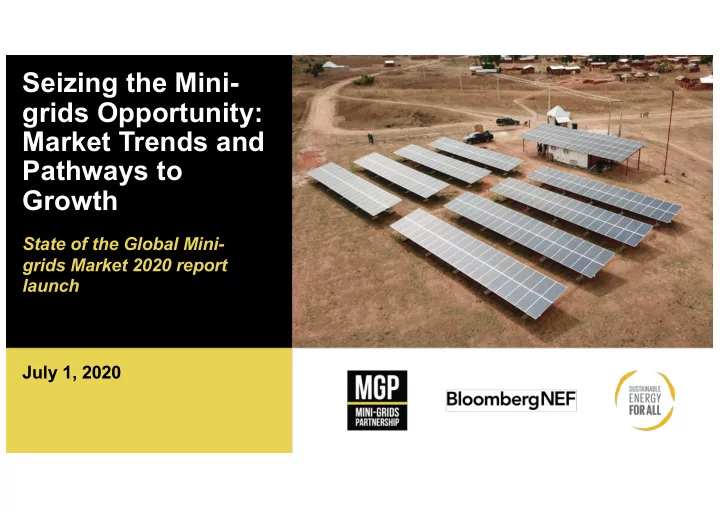
Seizing the Mini- grids Opportunity: Market Trends and Pathways to Growth
State of the Global Mini- grids Market 2020 report launch July 1, 2020
Seizing the Mini- grids Opportunity: Market Trends and Pathways to - - PowerPoint PPT Presentation
Seizing the Mini- grids Opportunity: Market Trends and Pathways to Growth State of the Global Mini- grids Market 2020 report launch July 1, 2020 Agenda Opening Remarks Mini-grids: Global Trends and Key Findings Q&A Keynote
State of the Global Mini- grids Market 2020 report launch July 1, 2020
Opening Remarks Mini-grids: Global Trends and Key Findings Q&A Keynote Facilitated High-Level Dialogue Q&A Closing
(Event concludes 17:00 CEST)
Ethan Zindler Head of Americas BloombergNEF
Mini-grids: Global Trends and Key Findings
Ruchi Soni Amar Vasdev Takehiro Kawahara Ulimmeh Ezekiel July 1, 2020
Takehiro Kawahara Frontier Power Senior Associate BloombergNEF Ruchi Soni Programme Manager Sustainable Energy for All
About the report 2 Highlights 5 Recommendations 22
MGP overview
stakeholders such as financiers, developers, facilitators, and policymakers
members to accelerate the development and deployment of clean energy mini-grids § Coordinate sector knowledge and action § Champion the sector & help shape policy for public and private sector § Broker partnerships
Secretariat Steering Committee An “umbrella” group that bridges discrete but related stakeholders and initiatives, especially those of industry, government and investors; tapping on collective experience of its members
Project overview
Raise awareness about and mobilize investments for the global mini-grids sector Provide stakeholders with information on the latest market and industry trends in the mini-grids sector First-ever open source public database of projects
Propose viable recommendations for key stakeholders to address challenges for the mini-grid market to scale-up
SPONSORS PARTNERS
Project overview
finance institutions (DFIs)/donors.
Source: BloombergNEF, GIZ, Carbon Trust, CLUB-ER, surveyed developers.
Mini-grid project data collected (as of February 2020)
65
Stakeholders Interviewed
7181
Number of Projects in the Public Database
Outlook
Source: BloombergNEF, Climatescope, World Bank.
Potential market size by technologies Investment required
Market status
Source: BloombergNEF, GIZ, Carbon Trust, CLUB-ER, surveyed developers
Installed mini-grids by regions
built under the development programmes with support by donor agencies (e.g., EnDev).
private developers and spur solar hybrid mini-grid market.
Market status
increase in the market share seen between 2009 and 2019.
Source: BloombergNEF, Carbon Trust, CLUB-ER, GIZ, surveyed developers. Note: Includes only mini-grid asset data with ‘operation year’ available.
Cumulative number of mini-grids installed Technology share of mini-grids in operation Battery storage penetration within new mini-grids
Market status
Source: Company websites, BloombergNEF. Note: Companies without arrows are developing proprietary products related to microgrids, battery management or UPS.
Large corporates aim to use these partners’ technologies and their combined sales networks to offer new products and services, and to address new customers.
Financing
Source: Mini-grid Funders’ Group, Carbon Trust, BloombergNEF. Note: YTD = February 29, 2020. the World Bank’s $150 million for Nigeria’s results-based subsidies in 2019 is not counted as ‘disbursed’
Group approved a total of more than $2 billion by the end of February 2020.
disbursed in the mini-grid sector.
Mini-grid financing: approved vs disbursed
Financing
Source: Mini-grid Funders’ Group, Carbon Trust, BloombergNEF. Note: YTD = February 29, 2020
Approved mini-grid financing by recipient country Approved mini-grid financing by funders
Financing
Source: BloombergNEF, company websites.
foundations and impact investors.
diversified in the last two years.
date has been through grants and concessional loans, and some equity.
Economics
Source: BloombergNEF, HOMER Pro model. Note: The levelized cost of energy (LCOEs) was calculated using HOMER Pro model.
distribution system and installation costs are a source of variation amongst countries.
varies by project even in the same country.
customers lowers LCOEs, benefitting all
model is the key.
Economics
Source: Africa Mini-grid Developers Association (AMDA), ECA.
largest component of capex.
required for communities in which the households are scattered across a wide range.
also high in both regions, which could be lowered by streamlining the government’s administrative procedures.
Capex breakdown for mini-grid projects in sub-Saharan Africa
Economics
Source: Africa Mini-grid Developers Association (AMDA), ECA.
electricity customers use and the price they pay per kWh, kW or energy service they receive.
in improving a developer’s economic returns and subsequently attracting private investment.
Correlation between utilization rate and ARPU
Economics
Source: Adopted from EEP Africa, Inensus, BloombergNEF.
productive use customers to increase revenues.
flexible tariff settings, streamline licensing processes and remove regulatory requirements for small-scale projects to encourage mini-grid developers.
Policy and regulations
prices to protect poorer rural customers.
to impose cost-reflective tariffs, true cost of a solar hybrid mini- grid is expensive for rural customers in general. In either cases, subsidies are mostly required.
electricity consumption increased when tariffs were lowered by subsidising developers.
Source: BloombergNEF, Climatescope 2019. Note: Countries surveyed are 39 in sub- Saharan Africa, 12 in Asia, 7 in Latin America and Caribbean.
Mini-grid tariff regulations, 2018
Cost reflective: Bangladesh, Cambodia, India, Philippines, Nigeria, Rwanda, Sierra Leone, South Africa, Tanzania, Togo, Zambia
Policy and regulations
schemes: upfront capex subsidies and results-based financing.
faster than tenders, but developers may still require financing support to achieve early milestones.
Source: BloombergNEF.
Policy and regulations
regulatory factors for mini- grid projects to be viable.
have clear main grid arrival rules.
governments do not always implement it.
Source: Climatescope 2019, BloombergNEF.
Clear rules No clear rules
Impacts
difficult as they can be diverse.
standardized and used by many organisations in the mini-grid sector.
metrics developed for electricity access projects (e.g., GOGLA, 60 Decibel).
Source: BloombergNEF, GOGLA, Lighting Global, World Bank Group. Note: Positions of outcomes are not correlated with those of impacts.
Mini-grid output, outcomes and impacts
Impacts
straightforward to measure are more commonly used.
have adopted are different depending on their objectives.
by transaction of financing depending on their relevance to the investee, business model, customers, or type of product or services.
Source: GIIN, BloombergNEF.
Metrics used for impact assessment by investors in the clean energy sector
Recommendations
– Take a least-cost approach for rural electrification. – Set electricity access targets and roadmaps by technology. – Outline clear “grid arrival” rules to protect value of mini-grids. – Identify and disclose potential sites for mini-grid development.
– Set up a results-based financing programme to scale mini-grids or provide more financial support for existing ones. – Provide partial-risk guarantees to financiers to insure against non-payment from utilities or governments. – Consider cross-sector collaboration.
– Finance mini-grid portfolios to increase potential economic return, and diversify operational and regulatory risks. – Employ advanced impact assessment metrics to collect social, economic and environmental impact data and use them to evaluate results.
– Apply data analytics solutions throughout various stages of a project’s lifetime. – Focus on opex reduction and demand stimulation – Involve operational and customer support service providers.
Available at minigrids.org/market- report-2020
July 1, 2020
Damilola Ogunbiyi CEO and Special Representative
Sustainable Energy for All, Co-Chair of UN-Energy
Wale Shonibare Director, Energy Financial Solutions, Policy & Regulations, African Development Bank Jaideep Mukherjee Chief Executive Officer, Smart Power India Steven Hunt Senior Energy Innovation Advisor, UK Department for International Development (DFID) Jessica Stephens Chief Operating Officer, Africa Mini-Grid Developers Association (AMDA)
Moderator Panelists
Lolade Abiola Component Lead, Solar Mini Grids for Nigeria Electrification Project (NEP)
SPONSORS PARTNERS
Available at minigrids.org/market- report-2020
July 1, 2020