Searching for the Origins of Life in Interstellar Space Michael - - PowerPoint PPT Presentation
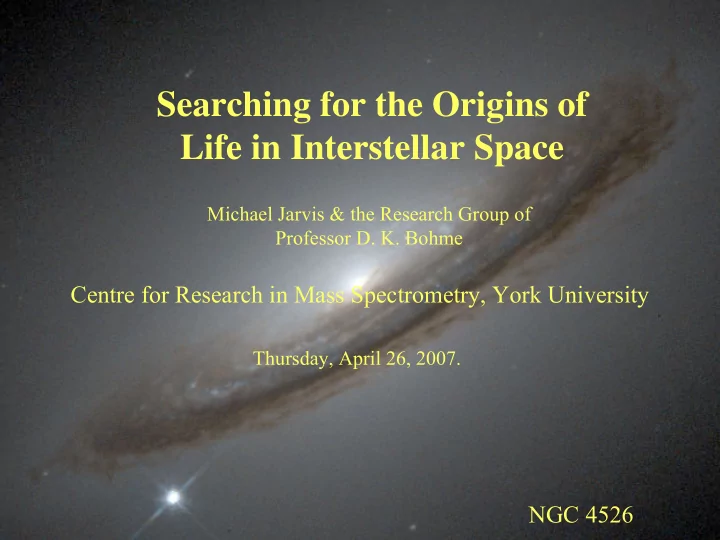
Searching for the Origins of Life in Interstellar Space Michael Jarvis & the Research Group of Professor D. K. Bohme Centre for Research in Mass Spectrometry, York University Thursday, April 26, 2007. NGC 4526 What is the chemical
What is the chemical composition
- f our galaxy?
Composition of the stars:
- 90% hydrogen
- 10% helium
- trace amounts of heavy elements
Our Sun Composition of interstellar clouds:
- gas and dust grains
- mostly hydrogen and helium
- trace amounts of small molecules (H2O,
CH2O, CH4, NH3, CO2, and CH3OH), in gas-phase and on the surface and in the interior of dust grains
H H O H H H H H N H H H H OH H
Horsehead nebula
Proteins DNA,RNA In our galaxy, Earth is a very special place. Complex organic molecules are abundant!
Earth atmosphere: N2 (78%), O2 (21%), Ar (0.9%), CO2 (0.04%) H2O, O3, CFCs...
LIFE is abundant!
What are the fundamental requirements for life?
(DNA,RNA) (proteins) “Bradykinin”: arg–pro–pro–gly–phe–ser–pro–phe–arg 4-member
- ligonucleotide
Topic of this presentation.
(1) water (2) nucleic acids and amino acids (organic polymers)
Where were organic compounds such as amino acids first formed? On Earth? Elsewhere? There are two (competing) theories:
Organic compounds were delivered to Earth by interplanetary dust, meteorites, comets and asteroids: “Panspermia” (1) Organic compounds were synthesized
- n Earth. The required energy is
provided by lightning, UV, cosmic radiation, thermal energy or radioactive
- decay. “Homegrown synthesis”.
(2) “Many of the interstellar molecules discovered to date are the same kinds detected in laboratory experiments specifically designed to synthesize prebiotic
- molecules. This fact suggests a universal prebiotic chemistry.”
- Jan M. Hollis, NASA Goddard Space Flight Centre
The planetary nebula K3-35. The colors show the 3.6 cm emission. The various colours represent different intensities of emission.
Can we “see” molecules in the interstellar medium?
The Very Large Array (VLA), consisting of 27 radio antennas on the Plains of San Agustin, New Mexico, is one of the world’s premier astronomical radio observatories. Each antenna is 25 meters in diameter.
Radioastronomy is used to identify molecules based on unique “fingerprint” emissions or absorptions. 2-carbon sugar 3-carbon sugar + 5-carbon sugar (ribose)
The synthesis of ribose molecules is important because these molecules form the backbone structure of both DNA and RNA, the carriers of all genetic information.
- Molecules rotate end-over-end.
- When they change from a higher rotational
energy level to a lower rotational level, they emit radio waves (photons) at precise frequencies.
In 2004, glycolaldehyde was discovered in a cold region (8 K) of the gas- and-dust cloud Sagittarius B2, 26,000 light years away, near the centre of
- ur own Milky Way Galaxy. The discovery was made using the National
Science Foundation’s giant Robert C. Byrd Green Bank Telescope (GBT).
A recent discovery:
Have amino acids been detected in the interstellar medium? INTERSTELLAR GLYCINE Y.-J. Kuan, S.B. Charnley, et al.
- Astrophys. J. 593: 848-867 (2003)
“…27 glycine lines were detected …in one or more sources..” A RIGOROUS ATTEMPT TO VERIFY INTERSTELLAR GLYCINE L.E. Snyder et al.
- Astrophys. J. 619: 914-930 (2005)
“We conclude that key lines necessary for an interstellar glycine identification have not yet been found.”
Thus, the presence of glycine in the interstellar medium has not yet been confirmed, but the possibility cannot be ruled out… Nonetheless, biological material has been found in ppm quantities in meteorites that have impacted on Earth.
- more than 70 different amino acids
- carboxylic acids
- pyrimidine
- purine
The “carbonaceous chondrite” class of meteorites have been found to contain up to 60 ppm of amino acids! CI Chondrites: CM Chondrites:
- cometary origin (material from interstellar medium)
- asteroidal origin (material from solar system)
Amino acid composition in two CI (Ivuna and Orgeuil) and two CM (Murchison* and Murray) meteorites: Amino acid CI(%) CM(%) Glycine 17 17 α-amino acids 17 63 β,γ-amino acids 66 20 *More than 70 different amino acids were detected in the Murchison meteorite!
- Sept. 28, 1969
Murchison, Australia
Why are ion/molecule reactions important in the ISM?
- They are largely unaffected by extreme low temperatures (10-20K).
- They are ~100 times faster than neutral/neutral reactions.
Let’s see if we can generate amino acids from starting materials, involving ions, that are known to exist in the ISM.
- gas and dust grains
- mostly hydrogen and helium
- trace amounts of small molecules (H2O,
CH2O, CH4, NH3, CO2, and CH3OH), in gas-phase and on the surface and in the interior of dust grains
H H O H H H H H N H H H H OH H
CH+ (vis), CF+, CO+, NO+, SO+, H3
+
(IR), HCO+, COH+, HCS+, N2H+, H3O+, HOCO+, HCNH+, H2COH+, HC3NH+, C6H-, C4H-, C8H-
In our laboratory we study gas-phase ion chemistry.
Selected-ion flow tube/triple quadrupole mass spectrometer (SIFT/QqQ)
“Simulating” the environment of the interstellar medium:
Ions enter instrument reagent molecules (variable flow) Analysis and quantitation in quadrupole mass spectrometer Fixed reaction time
To Roots Blower
- He as a buffer gas.
- Pressure of only 0.35 Torr (0.0005 atm).
- Reacting ions and molecules have no translational kinetic energy
Several attempts to generate glycine were unsuccessful: CH3NH2
+ + HCOOH
CH3NH2
+ + CO2
CH3NH2
+ + CO + H2O
NH3
+ + CH3COOH
CH2COOH+ + NH3
N-O bond formation is preferred over C-C and N-C bond formation.
OH O NH2
(Blagojevic et al., Mon. Not. R. Astron. Soc. 339 (2003) L7-L11.)
NH2OH+ + CH3COOH → NH2CH2COOH+ (ionized glycine) NH2OH2
+ + CH3COOH → NH3CH2COOH+ (protonated glycine)
- OH+O bonding allows N-C bond formation
Success!!
Some background on the precursors: Acetic acid: CH2
+ + CO → CH2CO+ + hv
CH2CO+ + 2H2O → CH3COOH+ + H2O Has been detected in ISM (1997) Hydroxylamine: NH3(s) + H2O(s) + hv → NH2OH(g) + other products Nishi et al. (J. Chem. Phys., 80, 3898, 1984) Undetected in ISM (so far)
- NH2OH will be made in irradiation of interstellar ice (as shown by Nishi et al.).
- Charnley et al. (Sept. 2001) proposed that NH2OH should be one of the major
components of interstellar ice. It can be formed by radical hydrogenation of NO
- n the surface of dust grains.
NH2OH+ + CH3COOH → NH2CH2COOH+
Comparing the fragmentation of our product ion with that of commercial (ie. purchased) glycine:
5 10 15 20 25 30 35 40 45 0.0 0.2 0.4 0.6 0.8
Gly+ CH2NH+
0.0 0.2 0.4 0.6 0.8
Gly+ CH2NH+ Nose cone potential (/-V) Relative abundance
- Increasing the voltage on the nose cone
induces energetic collisions between ions and the neutral buffer gas.
- The specific fragmentation patterns and
appearance energies can be used as a “chemical fingerprint” to identify unknowns.
Potential energy landscape for the reaction between protonated hydroxyl amine and acetic acid to produce GlyH+ B3LYP/6-311++G(df,pd)
(Galina Orlova) Computational Chemistry results: (NH2OH)H+ + CH3COOH
- 54.1
23.1 24.3 TS1 H2O
- 27.2
- 18.8
0.0 ΔH0, kcal mol-1 PRC2 TS2
- 13.7
Larger amino acids: Synthesizing alanine
Buoyed by our great success synthesizing glycine via a gas-phase ion/molecule reaction, we have attempted to synthesize alanine in a similar manner.
NH2OH+ + CH3CH2COOH → NH2CH2CH2COOH+ (ionized alanine) NH2OH2
+ + CH3CH2COOH → NH3CH2CH2COOH+ (protonated alanine)
The isomer formed is β-alanine... (protonated) α-alanine (protonated) β-alanine
Biological isomer Non-biological isomer
… this can be confirmed from the observed fragmentation pattern.
The “carbonaceous chondrite” class of meteorites have been found to contain up to 60 ppm of amino acids! CI Chondrites: CM Chondrites:
- cometary origin (material from interstellar medium)
- asteroidal origin (material from solar system)
Amino acid composition in two CI (Ivuna and Orgeuil) and two CM (Murchison and Murray) meteorites: Amino acid CI(%) CM(%) Glycine 17 17 α-amino acids 17 63 β-alanine 40 1
- ther β,γ-amino acids
26 19
- Sept. 28, 1969
Murchison, Australia
H2O
TS1 TS2-ß ΔH0, kcal mol-1 12.4 24.3
- 65.3
ß-AlaH+ TS2-a 17.4 0.0
- 59.5
a-AlaH+
- 27.2
- 14.5
- 19.4
TS2-a TS2-ß
Computational Chemistry results: (NH2OH)H+ + CH3CH2COOH
Potential energy landscape for the reaction between protonated hydroxyl amine and propanoic acid to produce β-AlaH+ (solid line) and α- AlaH+ (dotted line) B3LYP/6-311++(df,pd)
(Galina Orlova)
NH3(s) + H2O(s) NH2OH
hv hv
NO + 3H
hv, heat
NH2OH Interstellar ice Interstellar gas
hv/A+ RH+
NH2OH2
+
NH2OH+
CH3COOH CH3CH2COOH CH3COOH CH3CH2COOH
NH2CH2COOH+ NH2CH2CH2COOH+ NH3CH2COOH+ NH3CH2CH2COOH+
- H2O
- H2O
M M+
NH2CH2COOH NH2CH2CH2COOH
e- H
M and A represent any neutral atom / molecule with a suitable
- IE. RH+ represents a proton carrier with PA(R) < PA(NH2OH).
(Blagojevic et al., Mon. Not. R. Astron. Soc. 339 (2003) L7-L11.)
Some Conclusions
- “Precursors to life” such as amino acids may have been delivered to Earth
by meteorites, comets, etc.
- Remote sensing of amino acids in the ISM with radiotelescopes has
proved inconclusive. However, analysis of meteorites provides direct evidence of their presence.
- The synthesis of specifically β-alanine supports the hypothesis that “CI
chondrite” meteorites have interstellar origins.
- From starting materials that are present in the ISM, we have demonstrated
a mechanism for the interstellar synthesis of glycine and β-alanine!!!
NH2,3OH+ + CH3COOH → NH2,3CH2COOH+ NH2,3OH+ + CH3CH2COOH → NH2,3CH2CH2COOH+
Acknowledgements
York University
- Professor D.K. Bohme
- Dr. Voislav Blagojevic
- Bohme research group
Australian National University
- Dr. Simon Petrie
St Francis Xavier University
- Professor Galina Orlova