
SLIDE 1
Chapter 18 The Interstellar Medium Units of Chapter 18 18.1 - - PowerPoint PPT Presentation
Chapter 18 The Interstellar Medium Units of Chapter 18 18.1 Interstellar Matter 18.2 Emission Nebulae 18.3 Dark Dust Clouds Ultraviolet Astronomy and the Local Bubble 18.4 21-Centimeter Radiation 18.5 Interstellar Molecules 18.1
Gas is atoms and small molecules, mostly hydrogen and helium, with less than a percent other elements. (But most molecules contain these elements, because H and He do not form molecules easily.) Three ways to observe gas to be discussed (see notes that accompany slides at course web site) Neutral hydrogen 21 cm. line (radio), Emission lines from atoms in hot gas clouds (visible), and Spectral lines from interstellar molecules within cold dark clouds.
Dust is more like soot or smoke; larger clumps of particles. Dust absorbs light (“extinction,” dark clouds); and reddens light that gets through (reddens = changes shape of spectrum, which is how color is defined). Reddening can interfere with measurement of continuous spectra of stars and galaxies, requiring a correction; but spectral lines do not “shift,” as in Doppler “redshift.” Dust also emits its own light, a continuous spectrum, which always peaks somewhere in the infrared part of the spectrum, depending on the dust’s temperature.
This image illustrates how reddening works. On the right, the upper image was made using visible light; the lower was made using
also absorbing (besides reddening) light from stars behind it.
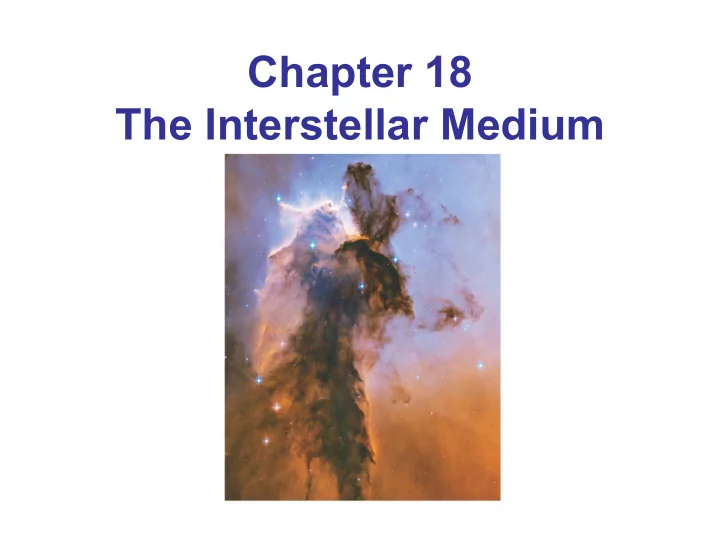
Here is a view of the central portion of the picture on the first slide, with several “nebulae” indicated. The bright nebulae are clouds of gas that have been heated and ionized by the UV radiation of hot young stars that recently formed within them. A hot thin gas radiates emission lines, which is what most of this light represents.
“Nebula” is a general term used for fuzzy objects in the sky: Dark nebula: Dust cloud Emission nebula: Glows, due to emission lines from gas heated by hot young stars (a way to find where stars have recently formed).
Emission nebulae generally glow red—this is the Hα line of hydrogen. But others shine primarily in green light from an ionized oxygen line. The dark dust lanes visible in these images are part
Images are zoom-in on emission nebulae M8 and M20 (seen in previous slide as bright spots along the Milky Way). Bottom left: appearance of both nebulae in visible, mostly emission lines; center, zoom on M20 in visible light, showing dark lanes of dust that are absorbing other light from the cloud; right, image in infrared light, showing the warm dust grains where the dark lanes were in the visible light image.
A protoplanetary disk seen edge-on, with a young star at its center.
Ultraviolet observations, which must be done from space, have shown that the interstellar medium is full of “bubbles” and “tunnels” that are very hot and have very low densities. The interior is the hot part, emitting UV spectral lines, the outer shell of the bubble is cold, and is observed in neutral hydrogen 21 cm line (yet to come). The Sun is within one such “bubble,” about 100 pc across, probably formed by supernova explosions.
This figure is an artist’s impression of the “Local Bubble”. It contains about 200,000 stars:
Interstellar gas emits low-energy radiation, due to a “spin flip” transition in the neutral hydrogen atom. Energy involved is tiny, so resulting spectral line is in the radio part of the spectrum.
The emitted photon has a wavelength of 21 centimeters, which is in the radio portion of the electromagnetic spectrum. Actual 21-cm spectra are complex, as the lines are Doppler shifted and broadened (see spectra to the right). This is the most important spectral line for mapping our own galaxy (the Milky Way): It is at radio wavelengths, so no extinction from dust; and there is lots of hydrogen everywhere, so strong line. It shows us where clouds and shells of gas are, and how they are moving. Example: This is how we know that the shells around the “bubbles” discussed earlier are expanding.
Fortunately, radio waves are not absorbed much, so molecular gas clouds can be detected even though there may be other gas and dust clouds in the way. These clouds are mostly molecular hydrogen, which unfortunately does not emit in the radio portion of the spectrum. Other molecules present include: CO, HCN, NH3, H2O, CH3OH, H2CO, and more than a hundred others. (See notes accompanying slides for a table in case you are curious; some are from fairly complex organic molecules.) Molecular clouds are molecular because they are also dark clouds, I.e. they are dense enough that the dust they contain can keep out most of the UV radiation from the rest of the Galaxies.
This is a contour map of H2CO near the M20 nebula. Other molecules that can be useful for mapping out these clouds are carbon dioxide and water. The most useful is carbon monoxide CO. It is abundant, and levels are easily excited at the temperatures of molecular clouds. Here, the red and green lines correspond to different rotational transitions:
grains
reddening
produce
centimeter line
molecular rotational transitions