Search Detail Submittal Details Docum ent I nfo Title : - - PowerPoint PPT Presentation

search detail
SMART_READER_LITE
LIVE PREVIEW

Search Detail Submittal Details Docum ent I nfo Title : - - PowerPoint PPT Presentation

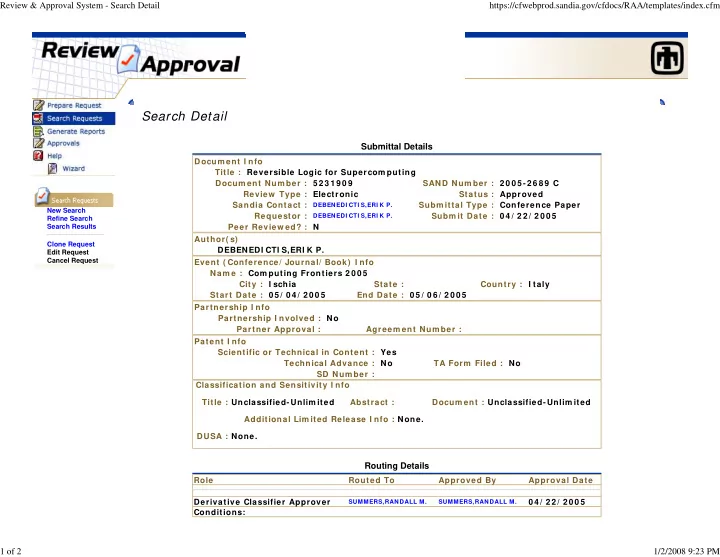
Review & Approval System - Search Detail https://cfwebprod.sandia.gov/cfdocs/RAA/templates/index.cfm Search Detail Submittal Details Docum ent I nfo Title : Reversible Logic for Supercom puting Docum ent Num ber : 5 2 3 1 9 0 9 SAND Num


slide-1
SLIDE 1

Review & Approval System - Search Detail https://cfwebprod.sandia.gov/cfdocs/RAA/templates/index.cfm 1 of 2 1/2/2008 9:23 PM

New Search

Refine Search Search Results Clone Request Edit Request Cancel Request

Search Detail

Submittal Details

Docum ent I nfo Title : Reversible Logic for Supercom puting Docum ent Num ber : 5 2 3 1 9 0 9 SAND Num ber : 2 0 0 5 -2 6 8 9 C Review Type : Electronic Status : Approved Sandia Contact : DEBENEDI CTI S,ERI K P. Subm ittal Type : Conference Paper Requestor : DEBENEDI CTI S,ERI K P. Subm it Date : 0 4 / 2 2 / 2 0 0 5 Peer Review ed? : N Author( s) DEBENEDI CTI S,ERI K P. Event ( Conference/ Journal/ Book) I nfo Nam e : Com puting Frontiers 2 0 0 5 City : I schia State : Country : I taly Start Date : 0 5 / 0 4 / 2 0 0 5 End Date : 0 5 / 0 6 / 2 0 0 5 Partnership I nfo Partnership I nvolved : No Partner Approval : Agreem ent Num ber : Patent I nfo Scientific or Technical in Content : Yes Technical Advance : No TA Form Filed : No SD Num ber : Classification and Sensitivity I nfo Title : Unclassified-Unlim ited Abstract : Docum ent : Unclassified-Unlim ited Additional Lim ited Release I nfo : None. DUSA : None.

Routing Details

Role Routed To Approved By Approval Date Derivative Classifier Approver

SUMMERS,RANDALL M. SUMMERS,RANDALL M.

0 4 / 2 2 / 2 0 0 5 Conditions:

slide-2
SLIDE 2

Review & Approval System - Search Detail https://cfwebprod.sandia.gov/cfdocs/RAA/templates/index.cfm 2 of 2 1/2/2008 9:23 PM

Classification Approver

W I LLI AMS,RONALD L. W I LLI AMS,RONALD L.

0 4 / 2 5 / 2 0 0 5 Conditions: Manager Approver

PUNDI T,NEI L D. PUNDI T,NEI L D.

0 4 / 2 9 / 2 0 0 5 Conditions: Adm inistrator Approver

LUCERO,ARLENE M. KRAMER,SAMUEL

0 6 / 0 5 / 2 0 0 7 Created by W ebCo Problems? Contact CCHD: by em ail or at 8 4 5 -CCHD (2243).

For Review and Approval process questions please contact the Application Process Ow ner

slide-3
SLIDE 3

Erik P. DeBenedictis Erik P. DeBenedictis

Sandia National Laboratories May 5, 2005

Reversible Logic for Supercomputing

How to save the Earth with Reversible Computing

Sandia is a multiprogram laboratory operated by Sandia Corporation, a Lockheed Martin Company, for the United States Department of Energy's National Nuclear Security Administration under contract DE-AC04-94AL85000.

SAND 2005-2689C

slide-4
SLIDE 4

Applications and $100M Supercomputers

1 Zettaflops 100 Exaflops 10 Exaflops 1 Exaflops 100 Petaflops 10 Petaflops 1 Petaflops 100 Teraflops System Performance 2000 2010 2020 2030 Year ↑ Red Storm/Cluster Technology Nanotech + Reversible Logic μP (green) best-case logic (red) ↑ Architecture: IBM Cyclops, FPGA, PIM 2000 2020 2010 No schedule provided by source Applications

[Jardin 03] S.C. Jardin, “Plasma Science Contribution to the SCaLeS Report,” Princeton Plasma Physics Laboratory, PPPL-3879 UC-70, available on Internet. [Malone 03] Robert C. Malone, John B. Drake, Philip W. Jones, Douglas A. Rotman, “High-End Computing in Climate Modeling,” contribution to SCaLeS report. [NASA 99] R. T. Biedron, P. Mehrotra, M. L. Nelson, F. S. Preston, J. J. Rehder, J. L. Rogers, D. H. Rudy, J. Sobieski, and O. O. Storaasli, “Compute as Fast as the Engineers Can Think!” NASA/TM-1999-209715, available on Internet. [SCaLeS 03] Workshop on the Science Case for Large-scale Simulation, June 24-25, proceedings on Internet a http://www.pnl.gov/scales/. [DeBenedictis 04], Erik P. DeBenedictis, “Matching Supercomputing to Progress in Science,” July 2004. Presentation at Lawrence Berkeley National Laboratory, also published as Sandia National Laboratories SAND report SAND2004-3333P. Sandia technical reports are available by going to http://www.sandia.gov and accessing the technical library.

2000 2020 2010 No schedule provided by source Applications

[Jardin 03] S.C. Jardin, “Plasma Science Contribution to the SCaLeS Report,” Princeton Plasma Physics Laboratory, PPPL-3879 UC-70, available on Internet. [Malone 03] Robert C. Malone, John B. Drake, Philip W. Jones, Douglas A. Rotman, “High-End Computing in Climate Modeling,” contribution to SCaLeS report. [NASA 99] R. T. Biedron, P. Mehrotra, M. L. Nelson, F. S. Preston, J. J. Rehder, J. L. Rogers, D. H. Rudy, J. Sobieski, and O. O. Storaasli, “Compute as Fast as the Engineers Can Think!” NASA/TM-1999-209715, available on Internet. [SCaLeS 03] Workshop on the Science Case for Large-scale Simulation, June 24-25, proceedings on Internet a http://www.pnl.gov/scales/. [DeBenedictis 04], Erik P. DeBenedictis, “Matching Supercomputing to Progress in Science,” July 2004. Presentation at Lawrence Berkeley National Laboratory, also published as Sandia National Laboratories SAND report SAND2004-3333P. Sandia technical reports are available by going to http://www.sandia.gov and accessing the technical library.

Compute as fast as the engineer can think [NASA 99] ↓ 100× ↑1000× [SCaLeS 03] Full Global Climate [Malone 03] Plasma Fusion Simulation [Jardin 03] MEMS Optimize

slide-5
SLIDE 5

Objectives and Challenges

  • Could reversible computing have a role in solving

important problems?

– Maybe, because power is a limiting factor for computers and reversible logic cuts power

  • However, a complete computer system is more

than “low power”

– Processing, memory, communication in right balance for application – Speed must match user’s impatience – Must use a real device, not just an abstract reversible device

slide-6
SLIDE 6

Outline

  • An Exemplary Zettaflops Problem
  • The Limits of Current Technology
  • Arbitrary Architectures for the Current Problem

– Searching the Architecture Space – Bending the Rules to Find Something – Exemplary Solution

  • Conclusions
slide-7
SLIDE 7

Simulation of Global Climate

Stott et al, Science 2000

“Simulations of the response to natural forcings alone … do not explain the warming in the second half of the century” “..model estimates that take into account both greenhouse gases and sulphate aerosols are consistent with observations

  • ver this*period” - IPCC 2001
slide-8
SLIDE 8

FLOPS Increases for Global Climate

1 Zettaflops 1 Exaflops 10 Petaflops 100 Teraflops 10 Gigaflops Ensembles, scenarios 10× Embarrassingly Parallel New parameterizations 100× More Complex Physics Model Completeness 100× More Complex Physics Spatial Resolution 104× (103×-105×) Resolution Issue Scaling Clusters Now In Use

(100 nodes, 5% efficient)

100 Exaflops Run length 100× Longer Running Time

  • Ref. “High-End Computing in Climate Modeling,” Robert C. Malone, LANL, John B.

Drake, ORNL, Philip W. Jones, LANL, and Douglas A. Rotman, LLNL (2004)

slide-9
SLIDE 9

Outline

  • An Exemplary Zettaflops Problem
  • The Limits of Current Technology
  • Arbitrary Architectures for the Current Problem

– Searching the Architecture Space – Bending the Rules to Find Something – Exemplary Solution

  • Conclusions
slide-10
SLIDE 10

8 Petaflops 80 Teraflops Projected ITRS improvement to 22 nm (100×) Lower supply voltage (2×) ITRS committee of experts ITRS committee of experts Expert Opinion

Scientific Supercomputer Limits

Reliability limit 750KW/(80kB T) 2×1024 logic ops/s Esteemed physicists

(T=60°C junction temperature)

Best-Case Logic Microprocessor Architecture Physical Factor Source of Authority Assumption: Supercomputer is size & cost of Red Storm: US$100M budget; consumes 2 MW wall power; 750 KW to active components 100 Exaflops Derate 20,000 convert logic ops to floating point Floating point engineering

(64 bit precision)

40 Teraflops Red Storm contract 1 Exaflops 800 Petaflops 125:1 Uncertainty (6×) Gap in chart Estimate Improved devices (4×) Estimate 4 Exaflops 32 Petaflops Derate for manufacturing margin (4×) Estimate 25 Exaflops 200 Petaflops

slide-11
SLIDE 11

Outline

  • An Exemplary Zettaflops Problem
  • The Limits of Current Technology
  • Arbitrary Architectures for the Current Problem

– Searching the Architecture Space – Bending the Rules to Find Something – Exemplary Solution

  • Conclusions
slide-12
SLIDE 12

Supercomputer Expert System

Expert System & Optimizer (looks for best 3D mesh of generalized MPI connected nodes, μP and other) Application/Algorithm run time model as in applications modeling Logic & Memory Technology design rules and performance parameters for various technologies (CMOS, Quantum Dots, C Nano-tubes …) Interconnect Speed, power, pin count, etc. Physical Cooling, packaging, etc. Time Trend Lithography as a function of years into the future Results

  • 1. Block diagram

picture of optimal system (model)

  • 2. Report of

FLOPS count as a function of years into the future

slide-13
SLIDE 13
  • Simple case: finite

difference equation

  • Each node holds n×n×n

grid points

  • Volume-area rule

– Computing ∝ n3 – Communications ∝ n2

Sample Analytical Runtime Model

Tstep = 6 n2 Cbytes Tbyte + n3 Fgrind /floprate Volume n3 cells n n n Face-to-face n2 cells

slide-14
SLIDE 14

Expert System for Future Supercomputers

  • Applications Modeling

– Runtime Trun = f1 (n, design)

  • Technology Roadmap

– Gate speed = f2 (year), – chip density = f3 (year), – cost = $(n, design), …

  • Scaling Objective Function

– I have $C1 & can wait Trun =C2 seconds. What is the biggest n I can solve in year Y?

  • Use “Expert System” To

Calculate:

  • Report:

and illustrate “design” Max n: $<C1 , Trun <C2

All designs

Floating operations Trun (n, design)

slide-15
SLIDE 15

Outline

  • An Exemplary Zettaflops Problem
  • The Limits of Current Technology
  • Arbitrary Architectures for the Current Problem

– Searching the Architecture Space – Bending the Rules to Find Something – Exemplary Solution

  • Conclusions
slide-16
SLIDE 16

The Big Issue

  • Initially, didn’t

meet constraints

One Barely Plausible Solution Scaled Climate Model Initial reversible nanotech 2D 3D mesh,

  • ne cell per processor

Parallelize cloud-resolving model and ensembles More Parallelism Consider only highest performance published nanotech device QDCA Consider special purpose logic with fast logic and low-power memory More Device Speed

slide-17
SLIDE 17

ITRS Device Review 2016 + QDCA

Technology Speed (min-max) Dimension (min-max) Energy per gate-op Comparison CMOS 30 ps-1 μs 8 nm-5 μm 4 aJ RSFQ 1 ps-50 ps 300 nm- 1μm 2 aJ Larger Molecular 10 ns-1 ms 1 nm- 5 nm 10 zJ Slower Plastic 100 μs-1 ms 100 μm-1 mm 4 aJ Larger+Slower Optical 100 as-1 ps 200 nm-2 μm 1 pJ Larger+Hotter NEMS 100 ns-1 ms 10-100 nm 1 zJ Slower+Larger Biological 100 fs-100 μs 6-50 μm .3 yJ Slower+Larger Quantum 100 as-1 fs 10-100 nm 1 zJ Larger QDCA 100 fs-10ps 1-10 nm 1 yJ Smaller, faster, cooler

Data from ITRS ERD Section, data from Notre Dame

slide-18
SLIDE 18

Outline

  • An Exemplary Zettaflops Problem
  • The Limits of Current Technology
  • Arbitrary Architectures for the Current Problem

– Searching the Architecture Space – Bending the Rules to Find Something – Exemplary Solution

  • Conclusions
slide-19
SLIDE 19

An Exemplary Device: Quantum Dots

  • Pairs of molecules create a

memory cell or a logic gate

  • Ref. “Clocked Molecular Quantum-Dot Cellular Automata,” Craig S. Lent and Beth Isaksen

IEEE TRANSACTIONS ON ELECTRON DEVICES, VOL. 50, NO. 9, SEPTEMBER 2003

slide-20
SLIDE 20

100 GHz 1 THz 10 THz 100 THz 10-7 10-6 10-5 10-4 10-3 10-2 10-1 100 101 Energy/Ek

  • Ref. “Maxwell’s demon and quantum-dot cellular automata,” John Timler and Craig S. Lent,

JOURNAL OF APPLIED PHYSICS 15 JULY 2003

  • How could we increase

“Red Storm” from 40 Teraflops to 1 Zettaflops?

  • Answer

– >2.5×10⁷ power reduction per

  • peration

– Faster devices × more parallelism >2.5×10⁷ – Smaller devices to fit existing packaging 3000 × faster 30 × faster 2004 Device Level 1010 × 108 ×

1 Zettaflops Scientific Supercomputer

slide-21
SLIDE 21

100 GHz 1 THz 10 THz 100 THz 10-7 10-6 10-5 10-4 10-3 10-2 10-1 100 101

  • Ref. “Maxwell’s demon and quantum-dot cellular automata,” John Timler and Craig S. Lent,

JOURNAL OF APPLIED PHYSICS 15 JULY 2003.

  • Ref. “Helical logic,” Ralph C. Merkle and K. Eric Drexler, Nanotechnology 7 (1996) 325–339.
  • A number of post-

transistor devices have been proposed

  • The shape of the

performance curves have been validated by a consensus of reputable physicists

  • However, validity of

any data point can be questioned

  • Cross-checking

appropriate; see

Not Specifically Advocating Quantum Dots

Helical Logic

slide-22
SLIDE 22

QCA Microprocessor Status

  • M. Niemier Ph. D. Thesis,

University of Notre Dame

  • 12 Bit μP
  • CAD design tool principles

– 10× circuit density of CMOS at same λ

  • Applies to various devices

– Metal dot 4.2 nm2 – Molecular 1.1 nm2

slide-23
SLIDE 23

Reversible Microprocessor Status

  • Status

– Subject of Ph. D. thesis – Chip laid out (no floating point) – RISC instruction set – C-like language – Compiler – Demonstrated on a PDE – However: really weird and not general to program with +=, -=, etc. rather than =

slide-24
SLIDE 24

CPU Design

  • Leading Thoughts

– Implement CPU logic using reversible logic

  • High efficiency for the

component doing the most logic

– Implement state and memory using conventional logic

  • Low efficiency, but not

many operations

– Permits programming much like today

Conventional Memory CPU Logic CPU State Reversible Logic Irreversible Logic

slide-25
SLIDE 25

Atmosphere Simulation at a Zettaflops

Supercomputer is 211K chips, each with 70.7K nodes of 5.77K cells of 240 bytes; solves 86T=44.1Kx44.1Kx 44.1K cell problem. System dissipates 332KW from the faces of a cube 1.53m on a side, for a power density of 47.3KW/m2. Power: 332KW active components; 1.33MW refrigeration; 3.32MW wall power; 6.65MW from power company. System has been inflated by 2.57 over minimum size to provide enough surface area to avoid

  • verheating.

Chips are at 99.22% full, comprised of 7.07G logic, 101M memory decoder, and 6.44T memory transistors. Gate cell edge is 34.4nm (logic) 34.4nm (decoder); memory cell edge is 4.5nm (memory). Compute power is 768 EFLOPS, completing an iteration in 224µs and a run in 9.88s.

slide-26
SLIDE 26

Performance Curve

Year FLOPS rate on Atmosphere Simulation Cluster Custom Custom QDCA

  • Rev. Logic
  • Rev. Logic

Microprocessor

slide-27
SLIDE 27

Outline

  • An Exemplary Zettaflops Problem
  • The Limits of Current Technology
  • Arbitrary Architectures for the Current Problem

– Searching the Architecture Space – Bending the Rules to Find Something – Exemplary Solution

  • Conclusions
slide-28
SLIDE 28

Conclusions

  • There are important

applications that are believed to exceed the limits of irreversible logic – At US$100M budget – E. g. solution to global warming

  • Reversible logic &

nanotech point in the right direction – Low power

  • Device Requirements

– Push speed of light limit – Substantially sub-kB T – Molecular scales

  • Software and Algorithms

– Must be much more parallel than today

  • With all this, just barely

works

  • Conclusions appear to

apply generally

slide-29
SLIDE 29

Backup

slide-30
SLIDE 30

8 Petaflops 80 Teraflops Projected ITRS improvement to 22 nm (100×) Lower supply voltage (2×) ITRS committee of experts ITRS committee of experts Expert Opinion

*** This is a Preview ***

Reliability limit 750KW/(80kB T) 2×1024 logic ops/s Esteemed physicists

(T=60°C junction temperature)

Best-Case Logic Microprocessor Architecture Physical Factor Source of Authority Assumption: Supercomputer is size & cost of Red Storm: US$100M budget; consumes 2 MW wall power; 750 KW to active components 100 Exaflops Derate 20,000 convert logic ops to floating point Floating point engineering

(64 bit precision)

40 Teraflops Red Storm contract 1 Exaflops 800 Petaflops 125:1 Uncertainty (6×) Gap in chart Estimate Improved devices (4×) Estimate 4 Exaflops 32 Petaflops Derate for manufacturing margin (4×) Estimate 25 Exaflops 200 Petaflops

slide-31
SLIDE 31

Metaphor: FM Radio on Trip to in USA

  • You drive to a distant

listening to FM radio

  • Music clear for a while, but

noise creeps in and then

  • vertakes music
  • Analogy: You live out the

next dozen years buying PCs every couple years

  • PCs keep getting faster

– clock rate increases – fan gets bigger – won’t go on forever

  • Why…see next slide

Details: Erik DeBenedictis, “Taking ASCI Supercomputing to the End Game,” SAND2004-0959

slide-32
SLIDE 32

FM Radio and End of Moore’s Law

Driving away from FM transmitterless signal Noise from electrons no change Increasing numbers of gatesless signal power Noise from electrons no change Shrink Distance