
SLIDE 1
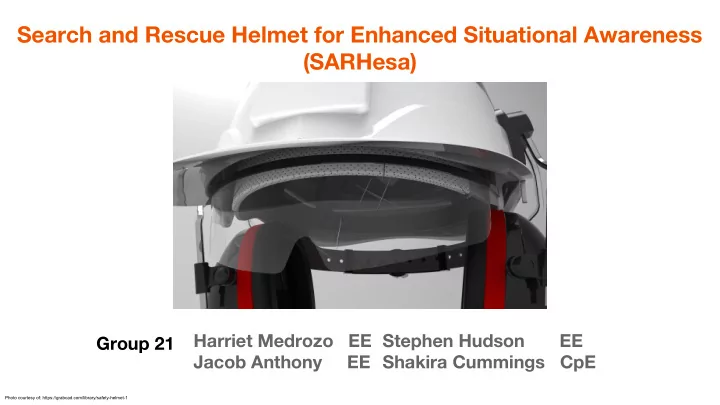
Search and Rescue Helmet for Enhanced Situational Awareness (SARHesa)
Harriet Medrozo EE Stephen Hudson EE Jacob Anthony EE Shakira Cummings CpE Group 21
Photo courtesy of: https://grabcad.com/library/safety-helmet-1
Search and Rescue Helmet for Enhanced Situational Awareness - - PowerPoint PPT Presentation
Search and Rescue Helmet for Enhanced Situational Awareness (SARHesa) Harriet Medrozo EE Stephen Hudson EE Group 21 Jacob Anthony EE Shakira Cummings CpE Photo courtesy of: https://grabcad.com/library/safety-helmet-1 MOTIVATION
Harriet Medrozo EE Stephen Hudson EE Jacob Anthony EE Shakira Cummings CpE Group 21
Photo courtesy of: https://grabcad.com/library/safety-helmet-1
*Not endorsed by any organization.
https://www.nfpa.org/News-and-Research/Data-research-and-tools/Emergency-Responders/Firefighter-fatalities-in-the-United-State s
Component Parameters Design Specification Units GPS Accurate within 3 meters Transceiver, RFM69HCW Minimum Range 3 meters Transceiver, nRF24L01+ Minimum Range 2 meters NIR Camera Minimum Range (NIR band) 5 meters NIR Beacon detection Minimum Range 10 meters Batteries Charge Time 4 hours Batteries Run Time 3.85 hours
noise, environmental settings, and distance
to 113 °F
RF circuit
surfaces
ATmega2560
ATmega2560
DIMENSIONS: 25 x 25 mm PACKAGE: surface mount device (SMD)
Photo courtesy of: timeandnavigation.si.edu https://www.u-blox.com/en/product/neo-6-series
PACKAGE: Throw hole
https://www.quora.com/What-is-the-pin-names-mapping-from-Arduino-to-th e-actual-AVR-pin-mapping-I-need-to-use-the-board-for-pure-AVR-program ming-The-Arduino-board-uses-an-ATmega328P-PU-chip
DIMENSIONS: 4.57 x 34.8 mm
Technology What it does Range Pros Cons GPS Calculates position by finding distance from 30 satellites orbiting earth using trilateration. unlimited not expensive. Accessible. Unlimited range. Used in many applications: tracking cars, tracking sports
powered.
scale, which is better use for micro-level
good view of the sky. BEACON Short-range wireless technology. Transmitters that send
1m-100m reduced power consumption. Good data
retail, bus stop information, smart houses effective range can be compromised by physical objects and reflections blocking signal. Too many beacons = signal noise and reduced accuracy.
resource courtesy of: www.theregister.co.uk, blog.lighthouse.io
resource courtesy of: www.theregister.co.uk,, ccm.net, blog.lighthouse.io
Technology What it does Range Pros Cons RFID Radio-frequency identifiers send out a signal that can be transmitted or read. 1cm-100m Passive RFID good for inventory management, contactless payments, access control Expensive, because of readers, not useful for hands-off
responders. Wi-Fi location-based
radio waves to transmit information across a
adaptors create hotspots for access 20m-100m to deliver personalized content to customers Not secure. Not as accurate as RFID and beacons. Need to be in a remote location to access hotspot. NFC Near Field
proximity communications chip
key cards 10cm or less Not very
accurate, low powered near range only for
distance for location module.
Properties EM-506 GPS Module- Neo-6M LS20031 5HZ dimensions 30x30x10.7mm 25x25x4mm N/A cost $39.95 $49.00 $69.95 hot start 1s 1s less than 1s cold start 35s with CGEE 27s 32 w/out AGPS less than 15 w/ AGPS max amps consumption 44-55mA at 4.5V-6.5V 39mA at 3.0V 41mA at 3.1V Tracking sensitivity
not on datasheet
ATmega2560
Technology How it works Pros Cons Low Light Amplifies incoming visible light Works very well
Dependent on external lighting,
extended exposure Near IR cameras
Detects infrared waves, just outside visible light Cheaper than Thermal cameras and is not ITAR controlled Often has to self illuminate with a Near IR light Thermal also often called Infrared Detects thermal radiation Does not use any illumination ITAR controlled and very expensive with limited resolution
Camera Company Technology Frame Rate Resolution Cost Boson FLIR Thermal 30 or 60 640x512 or 320x256 $1800 Lepton FLIR Thermal 8.7 160x120 $200 USB IR Camera ELP NIR 10-30 160x120 - 1280x720 $40
PROCESSOR PACKAGE COST STMf469 LQFP / BGA $12.64-17.21 PIC32MZ BGA $11.48-21.15 TI Davinci NFBGA $54.08 Raspberry Pi Complete Board $35
ATmega2560
3 Types of Channels for Voice Transmission SAR SAR SAR
WALKIE-TALKIE WITH LOCATION CAPABILITIES
PART NAME OPERATING FREQUENCY OPERATING VOLTAGE MAX OUTPUT POWER POWER CONSUMPTION RECEIVER SENSITIVITY DATA RATE CC1352P sub-1 GHz, 2.4 GHz 1.8V-3.8V +20 dBm for 863-930 MHz, +5 dBm for 2.4GHz sub-1 Rx - 5.8mA sub-1 Tx - 14.3mA 2.4 Tx - 8.2mA
4Mbps nRF24L01 2.4 GHz 1.9V-3.6V +4 dBm Rx- 12.3mA Tx-11.3mA
250 kbps- 2Mbps RFM69HCW sub-1 GHz 1.8V-3.6V +20 dBm Rx- 16mA Tx- 20mA
300 kbps
DIMENSIONS: 4 x 4mm
Photo courtesy of: howtomechatronics.com
modulation
DIMENSIONS: 16 x 16 mm PACKAGE: surface mount device (SMD)
ATmega2560
Photo courtesy of http://www.embien.com/blog/embedded-system-design-power-supply-design/
PART NAME INPUT SUPPLY VOLTAGE RANGE PROGRAMMABLE CHARGE CURRENT RANGE CHARGE VOLTAGE ACCURACY TRICKLE CHARGE CURRENT EXTERNAL COMPONENTS ANALOG
PROGRAMMABLE
TP4056 4-8V 130-1000mA 1.5% 120-140mA 10 Yes LT1512 2.7-25V 1000mA 1%
No ** BQ25606 3.9-13.5V 1000-2500mA 0.5%
Yes
**programmed with a PWM signal from a processor
MANUFACTURER NANJING TOP POWER ASIC CORP. Part No. BQ25606REGR Price $2.68 Current Required 3mA Program Charge Current 1000mA accuracy within 0.5%
DIMENSIONS: 4 x 4 mm
Photo courtesy of: https://www.amazon.com/dp/B071RG4YWM/ref=nav_timeline_asin?_encoding=UTF8&psc=1
Photo courtesy of: https://www.sensorsmag.com/components/demand-for-lithium-ion-batteries-outpacing-supply and https://shop.telegraph.co.uk/buy/miscellaneous/duracell-batteries/80/no/86541
LITHIUM ION
than NiMH
NICKEL METAL HYDRIDE
PART NAME OPERATING SUPPLY CURRENT SUPPLY VOLTAGE RANGE OUTPUT VOLTAGE IOUT RANGE EXTERNAL COMPONENTS SWITCHING FREQUENCY LT1108 .11mA 2-12V Adjustable .8A 5 19kHz LT1371 4mA 2.7-25V Adjustable 3A 8 500 kHz TCR2EF 22mA 1.5-5.5V Not Adjustable 35uA 2 **
LT1111
.3mA 2-12V Adjustable .8A 4 72kHz MIC4685 5mA 4-30V Adjustable 3A 7 200kHz
DIMENSIONS: 4 x 5 mm PACKAGE: 8-SOIC
Manufacturer Analog Devices/ Linear Technology Part No. LT1108CS8#PBF Price $5.26 Voltage supplied 1.8V & 3.3V
DIMENSIONS: 16 x 10 mm PACKAGE: 7-DD
Manufacturer Analog Devices/ Linear Technology Part No. LT1371CR#PBF Price $10.14 Voltage supplied 5V
Device Current in RFM69HCW Transceiver 130mA nRM24l01 Transceiver 12.3mA Neo-6M 39mA ATmega328p x 2 0.6mA Raspberry Pi 2500mA* MEMS GPS 3.11mA TOTAL CURRENT 2684.71mA *Anticipated current draw is from 1000-1500mA
Photo courtesy of: http://voltamperetomeiga.blogspot.com/2017/08/volt-ampere-ohm-cartoon.html
2684.71
COMMUNICATIONS MODULE
max power transfer
modified versions of the Arduino IDE
GPS communications and GPS data formats
OS PROS CONS Raspbian Native OS for Raspberry Pi Bloated with extra software Arch Linux Less extra programs than Raspbian Not as optimized as Raspbian Windows Easiest to use Slowest and least
LIBRARY PROS CONS OpenCV Documentation and large number of functions Can be harder to learn Mahotas Easier to start than OpenCV Fewer Optimizations than OpenCV Skimage Easiest option Fewest Functions
LIBRARY PROS CONS C++ Original OpenCV library C++ is not as easy to code in as Python Python Easier to use, uses the C++ code Can be slower if code is not optimized Java Easiest to use for those familiar with Java Slowest of the three
END
NRF24LO1+ TRANSCEIVER VOICE COMMUNICATIONS RANGE TEST NTS
RFM69HCW TRANSCEIVER DATA COMMUNICATIONS RANGE TEST NTS
Minimum Viable Product(MVP) Opportunity for Influence Insights:
closer to construction, there is much less opportunity to influence changes in design Cost of Changes Insights:
construction phase, the cost of changes to the design increase significantly
Part Name Quantity Price Each Price Total Other components varies varies ~$208.24 PCB 1 $54.88 $54.88
ATMEGA328P
4 $2.14 $8.56 POWER Batteries 4 $5.95 $46.56 Battery chargers 8 $0.60 $4.80 Regulators 6 $5-10 $24.00 Breadboard testing parts varies varies ~$60.00 Part Name Quantity Price Each Price Total COMMUNICATION n24L01+ transceiver 2 $3.50 $7.00 RFM69HCW transceiver 2 $5.95 $11.90 Headphones 1 $5.99 $5.99 VISION Raspberry Pi 2 $35.00 $70.00 Camera 2 $40.00 $80.00 Screen 2 $19.99 $39.98 LOCATION GPS 2 $49.00 $98.00 MEMS Motion Tracking Device 2 $15.00 $30.00 Total Price ~$763.90
FINAL BUDGET: ~$1500
ISSUE RESOLUTION
Noise on receiving end of voice comms LC filter for each speaker FCC Title 47 Part 15.231 FCC Title 47 Part 15.231 Part B Integration between Pi and UART Corrected settings Low charging issue Improved charging current GPS not locking on signal Corrected settings PCB design improved traces, changed design