SE307 Week 4. Ethnography: Writing the Past, Present and Future Dr - - PowerPoint PPT Presentation

se307 week 4 ethnography writing the past present and
SMART_READER_LITE
LIVE PREVIEW

SE307 Week 4. Ethnography: Writing the Past, Present and Future Dr - - PowerPoint PPT Presentation

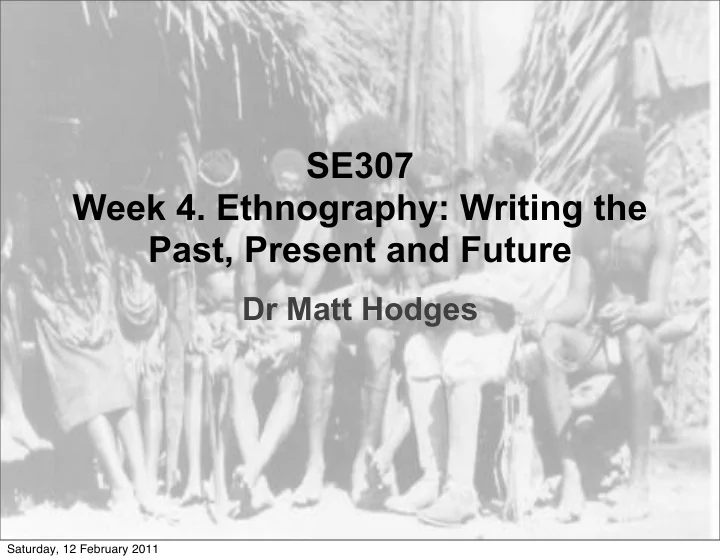
SE307 Week 4. Ethnography: Writing the Past, Present and Future Dr Matt Hodges Saturday, 12 February 2011 Lecture Outline Todays Aims and Objectives: 1) Examine the character and experience of ethnography The core product and

slide-1
SLIDE 1

SE307 Week 4. Ethnography: Writing the Past, Present and Future

Dr Matt Hodges

Saturday, 12 February 2011

slide-2
SLIDE 2

Lecture Outline

Today’s Aims and Objectives: 1) Examine the character and experience of ‘ethnography’

  • The core product and practice of social anthropology
  • i. Partly via an overview of some of its key practitioners
  • ii. Partly via an examination of what conducting ethnography

involves 2) By the end of the lecture you should therefore have a grasp of what has been done in the name of ethnography by some key anthropologists

  • And a sense of what it means to conduct ethnography …

Saturday, 12 February 2011

slide-3
SLIDE 3

Lecture Outline

  • So how will we proceed?

1) Preamble: What is Ethnography? 2) Ethnography: the Product a) Ethnography: An Historical Perspective b) Some Key Thinkers and Practitioners 3) Ethnography: the Process a) The Method of Participant Observation b) Ethnographic Fieldwork: the Experience

Saturday, 12 February 2011

slide-4
SLIDE 4
  • 1. Preamble: What is

Ethnography ?

  • Some definitions, to get us started …

Saturday, 12 February 2011

slide-5
SLIDE 5
  • 1. Preamble: What is

Ethnography ?

  • Some definitions, to get us started …

1) Ethnography: from the Greek, ἔθνος (ethnos, “a people, a nation”) + γράφω (gráphō, “write”) … i.e. originally ‘writing about a people’?

Saturday, 12 February 2011

slide-6
SLIDE 6
  • 1. Preamble: What is

Ethnography ?

  • Some definitions, to get us started …

1) Ethnography: from the Greek, ἔθνος (ethnos, “a people, a nation”) + γράφω (gráphō, “write”) … i.e. originally ‘writing about a people’?

Saturday, 12 February 2011

slide-7
SLIDE 7
  • 1. Preamble: What is

Ethnography ?

  • Some definitions, to get us started …

1) Ethnography: from the Greek, ἔθνος (ethnos, “a people, a nation”) + γράφω (gráphō, “write”) … i.e. originally ‘writing about a people’? 2) Two dimensions of ethnography:

Saturday, 12 February 2011

slide-8
SLIDE 8
  • 1. Preamble: What is

Ethnography ?

3) An ethnography is a ‘scientific’ description of a culture or society? (the consensus pre-1960s)

  • An ethnography is an interpretive, ‘thick description’ of a

culture or society? (the consensus, 1970s, 1980s?)

  • An ethnography is an interpretive ‘thick description’ of how

people live … usually but not always together or in an interlinked manner … somewhere, sometime … in the complex modern world system (post-1980s)

  • Some more definitions, in relation to other uses of

ethnography … 4) Ethnographies, as produced by professional anthropologists, constitute a distinctive genre of documentation and writing

  • Carried out according to methods and practices and ethical

guidelines that aim to establish agreed standards among

Saturday, 12 February 2011

slide-9
SLIDE 9
  • 1. Preamble: What is

Ethnography ?

  • And a high degree of reliability and validity for data
  • As opposed to other types of ethnography (‘para-

ethnographies’, Marcus 2000) which do not employ these techniques and methods … e.g. market research? Other academic disciplines? Sociology? Cultural Studies? 5) So, we could propose that in constructing ethnographies, anthropologists do more than just ‘tidy up’ the fieldnotes they’ve made

  • They interpret their information / data / fieldnotes, using

theory …

  • Ethnographies are the ‘building blocks’ and raw material for

creating and testing anthropological theory … But they are also shaped by theory

Saturday, 12 February 2011

slide-10
SLIDE 10
  • 1. Preamble: What is

Ethnography ?

7) So as theory changes, the shape of ethnographies changes

  • And as the subject matter ethnographies changes … i.e. the

world … the shape of theory has changed

  • As have the methods involved in ethnographic fieldwork …

8) One of the themes of today’s lecture …

  • To obtain an initial grasp of how ethnography and theory have

changed and developed during the history of anthropology

  • With reference to the key theorists whose work has driven the

changes …

  • i.e. a snapshot of the history of ethnography as product and

process …? 9) And to also get a sense of what ethnographic fieldwork

Saturday, 12 February 2011

slide-11
SLIDE 11
  • 1. Preamble: What is

Ethnography ?

  • Which research methods feed into the creation of an

ethnography? 1) In today’s anthropology, ethnography is usually based upon ‘participant observation’, a core method involving personal immersion in another culture

  • But this is usually the foundation of a research strategy

integrating several difgerent methods 2) Participant observation involves living in, observing, and to an extent participating informally in one or more social lifeworlds

  • Supported by taking methodical field notes (“ethnographic

fieldwork”) 3) Additional inter-personal methods involve using informal, semi-structured, structured, and group interviews, and sometimes, focus groups

Saturday, 12 February 2011

slide-12
SLIDE 12
  • 1. Preamble: What is

Ethnography ?

 So what do anthropologists create ethnographies of?  Or more precisely, bearing in mind our initial definitions … and the changing face of anthropology (and the world we study …)

  • What have anthropologists created ethnographies of?
  • What are anthropologists creating ethnographies of?
  • Let’s take a snapshot of this historical progression … from

Saturday, 12 February 2011

slide-13
SLIDE 13
  • 1. Preamble: What is

Ethnography ?

 Or more precisely, bearing in mind our initial definitions … and the changing face of anthropology (and the world we study …)

  • What have anthropologists created ethnographies of?
  • What are anthropologists creating ethnographies of?
  • Let’s take a snapshot of this historical progression … from

Saturday, 12 February 2011

slide-14
SLIDE 14
  • 1. Preamble: What is

Ethnography ?

 Or more precisely, bearing in mind our initial definitions … and the changing face of anthropology (and the world we study …)

  • What have anthropologists created ethnographies of?
  • What are anthropologists creating ethnographies of?
  • Let’s take a snapshot of this historical progression … from

Saturday, 12 February 2011

slide-15
SLIDE 15
  • 1. Preamble: What is

Ethnography ?

  • What have anthropologists created ethnographies of?
  • What are anthropologists creating ethnographies of?
  • Let’s take a snapshot of this historical progression … from

Saturday, 12 February 2011

slide-16
SLIDE 16
  • 1. Preamble: What is

Ethnography ?

  • What have anthropologists created ethnographies of?
  • What are anthropologists creating ethnographies of?
  • Let’s take a snapshot of this historical progression … from

Saturday, 12 February 2011

slide-17
SLIDE 17
  • 1. Preamble: What is

Ethnography ?

  • What are anthropologists creating ethnographies of?
  • Let’s take a snapshot of this historical progression … from

Saturday, 12 February 2011

slide-18
SLIDE 18
  • 1. Preamble: What is

Ethnography ?

  • Let’s take a snapshot of this historical progression … from

Saturday, 12 February 2011

slide-19
SLIDE 19
  • 1. Preamble: What is

Ethnography ?

  • Let’s take a snapshot of this historical progression … from

Saturday, 12 February 2011

slide-20
SLIDE 20
  • 1. Preamble: What is

Ethnography ?

Saturday, 12 February 2011

slide-21
SLIDE 21

Ethnography: Then & Now

Participant Observation: from the Trobriand Islands (Malinowski) to Celera Diagnostics’ work on human genomes in California (Rabinow)

Saturday, 12 February 2011

slide-22
SLIDE 22

Saturday, 12 February 2011

slide-23
SLIDE 23

Saturday, 12 February 2011

slide-24
SLIDE 24

Saturday, 12 February 2011

slide-25
SLIDE 25

Saturday, 12 February 2011

slide-26
SLIDE 26

Saturday, 12 February 2011

slide-27
SLIDE 27

Saturday, 12 February 2011

slide-28
SLIDE 28

Saturday, 12 February 2011

slide-29
SLIDE 29

Saturday, 12 February 2011

slide-30
SLIDE 30

Saturday, 12 February 2011

slide-31
SLIDE 31

Saturday, 12 February 2011

slide-32
SLIDE 32

Saturday, 12 February 2011

slide-33
SLIDE 33

Saturday, 12 February 2011

slide-34
SLIDE 34

Saturday, 12 February 2011

slide-35
SLIDE 35

Saturday, 12 February 2011

slide-36
SLIDE 36

Saturday, 12 February 2011

slide-37
SLIDE 37

Saturday, 12 February 2011

slide-38
SLIDE 38

Brazilian man whose kidney was sold via an Israeli broker photo Nancy Scheper-Hughes (inset)

Saturday, 12 February 2011

slide-39
SLIDE 39

Saturday, 12 February 2011

slide-40
SLIDE 40

Saturday, 12 February 2011

slide-41
SLIDE 41
  • 2a. Ethnography: An Historical

Perspective

1) An ethnography focuses on a particular population, place and time with the deliberate goal of describing it to others …

  • So bears something in common with travel writing? Emerges

from that juncture of culture contact? 2) Looking back to the 19th century, we see a range of discourse emerging mid-century that is aiming for this goal

  • The writings of explorers, missionaries, journalists, travellers

etc …

  • Why now? Part of both a larger project of rationalisation

associated with the industrial revolution and Enlightenment …

  • And an emergent discourse linked to colonialism and

increased travel around the globe, with routes in the journals

  • f the ‘explorers’ of the New World etc.

3) In this context, emerges an early example of ethnography …

  • Louis Henry Morgan, The League of the Ho-de-no-sau-nee or

Saturday, 12 February 2011

slide-42
SLIDE 42
  • 2a. Ethnography: An Historical

Perspective

4) Morgan, in distinction to other ‘ethnographic’ writings, aimed to depict:

  • The structure and operation of Iroquois society from an

Iroquois viewpoint

  • And aimed to do so drawing on the anthropological theorising
  • f his time
  • One of the first benchmarks for how professional ethnography

needed to be carried out and written up … 5) Then followed others, often referred to as ‘armchair anthropologists’, although there were some among them (e.g. W.H.R. Rivers and the Torres Straights expedition) who carried

  • ut ethnographic fieldwork as well
  • Using a proto-form of contemporary fieldwork, where the

researcher lived among those he was studying

  • E.g. Frank Cushing’s work among the Zuni Indians

6) But, in the British tradition at least, one has to wait until WWI before the contemporary tradition of ethnography was

Saturday, 12 February 2011

slide-43
SLIDE 43
  • 2a. Ethnography: An Historical

Perspective

  • The key to the modern tradition of ethnography lies in the

method known as participant observation (more later on what this entails) 1) Where and when did ‘participant observation’ originate as a method?

  • Often said to have originated with the work of Bronislaw

Malinowski (1884-1942, first Chair of Anthropology, LSE, 1927) 2) Linked to monograph Argonauts of the Western Pacific (1922)

  • Based on his fieldwork during WWI exiled on the Trobriand

Islands (ofg Papua New Guinea) 3) ‘Argonauts’ was the first self-consciously extended treatment

  • f the method
  • [Read out Malinowski quotation …]
  • It spurred other influential practitioners … Evans-Pritchard,

Saturday, 12 February 2011

slide-44
SLIDE 44

So we’ve already encountered Malinowski …

Saturday, 12 February 2011

slide-45
SLIDE 45
  • 2b. Some Key Thinkers &

Practitioners

Saturday, 12 February 2011

slide-46
SLIDE 46

Saturday, 12 February 2011

slide-47
SLIDE 47

Saturday, 12 February 2011

slide-48
SLIDE 48

Saturday, 12 February 2011

slide-49
SLIDE 49

Saturday, 12 February 2011

slide-50
SLIDE 50

Saturday, 12 February 2011

slide-51
SLIDE 51

Saturday, 12 February 2011

slide-52
SLIDE 52

Saturday, 12 February 2011

slide-53
SLIDE 53

Saturday, 12 February 2011

slide-54
SLIDE 54

Claude Lévi-Strauss (France, 1908-2009) Inventor of ‘Structuralism’ …

Saturday, 12 February 2011

slide-55
SLIDE 55

Saturday, 12 February 2011

slide-56
SLIDE 56

Saturday, 12 February 2011

slide-57
SLIDE 57

Clifgord Geertz, US, 1926-2006

Saturday, 12 February 2011

slide-58
SLIDE 58

Pierre Bourdieu, France, 1930-2002

Saturday, 12 February 2011

slide-59
SLIDE 59

Eric Wolf, US, 1923-99

Saturday, 12 February 2011

slide-60
SLIDE 60

Michael Taussig, Australia, 1940-

Saturday, 12 February 2011

slide-61
SLIDE 61

Fieldwork with demobilised Colombian paramilitaries

Saturday, 12 February 2011

slide-62
SLIDE 62

And peace negotiators with the ELN guerrilla

Saturday, 12 February 2011

slide-63
SLIDE 63

And psychologists working with the Medellin Reconciliation Program

Saturday, 12 February 2011

slide-64
SLIDE 64

Marilyn Strathern UK, 1941-

Saturday, 12 February 2011

slide-65
SLIDE 65

Paul Rabinow, US, 1944-

Saturday, 12 February 2011

slide-66
SLIDE 66

Paul Rabinow, US, 1944-

Saturday, 12 February 2011

slide-67
SLIDE 67
  • 3a. The Method of Participant

Observation

1)Participant observation involves both participation in the

social life of a community, place, group or groups of people …

  • And at the same time, observation of that social life

2)Now … any member of a community participates in its social

life … to a greater or lesser extent …

  • Fewer members attempt to observe this life in detail, although

we all do to varying degrees …

3)The thing about anthropologists is that they take this task of

participation and observation as their principal and primary

  • bjective
  • And they go about it systematically …
  • Drawing on a range of techniques … interviews, surveys,

archival research, alongside participating and observing …

Saturday, 12 February 2011

slide-68
SLIDE 68
  • 3a. The Method of Participant

Observation

4) PO is primarily a method focused on human interaction, which produces a particular frame on social reality 5) Combining both intimacy, and distance … participation and

  • bservation …
  • Getting close enough to people that they trust you and are

willing to share their lives … 6) And maintaining an observational distance to record and assess what is going on, and document this …

  • PO requires distancing yourself for at least part of the day to

write down / record what you have witnessed …

  • To remember at a later date
  • We participate in the world, and observe it; seeking the

proximity required to experience it as fully as possible; and the distance required to produce knowledge about it

Saturday, 12 February 2011

slide-69
SLIDE 69
  • 3a. The Aims of Participant

Observation

So let’s outline some key aims of Participant Observation: 1) See the world from the “natural” perspective of those you are working with, as far as that is possible (“reflexivity and naturalism” - Hammersley & Atkinson 2007) 2) Drawing on field notes, produce detailed ethnographic descriptions (contextualisation) of social behaviour

  • Premised on the notion that the meaning and significance of

social behaviour can only be understood with nuanced reference to its context

  • And as a basis for future reflection

3) Understand social life as a process:

  • Events are part of historical processes, derive their significance

from them, and must be studied processually, “over time”

Saturday, 12 February 2011

slide-70
SLIDE 70
  • 3a. The Aims of Participant

Observation

  • 4. Produce emergent research and results:
  • A wariness to impose external frames on social reality
  • The research focus is developed dialogically and via the

inductive method

  • 5. Participant observation requires a willingness to reject the

premature application of theories and concepts which may have been imposed from outside the social environment under study

  • A resistance to premature “coding”
  • An openness to develop ideas and theories about what is

happening processually as one learns about the social reality / realities in question

Saturday, 12 February 2011

slide-71
SLIDE 71
  • 3a. Summary: What is Participant

Observation

  • Summary: What is Participant Observation

1) It involves a strong emphasis on exploring the contextual nature of social phenomena, rather than testing hypotheses

  • What is going on? Not: Are they doing this?

2) The investigation of a small number of cases, or only one case study, in great ethnographic detail 3) And as a result:

  • The analysis of data involves explicit interpretation of the

meanings and functions of human actions in context

  • Through verbal descriptions and explanations
  • With a subordinate, though potentially supporting role for

quantitative and other methods

Saturday, 12 February 2011

slide-72
SLIDE 72
  • 3b. Ethnographic Fieldwork: The

Experience

  • Moving on to consider the experience of ethnographic

fieldwork

  • Ethnography: the Personal Experience

1) Fieldwork is distinctive for its emphasis on extended social immersion

  • It requires spending extended time in a “foreign” cultural

environment 2) Entering the field can provoke disorientation and “culture shock” depending on where you will be working

  • Entering a new cultural environment, to carry out fieldwork,

even in a nearby location, can be exhausting, demanding,

  • stressful. Why?
  • i. You spend a great deal of time in unfamiliar surroundings

Saturday, 12 February 2011

slide-73
SLIDE 73
  • 3b. Ethnographic Fieldwork: The

Experience

  • iii. You need to pay great attention to the mundane detail of

everyday life for a sustained period of time, which we do not usually do

  • iv. The experience of fieldwork is both exhilarating & exhausting

3) As a result, practically speaking, if you choose to use the method for your research, you need to schedule regular breaks

  • You need to arrange down-time and daily conditions of privacy

if possible – a room of your own

  • And if you enjoy the company – or once you have learned to –

and “living in the present”, it can of course be rewarding

Saturday, 12 February 2011

slide-74
SLIDE 74
  • 3b. Ethnographic Fieldwork: The

Experience

  • Some of the factors involved in conducting fieldwork …
  • Entering the Field

1) How do we initiate contact once we have begun research?

  • The importance of “gatekeepers”

2) When entering the field, and beginning research, we are usually be seeking to negotiate entry to a “backstage” closed environment

  • Where access will be regulated by “gatekeepers”

3) Gatekeepers are individuals who, through formal offjce, or informal nomination, mediate access to a social setting

  • If this is an institution, such as a laboratory, they may be in a

formal position of power, such as the director

  • You may also require institutional authorisation

Saturday, 12 February 2011

slide-75
SLIDE 75
  • 3b. Ethnographic Fieldwork: The

Experience

  • If this is a local community, a gatekeeper may hold civil offjce

within it; or they may be prominent, inquisitive, or gregarious individuals 4) Gatekeepers may seek you out; they may need to be sought

  • ut
  • They may be obstructive, they may be helpful
  • They may provide the only point of entry
  • They may subsequently mediate your research or quickly fade

from the picture

  • Anthropologists always have to think through negotiating with

gatekeepers as part of their fieldwork preparation

Saturday, 12 February 2011

slide-76
SLIDE 76
  • 3b. Ethnographic Fieldwork: The

Experience

  • Further observations …

1) Whatever happens with gatekeepers when you begin fieldwork, you will need to draw on your “people skills” to initiate contact

  • Participant observation is a social practice
  • Your social skills and your ability to adapt them to your

environment will be key to the success of your research 2) e.g. The importance of “identity management”

  • Particularly at the beginning, but also throughout your

research, the way you present yourself and your research will be central to your success

  • This will require reflection and management
  • And careful consideration in terms of your specific research

environment

  • Further observations: Who provides ‘ethnographic

information’?

Saturday, 12 February 2011

slide-77
SLIDE 77
  • 3b. Ethnographic Fieldwork: The

Experience

3) One goal in the early stages of a project is to seek out key informants

  • Informants are difgerentiated – casual / key
  • Who have a reflective nature; who know their social

environment well; who can speak with some authority; and who are willing and able to spend time working with you 4) Routine writing of field notes is crucial to successful fieldwork

  • Routine writing of field notes heightens our sensitivity to the

world, and builds explicit awareness We write field notes – to record our observations and sharpen our perception

  • We take notes as we participate if we can negotiate this with

informants

  • We take a dictaphone to record observations and improvised

interviews?

  • Usually set aside a period of time every day to methodically

Saturday, 12 February 2011