ENGL 105 Unit Project 2 Writing in the Social Sciences: Ethnography - - PDF document

engl 105 unit project 2 writing in the social sciences
SMART_READER_LITE
LIVE PREVIEW

ENGL 105 Unit Project 2 Writing in the Social Sciences: Ethnography - - PDF document

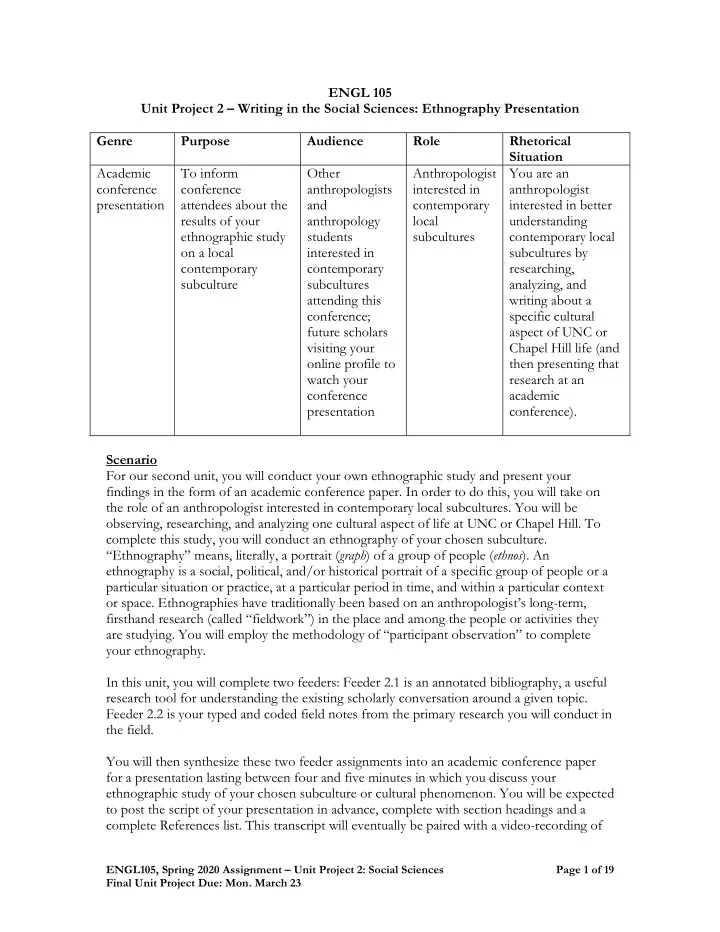
ENGL 105 Unit Project 2 Writing in the Social Sciences: Ethnography Presentation Genre Purpose Audience Role Rhetorical Situation Academic To inform Other Anthropologist You are an conference conference anthropologists interested


slide-1
SLIDE 1

ENGL105, Spring 2020 Assignment – Unit Project 2: Social Sciences Page 1 of 19 Final Unit Project Due: Mon. March 23

ENGL 105 Unit Project 2 – Writing in the Social Sciences: Ethnography Presentation Genre Purpose Audience Role Rhetorical Situation Academic conference presentation To inform conference attendees about the results of your ethnographic study

  • n a local

contemporary subculture Other anthropologists and anthropology students interested in contemporary subcultures attending this conference; future scholars visiting your

  • nline profile to

watch your conference presentation Anthropologist interested in contemporary local subcultures You are an anthropologist interested in better understanding contemporary local subcultures by researching, analyzing, and writing about a specific cultural aspect of UNC or Chapel Hill life (and then presenting that research at an academic conference). Scenario For our second unit, you will conduct your own ethnographic study and present your findings in the form of an academic conference paper. In order to do this, you will take on the role of an anthropologist interested in contemporary local subcultures. You will be

  • bserving, researching, and analyzing one cultural aspect of life at UNC or Chapel Hill. To

complete this study, you will conduct an ethnography of your chosen subculture. “Ethnography” means, literally, a portrait (graph) of a group of people (ethnos). An ethnography is a social, political, and/or historical portrait of a specific group of people or a particular situation or practice, at a particular period in time, and within a particular context

  • r space. Ethnographies have traditionally been based on an anthropologist’s long-term,

firsthand research (called “fieldwork”) in the place and among the people or activities they are studying. You will employ the methodology of “participant observation” to complete your ethnography. In this unit, you will complete two feeders: Feeder 2.1 is an annotated bibliography, a useful research tool for understanding the existing scholarly conversation around a given topic. Feeder 2.2 is your typed and coded field notes from the primary research you will conduct in the field. You will then synthesize these two feeder assignments into an academic conference paper for a presentation lasting between four and five minutes in which you discuss your ethnographic study of your chosen subculture or cultural phenomenon. You will be expected to post the script of your presentation in advance, complete with section headings and a complete References list. This transcript will eventually be paired with a video-recording of

slide-2
SLIDE 2

ENGL105, Spring 2020 Assignment – Unit Project 2: Social Sciences Page 2 of 19 Final Unit Project Due: Mon. March 23

the presentation you give to the rest of us in class on your research and findings so future audiences and scholars can revisit your work. Note that for all of our work in Unit 2, we will be using American Psychological Association (APA) citation format. Your primary source of information on APA citation format should be the UNC Libraries. See the following pages:

  • UNC Libraries: “Why We Cite”
  • UNC Libraries, APA:
  • “Sample References Page”
  • “In-Text Citations”
  • “Print Sources”
  • “Online Sources”

Feeder 2.1: Annotated Bibliography (at least 3-4 sources total) Step 1: Select a local contemporary subculture to study. Your first task is to choose some aspect of UNC or Chapel Hill life to analyze. It will help to think of UNC and Chapel Hill as consisting of unique cultures or subcultures that must be explored and analyzed to better understand them. There are limitless possibilities to study, but some ideas include: sports fandom, fraternity/sorority life, campus religious organizations, campus political

  • rganizations, other campus organizations or publications, non-UNC student life in Chapel

Hill, or other organizations or populations in or around UNC. The goal here is to observe and study a culture or subculture of which you are not a member, a group of people united by common interests, beliefs, values, activities, etc. Be creative but intentional in your choice. There are certainly some viable options I did not think to include in this list, so do not feel limited by the options I have suggested. Note: Do not choose an organization or population of which are already/becoming a member. For example, you cannot study the fraternity/sorority you are currently “pledging.” On Thurs. Feb. 13, we will go over our introduction to the Social Sciences and look through this unit assignment prompt. On that day, in class, you will be asked to brainstorm, discuss, and eventually commit to the specific subculture or cultural phenomenon you wish to study. You will be asked, in class, to post the subculture or cultural phenomenon you wish to study and provide a few sentences explaining why you’ve selected that topic. (This means that, prior to this day in class, you should have brainstormed some potential areas of study and your motivations/goals in studying these subcultures. What do you find interesting/confusing/engaging about this topic? What do you hope to learn? What assumption/s do you expect to confirm?) You must commit to a topic and post it to our forum for the day before leaving class that day. If you are absent, you are responsible for posting to the appropriate forum before 9:15am on Thurs. Feb. 13 with a selected topic. Step 2: Conduct a preliminary observation and develop a research question. Once you have selected a subculture to study, you will need to conduct what is called a “preliminary

  • bservation.” You will visit your chosen subculture or population and take about thirty

minutes to observe everything that occurs there. Take careful field notes and then type them up as soon as possible after your preliminary observation to capture everything as accurately

slide-3
SLIDE 3

ENGL105, Spring 2020 Assignment – Unit Project 2: Social Sciences Page 3 of 19 Final Unit Project Due: Mon. March 23

as possible. I will post a handout on Sakai for you to use to help you focus your analysis (“Field Notes for Preliminary Observations” at Sakai>Resources>Unit 2). After your preliminary observation, you will then need to generate a specific research question (RQ). It is crucially important that you have a single, specific question to answer so that you can focus your research and writing on one aspect of this subculture or cultural

  • phenomenon. Create a document titled “Preliminary Field Notes and Research Question.”

Your document should list:

  • Your specific subculture or cultural phenomenon of study
  • Your research question
  • Your typed field notes from your preliminary observation

Go to Sakai>Forums>Unit 2: Writing in the Social Sciences. Find the forum topic for

  • Wed. Feb. 19 and copy and paste this document into your post. I realize that

conducting a preliminary observation may be difficult and may create conflicts beyond your

  • control. At a bare minimum, if you are unable to complete a preliminary observation before

this due date, you should at least brainstorm 1-3 potential research questions. Your document should include all of these—ranked—as well as a concrete plan (including prior commitments or agreements) to complete your preliminary observation as soon as possible. You should complete your preliminary observation and then commit to a research question as soon as possible. Step 3: Compile and analyze secondary sources. Now that you have completed all of the above steps, you are prepared to actually complete your feeder assignment. In order to better understand the complexities of your research question, you need to conduct secondary research, which means consulting the work of other scholars in the field. Therefore, for Feeder 2.1, you will create an annotated bibliography. An annotated bibliography is a bibliography, a list of citations of various secondary sources relevant to your project, but in this case each citation is accompanied by an annotation, a paragraph of information that describes the source’s overall argument or point as well as its value toward your particular research project. Your annotated bibliography should include at least two or three scholarly sources, plus at least one source that isn’t necessarily scholarly but applies directly to your specific subculture or cultural phenomenon—a webpage on the UNC website regarding your chosen organization, for example. All of your sources should engage with your chosen subculture and/or your research question in some manner. This might be direct or indirect, explicit or implicit. I. At the top of your annotated bibliography, briefly state your selected subculture

  • f study and your research question. Then continue with your actual annotated

bibliography. II. Include a full, APA-style bibliographic citation for each source: title, author, year published, journal title (if applicable), and URL, etc. For Unit 2, we will be using APA citation style. For more information about citation formats, including APA, see the UNC Libraries page on citations. (Your sources should be listed in alphabetical order determined by how each bibliographic citation begins.)

slide-4
SLIDE 4

ENGL105, Spring 2020 Assignment – Unit Project 2: Social Sciences Page 4 of 19 Final Unit Project Due: Mon. March 23

III. After each citation for each source, write an annotation consisting of a solid paragraph that answers the following questions in complete sentences for each source:

  • 1. What is the author’s object of study (the specific object/subculture/cultural

phenomenon that is their focus of analysis)?

  • 2. What is the main argument or premise of the source?
  • 3. How will this source help you analyze your chosen subculture/cultural

phenomenon, specifically regarding your research question? IV. (This next component is a slight alteration to the typical style of an annotated bibliography.) In addition to your annotation, write out two or three relevant quotations from this source that speak to your analysis; each quote should include an in-text citation that includes page numbers (or paragraph numbers for online sources, etc.). (Then move on to the next citation for the next source, etc.) V. For your “non-scholarly” or “popular” source, simply mention at the beginning

  • f your annotation that this source is your “non-scholarly” source, so I know you

recognize which sources are scholarly and not. A rough draft of your annotated bibliography is due Mon. Feb. 24 by 11:59pm via the appropriate forum on Sakai. This rough draft should be attached to your post as its

  • wn document. We will workshop this in class on Tues. Feb. 25. The file name for

this document should be “[Your last name]_2.1 Rough Draft.” This draft does not have to be entirely complete, but it should be as close to complete as possible for you to maximize the benefits from the workshop in class. Step 4: Based on your workshop experience, revise your annotated bibliography into a second, separate, and final draft. This final draft of Feeder 2.1 is due for a grade on

  • Wed. Feb. 26 by 11:59pm via the “Assignments” tab on Sakai. The file name for this

document should be “[Your last name]_2.1 Final Draft.” Successful annotated bibliographies will:

  • Display considerable investment in the revision process.
  • Clearly state the chosen subculture or topic of study and the intended research

question.

  • Include an appropriate selection of secondary sources, appropriately and accurately

cited in APA format.

  • Include an annotation accompanying each citation that completely and accurately

answers all of the questions listed above.

  • Include appropriate and useful quotations from each secondary source, accompanied

by an in-text citation that is complete and accurate.

  • Exhibit the student’s overall awareness of the critical conversation currently taking

place around this topic.

  • Note: Your final annotated bibliography does not need to (and should not) include

your field notes from your preliminary observation. Those notes were intended to serve as a research tool, helping you to develop a research question so you could

slide-5
SLIDE 5

ENGL105, Spring 2020 Assignment – Unit Project 2: Social Sciences Page 5 of 19 Final Unit Project Due: Mon. March 23

begin conducting secondary research. Those notes are the first portion of your primary research and should be helpful when you begin work on Feeder 2.2 and your Unit Project. Although you should not include them in the final draft of your annotated bibliography, they will be helpful to reference moving forward. Grading Rubric for Feeder 2.1: Annotated Bibliography The final grade for Feeder 2.1, Annotated Bibliography, will be worth 5% of the student’s final course grade. 10 7 4 1 Research Question Research question is appropriately phrased,

  • pen-ended,

has a debatable answer, and expands on prior knowledge, attempting to contribute to the scholarly discourse on this topic. Research question poses an intriguing question with a debatable answer but does so in confusing or unclear language. Research question makes more of an

  • bservation

rather than a debatable claim

  • r question.

Annotated bibliography lacks a guiding research question, or the research question is totally unintelligible. Source 1 Annotation is complete, accurate, and appropriate. Some information is lacking or inaccurate. The response is cursory at best and does not provide enough information for the reader to understand. Little to no response to the questions. Source 2 (and 3) Annotation is complete, accurate, and appropriate. Some information is lacking or inaccurate. The response is cursory at best and does not provide enough information for the reader to understand. Little to no response to the questions. “Non- Scholarly”

  • r

Annotation is complete, Some information is The response is cursory at best and does not Little to no response to the questions.

slide-6
SLIDE 6

ENGL105, Spring 2020 Assignment – Unit Project 2: Social Sciences Page 6 of 19 Final Unit Project Due: Mon. March 23

“Popular” Source accurate, and appropriate. lacking or inaccurate. provide enough information for the reader to understand. Style Annotations feature varied and sophisticated sentence structure and diction. Annotations use some repetitive diction, overly simplistic language or sentence structures but mostly maintain a professional and objective tone. Annotations

  • ccasionally lapse

into overly casual, colloquial discourse or subjective claims. Writing appears erratic, and some sentences are hard to follow. Major lapses into casual discourse or little attempt to maintain objectivity. Diction is highly repetitive, and syntax is confusing. Citations A coherent citation system (APA format) is used consistently throughout; citations are complete and formatted accurately. A citation system is systematically used with some lapses in providing required bibliographical information. It is very difficult to tell if a single citation style has been adopted throughout. Citations are erratic and/or incomplete. No effort at citing sources accurately and consistently is made. Grammar Annotated bibliography is free from typographical errors as well as spelling and grammar mistakes. A few surface errors but none so consistent that they obscure the student- author’s meaning. Repeated surface errors. No sign of editing or revision. Total: /70

slide-7
SLIDE 7

ENGL105, Spring 2020 Assignment – Unit Project 2: Social Sciences Page 7 of 19 Final Unit Project Due: Mon. March 23

Feeder 2.2: Coded Field Notes (at least 1,600 words total) Now that you have one narrow research question and a more thorough understanding of the

  • ngoing conversation around the subject of your study, you will need to conduct at least two

more observations, each of which should be at least thirty minutes in duration. During these sessions, you will record expanded field notes, engage/participate more directly with your informants, and ask questions of your informants. You will polish, code, and type them (creating them on a laptop/tablet may speed things up) for your feeder assignment. The notes for each individual observation should be at least 800 words. (These are notes for two new observations; these do not include your notes from your preliminary

  • bservation, although you can feel free to reference back to that earlier observational

experience if appropriate.) Note: I realize that it may be difficult or beyond your control to schedule or observe your chosen subculture. In a worst-case scenario, if you are unable to attend/observe your subculture twice, one of your observations can consist of an interview/observation conducted via phone, Skype, Zoom Meetings, or email, etc. Again, this is only permissible for one of your observations and only as a worst-case scenario solution. In such a case, provide a brief explanation for this recourse, followed by a transcript coded with your reactions, thoughts and feelings, and analysis, as indicated below. It’s also best if you discuss this with me in advance. Coding System:

  • Description (what’s happening): plain text
  • Your thoughts and feelings (in response to what’s happening): italics
  • Analysis (tentative immediate conclusions about this subculture, usually based on the

events and/or your thoughts and feelings): bold When creating these expanded field notes, focus your attention to ideas concerning identity and reflexivity. Here are some questions to keep in mind. You will not be able to answer all

  • f these questions; instead, you will need to think about which questions best relate to your

chosen subculture and research question. Identity:

  • What are some of the markers of identity here (such as symbols, clothes, body

language, verbal language)? In other words, how do people here create or display “identity”?

  • How do you know that these things mean “identity”? Is the meaning something you

deduced or something you were told?

  • How relevant or important is identity in this setting?
  • Are there political or power implications for identity at your site? Are there active

stereotypes about or within the community?

  • Is a group identity used to create borders between insiders and outsiders here? How

is that shared identity marked? What is the purpose?

slide-8
SLIDE 8

ENGL105, Spring 2020 Assignment – Unit Project 2: Social Sciences Page 8 of 19 Final Unit Project Due: Mon. March 23

Reflexive You (a shift to thinking about your own identity):

  • How do you think you’re perceived in this site? Is it different from how you want to

be perceived? What do you do to create that perception?

  • What sorts of comments or actions from the informants suggest the ways in which

they have chosen to “see” you and grant you an identity?

  • What processes have you had to go through (internal and external) to be a researcher

and/or participant at the site?

  • Are you an insider, outsider, or both? Explore this as fully as you can and talk about

how it feels to be an observer at the site, a participant at the site, or both.

  • Are there social or political/power implications for you as a researcher at this site?
  • What are the perceptions of you and your research by the community you’re working

with? How do you feel about that? The style of these expanded field notes will almost begin to form a kind of narrative or reflective essay on your experience. Remember to code all of your notes in the manner described above. At the top of your field notes, please insert a brief reminder of your chosen subculture and state your current research question. This question might have changed based on the results of your observations, but your current research question will be a part of your grade for your coded field notes. A rough draft of your field notes is due Mon. March 2 by 11:59pm via the appropriate Sakai forum for us to workshop in class on Tues. March 3. The file name for this document should be “[Your last name]_2.2 Rough Draft.” This draft does not have to be entirely complete, but it should be as close to complete as possible for you to maximize the benefits from the workshop in class. Based on your workshop experience, revise and complete your Feeder 2.2 in to a separate, final draft. This final draft of Feeder 2.2 is due for a grade on Wed. March 4 by 11:59pm via the “Assignments” tab on Sakai. The file name for this document should be “[Your last name]_2.2 Final Draft.” Successful drafts will:

  • Display considerable investment in the revision process.
  • Address some, or all, of the questions listed above.
  • Include concrete and specific examples from observations including quotations,

sensory details, (non)verbal cues, (non)visual cues, etc.

  • Integrate the student-observer’s thoughts and feelings into the observational

experience.

  • Integrate the student-observer’s analysis into the observational experience.
  • Shift from thinking strictly about the observed subculture to the student-observer’s

reflection on their own identity and place in relation to the observed subculture.

  • Exhibit the student-observer’s critical engagement with the chosen subculture in

general and regarding their specific research question.

slide-9
SLIDE 9

ENGL105, Spring 2020 Assignment – Unit Project 2: Social Sciences Page 9 of 19 Final Unit Project Due: Mon. March 23

Grading Rubric for Feeder 2.2: Coded Field Notes The final grade for Feeder 2.2, Coded Field Notes, will be worth 5% of the student’s final course grade. 10 7 4 1 Research Question Research question is appropriately phrased,

  • pen-ended,

has a debatable answer, and expands on prior knowledge, attempting to contribute to the scholarly discourse on this topic. Research question poses an intriguing question with a debatable answer but does so in confusing or unclear language. Research question makes more of an

  • bservation

rather than a debatable claim

  • r question.

Coded field notes are not accompanied by a guiding research question, or the research question is totally unintelligible. Depicting Events Field notes clearly explain or depict the events taking place in a well-

  • rganized

and carefully depicted manner. Field notes are lacking some detail or

  • specificity. In

a few instances, more detail or information is necessary for the reader to follow the events. Field notes are significantly lacking in some

  • way. Minimal or

no detail is provided. Field notes are cursory at best, lacking detail, disorganized, and/or confusing. Thoughts and Feelings Field notes effectively and appropriately integrate the student-

  • bserver’s

thoughts and feelings into the Some information is lacking or confusing. The response is cursory at best and does not provide enough information for the reader to understand. Little to no integration of student-observer’s thoughts and feelings.

slide-10
SLIDE 10

ENGL105, Spring 2020 Assignment – Unit Project 2: Social Sciences Page 10 of 19 Final Unit Project Due: Mon. March 23

  • bservational

experience. Analysis Field notes effectively and appropriately integrate the student-

  • bserver’s

analysis into the

  • bservational

experience. Some information is lacking or confusing. The response is cursory at best and does not provide enough information for the reader to understand. Little to no integration of student-observer’s analysis of the events taking place. Paragraph Structure Paragraphs contain an analytical topic sentence that makes one central claim

  • r introduces
  • ne new

narrative topic and then expands

  • n that claim
  • r topic.

Each paragraph flows well. Paragraphs are mostly well structured with a few slip-ups; some paragraphs either do not contain adequate flow, are missing a topic or ending sentence, or do not analyze their evidence

  • r topic.

A few paragraphs attempt to do too much or do not advance one specific claim. Paragraphs do not contain logical flow of information. Paragraphs are highly unorganized and very difficult to follow; paragraphs do not advance any claim or narrative topic at all. Organization Field notes are organized with a logical and explicit pattern. Coding is complete and accurate. Field notes are mostly well-

  • rganized, but

some paragraphs seem out of

  • rder or
  • repetitive. Or

some coding is lacking or inaccurate. Field notes are very confusingly

  • rganized and do

not reflect an

  • verall
  • rganizational
  • pattern. Little to

no coding of the Field Notes is attempted. Field notes are

  • rganized so

confusingly that it impedes the student- author’s purpose.

slide-11
SLIDE 11

ENGL105, Spring 2020 Assignment – Unit Project 2: Social Sciences Page 11 of 19 Final Unit Project Due: Mon. March 23

Style Field notes feature varied and sophisticated sentence structure and diction. Field notes use some repetitive diction, overly simplistic language or sentence structures but mostly maintain a professional and objective tone. Field notes

  • ccasionally lapse

into overly casual, colloquial discourse or subjective claims. Writing appears erratic, and some sentences are hard to follow. Major lapses into casual discourse or little attempt to maintain objectivity. Diction is highly repetitive, and syntax is confusing. Grammar Field notes are free from typographical errors as well as spelling and grammar mistakes. A few surface errors but none so consistent that they

  • bscure the

student-

  • bserver’s

meaning. Repeated surface errors. No sign of editing or revision. Total: /80 Unit Project: Ethnography Presentation (4-5 minutes, approx. 800-1,000 words) Now that you’ve become familiar with the ongoing scholarly conversation around your selected subculture and that you’ve conducted your own primary research in the field, it’s time to present your findings. Synthesize the information from your two feeders into an ethnographic study of your selected subculture or cultural phenomenon, a study that you will present in the style of an academic conference presentation to me and the rest of your classmates on Tues. March 24 in class. Because our time is limited, we will be following the criteria of the “3-Minute Thesis” Competition (http://gradprofdev.web.unc.edu/3-minute-thesis/), although I’ve adjusted the parameters for the purposes of this assignment and this class, extending the presentation time to be between four and five minutes. Each presentation should be no less than four and no more than five minutes long. Ideally, you should aim to conclude your presentation just before the five-minute-mark. This translates to about 2.67 to 3.33 double-spaced pages of text, although you should practice reading your presentation aloud with your own timer to adjust as necessary in advance. We will discuss tips for oral communication in class, but for more information, see the UNC Writing Center’s page on speeches: http://writingcenter.unc.edu/tips-and-tools/speeches/.

slide-12
SLIDE 12

ENGL105, Spring 2020 Assignment – Unit Project 2: Social Sciences Page 12 of 19 Final Unit Project Due: Mon. March 23

This abbreviated format should allow you to practice your editing and condensing skills. All

  • f the vital portions of your primary and secondary research should be included in your oral
  • presentation. Some aspect of each section of your paper should be included, but make sure

to ultimately prioritize your own primary research and your findings/conclusions. Part of your grade will rely on your ability to effectively and appropriately present your findings in the context of an oral presentation. Your presentation should be between four and five minutes long. A presentation length that is more or less than this amount will result in a rapid reduction of points on your grade. If we assume that a single page of double-spaced text is roughly 300 words per page, then each page takes approximately 90 seconds or 1.5 minutes to present orally. This means that a presentation of four to five minutes will consist of a script of approximately 800-1,000 words (2.67 to 3.33 pages of double-spaced text). Please note that these are approximations; your time will depend upon the specific content you present and the style of your writing and your delivery. In addition, you have the option of incorporating 1-3 static image/text slides into your presentation (via PowerPoint, Google Slides, or some other similar platform). Please note that the 3-Minute Thesis Competition only allows for a single static slide to be incorporated into presentations, but we are adjusting those regulations for the purposes of this assignment. The inclusion of any images/slides is completely optional, and such slides/images should only be used if they provide useful visuals, graphics, or some other illustration that assists in the audience’s comprehension of the speaker’s points and to which the speaker directly refers during their presentation. No presentation handouts are allowed. If you wish to incorporate any slides or images into your presentation, please submit those to me via email by 11:59pm on March 23 so I will be prepared to incorporate them into your in-class presentation on Tues. March 24. If you submit any visuals late, they will not be part of your presentation. You will be posting the script of this presentation in advance and then presenting your paper to us in class as though we were the attendees at your presentation at an academic

  • conference. We will video-record your presentations, and the final product posted to the

course website will consist of the video recording of your presentation in conjunction with the script/transcript you will have already posted. (We will work together after your presentations to upload the videos of your presentations.) You should prioritize the crafting and posting of your presentation script along with preparing to effectively present your paper to us. The script of your ethnographic study presentation will be divided into several sections: Preface, Background Information, Observational Data and Analysis, Conclusion, and

  • References. We will look at some sample ethnographic studies in class or for homework, but

here is a basic summation of each section:

  • Preface: Sets up your connection to or interest in a particular subculture and very

briefly introduces the reader to that subculture. What prior connections to or interest in this topic did you have? What assumptions did you have? What did you expect to learn or confirm? What is your research question?

slide-13
SLIDE 13

ENGL105, Spring 2020 Assignment – Unit Project 2: Social Sciences Page 13 of 19 Final Unit Project Due: Mon. March 23

  • Background Information: Integrates secondary source material to contextualize the

topic of study both specifically and in a broader sense beyond the immediate UNC- Chapel Hill area. In other words, you should provide the background information on your selected subculture or cultural phenomenon so that the reader can better understand your topic. Specifically, try to use this background information to better contextualize the observational field notes in your next section. If you’re discussing a Greek organization on campus, for instance, your scholarly sources might discuss Greek culture on large public universities. Your non-scholarly/popular source might be the webpage for that chapter at UNC and provide background information on that particular chapter. Provide all relevant information to help your reader better understand this organization, population, site, or subject before you begin describing your observations and findings. (Ideally, Feeder 2.1 laid the groundwork for this section for you already.)

  • Observational Data and Analysis: Use the notes from your preliminary observation

and, especially, your expanded field notes from your two actual observations to walk your reader through your observational experience. You don’t have to list every single moment or detail. Craft the events of your observation into a kind of narrative, describing events and analyzing them in a way that addresses the answer to your research question. (You have to walk a fine line here because you need to be truthful but at the same time concise. You can’t just omit important aspects of your

  • bservation because it doesn’t fit into your question. However, you can gloss over

some details or sum them up quickly if they’re not particularly relevant.) This section should provide details from observations, integrating sensory details, quotes, and

  • ther concrete examples to narrate and analyze your observational experience,

especially one relevant to your research question.

  • Conclusion: This section describes your new insights in reaction to your observation

experience, specifically answering your research question and touching on larger implications of your research: what conclusions do you draw personally from these observations and interactions, especially regarding your research question? Additionally, you should attempt to address some or all of the following questions: Were your initial assumptions confirmed or challenged? What new insights did you gain? What aspects of your observation surprised you? How did your original research question fail to address certain things you learned or observed? What would you like to know more about regarding this cultural phenomenon? If you had the chance, what other questions or observations would you conduct to learn more? (Although it’s vital to be transparent about the limitations of your study, you are still expected to come up with some larger conclusion/take-away from your primary/secondary research; it’s not sufficient to simply shrug and say that your research is inconclusive.)

  • References: List all of your secondary sources (scholarly and otherwise) in a list titled

“References” at the end of your paper. All citations should be in APA format. You won’t read your References list during your presentation, but this list needs to be included in the transcript you post. This list should include any sources you cite in your script but should omit sources not cited or referenced in your script. (Remember to include in your script in-text citations or attributions to the sources you mention.)

slide-14
SLIDE 14

ENGL105, Spring 2020 Assignment – Unit Project 2: Social Sciences Page 14 of 19 Final Unit Project Due: Mon. March 23

  • You won’t explicitly signal each of these shifts from section to section while

delivering your conference presentation, but the script/transcript you post should clearly indicate where each section ends/begins with something as simple as a section header.

  • If there are visuals, charts, graphs, or other images, etc. that you plan to incorporate

into your presentation via slides, you should also integrate these images into the script of your presentation for the benefit of any outside audiences. Please make sure that the inclusion of any such images are properly cited if they come from any

  • utside sources.
  • Remember that your presentation should have a descriptive title that engages an

audience while also suggesting the overall content you’ll be discussing. Timeline for Unit Project: Your first draft of your presentation script is due Mon. March 16 by 11:59pm via the appropriate Sakai forum for us to workshop in class on Tues. March 17. The file name for this document should be “[Your last name]_UP2 Draft 1.” This draft does not have to be entirely complete, but it should be as close to complete as possible for you to maximize the benefits from the workshop in class. Based on your workshop experience, revise and complete your presentation script in to a separate, second draft. The second draft of your presentation script is due Wed. March 18 by 11:59pm via the appropriate Sakai forum for us to workshop in class on

  • Thurs. March 19. The file name for this document should be “[Your last name] UP2

Draft 2.” This draft should be a more complete draft, quite close to a finished, polished draft. Based on your workshop experience, revise and complete your presentation script in to a separate, final draft. This final draft of your Unit Project is due for a grade on

  • Mon. March 23 by 11:59pm via the course website. This means you will need to take

your final draft Word document and copy and paste it as a post on our course

  • website. This will take time, but the completed draft of your presentation script must

be published online by 11:59pm, so you should start this process early. Your submissions are time-stamped, and once the deadline has passed, if you go back and revise, your script will be considered late. Please remember that part of your grade will rely on your effective delivery of this

  • presentation. This means you will need to complete your presentation script early

enough to allow you adequate time to rehearse your final script prior to our in-class presentations on Tues. March 24. There are many reasons I’m requiring you to provide a transcript of your presentation in

  • advance. It will serve as a reference for me while grading, and it also makes your work

accessible to those who cannot watch or hear the video of your actual presentation. How to post your presentation script/transcript:

  • Go to the course website at https://engl105sp2020.web.unc.edu/. Scroll to the

bottom and look for the heading “Webmaster Login.” The second option allows you

slide-15
SLIDE 15

ENGL105, Spring 2020 Assignment – Unit Project 2: Social Sciences Page 15 of 19 Final Unit Project Due: Mon. March 23

to log in using your ONYEN. Once you’re logged in, go to the Dashboard. Then click on “All Posts” and then “Add New.”

  • Copy and paste your presentation script into the browser.
  • Note that when composing online, you indicate paragraph breaks not by

indenting your paragraph but by inserting a blank line in between each paragraph.

  • Because your post is one continuous page, you will not need page numbers.

Nor will you use the academic heading of your name, the course number, etc. Instead, insert the descriptive title of your presentation into the bar for the title of your post, and insert the text of your script directly into the text box. Your name will automatically be included in/attached to your post.

  • Because this is meant to be a transcript of your presentation, make sure that

you’ve inserted section headings for each section of your presentation script where needed (Preface, Background Information, Observational Data and Analysis, Conclusion, References).

  • Because your post is one continuous page, you will not have a separate

References page. Instead, at the end of the text of your script, insert a few blank lines and then begin your References list. You will not be able to use hanging indents for your bibliographic citations. Instead, insert an empty line in between each citation.

  • Check your formatting to make sure everything copied over appropriately, especially

if you are including tables, charts, or other visuals.

  • You have the option of inserting images, but those images should be cited
  • appropriately. You can also add hyperlinks or other media when appropriate. If

possible, your References list should include appropriate hyperlinks to those sources referenced.

  • Images you might have included in your presentation slides should be

incorporated (and cited) within the text of your presentation script.

  • Do not alter any settings for the blog or any other webpage or the site in general.
  • On the right, you’ll see a spot to add tags for your post. Feel free to use some already

listed and/or add your own.

  • On the right, you’ll also see a place to choose a category for your post. Make sure

you select “Social Sciences: Ethnography Presentation” for your post.

  • Remember to hit “Publish” near the top-right corner when you’re done. Once you

have published your post, I strongly encourage you to view your post as though you were any other online visitor in order to double-check the appearance of your post

  • ne last time, just in case you need to go back and edit changes before the final

deadline and to ensure that your readers can fully comprehend your intended message. Most, if not all, of you will present on Tues. March 24, followed by time for open Q&A from the audience and then some time for constructive feedback from the

  • audience. I will take notes on everyone’s participation during the Q&A and feedback

sessions as well. Those who do not present on Tues. March 24 will present on Thurs. March 26, during which we will follow the same structure. Your presentation order will be randomized; if you are randomly selected to present but are absent, your absence will affect your grade on this unit project significantly.

slide-16
SLIDE 16

ENGL105, Spring 2020 Assignment – Unit Project 2: Social Sciences Page 16 of 19 Final Unit Project Due: Mon. March 23

Although you should rehearse your presentation multiple times in advance and should be comfortable and familiar with your presentation script, you are not expected to recite your presentation from memory. You may read from your script in any hard copy format (typed then printed on full sheets of paper, handwritten on full sheets of paper, written on index cards, etc.). You may not, however, read your script from your phone, tablet, laptop, or any

  • ther electronic device as the inclusion of such devices is distracting in this type of

presentation format. Everyone should come to class on Tues. March 24 with a hard copy of the script from which you plan to read. Remember: if you wish to incorporate visuals into your presentation, those must be emailed to me by 11:59pm on Mon. March 23. When delivering your presentation, remember that you audience will not know the descriptive title of your presentation, so you may want to begin with something as simple as, “Good morning. My name is [your name], and the title of my presentation is [your presentation title]. After everyone has presented, we will eventually take some time in class to upload the video of everyone’s presentation to the course website to accompany the transcript of your presentation. Successful presentations will display considerable investment in the revision process and will be well-rehearsed, poised, and delivered in a professional, articulated manner within the time frame of four to five minutes. Grading Rubric for Unit Project 2: Ethnography Presentation The final grade for UP2, Ethnography Presentation, will be worth 15% of the student’s final course grade. 10 7 4 1 Preface & Research Question Preface signals the student’s interest in a specific subculture, their prior expectations, assumptions, and goals, leading to a research question. This research question is appropriately phrased, open-ended, has a debatable answer, and expands

  • n prior knowledge,

attempting to contribute to the scholarly discourse

  • n this topic.

Preface inadequately addresses student’s prior goals or assumptions. Or the research question poses an intriguing question with a debatable answer but does so in confusing or unclear language. Preface is severely

  • lacking. Or the

research question makes more of an observation rather than a debatable claim or question. Presentation lacks either a preface and/or a guiding research question, or the research question is totally unintelligible.

slide-17
SLIDE 17

ENGL105, Spring 2020 Assignment – Unit Project 2: Social Sciences Page 17 of 19 Final Unit Project Due: Mon. March 23

Background Information Sources are excellently paraphrased and summarized and are incorporated into the writing using signals

  • r attributions.

Quotations of specific phrases, word choice, etc. are used when appropriate. Student skillfully integrates this material to contextualize their chosen subculture. Sources are mostly paraphrased and summarized well, as is the inclusion of quotations. Student attempts to provide some context for their chosen subculture. Summaries and paraphrases are confusing, awkward, and do not flow well with the rest of the paragraph. Quotations are poorly integrated into the text and tend to be unnecessarily long with little comment/anal

  • ysis. Sources

do not adequately provide context for the chosen subculture. Sources are pulled in as lengthy direct quotes and almost no effort is made to paraphrase

  • r summarize
  • them. Student

does not provide enough information to understand the importance of this material to their study. Observation al Data & Analysis Studently adeptly uses a combination of details from their

  • bservational

experiences, integrating sensory details, quotes, and

  • ther concrete

examples to narrate and analyze their

  • bservational

experiences in a way that addresses their research question. The narrative is lacking some detail or

  • specificity. In a

few instances, more information is necessary to support its

  • claims. Or the

analysis of this narrative is lacking. The narrative is significantly lacking in some way. Minimal or no detail is provided and/or minimal or no analysis is attempted. Narrative contains almost no clear information or attempt at analysis, and/or the narrative is disorganized and confusing. Paragraph Structure Paragraphs contain an analytical topic sentence that makes

  • ne central claim or

introduces one new narrative topic and then expands on that Paragraphs are mostly well structured with a few slip-ups; some paragraphs either do not A few paragraphs attempt to do too much or do not advance one specific claim Paragraphs are highly unorganized and very difficult to follow; paragraphs do

slide-18
SLIDE 18

ENGL105, Spring 2020 Assignment – Unit Project 2: Social Sciences Page 18 of 19 Final Unit Project Due: Mon. March 23

claim or topic. Each paragraph flows well. contain adequate flow, are missing a topic or ending sentence, or do not analyze their evidence

  • r topic.
  • r topic.

Paragraphs do not contain logical flow of information. not advance any claim or narrative topic at all. Organizatio n Presentation is

  • rganized with a

logical and explicit pattern marked by section headings. Presentation is mostly well-

  • rganized, but

some paragraphs seem out of

  • rder or

repetitive, or some section headings are missing. Presentation is very confusingly

  • rganized and

does not reflect an

  • verall
  • rganizational

pattern. Presentation is

  • rganized so

confusingly that it impedes the student’s purpose. Style Presentation features varied and sophisticated sentence structure and diction. Any visuals included are integrated appropriately. Presentation uses some repetitive diction, simplistic language or sentence structures but mostly maintains a professional and objective tone. Presentation

  • ccasionally

lapses into casual, colloquial discourse or subjective

  • claims. Writing

appears erratic, and some sentences are hard to follow. Major lapses into casual discourse or little attempt to maintain

  • bjectivity.

Diction is highly repetitive, and syntax is confusing. Conclusion Student explicitly answers their research question by using their observations and analysis to draw an overall conclusion that also gestures towards larger implications. Student makes some effort to answer their research question and articulate the wider implications of their findings. Student provides very cursory concluding statements that do not appear explicitly related to their research question. No conclusions or incomprehensi ble conclusions are offered.

slide-19
SLIDE 19

ENGL105, Spring 2020 Assignment – Unit Project 2: Social Sciences Page 19 of 19 Final Unit Project Due: Mon. March 23

Citations A coherent citation system (APA format) is used consistently throughout; References list is complete and formatted accurately. Any visuals included are cited when necessary. A citation system is systematically used with some lapses in providing required bibliographical information; References list does not include all sources cited in body of text. It is very difficult to tell if a single citation style has been adopted throughout. References list is erratic and/or incomplete. No effort at citing sources accurately and consistently is made. Grammar Presentation script is free from typographical errors as well as spelling and grammar mistakes. A few surface errors but none so consistent that they obscure the writer’s meaning. Repeated surface errors. No sign of editing or revision. Presentation Delivery Presentation is well- rehearsed, poised, and delivered in a professional, articulated manner within the time frame

  • f four to five
  • minutes. Presenter

varies their tone and speed, maintains eye contact, and is engaging and

  • confident. Any
  • ptional visuals or

slides contain content that is appropriate, useful, and directly referenced in the presentation. Presentation is well-rehearsed and mostly poised. Presenter

  • ccasionally

spends too much time looking down

  • r speaking

too quickly/quietly . Minor issues with visuals and/or duration of presentation. Presentation does not feel adequately prepared. Presenter fails to maintain eye contact or appropriate speed or

  • volume. Major

issues with visuals and/or duration of presentation. No sign that the presenter has rehearsed the presentation. Total: /100