Scribes in the ED: No financial relationships I get what you are - - PowerPoint PPT Presentation

scribes in the ed
SMART_READER_LITE
LIVE PREVIEW

Scribes in the ED: No financial relationships I get what you are - - PowerPoint PPT Presentation

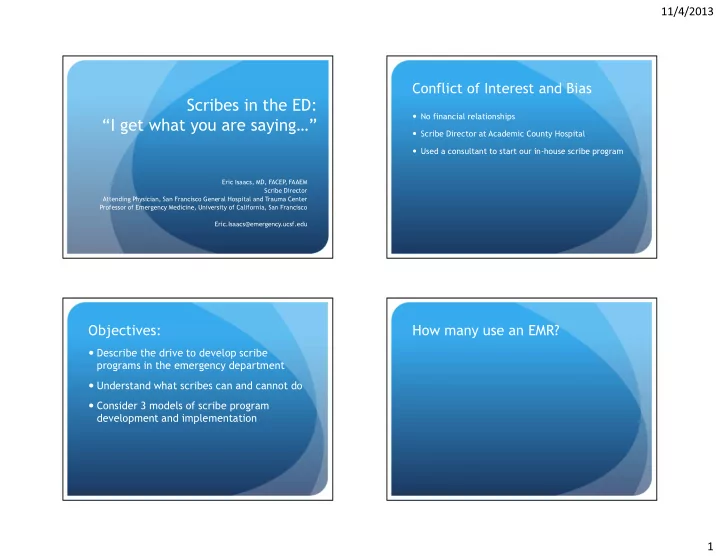
11/4/2013 Conflict of Interest and Bias Scribes in the ED: No financial relationships I get what you are saying Scribe Director at Academic County Hospital Used a consultant to start our in-house scribe program Eric Isaacs,


slide-1
SLIDE 1

11/4/2013 1

Scribes in the ED: “I get what you are saying…”

Eric Isaacs, MD, FACEP , FAAEM Scribe Director Attending Physician, San Francisco General Hospital and Trauma Center Professor of Emergency Medicine, University of California, San Francisco Eric.Isaacs@emergency.ucsf.edu

Conflict of Interest and Bias

No financial relationships Scribe Director at Academic County Hospital Used a consultant to start our in-house scribe program

Objectives:

Describe the drive to develop scribe programs in the emergency department Understand what scribes can and cannot do Consider 3 models of scribe program development and implementation

How many use an EMR?

slide-2
SLIDE 2

11/4/2013 2

How many stay late to document? How many use scribes? How did we get into this mess? Bush and Obama Agree!

Bush 2004 State of the Union – “…By computerizing health records, we can avoid dangerous medical mistakes, reduce costs, and improve care.” Obama 2008 “We will make sure that every doctor’s

  • ffice and hospital in this country is using cutting edge

technology and electronic medical records so that we can cut red tape, prevent medical mistakes, and help save billions of dollars each year.” Penalties for not using EMR “meaningfully” by 2015

slide-3
SLIDE 3

11/4/2013 3

Unintended consequences

Rapid implementation Go live together EDIS – frequently an afterthought Productivity loss Compensation is productivity based

Reality Check: After EMR implementation

Less efficient Less time with patients Patient Satisfaction Job Satisfaction Physician retention Chart accuracy/Medico-legal risks

Percent Time Spent per patient: using EMR

28% Direct patient contact 44% Data entry 12% Reviewing tests and records 13% Case discussion 3% other

  • Robert G Hill Jr. et al, 4000 clicks: a productivity analysis of electronic medical records

in a community hospital, American Journal of Emergency Medicine; article in press.

Can we find a way to:

Improve patient satisfaction Better connections with patients Increase RVU per hour Improve efficiency Go home sooner Getter job satisfaction

slide-4
SLIDE 4

11/4/2013 4

There’s an “app” for that!

http://www.medicine.virginia.edu/clinical/departments/emergency-medicine/forundergraduatestudents/

Why Scribes?

Imagine someone who:

Pulls up the old chart prior to your encounter Documents the HPI/PMH/ROS/SH/Physical exam for you Pulls up old ECG (and document it) Pulls up X-rays for you Tells you when labs or studies are back (and to acknowledge)

Why Scribes?

Imagine someone who:

Confirms you have enough elements and 10 ROS for level 5 Reminds you if a patient meets critical care (more than you think) Reminds you to check on serial observation patients Specific areas of your charting deficiencies

Why Scribes?

Imagine someone who:

Allows you to actually look at the patient while you are talking to them. Takes care of your documentation while you are doing a procedure or other task.

slide-5
SLIDE 5

11/4/2013 5

Why Scribes?

Imagine someone who:

Allows you to talk to the nurses, ancillary staff, or consultants with greater attention while they are documenting your chart or pulling up results. Decreases your need to stay after to complete charts. “Scrub” the charts in the morning

Scribes not right for you if…

Excellent Documentation Patients seen and discharged quickly Everyone going home on time Group is stable Making lots of money EMR is easy to learn and use Access to old records, labs, x-ray is simple

Why not scribes?

Initial outlay of $$ Space and computers Scheduling for partners not utilizing Medicolegal risk HR concerns ED Volume or payer mix “Concern” about teaching and mentoring

What can’t scribes do?

No independent interviewing/practice Place orders

The Joint Commission does not support scribes being utilized to enter orders for physicians or practitioners due to the additional risk added to the process.

www.jointcommission.org/standards_information/jcfaqdetails.aspx?StandardsFAQId=426&StandardsFAQChapterId=66

slide-6
SLIDE 6

11/4/2013 6

What is a scribe?

Unlicensed person hired to: Enter information into the electronic medical record (EMR) MD, NP , or PA The scribe does not and may not act independently but can document the provider’s dictation and/or activities. Scribes also assist navigating the EMR

  • locating information such as test results and lab results.

support work flow and documentation for coding.

www.jointcommission.org/standards_information/jcfaqdetails.aspx?StandardsFAQId=426&StandardsFAQChapterId=66

Regulatory requirements

CMS E/M Guidelines: Every chart entry (by a scribe) needs to clearly indicate that the scribe made the entry.

Scribes need to have their own log in – not a problem with most EMR systems

The provider needs to attest or authenticate that the scribe made the entry (can cover all the entries).

CMS Guidelines

The Scribe’s Note Should also Include

  • The name of the scribe and a legible signature
  • The name of the physician providing the service
  • The date the service was provided
  • The name of the patient for whom the service was provided

The Physician’s Note Should Indicate Affirmation of that physician’s presence during the time encounter was recorded Verification that he/she reviewed the information Verification of the accuracy of the information Any additional information needed

http://www.ngsmedicare.com/wps/portal/ngsmedicare/!ut/p/c5/dY3LCoJAGIWfpRfw_H... 12/12/2011

Examples of scribe charts

Scribe: “I, Sue Perhelpful, am scribing for, and in the presence of, Dr. Isaacs” Physician: “I, Dr. Isaacs, personally performed the services described in this documentation, as scribed by Sue Perhelpful in my presence, and it is both accurate and complete. Any differences or additional information is noted.”
slide-7
SLIDE 7

11/4/2013 7

Who are the scribes?

MEA model Burger King model Pre-Health Care students

Last application period:

> 200 applications for 6 positions

Models of scribe programs

In-house program from beginning to end

Recruit, hire, orient, train, schedule Evaluations with action plans, payroll Turnover

Consultant to start in-house program Outside Scribe provider

50%-100% admin fee

What do you need to start a program?

Interest from partner/director Identify what issue you are trying to address Identify physician champion Metrics for success Buy in from administration and nursing

What is the goal?

Adapt to new EMR? Productivity? Turnaround times? Documentation and coding? Patient satisfaction and service? Reimbursement?

Coding Productivity

slide-8
SLIDE 8

11/4/2013 8

Keys to success

Motivated and engaged scribes Wiki to track physician preferences Train the physicians to use the scribes Engaged physicians (give feedback not just complain)

Pitfalls

Splitting a scribe between two providers Failed feedback Lack of physician engagement Failure to actually read the chart

Conclusion

Use of scribes impacts:

Quality of physician life Reimbursement Productivity Efficiency

Scribes are not for every practice If you are going to start a scribe program

Have the goal in mind Get buy-in from physicians, nursing, administration Persistence and engagement in program maintenance

Resources

ACEP Scribe FAQ

  • www.acep.org/Content.aspx?id=85988

ACEP Focus On the Use of Scribes

  • http://www.acep.org/Continuing-Education-top-banner/Focus-On--The-Use-of-

Scribes-in-the-Emergency-Department/

Additional references available on request

slide-9
SLIDE 9

11/4/2013 9

Questions?

Eric.Isaacs@emergency.ucsf.edu