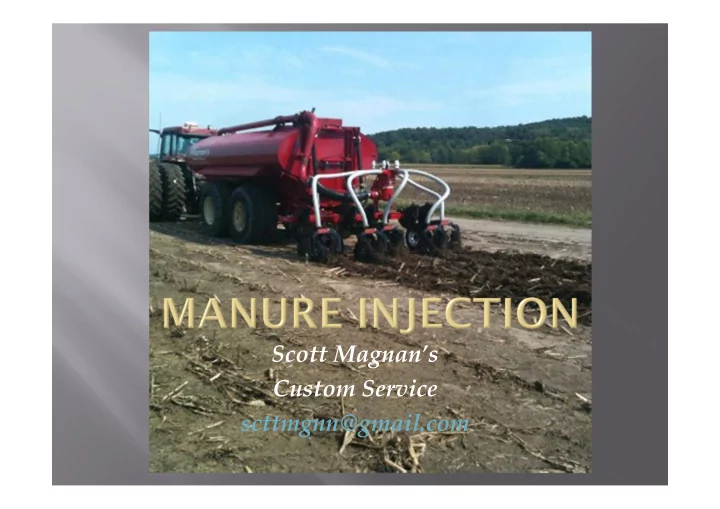
SLIDE 1
Scott Magnan’s Custom Service scttmgnn@gmail.com
SLIDE 2
High flow from stock pump on tank required us to
spread over 6 mph in order to drop application rates, resulting in mechanical failure’s and uncontrolled application rates.
We mounted a flow valve to control flow. With the
stock pump, the main hose built pressure and blew off.
Unable to see the injector, we broke points, and had
issues knowing what the implement was doing.
Application rate was difficult to calculate. Weight of the injector decreased tongue weight Loose bolts
SLIDE 3
Reduced pump size- Cut horsepower requirement, kept main
hose from blowing apart
Flow valve- We can maintain a ground speed of 3-5mph, and
adjust flow with this valve to control rate.
GPS- Allows us to have a more professional looking, evenly
applied field, and gives us the acreage per load, allowing us to quickly calculate GPA
Camera- Having visual contact has saved on repairs, allows us
to do a cleaner job, and know when the implement is up or down and if service is needed.
Tank Balance- We slid the tank ahead to increase tongue
weight applied to drawbar
Routine Inspection- It is important to check the machine every
day for loose bolts, worn points, ETC. The injector is a tool that requires more care than a broadcast spreader
SLIDE 4
SLIDE 5
SLIDE 6
SLIDE 7 PRO’S CON’S
Allows us to spread in
urban area’s
Rate control Nearly eliminates odor Buries nutrients in the
soil
Leaves surface dry to
perform additional field practice.
Adds professionalism Takes 10-20% more time Plugs if the pit has
Manure, a problem that happens commonly if the pit is nearly empty.
Implement cost or
custom hire expense
Some disturbance to a
true no-till field or meadow
Requires more service
time than broadcast spreading
SLIDE 8 Farm 1- (Spring) 55 acres we injected from nurse trucks in the field, Farmer followed us on the same day with a primary tillage pass, We were able to spread in a field near camps that had not been covered is recent years. Farm 2- (Spring) 8 acres Injected into a field directly from the pit that was later no-till planted into corn Farm3- (fall) Spread into 88 acres near the farm, directly from the pit. The farmer later made a primary tillage pass Farm-4 (fall) 214acres mostly transferred in the field with no additional
- tillage. The farmer has the option to do conventional, reduced till or no-till
this spring.
SLIDE 9
20 40 60 80 100 120 F1- 6,500 GPA F2- 6,000 GPA F-3 7000 GPA F-4 12,000 GPA
Pounds of Nitrogen saved @ 8lbs per 1,000 gal
Pounds of Nitrogen saved @ 8lbs per 1,000 gal
SLIDE 10
10 20 30 40 50 60 F1- 5.6 loads hr F2- 3.0 loads hr F3- 2.3 loads hr F4- 4.8 loads hr N Savings @ $4.00 per 1,000 gal Additional cost over broadcast
SLIDE 11 This field was being rotated into soybean. Replacing the closing discs which did most of the damage in this photo, may be trialed this summer. Complete alternatives to this system may be necessary.
SLIDE 12
SLIDE 13
We have a solution
SLIDE 14
SLIDE 15