Scott Kahan, MD, MPH ABCDEF Approach to Obesity Management Obesity - - PDF document

scott kahan md mph abcdef approach to obesity management
SMART_READER_LITE
LIVE PREVIEW

Scott Kahan, MD, MPH ABCDEF Approach to Obesity Management Obesity - - PDF document

COPE WEBINAR SERIES FOR HEALTH PROFESSIONALS FINDING SLIDES FOR TODAYS WEBINAR May 20, 2020 www.villanova.edu/COPE Obe sity T r e atme nt, Be yond the Guide line s: Click on Kahan A Str uc tur e d A-B-C-D-E -F F r ame wor


slide-1
SLIDE 1

Scott Kahan, MD, MPH ‐ ABCDEF Approach to Obesity Management

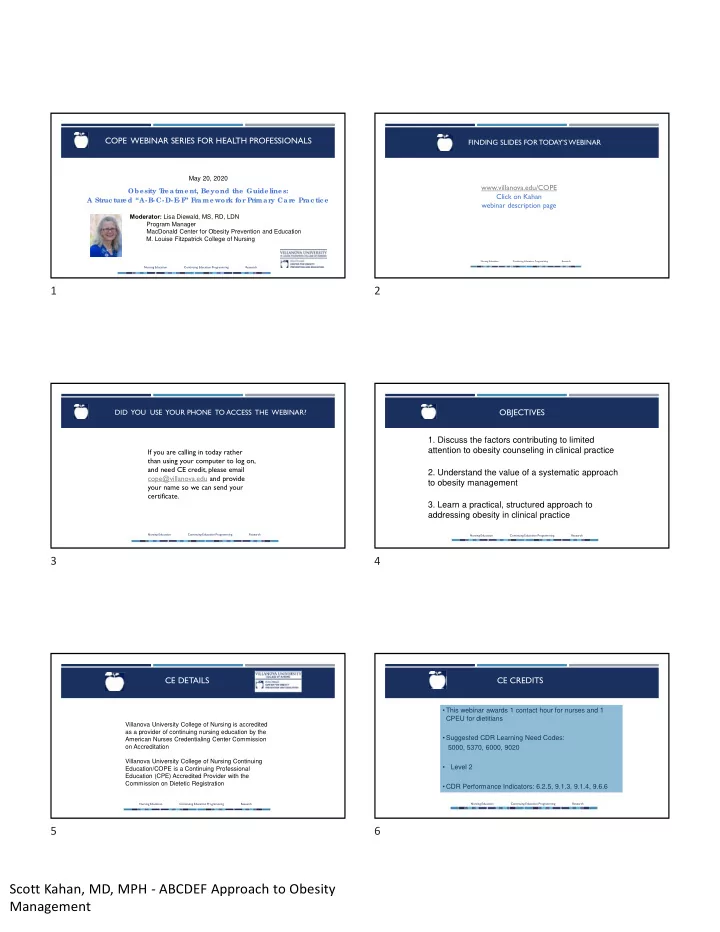
COPE WEBINAR SERIES FOR HEALTH PROFESSIONALS

May 20, 2020 Obe sity T r e atme nt, Be yond the Guide line s: A Str uc tur e d “A-B-C-D-E

  • F

” F r ame wor k for Pr imar y Car e Pr ac tic e

Moderator: Lisa Diewald, MS, RD, LDN Program Manager MacDonald Center for Obesity Prevention and Education

  • M. Louise Fitzpatrick College of Nursing

Nursing Education Continuing Education Programming Research

FINDING SLIDES FOR TODAY’S WEBINAR www.villanova.edu/COPE Click on Kahan webinar description page

Nursing Education Continuing Education Programming Research

DID YOU USE YOUR PHONE TO ACCESS THE WEBINAR? If you are calling in today rather than using your computer to log on, and need CE credit, please email cope@villanova.edu and provide your name so we can send your certificate.

Nursing Education Continuing Education Programming Research

OBJECTIVES

Nursing Education Continuing Education Programming Research

  • 1. Discuss the factors contributing to limited

attention to obesity counseling in clinical practice

  • 2. Understand the value of a systematic approach

to obesity management

  • 3. Learn a practical, structured approach to

addressing obesity in clinical practice CE DETAILS

Villanova University College of Nursing is accredited as a provider of continuing nursing education by the American Nurses Credentialing Center Commission

  • n Accreditation

Villanova University College of Nursing Continuing Education/COPE is a Continuing Professional Education (CPE) Accredited Provider with the Commission on Dietetic Registration

Nursing Education Continuing Education Programming Research

CE CREDITS

  • This webinar awards 1 contact hour for nurses and 1

CPEU for dietitians

  • Suggested CDR Learning Need Codes:

5000, 5370, 6000, 9020

  • Level 2
  • CDR Performance Indicators: 6.2.5, 9.1.3, 9.1.4, 9.6.6

Nursing Education Continuing Education Programming Research

1 2 3 4 5 6

slide-2
SLIDE 2

Scott Kahan, MD, MPH ‐ ABCDEF Approach to Obesity Management

Obesity Treatment, Beyond the Guidelines: A Structured “A-B-C-D-E-F” Framework for Primary Care Practice Scott Kahan, MD, MPH Director, National Center for Weight and Wellness Medical Director, Strategies to Overcome and Prevent (STOP) Obesity Alliance DISCLOSURES

The planners and presenter of this program have no conflicts of interest to disclose. Accredited status does not imply endorsement by Villanova University, COPE or the American Nurses Credentialing Center of any commercial products or medical/nutrition advice displayed in conjunction with an activity.

EVIDENCE-BASED OBESITY TREATMENT IN PRIMARY CARE: A PATIENT-CENTERED A-B-C-D-E-F FRAMEWORK

Scott Kahan, MD, MPH National Center for Weight & Wellness Johns Hopkins School of Public Health kahan@nationalweight.org | @scottkahan

Which of these best characterizes your beliefs about obesity treatment?

  • A. Obesity is a medical condition; it is the healthcare provider’s

responsibility to ensure that patients are appropriately counseled and provided appropriate treatment for obesity, when indicated

  • B. Obesity is a personal issue; it is the patient’s responsibility to

ensure that he/she gets the help they need

  • C. Obesity is both a medical and personal issue; the responsibility

for addressing obesity is shared between healthcare providers and patients

  • D. Obesity is an issue of personal responsibility and willpower;

patients should take better care of themselves and not burden the healthcare provider or the healthcare system

Petrin C, Kahan S, et al. Obes Res Clin Pract, 2016.

An Obesity Paradox An Obesity Paradox

0% 25% 50% 75% 100% HCP responsibility Diagnosis (BMI >50) Diagnosis (BMI 30-35) Documentation (surgical) Discussion (BMI >25) Counseling (BMI >40) Treatment (IBT) Treatment (surgery Treatment (medication) Kahan S. Mayo Clin Proc, 2018.

7 8 9 10 11 12

slide-3
SLIDE 3

Scott Kahan, MD, MPH ‐ ABCDEF Approach to Obesity Management

HCP Knowledge of Obesity Guideline Recommendations

Kahan S, et al. Obesity, 2018 . Kahan S, et al. ACPM Annual Meeting, 2017.

25 50 75 100 Diet/ nutrition patterns Physical activity targets Behavioral counseling intensity Medication prescribing threshold % Correct

p=0.0 2 p=0.02 p=0.03 p=0.02

Obesity Guidelines

ACC/AHA/TOS Obesity Guideline ENDO Pharmacotherapy Guideline AACE/ACE Obesity Guideline

Metabolic Surgery Guideline OMA Obesity Algorithm

An “ABCDEF” Approach to Weight Counseling

Kahan S, Manson JE. Obesity Treatment, Beyond the Guidelines. JAMA. 2019;321(14):1349-1350. doi:10.1001/jama.2019.2352

A: Ask “Permission”

Kahan S, Manson JE. Obesity Treatment, Beyond the Guidelines. JAMA. 2019;321(14):1349-1350. doi:10.1001/jama.2019.2352

“Over the last few years, your weight has been

increasing, and I’m concerned that it may lead to diabetes and other health problems. Would it be

  • kay if we started working on this together? ”

An “ABCDEF” Approach to Weight Counseling

Kahan S, Manson JE. Obesity Treatment, Beyond the Guidelines. JAMA. 2019;321(14):1349-1350. doi:10.1001/jama.2019.2352

B: Be Systematic in the Clinical Workup

  • “Just less and exercise more” isn’t helpful

Kahan S, Manson JE. Obesity Treatment, Beyond the Guidelines. JAMA. 2019;321(14):1349-1350. doi:10.1001/jama.2019.2352

13 14 15 16 17 18

slide-4
SLIDE 4

Scott Kahan, MD, MPH ‐ ABCDEF Approach to Obesity Management

Elicit Weight History

Kushner RF, Kahan S, et al. TOS Position Statement on Weight History-Taking in Clinical Practice. Obesity, 2019.

Sample Questions Onset “When did you first notice your weight increasing?” “What was your lightest and heaviest weight as an adult? What did you weigh in high school, college, early 20s, 30s, 40s?” Precipitating “Have you noticed specific life events causing weight gain, e.g., stressful new job, marriage, divorce, children, smoking cessation, financial stress, depression, illness?” Quality of life “How does your weight affect your life?” “At what weight did you feel your best?” Remedy “What have you done or tried in the past to control your weight?” Setting “What was going on differently in your life during times when you felt in control of your weight, versus times when it is more challenging to manage?” Temporal pattern “What is the pattern of your weight gain, e.g., gradual, progressive gain, large, cyclic gain-loss (“yo-yo”)?”

Elicit Weight History Weight History Informs Treatment

Chao AM, et al. Obesity 2016;24:2327-2333. Yanovski SZ, et al. Obes Res 1994;2(3):205-12. 10 20 30 40 50 With BED Without BED

% of Subjects

VLCD Subjects with Poor Outcomes

Weight History Informs Treatment

Notable Medications/Classes Associated With Weight Gain Potential Alternatives Diabetes medications Insulin, sulfonylureas, TZDs (Metformin), (GLP-1 agonists), (SGLT2 inhibitors), (pramlintide) Hypertension medications Beta-blockers ACE inhibitors, CCAs, ARBs Psychiatric medications Antipsychotics, mirtazapine, TCAs, paroxetine (Bupropion), nefazodone, fluoxetine Birth control Progestational steroids Barrier methods, intrauterine devices

Apovian CM, et al. J Clin Endocrinol Metab. 2015;100:342-62.

An “ABCDEF” Approach to Weight Counseling

Kahan S, Manson JE. Obesity Treatment, Beyond the Guidelines. JAMA. 2019;321(14):1349-1350. doi:10.1001/jama.2019.2352

C: Counseling and Support

  • Address weight loss expectations
  • Counsel on benefits of modest weight loss
  • Use evidence-based counseling strategies

Kahan S, Manson JE. Obesity Treatment, Beyond the Guidelines. JAMA. 2019;321(14):1349-1350. doi:10.1001/jama.2019.2352

19 20 21 22 23 24

slide-5
SLIDE 5

Scott Kahan, MD, MPH ‐ ABCDEF Approach to Obesity Management

Address Weight Loss Expectations

1.0 2.0 3.0 4.0 10 20 30 40

Time (years)

Cumulative incidence T2D (%)

  • 8

1.0 2.0 3.0 4.0

  • 6
  • 4
  • 2

% Weight Loss

Lifestyle intervention Metformin Placebo

Modest Weight Loss Improves Health and Risks

Weight-related Condition % Weight Loss for Therapeutic Benefit References

Diabetes Prevention 3% to 10%

DPP (Lancet, 2009) SEQUEL (Garvey et al, 2013)

Hypertension 5% to >15%

Look AHEAD (Wing, 2011)

Dyslipidemia 3% to >15%

Look AHEAD (Wing, 2011)

HbA1c 3% to >15%

Look AHEAD (Wing, 2011)

NAFLD 10%

Assy et al, 2007; Dixon et at, 2004; Anish et al, 2009

Sleep Apnea 10%

Sleep AHEAD (Foster, 2009) Winslow et al, 2012

Osteoarthritis 5-10%

Christensen et al, 2007; Felson et al, 1992; Aaboe et al, 2011

Stress Incontinence 5-10%

Burgio et al, 2007 Leslee et al, 2009

GERD 5-10% (women), 10% (men)

Singh et al, 2013 Tutujian R, 2011

PCOS 5-15% (>10% optimal)

Panidis D et al, 2008; Norman et al, 2002; Moran et al, 2013

Guidelines For Intensive Behavioral Therapy

  • Patients should receive a comprehensive behavior

management program of at least 6 months (Level A)

  • Gold standard is on-site, high-intensity (14+ sessions in

6 months), comprehensive intervention, delivered by trained interventionist (individual or group) and persisting for at least 1 year (Level A)

  • Low intensity interventions may not be effective (Level A)
  • Other approaches (web, phone) lead to less weight loss

(Level B)

AHA/ACC/TOS Guideline for the Management of Overweight and Obesity in Adults. Circulation, 2013.

Counseling

  • Regular, frequent interaction via group or individual contact

Diet

  • Reduced energy intake, regardless of macronutrient composition

Physical activity

  • 150 minutes/week of moderate activity
  • Strength training desirable

Behavioral strategies

  • Structured curriculum of behavior change education, including identifying

target behaviors and building skills to achieve target behaviors

  • Self-monitoring of food intake, physical activity, and/or weight
  • Goal setting, problem solving, stimulus control
  • Addressing barriers to change
  • Behavioral resources (e.g., portion-controlled meals)
  • Regular feedback and guidance from an interventionist
  • Weight maintenance strategies and relapse prevention

Behavioral Therapy for Obesity

Behavioral Therapy in Obesity/Diabetes

Look AHEAD Research Group. Obesity. 2014;22(1):5-13.

YEAR 1 YEAR 8

92.8 68.0 37.7 15.6 73.6 50.3 26.9 11.0

20 40 60 80 100 % of Participants

>0% ≥5% ≥10% ≥15% >0% ≥5% ≥10% ≥15%

An “ABCDEF” Approach to Weight Counseling

Kahan S, Manson JE. Obesity Treatment, Beyond the Guidelines. JAMA. 2019;321(14):1349-1350. doi:10.1001/jama.2019.2352

25 26 27 28 29 30

slide-6
SLIDE 6

Scott Kahan, MD, MPH ‐ ABCDEF Approach to Obesity Management

Normal Weight (BMI 19 to 24.9) Obesity (Class II) (BMI 35 to 39.9 ) Obesity (Class I) (BMI 30 to 34.9) Overweight (BMI 25 to 29.9) Obesity (Class III) (BMI 40 or more)

Increased complications/risk? Increasing benefit? Increased risk acceptance?

Kahan S, et al. Curr Obes Rep, 2013.

D: Determine Health Status D: Determine Health Status

Yuen M, Kahan S, Kaplan LM, et al. Obesity Week. 2016. Poster T-P-3166.

Assess Health Status via Staging

Sharma AM, Kushner RF. IJO 2009.

co-morbidity moderate moderate

Obesity

Stage 0 Stage 1 Stage 2 Stage 3 Stage 4

Padwal R, et al. CMAJ 2011.

Staging Better Predicts Outcomes

2 Patients of Same Age and Weight/BMI

Stage 0

  • Feels good
  • Physically active
  • No known RFs
  • No functional limitations
  • No mental health issues

Stage 2

  • Hypertension
  • Diabetes
  • Sleep apnea
  • Osteoarthritis
  • Depression

Is aggressive treatment worth it? Are less intensive options sufficient? Is any treatment indicated? Consider:

  • Intensive counseling
  • Referral
  • Pharmacotherapy
  • Bariatric surgery

An “ABCDEF” Approach to Weight Counseling

Kahan S, Manson JE. Obesity Treatment, Beyond the Guidelines. JAMA. 2019;321(14):1349-1350. doi:10.1001/jama.2019.2352

31 32 33 34 35 36

slide-7
SLIDE 7

Scott Kahan, MD, MPH ‐ ABCDEF Approach to Obesity Management

E: Escalate Treatment When Appropriate

  • Specialist referral
  • Medically-monitored structured diets
  • Obesity pharmacotherapy
  • BMI >27 kg/m2 with comorbidities
  • Medical devices/endoscopic procedures
  • Generally BMI 30-40+ kg/m2
  • Bariatric surgery
  • BMI >35 kg/m2 with comorbidities

Kahan S, Manson JE. Obesity Treatment, Beyond the Guidelines. JAMA. 2019;321(14):1349-1350. doi:10.1001/jama.2019.2352

Medically-Monitored Structured Diet/Counseling

  • Comprehensive, high-intensity, specialist-led, on-site

lifestyle interventions

  • May include a medically supervised low-calorie or

very-low-calorie-diet utilizing meal replacement products (Level A)

  • Average weight loss of 14-21 kg over 11-14 weeks

(Level A)

AHA/ACC/TOS Guideline for the Management of Overweight and Obesity in Adults. Circulation, 2013.

Effect of Weight Loss on Satiety

10 20 30 Satiety/fullness Baseline Weight Weight-10% Weight-10% + Medication

Kissileff HR, et al. Am J Clin Nutr, 2012.

Obesity Pharmacotherapy

  • 5 FDA-approved short-term medications
  • Phentermine and noradrenergics
  • 4 FDA-approved long-term medications
  • Orlistat
  • Phentermine/topiramate ER
  • Naltrexone/Bupropion SR
  • Liraglutide 3.0 mg

Obesity Pharmacotherapy

  • Use pharmacotherapy as adjunct to diet, exercise, and

behavioral counseling for adults… (Level 1 evidence)

  • with BMI 30+; or 27+ with comorbidity;
  • who are unable to lose and successfully maintain weight;
  • who meet label indications
  • Assess efficacy/safety monthly for three months, then at

least quarterly thereafter (Level 2)

  • At three months, if >5% weight loss, continue; if not,

discontinue and seek alternative approaches (Level 1)

  • Use medications to promote long-term weight loss

maintenance (Level 2)

Pharmacological Management of Obesity: An Endocrine Society Clinical Practice Guideline. J Clin Endocrinol Metab, 2015.

Obesity Pharmacotherapy

Garvey WT, et al. Am J Clin Nutr. 2012;95:297-308

37 38 39 40 41 42

slide-8
SLIDE 8

Scott Kahan, MD, MPH ‐ ABCDEF Approach to Obesity Management

Orlistat Phentermine/ topiramate ER Naltrexone/ bupropion SR Liraglutide 3.0 mg

WC     BP     LDL     HDL     TG     HR 

 A1C    

Pharmacotherapy Improves RFs and Prevents Comorbid Conditions Pharmacotherapy Improves RFs and Prevents Comorbid Conditions

  • 100
  • 75
  • 50
  • 25

% Decreased DM Incidence (vs placebo) Kahan S, Fujioka K. Diab Spectr, 2018.

Short versus Long-Term Use

Smith SR, et al. N Eng J Med. 2010;363:245-256.

Outcomes by Responder Status

Smith SR, et al. Obesity. 2014;22:2137-2146.

Combination Therapy

Adapted from Wadden, et al. N Eng J Med. 2005;353:2111-2120.

Medication alone Lifestyle modification alone Combined therapy Placebo alone

Devices and Endoscopic Procedures

Gastric Balloons Gastric Band Plenity Hydrogel

Endoscopic Sleeve Gastrectomy

43 44 45 46 47 48

slide-9
SLIDE 9

Scott Kahan, MD, MPH ‐ ABCDEF Approach to Obesity Management

Bariatric Surgery Procedures

Sleeve Gastrectomy Roux‐en‐Y Gastric Bypass

Guidelines For Bariatric Surgery

  • Advise patients with BMI >40 (or >35 with comorbidity)

that bariatric surgery may be an appropriate option to improve health (Grade A)

  • Offer referral to an experienced bariatric surgeon for

consultation and evaluation (Grade A)

  • Insufficient evidence to recommend for or against surgery

for BMI <35

  • No clear guidance for medical devices

AHA/ACC/TOS Guideline for the Management of Overweight and Obesity in Adults. Circulation, 2013.

Bariatric Surgery Outcomes

Aminian A, et al. JAMA 2019;322(13):1271‐82. Aminian A, et al. JAMA 2019;322(13):1271‐82.

Bariatric Surgery Outcomes

An “ABCDEF” Approach to Weight Counseling

Kahan S, Manson JE. Obesity Treatment, Beyond the Guidelines. JAMA. 2019;321(14):1349-1350. doi:10.1001/jama.2019.2352

F: Follow Up Regularly, Leverage Resources

Kaplan LM, et al. Obesity, 2018. 100% 71% 55% 24% 0% 25% 50% 75% 100% Total people with obesity (n=3008) Discussed weight in past 5 yrs (n=3008) Diagnosed with obesity (n=2185) Scheduled follow-up appointment re weight (n=2185)

Respondents

49 50 51 52 53 54

slide-10
SLIDE 10

Scott Kahan, MD, MPH ‐ ABCDEF Approach to Obesity Management

Follow up, Leverage Resources: Don’t Do It All At Once

  • Weight management is a chronic process
  • Don’t expect to impact long-term behavioral

change during a single episode of care

Kahan S, Manson JE. JAMA 2017.

Follow up, Leverage Resources: Don’t Do It All On Your Own

  • Utilize a team-based approach
  • Clinical and non-clinical staff
  • Referrals and specialists
  • RDNs, Obesity Medicine physicians, CDEs,

psychologists, etc

  • Community-based programs
  • Diabetes prevention programs, others
  • Online/virtual programs

Kahan S, Manson JE. JAMA 2017.

Long-Term Benefits (Generally) Require Continued Management

Perri M, et al. 1990.

An “ABCDEF” Approach to Weight Counseling

Kahan S, Manson JE. Obesity Treatment, Beyond the Guidelines. JAMA. 2019;321(14):1349-1350. doi:10.1001/jama.2019.2352

EVIDENCE-BASED OBESITY TREATMENT IN PRIMARY CARE: A PATIENT-CENTERED A-B-C-D-E-F FRAMEWORK

Scott Kahan, MD, MPH National Center for Weight & Wellness Johns Hopkins School of Public Health kahan@nationalweight.org | @scottkahan

Villanova.edu/cope

Upcoming FREE Continuing Education Webinar

Presented by: Tanja Kral, Ph.D. Associate Professor of Nutrition Science University of Pennsylvania School of Nursing & Perelman School of Medicine

Early life risk factors for obesity in children with Autism Spectrum Disorder Date to be announced soon!

55 56 57 58 59 60

slide-11
SLIDE 11

Scott Kahan, MD, MPH ‐ ABCDEF Approach to Obesity Management

COPE

  • ffers an o nline c atalo g o f webinars

and presentatio ns Yo u c an earn CE c redits fo r viewing Se arc h fo r to pic s that inte re st yo u Affo rdable: 2 CPE U / 2 c o ntac t ho urs fo r $20

QUESTIONS & ANSWERS

Moderator: Lisa K. Diewald MS, RD, LDN Email: cope@villanova.edu Website: www.villanova.edu/COPE

61 62