SLIDE 1
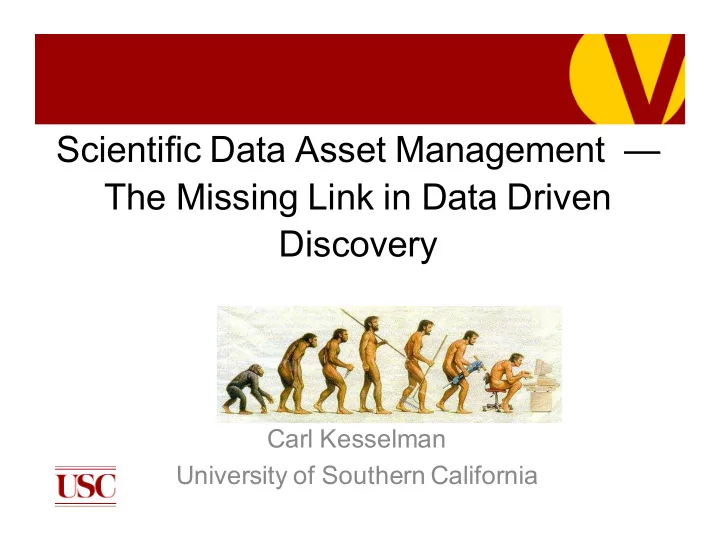
Scientific Data Asset Management — The Missing Link in Data Driven Discovery
Carl Kesselman University of Southern California
SLIDE 2
Acknowledgements 4Karl Czajkowski, Mike D’Arcy, Hongsuda Tangmunarunkit, Robert Schuler, Anoop Kumar, Alejendro Bugacov 4Kristi Clark, Lu Zhau 4Ian Foster, Kyle Chard, Ravi Madduri, 4Mike Hanson, Jeff Su, Ray Stevens 4Funded in part by NIH Big Data for Discovery Science Center of Excellence.
SLIDE 3
Set the way back machine…. 4In 2000 we described how real-time data acquisition could be integrated into the Grid for diffraction studies and tomography
SLIDE 4
System architecture….
SLIDE 5
Fancy file systems….
SLIDE 6
The whole story (kind of….)
Construct Design Virus creation Biomass production Protean Purification Crystallization Diffraction Flow Cytometry Chromotogahraphy Gel electrophorisis Imaging Stability measures
SLIDE 7
PheWAS findings
7 Shaw, Molecular Psychiatry (2009) 14, 348–355 Raznahan, Neuroimage (2011) 57, 1517-23
SLIDE 8 Image PheWAS
- 1. Assemble Data Collections
- 2. Identify subjects with images and extract images
- 3. Compute image phenotypes
- Use Freesurfer with different atlases and computed
measures
- 4. Associate Freesurfer results with each subject.
- 5. Quality control on derived data. Rerun on bad results
- 6. Identify subset of subjects that have variant of interest
in SNP being considered
- 7. Collect up all phenotype data associated with identified
subset
- 8. Do correlation analysis of phenotypes for the SNP to
look for predictive correlations.
- 9. Repeat until discovery
SLIDE 9 Publish results
Collect data Design experiment Test hypothesis Hypothesize explanation Identify patterns Analyze data
How do we accelerate discovery?
9
Pose question
SLIDE 10 A view from 1960…. “my choices of what to attempt and what not to attempt [are] determined to an embarrassingly great extent by considerations of clerical feasibility, not intellectual capability” Man-Computer Symbiosis
SLIDE 11 The View From 2016
Scientists report 50-80% of their time is spent “wrangling” messy data, not analyzing it
- The problem is not the cost of computing!!
Repeatability of results from papers is shockingly low: 10% 4Lack of comprehensive tools for organizing, contextualizing, and sharing data 4Ad hoc processes and practices for managing and sharing information 4Messy Data à Reusable Data à Discovery
- How to get from point A to point B?
SLIDE 12
SLIDE 13 What if….
4Every piece of data produced in was “citable
- Microscope, flow cytometry, mass spec, sequence,
mouse, zebrafish, material sample
4Data flowed instantly and seemlessly
- From points of production/acquisition
- between dynamically evolving research teams
4Data was contextualized 4You had automated support to help discover data, extract interesting features, point you to related data, assemble data sets...
SLIDE 14
It’s the data, not the analysis!! Data is a precious thing and will last longer than the systems themselves.
Tim Berners-Lee
SLIDE 15 An Ecosystem for Data
Why don’t we have tools for managing data sets of cancer and kidneys that are as good as the tools we have for managing data sets of cats and kids?
Apple iPhoto
Editable
attributes and metadata
Full text search Data browsing Flexible data
Edit and share
Automatic analysis
SLIDE 16 Applied to other types of work? 4Can we create a reusable platform that enables us to address data centric integration of
- devices,
- computation,
- human interactions
- …
SLIDE 17 Digital Asset Management
4“management tasks and decisions surrounding the ingestion, annotation, cataloguing, storage, retrieval and distribution
4streamline free-form “creative” processes rather than enforce predefined business processes. 4Many commercial DAM offerings, but not well suited to biomedical data
- Complex and diverse data types
- Specialized data ingest requirements
- Data size (big data)
SLIDE 18 Scientific Digital Asset Management 4Discovery Environment for Relational Information and Versioned Assets (DERIVA). 4Model discovery as process of creating and updating contextualized digital assets. 4Web services platform
- “Data Oriented Architecture”
4Adaptive and extensible
SLIDE 19 Platform Elements
4Object/Relational data store
- Pub/Search/Retrieve structured data
4Object store
- Pub/Retrieve immutable objects
4Batch publish/retrieval tool
- Watch file system and publish data bundle
4Model-driven UI
- Introspect and adapt to data model
ERMRest HATRAC IObox Chaise
SLIDE 20
Software ecosystem
SLIDE 21 IOBox
4Configurable tools for enabling arbitrary endpoint
- Files, databases, microscopes, etc.
- IoT like
4Contextualize data based on time and location
- Ruleset per location
- Metadata extraction, publication to catalog,
management of asset
- Simple recovery mechanisms based on
retry/notification
4Triggers per asset ingest pipeline in “cloud”
SLIDE 22 ERMRest 4Relational data storage service for web- based, data-oriented collaboration.
- general entity-relationship modeling of data
resources manipulated by RESTful access methods.
4RESTful interface à data views as named resource 4Focus on introspection and evolution
- Data model can change over time to reflect
evolving understanding of problem space
SLIDE 23 Chaise – Adaptive User Interface
4How little can we assume?
- discovery, analysis, visualization, editing, sharing and
collaboration over tabular data (ERMRest).
4Makes almost no assumptions about data model
- Introspect the data model from ERMrest.
- Use heuristics, for instance, how to flatten a
hierarchical structure into a simplified presentation for searching and viewing.
- Schema annotations are used to modify or override its
rendering heuristics, for instance, to hide a column of a table or to use a specific display name.
- Apply user preferences to override, for instance, to
present a nested table of data in a transposed layout
SLIDE 24
One platform, many use cases 4High-resolution 2D and 3D microscopy 4GPCR protein conformation studies 4Kidney reconstruction using stem-cells 4Mapping dynamic synaptome in vivo 4Gene expression studies for craniofacial dysmorphia 4Digital cell line for cancer 4Developmental biology
SLIDE 25 Neuroimaging PheWAS
4What is PheWAS?
- One SNP -> a wide variety of neuroimaging
phenotypes (inverse of GWAS)
4Why PheWAS?
- explores system-level genetic associations.
4Challenges
- Complexity, heterogeneity, and volume of the data
- Complex and sophisticated brain image processing
- Multiple-comparison correction
- Result visualization
SLIDE 26 Philadelphia Neurodevelopmental Consortium 48719 subjects in study
- Baseline clinical elements
46 different SNP array chipsets resulting in a combined set of 1,873,486 distinct SNPs (out of a possible 85 million in the human genome).
- The total combinatorial space of the genomic
data is 5,435,533,460 (SNP, subject, allele) tuples across the 8719 subjects
4997 of the subjects have MRI imaging data
SLIDE 27
Managing data collections
SLIDE 28
Heterogeneous source data
SLIDE 29 Bags bridge the gap between tools
10/6/16 29 BIG DATA for
- 5. Query for specific imaging
information based on the derived genetic data
Raw Brain MRI data Processed MRI data
new bags of derived data
bags out for publication
Genetic Data Brain MRI
ERMrest
Process imaging data
dbGaP
discover data (wherever it is)
bags
genetic data from 6 chipsets
PLINK format genetic data
Alleles per subject
new bags of derived data
Alignm ent Files
After step 6 628 subjects
SLIDE 30
Details on one data element
SLIDE 31
QC on derived data
SLIDE 32
Complex data relationships…
SLIDE 33
NeuroimagingPheWAS Toolbox
SLIDE 34 Summary 4Exponential increases in computing/storage imposes additional complexity on the end user…. What to do? 4Scientific Digital Asset Management is the missing link
- Make science data as good as consumer data
4We have demonstrated that generally applicable software ecosystem for DAM is feasable