Science Overview - 1 ! GSFC Astrophysics on the International Space - - PowerPoint PPT Presentation

science overview 1
SMART_READER_LITE
LIVE PREVIEW

Science Overview - 1 ! GSFC Astrophysics on the International Space - - PowerPoint PPT Presentation

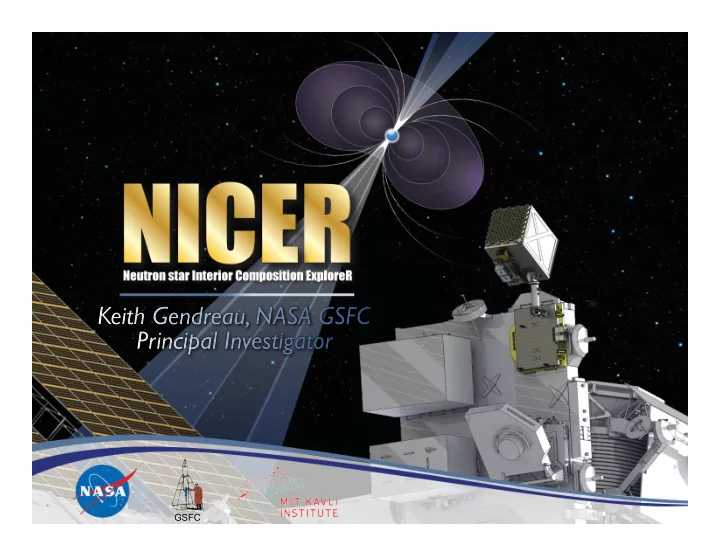
Science Overview - 1 ! GSFC Astrophysics on the International Space Station " Understanding ultra-dense matter through soft X-ray timing ! Science: A proposed International Space Station (ISS) payload dedicated to the study of neutron


slide-1
SLIDE 1

Science Overview - 1!

GSFC
slide-2
SLIDE 2

Science Overview - 2!

  • Science: A proposed International Space

Station (ISS) payload dedicated to the study of neutron stars. A fundamental investigation of extremes in gravity, material density, and electromagnetic fields !

  • Launch: Late 2016, JAXA HII-B or U.S.

commercial (e.g., SpaceX)!

  • Duration: 18 (minimum 12) months, with

an optional Guest Observer program!

  • Platform: ISS ExPRESS Logistics Carrier

(ELC), with active pointing over 2π steradians!

  • Instrument: X-ray (0.2–12 keV)

“concentrator” optics and silicon-drift

  • detectors. GPS position and absolute time

reference to better than 300 ns.!

Astrophysics on the International Space Station — " Understanding ultra-dense matter through soft X-ray timing!

NICER FRAM ELC NICER FRAM ELC

slide-3
SLIDE 3

Science Overview - 3!

The ISS offers:!

  • Established infrastructure "

(transport, power, comm, etc.) " that reduces risk!

  • Generous resources that "

simplify design and reduce cost.!

  • A stable platform for arcminute

astronomy! NICER’s design:!

  • Is tolerant of ISS vibrations!
  • Is insensitive to the ISS

contamination and radiation environments, with safe-stow capability!

  • Provides high (> 65%) observing

efficiency.!

An established platform and a benign environment!

slide-4
SLIDE 4

Science Overview - 4!

  • To address NASA and National Academy of

Sciences strategic questions!

  • To resolve the nature "
  • f ultradense matter "

at the threshold of " collapse to a black hole!

  • To reveal interior "

composition, dynamic " processes, and " radiation mechanisms "

  • f neutron stars. !

Neutron stars — Unique environments in which all four fundamental forces of Nature are simultaneously important.!

Objective Measurements

Structure — Reveal the nature of matter in the interiors of neutron stars Neutron star radii to ±5%. Cooling timescales Dynamics — Uncover the physics of dynamic phenomena associated with neutron stars Stability of pulsars as clocks. Properties of outbursts, oscillations, and precession Energetics — Determine how energy is extracted from neutron stars. Intrinsic radiation patterns, spectra, and luminosities.

slide-5
SLIDE 5

Science Overview - 5!

Lightcurve modeling constrains the compactness (M/R) and viewing geometry of a non-accreting millisecond pulsar through the depth of modulation and harmonic content

  • f emission from rotating hot-spots, thanks to gravitational light-bending… !

Reveal stellar structure through lightcurve modeling, long-term timing, and pulsation searches!

slide-6
SLIDE 6

Science Overview - 6!

… while phase-resolved spectroscopy promises a direct constraint of radius R. !

slide-7
SLIDE 7

Science Overview - 7!

Simulations demonstrate how well an assumed neutron star radius can be

  • recovered. The ±5% (3σ)

measurement goal is attained in less than 1 Msec. ! The resulting allowed regions in the M-R plane rule out proposed families

  • f neutron star equations of
  • state. The best mass

measurements alone can’t distinguish among competing models.!

slide-8
SLIDE 8

Science Overview - 8!

  • Bandpass: 0.2–12 keV
  • Effective area:

> 2000 cm2 @ 1.5 keV, 600 cm2 @ 6 keV 2x XMM-Newton for soft X-ray timing

  • Energy resolution:

85 eV @ 1 keV, 137 eV @ 6 keV Similar to XMM and Chandra

  • Time-tagging resolution:

< 300 nsec (absolute) ~25x better than RXTE ~100–1000x better than XMM

  • Spatial resolution: 5 arcmin diam.

non-imaging FOV

  • Background: Dominated by diffuse

cosmic XRB (soft)

  • Sensitivity: 3 x 10–14 ergs s–1 cm–2

(0.5–10 keV, 5! in 10 ksec) ~30x better than RXTE, ~4x better than XMM

High-throughput, low-background soft X-ray timing and spectroscopy!

slide-9
SLIDE 9

Science Overview - 9!

High-throughput, low-background soft X-ray timing and spectroscopy! NICER offers a combination of capabilities not available in any existing mission.!

“Best effort” XMM and NICER lightcurves for key target PSR J0437–4715.!

slide-10
SLIDE 10

Science Overview - 10!

Interplay between multiwavelength capabilities amplifies scientific returns from all!

slide-11
SLIDE 11

Science Overview - 11!

A proposed two-part Guest Investigator/Observer program, modeled after Swift:!

  • In

Year 1, support " for corollary neutron" star research: theory " & complementary " multiwavelength "

  • bservations !
  • In

Year 2, solicitation "

  • f proposals for "

guest observations " with NICER, not " necessarily targeting neutron stars.!

X-ray astrophysics beyond neutron stars, continuity of RXTE timing science!

NE2338

L − 5 months Phase E start (L + 1 month) L + 7 months L + 13 months L + 19 months L + 25 months Time NICER baseline and SEO support 100% Launch (L) NICER GI program activities NICER baseline science obs. NICER GO program obs. AO1 released (GI program) AO2 released (GO program)

slide-12
SLIDE 12

Science Overview - 12!

Sample science enabled by the NICER GO program!

Black holes of all sizes are probed through soft continuum spectroscopy to constrain spins in stellar-mass binaries, power spectra of QPOs to definitely establish ultraluminous X-ray sources as intermediate-mass black holes, and relativistic reflection lines to discrimi- nate among AGN models.! Redshifted Fe lines from galaxy clusters reveal star- formation history and poorly under- stood feedback processes that drive galaxy evolution. (Left) A z = 1.18 line is seen well above the diffuse X-ray back-ground (blue).! Plus… !

  • Temporal and spectral variability studies of bright

coronal stars can be conducted on much shorter timescales than previously possible!

  • The interplay of accretion processes and gravitational

radiation in double-degenerate systems can be studied through QPOs in “polars” and long-term timing of SN Ia progenitors!

  • Emission lines and soft excesses in high-mass X-

ray binaries probe field strengths, accretion geometry, and long-term spin evolution.!