65th Annual Meeting of the American Scientific Affiliation
Science, Faith, and Public Policy
“And who knows but that you have come to royal position for such a time as this?” Esther 4:14b –NIV
The Catholic University of America 30 July–2 August 2010
Science, Faith, and Public Policy And who knows but that you have - - PDF document
65 th Annual Meeting of the American Scientific Affiliation Science, Faith, and Public Policy And who knows but that you have come to royal position for such a time as this? Esther 4:14b NIV The Catholic University of America 30
65th Annual Meeting of the American Scientific Affiliation
“And who knows but that you have come to royal position for such a time as this?” Esther 4:14b –NIV
The Catholic University of America 30 July–2 August 2010
General Information ........................................................................................................................... 1 2010 ASA Annual Meeting Schedule .......................................................................................... 2 Abstracts
HEALTH AND MEDICINE *Elizabeth Chmielewski...................................................................................................................... 6 Mark A Strand................................................................................................................................... 6 Jay D Bernheisel............................................................................................................................... 6 Jimmy Lin.......................................................................................................................................... 7 *Elisha R Injeti and Ralph Ankenman................................................................................................. 7 Heather Prior and Heather Looy....................................................................................................... 7 SCIENCE AND TECHNOLOGY ETHICS George L Murphy.............................................................................................................................. 8 James Peterson................................................................................................................................ 8 Brian V Johnstone ............................................................................................................................ 8 Nancy L Jones and Ann Peiffer ........................................................................................................ 8 David C Daniels................................................................................................................................ 9 Jason E Summers ............................................................................................................................ 9 Roman J Miller.................................................................................................................................. 9 William P Cheshire ......................................................................................................................... 10 Rodney J Scott ............................................................................................................................... 10 *Arvin M Gouw ................................................................................................................................. 10 ENERGY Kenell J Touryan............................................................................................................................. 11 Peter M J Hess and Richard J. McDonald ...................................................................................... 11 Ruth Douglas Miller ........................................................................................................................ 11 *Benjamin G Lee.............................................................................................................................. 12 Jack C Swearengen........................................................................................................................ 12 Lynn Billman ................................................................................................................................... 12 Paul T Arveson ............................................................................................................................... 12 SCIENCE AND EDUCATION Paula R Gossard ............................................................................................................................ 13 Terry M Gray................................................................................................................................... 13 Jon Bailey ....................................................................................................................................... 13 Georgia Arbuckle-Keil..................................................................................................................... 14 Soo Y Chang, Chi-Young Yun, Hyun Hoon Song, Seong Uk Hong, Byoung Yoon Kim, and Yong Jun Oh ............................................................................................. 14 John R Staver................................................................................................................................. 14 *B Ashley Zauderer and Gladys V Kober ......................................................................................... 14 Thomas L Walters........................................................................................................................... 15 Benjamin J McFarland.................................................................................................................... 15 HISTORY OF SCIENCE Christopher M Rios......................................................................................................................... 15 Jason M Rampelt............................................................................................................................ 16 Ted Davis ...................................................................................................................................... 16 Denis O Lamoureux........................................................................................................................ 16 LIVING AS A CHRISTIAN IN THE WORKPLACE Robert Kaita.................................................................................................................................... 16 FEDERAL AGENCY POLICY Susan A Daniels ............................................................................................................................. 17 Ann Marie Thro............................................................................................................................... 17 Ward Sanford.................................................................................................................................. 17
*Student or early career scientist presenting a paper through donated scholarships.
APPROPRIATE TECHNOLOGY Chong-Min Kyung, Jong Wook Lee, Han-Cheol Jeong, Jin-Kuk Kim, Hee Ju Youn, and Chan-Joong Kim................................................................................................ 18 CLIMATE CHANGE AND ENVIRONMENTAL POLICY Mary H Korte................................................................................................................................... 18 Johnny Wei-Bing Lin....................................................................................................................... 18 Jim Ball ........................................................................................................................................... 19 Keith B Miller................................................................................................................................... 19 David C Campbell........................................................................................................................... 19 *Jennifer K Hellmann and Jeff Erikson............................................................................................. 20 PUBLIC POLICY William M Jordan ............................................................................................................................ 20 Robert Mann................................................................................................................................... 20 SPACE POLICY David S Leckrone ........................................................................................................................... 20 Kamesh Sankaran .......................................................................................................................... 21 Mark Shelhamer ............................................................................................................................. 21 Steven L Ball................................................................................................................................... 21 POSTERS Hank D Bestman and *Jordyn B Brandsma.................................................................................... 21 David S Hollman............................................................................................................................. 22 Anding Shen ................................................................................................................................... 22 SYSTEMS BIOLOGY Harry Cook...................................................................................................................................... 22 Hank D Bestman............................................................................................................................. 23 *Jordyn B Brandsma ........................................................................................................................ 23 SCIENCE EDUCATION ANDLAW Ted Davis ...................................................................................................................................... 23 *Samuel Chen.................................................................................................................................. 23 THEOLOGY *Bethany N Sollereder...................................................................................................................... 24 John C Munday............................................................................................................................... 24 Paul H Seely................................................................................................................................... 25 Dick Fischer ................................................................................................................................... 25 John A Bloom ................................................................................................................................. 25 SPECIAL LECTURE Rick Potts ....................................................................................................................................... 25 PLENARY SESSIONS Vernon J Ehlers .............................................................................................................................. 26 Sara Joan Miles.............................................................................................................................. 26 Stanley R Bull ................................................................................................................................. 26 Francis S Collins............................................................................................................................. 26 Richard Cizik................................................................................................................................... 26 Jennifer Wiseman........................................................................................................................... 26
Presenters’ Contact Information ................................................................................................ 27 ASA Business Meeting Agenda .................................................................................................. 29 Index of Presenters .......................................................................................................................... 30
*Student or early career scientist presenting a paper through donated scholarships.
ASA Book Room
Book tables featuring books of interest to attendees will be in the Pryzbyla Atrium. Hours are as follows: Saturday: 10:00 AM–6:00 PM Sunday: 12:45 PM–6:15 PM Monday: 10:00 AM–2:00 PM
Emergency Phone Numbers
“Nonemergency” Information Desk: 202.319.5200 (7:00 AM–10:00 PM) Public Safety Office: 202.319.5111 Emergencies only.
Plenary Sessions
All plenary sessions will be held in Pryzbyla, Great Hall 320B. Friday: 7:00 PM Congressman Vernon Ehlers, “A Higher Calling for Scientists: Stewardship, Governance, and Leadership” Saturday: 9:00 AM Sara Joan Miles, “From Limping to Walking” 1:30 PM Stanley Bull, “Renewable Energy: A Walk through Time and into the Future” 7:30 PM Francis Collins, “Experiences of a Scientist-Christian in the Washington Fishbowl” Sunday: 10:10 AM Richard Cizik, “Evangelicals and Science: Overcoming Our Past” 1:30 PM Jennifer Wiseman, “Seeking Other Earths: Exoplanets and the Significance of Life”
Special Events
Friday: 8:30 AM Workshop: “A Short History of American Religion and Science” –Pryzbyla, Room 351 8:30 AM Workshop: “Scripture, Science, and Origins: An Overview” –Pryzbyla, Room 327 9:00 PM Fellowship Mixer –Pryzbyla Atrium Saturday: 7:15 AM Publications Breakfast Meeting –Pryzbyla Dining Hall 12:15 PM Women in Science Luncheon –Pryzbyla Dining Hall 9:00 PM Students and Early Career Scientists Coffee with Francis Collins Sunday: 9:00 AM Worship Service –Pryzbyla, Great Hall 320B 12:15 PM Fellows Luncheon –Pryzbyla Dining Hall 12:15 PM Students and Early Career Luncheon –Pryzbyla Dining Hall 6:15 PM ASA Business Meeting –Pryzbyla, Great Hall 320B 7:30 PM Special Guest Speaker Rick Potts, “Challenges to Understanding Human Evolution in a Religious Context” –Pryzbyla, Great Hall 320B 8:30 PM InterVarsity People –Pryzbyla Atrium
Check-out
Monday: 2:00 PM (1) Please return all meal cards and room keys to the ASA registration desk; (2) If you are staying in the university dorm, please bring your pillow and linens rolled up in your pillowcase to the ASA registration desk; (3) Please leave your completed evaluation form at the ASA registration table.
Many thanks to …
Program Chair Susan Daniels and Local Arrangements Chair Paul Arveson. We are especially thankful for the donors who contributed to the Students and Early Career Scientists’ Scholarship Fund.
The ASA Spirit
The American Scientific Affiliation encourages thoughtful and provocative scientific presentations and discussions. Presenters and discussants are expected to maintain a humble and loving attitude toward individuals who have a different opinion. The Catholic University of America, Washington, DC 1
Meeting rooms, dining hall, and atrium are located on the third floor in the Pryzbyla Center. Abstracts for each session are listed on the page numbers in parentheses.
Thursday, 29 July 2010
3:00 PM–9:00 PM Registration, Flather Hall 7:30 PM–9:00 PM Private Tour of the new Smithsonian David H Koch Hall of Human Origins –Rick Potts, curator
Friday, 30 July 2010
7:30 AM Breakfast –All meals are in the Pryzbyla third-floor dining hall. 10:00 AM–9:00 PM Registration, Flather Hall 8:30 AM–4:30 PM Workshops I: A Short History of American Religion and Science –Ted Davis, Room 351 II: Scripture, Science, and Origins: An Overview –Denis Lamoureux, Room 327 9:45 AM CUA Vitreous Lab Tour –meet at the Pryzbyla West Entrance 12:00 PM–1:00 PM Lunch 12:00 PM Meet at McMahon parking lot for the following field trips: NASA Goddard Space Flight Center –Jennifer Wiseman Great Falls Gorge and C&O Canal Boat Ride –Kathy Arveson 12:15 PM Arboretum Tour –Ann Marie Thro, meet at the McMahon parking lot 12:30 PM Tour of the Basilica Shrine –Sr. Miriam MacLean, meet at the Pryzbyla West Entrance 12:45 PM ASA/ACG Tour of the Smithsonian National Museum of Natural History –Ken VanDellen Meet at the Pryzbyla West Entrance 2:45 PM CUA Vitreous Lab Tour, meet at the Pryzbyla West Entrance 5:30 PM–6:45 PM Dinner 7:00 PM Welcome and Introductions, Great Hall 320B
Randy Isaac, ASA Executive Director Jennifer Wiseman, ASA Executive Council President Susan Daniels, Program Chair Paul Arveson, Local Arrangements Chair7:30 PM Plenary Session I, Great Hall 320B Introduction: Jennifer Wiseman (26) Congressman Vernon Ehlers, “A Higher Calling for Scientists: Stewardship, Governance, and Leadership” 9:00 PM Fellowship Mixer, Atrium
Saturday, 31 July 2010
7:15 AM Breakfast Publications Breakfast Meeting –Arie Leegwater presiding 8:30 AM Devotions: Hal Poe, Great Hall 320B 9:00 AM Plenary Session II, Great Hall 320B Introduction: Susan Daniels (26) Sara Joan Miles, “From Limping to Walking” 10:00 AM Refreshment Break, Atrium
2 2010 ASA Annual Meeting
Saturday, 31 July 2010
Parallel Session I I-A. Health and Medicine –Great Hall 320A (6–8) Moderator: Jimmy Lin I-B. Science and Technology Ethics –Great Hall 320B (8–10) Moderator: Nancy Jones I-C. Energy –Great Hall 320C (11–13) Moderator: Lynn Billman I–D. Science Education –Room 327 (13–15) Moderator: Dennis Cheek 10:15 AM Elizabeth Chmielewski “A Biologist Serving in India” George L Murphy “An Ethic of the Cross and Public Policy” Kenell J Touryan “A Look at Emerging Global Markets in Renewable Energy and Energy Efficiency” Paula R Gossard “Framing the Context: The Necessity of Nature
10:45 AM Mark A Strand “Global Alcohol Consumption Patterns: Disease and Public Policy” James Peterson “Our Changing Nature” Peter M J Hess “Scientific, Ethical, and Policy Aspects of Affordable Oil” Terry M Gray “Principled Pluralism: A Model for a Just and Religiously Sensitive Educational System and Its Application in Science Education” 11:15 AM Jay D Bernheisel “Moral, Ethical, and Social Policy Considerations for Liver Transplantation and Two Alternatives for Patients with Primary Schlerosing Cholangitis” Brian V Johnstone “The Fact/Value Dichotomy: Does the Philosophy of the Gift Offer a Solution?” Ruth Douglas Miller “National Policies to Encourage Wind- and Solar- Generated Electricity” Jon Bailey “Einstein’s Relativity and Biblical Theism: A Rhetorical-Pedagogical Synthesis” 11:45 AM Jimmy Lin “An Introduction to a Systematic Theology
Nancy L Jones “Restoring Science to Its ‘Rightful Place’— Enlightenment or Scientism?” Benjamin G Lee “Progress in Photovoltaics: Potential for Powering Prosperity?” Georgia Arbuckle-Keil “Supporting Women Scientists via the NSF ADVANCE Program” 12:15 PM Lunch Women in ASA Luncheon 1:30 PM Plenary Session III, Great Hall 320B Introduction: Lynn Billman (26) Stanley Bull, “Renewable Energy: A Walk through Time and into the Future” 2:30 PM Refreshment Break, Atrium Parallel Session II II–A. History of Science –Great Hall 320A (15–16) Moderator: Ted Davis II–B. Science and Technology Ethics (cont’d) –Great Hall 320B (8–10) Moderator: Nancy Jones II–C. Energy (cont’d) –Great Hall 320C (11–13) Moderator: Lynn Billman II–D. Science Education (cont’d) –Room 327 (13–15) Moderator: Dennis Cheek 2:45 PM Christopher M Rios “Complementarity: Its Past and Future” David C Daniels “Calculating the Value
Jack C Swearengen “Carbon-Free Ammonia for Farms” Soo Y Chang “A Critique on the Idea of Vertical Integration within a Christian Perspective” 3:15 PM Jason M Rampelt “The Details of Your Theology Matter in Your Science: A Case Study in Neuroscience” Jason E Summers “Ethical Implications of Simulation-Based Training for Military Applications” Lynn Billman “How Much Might We Get as Taxpayers from the Department of Energy’s Funding of Green Technologies” John R Staver “Skepticism, Truth as Coherence, and Construc- tivist Epistemology: Grounds for Resolving the Discord between Science and Religion?” 3:45 PM II–E. Living as a Christian in the Workplace –Great Hall 320A (16) Roman J Miller “Attachment and Bioethics: An Anabaptist Trans-Disciplinary Perspective” Paul T Arveson “A Global Strategy for Fuel-Free Cooking” B Ashley Zauderer and Gladys V Kober “High School Curriculum Development: Teaching Astronomy with Scientific Rigor and a Christian Worldview” Robert Kaita “The Challenges of Being a Christian in the Workplace” 4:15 PM William P Cheshire “Cognitive Enhancement Biotechnology, Public Policy, and the Purpose of Human Intelligence” II–F. Federal Agency Policy –Great Hall 320C (17–18) Moderator: Ann Marie Thro Thomas L Walters “Science and Religion or Science and Theology? And What about Science and History?” Susan A Daniels “An Update on Federal Policy for Autism Spectrum Disorder Research”
The Catholic University of America, Washington, DC 3 Saturday, 31 July 2010
Saturday, 31 July 2010
4:45 PM Networking Event— ASA Café Topic: “The Challenges of Being a Christian in the Workplace” Respondent/Moderator: Kamesh Sankaran Rodney J Scott “Stem Cells—Ethical Dilemmas after the Policies Have Been Written” Ann Marie Thro “Update on the Federal Global Hunger and Food Security Initiative” Benjamin J McFarland “The Chemicals Pour Forth Speech: Teaching Origins with a Biogeochemical Narrative” 5:15 PM Arvin M Gouw “The Stem Cell Debate: Insights from Theological Anthropology” Ward Sanford “Deep Drilling of the Chesapeake Bay Impact Crater—Finding Order in the Chaos” II-G. Appropriate Technology –Room 327 (18) Moderator: Jaeyul Kwon Chong-Min Kyung “Journey of CFSE, A Group
Engineers in Korea” 5:45 PM Dinner 7:30 PM Welcome to CUA, Great Hall 320B
Larry Poos, Dean of the School of Arts and Sciences, CUA7:45 PM Plenary Session IV, Great Hall 320B Introduction: Susan Daniels (26) Francis Collins, “Experiences of a Scientist-Christian in the Washington Fishbowl” 9:00 PM Students and Early Career Scientists Coffee with Francis Collins
Sunday, 1 August 2010
7:30 AM Breakfast 9:00 AM Worship Service, Great Hall 320B
10:10 AM Plenary Session V, Great Hall 320B Introduction: Randy Isaac (26) Richard Cizik, “Evangelicals and Science: Overcoming Our Past” Parallel Session III III–A. Health and Medicine (cont’d) –Great Hall 320A (6–8) Moderator: Jimmy Lin III–B. Climate Change and Environmental Policy –Great Hall 320B (18–20) Moderator: Johnny Lin III–C. Public Policy –Great Hall 320C (20) Moderator: Sy Garte 11:15 AM Elisha R Injeti “Immature Beta-Adrenergic Overactivity Can Cause Rage Behavior in Children” Mary H Korte “Faith and Science in Environmental Policy-Making” William M Jordan “Public Policy from the Inside: Direct Involvement” 11:45 AM Heather Prior and Heather Looy “Faith and Fertility: Christians Making Personal Decisions about Reproductive Technology” Johnny Wei-Bing Lin “On the Nature of Obedience to Biblical Commands Regarding Creation-Care” Robert Mann “Faith and Reason in Presidential Context” 12:15 PM Lunch Fellows Luncheon Students and Early Career Luncheon 1:30 PM Plenary Session VI, Great Hall 320B Introduction: David Leckrone (26) Jennifer Wiseman, “Seeking Other Earths: Exoplanets and the Significance of Life” 2:30 PM Refreshment Break, Atrium 2:30 PM Poster Session, Atrium (21–22)
Hank D Bestman and Jordyn B Brandsma, “Systems Biology: A Sampling of Research Approaches and in Silico Tools” David S Hollman, “The Benzene–OH Potential Energy Surface” Anding Shen, “Human Resting CD4+ T Cells Co-Cultured with Endothelial Cells Are Permissible for HIV-1 Infection
without Signs of Activation”
Sunday, 1 August 2010 4 2010 ASA Annual Meeting
Sunday, 1 August 2010
Parallel Session IV IV–A. History of Science (cont’d) –Great Hall 320A (15–16) Moderator: Sara Miles IV–B. Climate Change and Environmental Policy (cont’d) –Great Hall 320B (18–20) Moderator: Johnny Lin IV–C. Space Policy –Great Hall 320C (20–21) Moderator: David Leckrone 3:00 PM Ted Davis “Darwin and Religion: Rumors of Warfare in a Post-Darwinian Age” 3:00 PM Jim Ball “Climate and Energy Policy Today and How Christians Can Be Sustained for the Long Haul” David S Leckrone “The Human Impulse to Explore: Is There a Spiritual Component?” 3:30 PM Keith B Miller “The Nature of Science and the Public Debate over Anthropogenic Global Warming” Kamesh Sankaran “Examining the Metaphysical and Ideological Views in Space Policy Debates” 3:45 PM Denis O Lamoureux “Darwinian Theological Insights: Toward an Intellectually Fulfilled Theism” 4:00 PM David C Campbell “Biogeography and Environmental Stewardship” Mark Shelhamer “Our Place in God’s Universe: Perspectives from Human Space Flight” 4:30 PM Discussion 4:30 PM Jennifer K Hellmann “Evaluating Macroinvertebrate Communities at the Nexus of Limestone and Freestone Streams” Steven L Ball “The Origin of the Moon and the Origin
5:00 PM Dinner 6:15 PM ASA Business Meeting, Great Hall 320B (29) 7:30 PM Special Guest Speaker, Great Hall 320B Introduction: Randy Isaac (25–26) Rick Potts, “Challenges to Understanding Human Evolution in a Religious Context” 8:30 PM Intervarsity People –hosted by Terry Morrison, Atrium
Monday, 2 August 2010
7:30 AM Breakfast 8:30 AM Devotions, Great Hall 320B General Sessions
–Great Hall 320A (22–23) Moderator: Hank Bestman
–Great Hall 320B (23–24) Moderator: Ted Davis
–Great Hall 320C (24–25) Moderator: Bethany Sollereder 9:00 AM Harry Cook “Cellular Complexity: The Cytoplasm Strikes Back” 9:00 AM Ted Davis “Intelligent Design on Trial” 9:00 AM Bethany N Sollereder “Evolution, the Good Creation, and the Problem of Evil” 9:30 AM Hank D Bestman “Post-Genomic Biology: From Molecular to Systems?” 9:30 AM John C Munday “Scriptural Modes of Creation Revisited” 9:45 AM Casey Luskin, Respondent 10:00 AM Jordyn B Brandsma “Systems Biology and the Definition of Emergence” 10:00 AM Paul H Seely “Ramm’s The Christian View of Science and Scripture Revisited” 10:05 AM Samuel Chen “Evolving Beyond Lemon: The Use of the Lemon Test in Origin of Life Case Law” 10:30 AM Discussion 10:30 AM Q & A 10:30 AM Dick Fischer “The Tower of Babel: A Confusing Incident Made Less Confusing” 11:00 AM 11:00 AM John A Bloom “Is There Science in the Bible?” 11:30 AM Lunch 2:00 PM Check out closes, Flather Hall
The Catholic University of America, Washington, DC 5 Monday, 2 August 2010
Saturday 10:15 AM
A Biologist Serving in India
Elizabeth Chmielewski There are tremendous challenges facing people in developing nations. However, there are also many opportu- nities for Christians to witness to their faith by using their skills to improve the lives of others. After graduating with a BS in biology, I served in India for two years with Mennonite Central Committee, a Christian relief and development
an English teacher at a nursing college and a year and a half as a program assistant for Mennonite Christian Service Fellowship of India (MCSFI), the service agency of the Indian Mennonite Church. MCSFI’s main projects were digging wells in villages, providing HIV/AIDS awareness and peace and justice training to churches, and administering disaster relief. At MCSFI, I worked with my Indian co-workers on several projects, includ- ing developing a one-day HIV/AIDS awareness training for church members and administering a vocational training scholarship program. According to UNAIDS estimates, in 2007, India had the third highest number of people living with HIV in the world (about 2.4 million), although the prevalence was low (0.3% adult prevalence). To inform the church of the importance of HIV/AIDS awareness and prepare church members to share with others how to prevent infection, MCSFI held training programs for over 350 church members, including women and youth. Through these trainings and other initiatives, MCSFI has been working to equip the Mennonite Church in India to serve the community. Saturday 10:45 AM
Global Alcohol Consumption Patterns: Disease and Public Policy
Mark A Strand Much has been made in recent years
consumed in moderation. It is little appreciated that people in Russia, China, and India primarily consume spirits, and that excessive alcohol consumption is associated with excess mortality from liver cancer, upper digestive cancer, liver disease, and pancreatic disease. For example, Zaridze et al. (2009) found a dose-response relationship between death due to pancreatic disease in Russian men, ages 15–74 years, who consumed three or more half-liter bottles of vodka per week. Metabolic syndrome is a condition in which an individual presents with three or more of the following symptoms: elevated triglycerides, low HDLs, obesity, hyperglycemia, and elevated blood pressure. Surveying a north China urban, middle-to-lower class population, age 44–52 (n=793), we discovered an elevated rate of metabolic syndrome among individuals who consume alcohol two or more times a week (59.5% vs 42.4%, chi-square=14.93, p=.002). Limiting alcohol intake is just one of many levers to control the epidemic of metabolic syndrome globally, but it is a neglected one. While public awareness of the harmful effects of alcohol is increasing, it is time to consider the role of the alcohol industry in compromised individual and population health globally, especially its relationship to the global chronic disease epidemic. Saturday 11:15 AM
Moral, Ethical, and Social Policy Considerations for Liver Transplantation and Two Alternatives for Patients with Primary Schlerosing Cholangitis
Jay D Bernheisel Primary schlerosing cholangitis (PSC) is a chronic cholestatic liver condition characterized by inflammation of the bile ducts. Strictures develop, imped- ing the flow of bile which ultimately leads to liver cirrhosis. The cause of PSC is unknown, and there is no cure. Liver transplantation is the commonly accepted treatment for patients with PSC experiencing liver failure. This forces patients with PSC and other chronic, incurable liver disease into a difficult decision—the decision to go through with a transplantation or wait, possibly for an alternative treatment. Medical science and empirical results reassure us that transplantation is reasonably safe and successful, and
But there are ethical, theological, and social policy questions surrounding the donation of organs that patients need to consider. Donor rates and the scarcity of donated livers vary under
programs. This paper compares human liver transplantation with two promising alternative treatments for PSC which may be available in the near future. Each has different ethical, theological, and social ramifications. The two alter- natives are autologous hematopoetic stem cell transplant, a “resetting” of the immune system, and xenotransplanta- tion, transplanting an animal organ. Current medical results and prognosis
from cadavers and living donors are presented, and the current system of allocating cadaver organs is reviewed. Moral and theological permissibility of the two alternatives are compared with a survey of current related scholarship
6 2010 ASA Annual Meeting
HEALTH AND MEDICINE
Saturday 11:45 AM
An Introduction to a Systematic Theology of Medicine
Jimmy Lin In discussing the fundamentals of medicine, philosophers of medicine are starting to dig deep into the epistemic,
natural law appeals are necessary; within the church, there is a rich history of theological thought that informs our understanding of these important foundations. Using a Van Tillian presuppositional apologetic and starting with the under- standing of the Bible as the Word of God, I will briefly explore the different categories within systematic theology and survey their implications on our understanding of medical practice and bioethics.
will build the epistemic foundation and provide a basis for absolutist moral knowledge.
understand medical practice in the light of God’s virtues, goodness, sovereignty, creation, and providence.
us understand what it means to be human in light of the imago dei. I will briefly touch on the important questions of abortion, stem cell research, euthanasia, and disability.
help us understand suffering and disease.
teach us what true salvation is, and the role medical care plays in the larger picture.
the already, but not yet, world and save lives, in the present, on Earth while looking toward souls living forever in heaven. Overall, this brief survey will help to be an introduction to the richness that systematic theology has to offer physicians, bioethicists, scientists, patients, and health care providers. Sunday 11:15 AM
Immature Beta-Adrenergic Overactivity Can Cause Rage Behavior in Children
Elisha R Injeti and Ralph Ankenman Early research in psychiatry considered adrenaline as a key neurotransmitter that influenced behavioral health while later studies emphasized serotonin. Though this new understanding of serotonin’s role improved therapeutic care of some major psychiatric disor- ders, the role of adrenergic agents gradually disappeared. Given that, in recent times, chronic use
increased among children, the purpose
approach based on three successful cases of treating rage behavior using beta-adrenergic receptor blocker (propranolol). As mature adrenergic activity is critical for control of fight and flight response among healthy adults, this study proposes that immature beta-adrenergic overactivity can cause rage behavior in children. Three patients, ages 3 to 6 years, who showed intense, frequent, impul- sive, intrusive rage behavior along with profuse sweating, pupil dilation, and high pulse rate, were initially treated with 60mg/day of propranolol. Gradually the dosage was titrated to 160mg/day. Within a few weeks, frequency and intensity of rage
was tapered and discontinued after
these patients rarely showed rage behavior. These results indicate that an assess- ment of immature beta-adrenergic
dure of rage behavior may decrease chronic use of psychopharmacological agents in children. This minor modifi- cation to the current behavioral health assessment policy may be the first step toward promoting judicious use of medications, especially among children. Sunday 11:45 AM
Faith and Fertility: Christians Making Personal Decisions about Reproductive Technology
Heather Prior and Heather Looy What role does a couple’s faith play in their decision making about assisted reproductive technologies (ART)? Many guidelines have been published by theologians, religious denomina- tions, and bioethicists on the ethical use of ART. However, the academic literature is unclear about the extent to which couples experiencing infertility are aware, and/or acknowledge the authority, of such guidelines. Material directed at people seeking ART focuses primarily on technical information about diagnosis and treatment and on providing emotional support. We hope to determine whether couples experi- encing infertility gain meaningful and constructive guidance about ART decisions from the high-level academic and religious discussions or from their faith communities. To this end, we have initiated a qualita- tive study of married Christian couples who are currently or have previously had to make decisions about ART, using thematic analysis and grounded
excellent and thoughtful academic discussions provide real guidance to those considering ART; whether they are aware of and guided by position statements developed by their faith communities; whether they seek and find support for their decision making within their faith communities; and whether they have internalized beliefs and principles that guide their decision making. Preliminary findings suggest that these couples are either unaware of, or find irrelevant, position statements of their faith communities; make decisions about ART based on internal, individ- ual values and desires; and feel uncomfortable sharing information about their experiences with infertility and their decisions about ART with their pastors and faith communities. This work has implications for academ- ics, bioethicists, denominations, and pastors as they seek to speak to, and provide support for, couples and
HEALTH AND MEDICINE The Catholic University of America, Washington, DC 7
and has further implications for government policies regarding the regulation of and access to these technologies. Saturday 10:15 AM
An Ethic of the Cross and Public Policy
George L Murphy In The Cosmos in the Light of the Cross, I discussed issues raised by science and technology in the context of Luther’s theology of the cross. A consistent use
requires a coherent social ethic of the cross, because Christians who are involved with public affairs must consider questions about policies related to science and science-based
seems possible (though perhaps difficult) for Christian communities
fundamental obstacles that would keep such an ethic from dealing realistically with modern problems
A cruciform ethic offers novel insights into problems of a scientific world with which other ethical systems find it hard to deal, but it must overcome at least two barriers. First, the theology
easy to see how an ethic proceeding from it can share common ground with the views of citizens who are not
assumed that an ethic of the cross must eschew the use of force, thus raising questions about its ability to deal with some threats to public safety. This paper will describe the ways to meet these challenges. Luther’s distinction between God’s “proper” and “alien” works makes it possible to understand the different ways in which the God revealed in the cross
church and state. Applications of a cruciform social ethic to science- related policy areas, such as end-of-life issues, stem cell research, environmen- tal protection, and technological war will then be discussed. Saturday 10:45 AM
Our Changing Nature
James Peterson In my new book for Eerdmans this fall, I observe that nature is constantly adjusting and reforming. The question before us is not if there will be change. The question is whether we will be conscious and conscientious about the course of that change. In the biblical tradition, human beings are placed in a garden, not a wilderness, to play a role in shaping the creation entrusted to them. It is an assigned responsibility for us to reflect God’s image in how we care for and develop God’s world. In this session, we will consider arguments that the responsibility for the world includes the care and development of our bodies, and how we might make the involved decisions well. Saturday 11:15 AM
The Fact/Value Dichotomy: Does the Philosophy of the Gift Offer a Solution?
Brian V Johnstone The fact/value dichotomy has been a major problem for bioethics. Are facts “objective,” while values are “subjec- tive?” Are religious values purely subjective and private, and thus to be excluded from public scientific discourse? This paper will argue that the problem arises from the detach- ment of subject and object and the philosophical and theological theories that were constructed on this basis (Charles Taylor). The “framework” that I will propose is that of the “Gift,” and the receiving and giving of gifts (a criti- cal adaptation from Jean-Luc Marion.) To regard a fact as objective cannot mean that it is completely dissociated from a subject or subjective factors. It means that the interpretation of the facts by the subject is not distorted by a will to dominate or deceive. “Subjective” does not necessarily mean suspect (Kant); it simply means referred to a subject. “Objective” does not necessarily mean authentic; nor does it mean completely dissociated from a subject or from a subject’s desires but from the subject’s distorted desires. How do we distinguish distorted desires from genuine ones? Genuine desires are those which move us to the free giving of gifts to others, who can freely receive them, so as to make them more effectively free. Distorted desires are those which impel us to take from
so as to dominate them. One who is committed to being a free giver of gifts to another is required by the internal logic of giving and receiv- ing to understand the nature of the receiver, the nature of the gift, and his
presupposes relationships of love. Christian faith traditions can restore love to its due place in bioethical reflec- tion and policy making. Saturday 11:45 AM
Restoring Science to Its “Rightful Place”— Enlightenment or Scientism?
Nancy L Jones and Ann Peiffer A new administration raises two
“What is the role of science and technology in our nation’s future?” and “What is the role of science and scien- tists in decision making?” The scientific elite are reveling in a new era, “The Enlightenment Returns,” following a clear message of President Obama’s commitment to use science and scien- tific progress to inform and guide our
supporting science are becoming dangerously entwined with scientific
Progress. The current science and technology policy themes (essential for our prosperity, security, health, environ- ment, and quality of life) will be traced back to Vannever Bush’s 1945 Science the Endless Frontier, showing more elements of scientific optimism inter-
its rightful place is a proper under- standing of the nature and epistemology of science and defining the role scientists should have in decision making. Should scientific experts make the decisions (technocratic model) or be on tap to advice politicians (decisionistic 8 2010 ASA Annual Meeting SCIENCE AND TECHNOLOGY ETHICS
SCIENCE AND TECHNOLOGY ETHICS
model), or should the public, politi- cians, and experts equally be involved (democratic model)? The findings of the Views on Science-Technology- Society (VOSTS) survey of 2006–2008 will be presented. Many students (and faculty) are naive about the nature of science, favoring the ideology of science rather than the epistemology of
ing of the social construct of science and generation of scientific knowledge will overinflate scientific capabilities and claims in the policy arena. Saturday 2:45 PM
Calculating the Value
David C Daniels Many policy decisions are based on the tradeoff between human lives and limited financial resources, yet political considerations make the objective calculation of the value of a human life
an explicit value is cited, it is often borrowed from previous analyses, as if to gain legitimacy from precedent. This analytical deflection can have unintended political (policy) consequences. Without proposing a universal numeric value of a human life, this paper reviews several ways the value of a human life has been calculated and examines the policy implications of using results obtained through these methods in government resource allocation decisions. The paper concludes that the value of a human life is itself a fundamental policy decision that should not be delegated to analysts. Saturday 3:15 PM
Ethical Implications of Simulation-Based Training for Military Applications
Jason E Summers The military faces an ethical dilemma in which the obligation to ensure force readiness through training is held in tension with the obligation to reduce collateral damage associated with
military requires preparedness of its forces to respond to acts of aggression that endanger life and property. However, deployment of forces
economic, environmental, and human costs. In many areas of military
being pursued as a means of resolving the tension between these two compet- ing obligations, but this has associated with it new ethical challenges. In par- ticular, there is a danger that regularly engaging in actions in a virtual environment reshapes moral judgment through habituation to scenarios that are ontologically distinct from real experiences. Simulation-based training uses computer-generated virtual environ- ments to augment or replace real
able technology with present economic, geopolitical, and judicial realities has resulted in a number of current policy and funding decisions to support broadly incorporating these technolo- gies in training. In particular, I examine simulation-based training for sonar
mediated connection to the world for which simulation-based training provides a sensory experience essen- tially identical to reality, but an ontological status that is entirely
acute when real data is augmented by simulated entities. Display of onto- logically distinct entities by a single interface conditions users to a reality in which simulated threats and actions taken against them are not real in the same sense as other entities and the actions taken against them. I consider these representational issues in terms
ity of combatants, as developed by Augustine, and consider whether there are ethical imperatives on the level of realism and ecological validity achieved by simulation-based training. Saturday 3:45 PM
Attachment and Bioethics: An Anabaptist Trans-Disciplinary Perspective
Roman J Miller In furthering our understanding of the centrality of attachment in bioethics, this paper presents three claims: (1) Attachment is a universal ethical thread that holds the fabric of life together; (2) Biological studies evidence somatic bases for attachment; and (3) Anabaptism theologizes Chris- tian community and relationship with God as essential attachments for human flourishing and social peace. Over 50 years ago, attachment first gained recognition, when psycholo- gists John Bowlby and Mary Ainsworth hypothesized that attachment patterns can explain interpersonal relationships between
counseling, education, nursing, and
ment as foundational for healthy
attachment, have been discovered in both human and animal models through behavioral, endocrine, and neurological studies. A view of biologi- cal anthropology suggests that the evolutionary emergence of human rule-governed behavior was made possible by the formation of attach- ments, which provided the milieu for the emergence of human culture. Recent work in feminist bioethics and the ethics of care illustrates the primacy of attachment in human
score common attachments that humankind have or do not have with
Anabaptists, who were neither Catholic nor Protestant, emerged during the period of the Radical Reformers in 16th-century Europe. The Anabaptists sought to follow Jesus of Nazareth by faithfully obeying his teachings and
grace as divine enablement flowing from attachment with God. Christian community became the embodied environment within which attachments with God and with fellow followers were sustained. The contemporary Anabaptist concep- tion of Christians, called to be a people
nourished by experiences of deep
is a central paradigm in disciplines ranging from biology to theology, i.e., from Darwin to Jesus! SCIENCE AND TECHNOLOGY ETHICS The Catholic University of America, Washington, DC 9
Saturday 4:15 PM
Cognitive Enhancement Biotechnology, Public Policy, and the Purpose of Human Intelligence
William P Cheshire Considerable recent interest has focused on the development of cognitive performance enhancement pharmaceuticals and the policies that should guide their appropriate use. Licit and illicit use of stimulants and
sustain wakefulness, increase alertness, improve memory or otherwise enhance cognitive capacity has increased among healthy students and professionals. The anticipated availability of more potent “smart pills” targeted to the molecular basis of specific brain functions raises many challenging ethical and public policy questions. Among them are whether physicians should prescribe cognitive enhancing drugs to healthy individuals; how the government should regulate research, marketing, and prescribing; whether public education programs should make such drugs available to students to improve test scores; and whether it might benefit society’s greater good if certain professionals were encouraged to take them. The ability of government agencies to address these questions is limited by their existing mandates. The National Institutes of Health exists to conduct and support research in the causes, diagnosis, prevention, and cure of human diseases, not to make the public better than well. The Food and Drug Administration exists to advance public health by ensuring that medicines and foods are effective and safe for particular medical indications, whereas enhancement uses would be
personal freedoms, provide opportuni- ties, and supply resources, but the weightier questions regarding the purpose for which citizens have intelli- gence is beyond their purview. It is here that a Christian perspective on human nature can inform decisions about the wise use of biotechnology. Pharmaceuticals ultimately cannot cure the deepest of human needs. Applying biotechnology to enhance human intelligence beyond normal cannot fill, although it might enlarge, the empti- ness within us. “This infinite abyss,” wrote Pascal, “can be filled only with an infinite and immutable object; in other words, by God himself.” Saturday 4:45 PM
Stem Cells—Ethical Dilemmas after the Policies Have Been Written
Rodney J Scott Many Christians currently oppose the development of embryonic stem cells (ESCs) for potential use in various types of medical therapies, and instead support the development of adult stem cells (ASCs) for such purposes. This
considering that their derivation requires the destruction of human
and political trends suggest that both ESCs and ASCs will be available and commonly used for certain therapeutic purposes in the not-too-distant future. If such a prediction is correct, individuals who might be morally
will be faced with the practical and morally vexing question of whether they should use existing ESC lines for certain kinds of applications once they have been developed. This paper will examine some of the scientific developments that suggest that both ESCs and ASCs will be useful for certain types of therapies. It will also consider practical aspects of the developing technologies that indicate that both types of stem cells have unique practical benefits that will promote the further development of
and social trends that indicate that both types of stem cells will be broadly accepted as viable alternatives for therapeutic purposes. And finally, possible responses to the use of readily available ESC lines by Christians, who might previously have opposed devel-
Such consideration will include examples of how Christians have responded to other types of reproduc- tive biotechnologies. It will also include ethical arguments for and against the therapeutic uses of ESC lines once such cell lines have already been developed. Saturday 5:15 PM
The Stem Cell Debate: Insights from Theological Anthropology
Arvin M Gouw The stem cell debate revolves around the use of human embryonic stem cells (hESC) from ex vivo blastocysts for
ethical frameworks: teleological, deontological, and anthropological. The teleological mindset can justify using hESC for the greater good of regenerative medicine as opposed to discarding the ex vivo blastocysts. On the other hand, the deontological framework questions the duty and limits of scientists; whether scientists are playing God. Finally, both teleolog- ical and deontological frameworks essentially presuppose certain assump- tions about what makes us human. First, one can argue that the novel genome which is created at the moment of conception establishes the presence of a unique individual. Second, one can argue that a blastocyst is not a person until it is implanted in the mother, because only then will it develop into an individual. As Christians, we believe that God created us in his image. If we believe that God has given us a unique genetic make-up in order to bestow on us our humanity and dignity, then those with genetic disorders are less of a person. But I believe that, by grace, God bestows on us our humanity and dignity independent of our genetic make-up. God loves us despite our imperfections, and God will renew his creation in the end of times. Thus, human nature is not something that we find in the beginning within us, but in the future. Within this theological framework, I argue that a person is a person in relation to God and others. Though this theological insight by no means ends the debate, at least it gives us a new framework to think of this problem. 10 2010 ASA Annual Meeting SCIENCE AND TECHNOLOGY ETHICS
Saturday 10:15 AM
A Look at Emerging Global Markets in Renewable Energy and Energy Efficiency
Kenell J Touryan As good stewards of God’s creation, Christians have the responsibility to lead the world in the proper use of the limited energy resources available on planet Earth. The dependence upon limited fossil resources, their excessive use by developed nations, and the attendant environmental overload created, should top our agenda of
able energy technologies (RET) is critical for dealing with the energy crisis the world faces. In this presentation, we will first identify clearly what we mean by renewable energy. We will then draw attention to five converging factors that have prepared the ground for the wide use of these technologies globally, and employ the most recent statistics that the International Energy Agency (IEA) has accumulated for the use of RETs among the Organization for Economic Co-operation and Development
developing country, Armenia, that is completely devoid of fossil fuel resources and show how a reluctant government has finally decided to prepare a comprehensive strategy to become energy independent. The five converging factors are (1) the world energy demand growth, (2) global environmental awareness, (3) energy security, (4) mature technol-
business interest. Renewables Informa- tion 2009 brings together the basic statistics compiled by the IEA on renewables and waste, and provides a strong foundation for policy and market analysis to best meet domestic and international objectives. During my ministry spanning 20 years, I campaigned tirelessly in Armenia to bring RETs to the country, working both with the private and public
the Ministry of Energy to develop a comprehensive energy plan for the use of RETs as a substantial fraction of the country’s energy budget. The funds for these plans and exploratory studies were provided by the World Bank. Saturday 10:45 AM
Scientific, Ethical, and Policy Aspects of Affordable Oil
Peter M J Hess and Richard J. McDonald Oil has become the lifeblood of human- ity, making possible the transportation, education, medicine, and food produc- tion our civilization takes for granted. A world without liquid fuels simply cannot sustain a population of seven billion people. There is presently no viable substitute for gasoline or diesel in the quantities we need. As afford- able oil declines, it is likely that resource wars, mass migrations, and famine will forcibly reduce the human population to a sustainable level, possi- bly several billions fewer than at
tific, technological, ethical, and religious implications, particularly with regard to the value and quality of “truly human” life. Conventional oil is nearing its peak of world production and will soon enter a perpetual depletion phase until it is
strategic reserves, probably reducing its availability to the public by half. This will be a disaster for regions already overpopulated. Ethanol and
Brazil), but biofuels in large volume will merely displace food production. We propose that the only viable solution is to make the transition to synthetic fuels, beginning with gas- and coal-to-liquids conversion, followed quickly by the synthesis of carbon-neutral liquid fuels, using the energy of nuclear reactors along with feed stocks of only water and carbon
required: nuclear power has provided safe and low-carbon power for over 50 years. Soon we will reprocess spent fuel, eliminating the “waste” problem. Synthetic fuels were made in WWII by Germany and are presently being made in South Africa. However, this will require a radical policy shift away from an “electric economy” (e.g., from solar and wind) and toward a synthetic liquid fuels economy. Initially coming from fossil sources, ultimately carbon- neutral liquid fuels (from carbon dioxide, water, and nuclear power) should be sustainable for millennia. Saturday 11:15 AM
National Policies to Encourage Wind- and Solar-Generated Electricity
Ruth Douglas Miller The science of climate change is clear: we must generate more of our electric- ity from renewable sources rather than fossil fuels if we wish to leave a planet much like our present one to our
convincing, the effects of particulate pollution on our children’s lungs, and shortages of water for drinking and growing food, let alone generating electricity, are other strong arguments for decreasing electric demand and increasing electric energy production from wind and solar sources. The US is behind in implementing these energy sources largely because it has been unwilling to use policy— both positive and negative incentives— to increase market penetration of solar- and wind-generated electricity. What are the real comparative costs
sorts of policy efforts are used globally, and what should the informed Christian voter in a representative democracy know and think about such decisions? At present, electricity from newly installed commercial-scale wind farms is competitive in price with any other
considerably more expensive on a large scale, but competitive on an individual household or business scale in markets where retail electricity costs are above the national average. Incentives in different states include premium prices paid for energy generated by renew- able sources, tax credits, and outright
penalties for fossil-fuel-generated energy and/or emissions and require- ments that utilities produce some percentage of their total energy from renewable sources. A consistent national policy requiring that 20% of our electricity be generated by renewable sources by 2020 would ENERGY The Catholic University of America, Washington, DC 11
ENERGY
stabilize electricity prices, hold carbon emissions due to electricity production flat through 2020, and dramatically increase jobs and economic develop- ment in both rural- and industrial- based states. Actions for the ordinary citizen to take, and resources for more information, will be included in this presentation. Saturday 11:45 AM
Progress in Photovoltaics: Potential for Powering Prosperity?
Benjamin G Lee The need for renewable energy is explored in terms of resource avail- ability, our need to care for the created world and to combat climate change, and the energy requirements of people in developed and developing nations. We will also discuss the benefits of the increasing availability of energy and prosperity, but caution against overly
renewable energy technology. The current energy usage of human- kind is around 15 terawatts, which is the equivalent of 220 million barrels of
energy was obtained from fossil fuels like coal, oil, and natural gas. The need to develop alternatives to fossil fuels is highlighted by their inevitable future scarcity, the cost of oil-dependence in a world with oil-rich despotic regimes and resource-driven conflicts, and the growing realization that carbon emissions from fossil fuels are the largest cause of global climate change. With the expanding energy needs of humankind, particularly as we hope to lift billions of people out of poverty in developing countries, we must look to energy technologies that have suffi- cient scope and potential. Given that the sun provides us with 165,000 tera- watts of energy continuously, or more than ten thousand times what we currently use in energy, one can be hopeful that solar energy can help us solve our energy needs; indeed, it is the largest available source of renew- able energy. I will present the progress made in capturing solar energy using photovoltaics, covering both existing and emerging technologies. At the same time, we should not over- emphasize the role of renewable energy technologies in solving problems like resource-usage, environ- mental damage, and global poverty. We must also deal with the realities of
world, which contribute to wasting resources, damaging the environment, and global inequality. Saturday 2:45 PM
Carbon-Free Ammonia for Farms
Jack C Swearengen Production of anhydrous ammonia from fossil fuels presently results in worldwide CO2 (greenhouse gas) emissions of approximately 250 million tons a year. This is about 1½ times the total CO2 entering the atmosphere due to passenger car and truck usage in California, and a full 3% of the total world greenhouse gases released annually to the atmosphere from all places, for all purposes. If domestic NH3 could be produced instead by solid state ammonia synthesis (SSAS) technology—which produces no CO2—several key US markets would benefit, including
used annually in the US, with over half that amount imported);
agent;
liquid fuel for replacement of petroleum based fuels; and
energy storage medium. We have formed a small business called WindToGreen LLC, with the
technology systems, thereby enabling farms and other NH3 consumers to become their own supplier of NH3 for fertilizer and, possibly, also for diesel
economic and operational feasibility by means of a project on our family farm, using electricity from a wind turbine. The results of the demonstration should be applicable to off-grid solar power systems as well, thereby extend- ing the potential market to sites that do not have a high-quality wind resource. Saturday 3:15 PM
How Much Might We Get as Taxpayers from the Department of Energy’s Funding of Green Technologies
Lynn Billman Unknown to many people, agencies in the federal government go through rigorous efforts to show how the federal funding they request supports the overall goals of the current admin-
passage of the Government Perfor- mance and Results Act signed by President Clinton. My agency, the Department of Energy’s Office of Energy Efficiency and Renewable Energy, takes this very seriously. We run computer models each budget cycle that integrate the effects of research, development, and deploy- ment funding with standard projections of nonrenewable energy and economic projections for the future
modeling show how federal spending
energy technologies may impact the nation in the future. I will discuss the now-public results calculated for the fiscal year 2011 budget request that went to Congress in Feb. 2010, and compare these results to current administration goals and some other recent modeling in the public domain. Saturday 3:45 PM
A Global Strategy for Fuel-Free Cooking
Paul T Arveson At the 2005 ASA annual meeting, I presented a brief description of two underutilized technologies: hybrid cars and solar cookers. Since then, the 50-mpg Prius hybrid has become well known and sales have exceeded 100,000 per year. Unfortunately, the benefits of solar cookers remain largely
the less-developed countries of the world depend on primitive wood-burning cooking fires that remain as a leftover of the stone age. This paper summarizes the strategy being developed to greatly expand awareness of fuel-free cooking benefits 12 2010 ASA Annual Meeting ENERGY
for two groups: (1) international NGOs and governments of developed countries like the US that seek ways to reduce carbon emissions, preserve forests, and provide disaster relief; and (2) low-income people in the sunny regions of the world that can reduce the need for fuels, sterilize water, and provide a basis for micro-enterprise. Saturday 10:15 AM
Framing the Context: The Necessity
Paula R Gossard Most science educators have had the same experience: students recite facts from any number of scientific disci- plines, yet have no idea what constitutes an appropriate scientific question or valid methods of scientific investigation, nor can they distinguish real science from pseudoscience. Science curricula (K–16) focus largely
science—usually at science fair time. Students see the “trees” of discipline- specific science content, but rarely are aware of the “forest” of scientific
live in and are conditioned by a scien- tific culture without any recognition of the influence of science upon their thinking—for good or for ill—because they don’t understand the larger context of science as a method of inquiry. I propose that every institution of higher learning should offer a course
tions, and methodologies of science and that this course should be required for all undergraduates. Civics is a required subject in most schools because students live in a democratic society, and they must understand how the political process works. Similarly, these students also live in a scientific society, and they require a much more intimate acquaintance with the process
in most schools. Conclusions about the effectiveness of such a course among Christian univer- sity students will be presented from my own research and the importance
at all types of schools will be discussed. Saturday 10:45 AM
Principled Pluralism: A Model for a Just and Religiously Sensitive Educational System and Its Application in Science Education
Terry M Gray Structural pluralism is the recognition that there are real societal structures in between the individual and the state. Examples of such intermediate struc- tures are family, church, school, labor union, media, and business commu-
journalist, statesman, educator, and theologian, Abraham Kuyper, and
sphere sovereignty, where these inter- mediate societal structures are directly accountable to God in their “sphere.” In other words, these intermediate societal structures are not merely instruments of the state (as in the case
als (as most Americans would regard various other associations). One of the roles of the state is to ensure the free (noninterfering) and “sovereign”
Confessional pluralism is the recogni- tion that there are religiously rooted worldviews that inform all areas of life, including schools and other aspects of public life, and that these religious perspectives ought to be allowed to influence discourse in the other areas. How these pluralisms affect education is the topic of the 1981 book Society, State, & Schools by McCarthy, Oppewal, Peterson, and Spykman. The book was the fruit of a 1978–1979 project of the Calvin Center for Christian Scholarship entitled “Public Justice and Educa- tional Equity.” This paper will review the underlying principles and the proposals of this book, which, while over 30 years old, have not been extensively explored. Drawing upon personal experiences as a student, parent, and teacher in public K–12 schools, Christian K–12 schools, public and private higher education, and homeschooling, I will suggest a path for the future. Particularly, the implications of a principled pluralistic approach to science education will be discussed. Saturday 11:15 AM
Einstein’s Relativity and Biblical Theism: A Rhetorical-Pedagogical Synthesis
Jon Bailey With the advent of modern medical technology, the influence of moral relativism on corporate and govern- mental policy decisions is now felt in
At the same time, postmodern moral relativists often unconsciously assume that the God of the Bible does not exist. Although such assumptions appear existentially rooted in misconceptions and ignorance about naturalism and theism, postmodern moral relativists also gain rhetorical capital through linkage with Einstein’s relativity. Christian educators have access to important platforms for equipping the body of Christ to engage the post- modern world with cogent, biblically consistent rhetoric. After recalling the defining propositions of biblical theism, I suggest that the effectiveness
its consistency with not only the logos
the ethos and pathos of the post- modern zeitgeist that are inconsistent with the rhetoric of Christ and suggest biblical alternatives. I then propose a pedagogical approach to Einstein’s relativity that can be implemented in an introductory setting without resorting to advanced mathematics. By focusing on Einstein’s first premises and their rigorously demonstrated implications while emphasizing the parallels between Einstein’s relativity and the relativity of Newton and Galileo, Christian educators can eluci- date the logical structure of the theory, provide additional associations to students, lay the foundations for criti- cal evaluations of analogical appeals on behalf of moral relativism, and enable the assimilation of Einstein’s ideas within the presuppositional context of biblical theism. Considered in such a context, Einstein’s relativity reflects the beauty and majesty and power and sheer genius of our Sovereign Creator, Redeemer, and Friend. SCIENCE AND EDUCATION The Catholic University of America, Washington, DC 13
SCIENCE AND EDUCATION
Saturday 11:45 AM
Supporting Women Scientists via the NSF ADVANCE Program
Georgia Arbuckle-Keil Rutgers, the State University of New Jersey, was awarded support from the National Science Foundation (NSF) ADVANCE program that seeks to increase the participation and advance- ment of women in academic science and engineering careers. The Rutgers program for institutional transforma- tion is entitled Rutgers University (RU) Faculty Advancement and Institutional Re-imagination (RU-FAIR). RU is a large multicampus research institution. The Camden campus, with approxi- mately 5,000 students (including law and business) is the smallest campus; this campus qualifies as a predomi- nately undergraduate institution. The NSF-funded program includes the selection of RU-FAIR professors
who implement local events to benefit women faculty in the sciences. On the Camden campus, Arbuckle-Keil is one of only three tenured female faculty in the physical sciences (includ- ing math and computer science). She is currently the only female faculty in the chemistry department; there are no tenure-track women faculty in biology
professors seek to encourage women faculty in various ways, including training via workshops in leadership development, work-life balance, grant writing, etc. As a longtime member of the ASA, Arbuckle-Keil strives to use this opportunity to encourage all academic faculty, but especially women scientists, with the hope that women will remain in academics and use their talents to the fullest. Saturday 2:45 PM
A Critique on the Idea of Vertical Integration within a Christian Perspective
Soo Y Chang, Chi-Young Yun, Hyun Hoon Song, Seong Uk Hong, Byoung Yoon Kim, and Yong Jun Oh The idea of vertical integration in medical and engineering education is reviewed critically from a Christian
and the learning stream are discussed. An important aspect of the vertical integration is that it has students in different grades interacting with each
better understanding of the subject matter may help others with less
to more actively participate and contribute to the process of learning. Several passages in the Bible which seem to be in support of the key features of the vertical integration are identified and reflected upon. For a successful and Christianly accept- able implementation of the vertical integration, however, there seem to be quite a few difficulties and important issues to be addressed. Such difficulties and issues are identified along with some suggestions for coping with them. Then, it is argued that the engineering capstone design course is a strategi- cally important venue for Christian academics to implement the various features of vertical integration, but also to embed Christian values into the engineering curriculum. Saturday 3:15 PM
Skepticism, Truth as Coherence, and Constructivist Epistemology: Grounds for Resolving the Discord between Science and Religion?
John R Staver Science and religion exhibit multiple relationships as ways of knowing. These connections have been character- ized as cousinly, mutually respectful, nonoverlapping, competitive, proxi- mate-ultimate, dominant-subordinate, and opposing-conflicting. Some of these ties create stress; and tension between science and religion repre- sents a significant chapter in humans’ cultural heritage before and since the
their relation are central to science and religion as ways of knowing, as social institutions, and to their interaction. In religion, truth is revealed through God’s Word. In science, truth is sought after via empirical methods. Discord can be viewed as a competition for social legitimization between two social institutions whose goals are explaining the world and how it works. Under this view, the root of the discord is truth as correspondence. In this concept of truth, knowledge corre- sponds to the facts of reality, and conflict is inevitable for many because humans want to ask which one— science or religion—gets the facts
known as the problem of the criterion, suggests that seeking to know nature as it is, represents a fruitless endeavor. The discord can be set on new ground and resolved by taking a moderately skeptical line of thought, one which employs truth as coherence and a moderate form of constructivist
and evolution as scientific theories and scientific research on human conscious- ness and vision provide support for this line of argument. Within a constructivist perspective, scientists would relinquish only the pursuit of knowing reality as it is. Scientists would retain everything else. Believers who hold that religion explains reality would come to understand that God never revealed his truth of nature; rather, he revealed his truth in how we are to conduct our lives. Saturday 3:45 PM
High School Curriculum Development: Teaching Astronomy with Scientific Rigor and a Christian Worldview
B Ashley Zauderer and Gladys V Kober We are developing a high school curriculum for teaching astronomy with scientific rigor from a Christian
a resource for the growing homeschool community; however, the textbook and materials could also be easily adapted for use in Christian schools. Homeschoolers are an important and growing group of students and future scientists, with 1.5 million students being homeschooled in 2007. The majority of parents who home- school their children choose to do so for religious and moral reasons. If Christian educators in a homeschool
include astronomy in their curricula, they are faced with the challenge of choosing between Christian and secular materials. Unfortunately, many Christian materials do not present 14 2010 ASA Annual Meeting SCIENCE AND EDUCATION
accurate, up-to-date scientific informa-
currently available from a Christian perspective do not adequately prepare students for the challenges they will face in college concerning how to relate their faith to science. Whereas secular materials do offer the necessary rigor in scientific information, they lack a Christian worldview and instead often have an underlying naturalistic philosophy. This astronomy curriculum project was borne out of the desire to bridge this gap and provide materials to the Chris- tian community with reliable scientific information and instruction on the relationship between science and faith from a Christian worldview. Through the use of layout, color, and organiza- tion, we plan to clearly present and distinguish between material that is scientific in nature and that which is philosophic or religious. We aim to write a textbook that will be scientifically rigorous and will also strengthen and support the faith of students, encouraging many to pursue scientific careers and become Christian professionals with potential to influ- ence our culture. Saturday 4:15 PM
Science and Religion or Science and Theology? And What about Science and History?
Thomas L Walters Two major works that shaped the discussion of science and religion in the 20th century are A History of the Warfare of Science with Theology in Chris- tendom (1896), by Andrew Dickson White and Issues in Science and Religion (1968), by Ian Barbour. We argue that comparing science and religion is inapt—White chose the more appropri- ate title for his volume; Barbour did
functional definitions and examples, the academic disciplines of science, theology, and history in terms of their unique discourses and their attendant applied disciplines: technology, religion, and political science. From this comparison, we draw such conclu- sions as (1) These disciplines can easily stray into the other’s territories, sometimes with laudable results; sometimes not; (2) These disciplines may become blinded by their political agendas, sometimes violating the requirements of their accepted discourses. Saturday 4:45 PM
The Chemicals Pour Forth Speech: Teaching Origins with a Biogeochemical Narrative
Benjamin J McFarland Theories are stories that unite fragmented data. Christians are committed to the scriptural story; scientists are committed to the story that best explains close natural obser- vations; and sparks fly when the stories
the natural world must bring stories together, and here four stories are incorporated: the astronomical, biologi- cal, chemical, and scriptural stories. Teaching in the historical order of scientific discovery may help to clarify how some scientists maintained both stories, as the astronomical story of deep space and deep time began to challenge the scriptural story. The biological story, emphasizing the random nature of genetic variation, challenges many preconceived theological notions; but recently a biogeochemical narrative has emerged in which elemental availabilities provide order and constraint to biological variation, most prominently in books by R. J. P. Williams and J. J. R. Frausto da Silva. This biogeochemical story will be summarized as a sequence of energy degradation powered by the Second Law of Thermodynamics and the resulting gradual oxidation of the planet over billions of years, in the context of the remarkable consistency of the earth’s environment allowing chemical
challenging and debated aspect of this story is that early available chemicals provide patterns seen in current biomolecules, suggesting a chemical
genomes coincide with the elemental availability of these metals in soluble form, showing how the physical constraints of metal ion solubility may have shaped biochemistry, genes, and therefore biology. In essence, both the biogeochemical and the scriptural stories are direc- tional, dramatic sequences ordered in time, together laying a foundation for further close inquiry into both nature and Scripture. Because many students learn from narrative form, education policies and teaching strategies can be built on this foundation. Saturday 2:45 PM
Complementarity: Its Past and Future
Christopher M Rios Throughout the second half of the 20th century, the concept of complementar- ity was a cornerstone of the evangelical engagement with science. Drawing on insights from quantum physics, leading evangelical scientists in both the USA and Britain argued that science and religion offered distinct perspectives of the natural world that were reconcilable, if one recognized them as complementary models rather than as mutually exclusive claims. Though it was not without its critics, this logic was employed by a majority
scientists who attempted to ease the tension between Christianity and modern science. The benefit of such a view, they argued, was the avoidance
scientists could assume that their approach to understanding the world invalidated the other perspective. At the 2009 annual meeting of the American Academy of Religion, theologian Sarah Coakley questioned the value of complementarity. Rather than fostering genuine dialogue between science and theology, she argued that complementarity treats the two as distinct and unaffected categories and allows for a fully reductionist view of the issues. Drawing on the history of the Ameri- can Scientific Affiliation and Christians in Science (formerly the Research Scientists’ Christian Fellowship), this paper will examine the past use of complementarity in light of Coakley’s critique and will begin to ask what value complementarity might still have in the 21st century. HISTORY OF SCIENCE The Catholic University of America, Washington, DC 15
HISTORY OF SCIENCE
Saturday 3:15 PM
The Details of Your Theology Matter in Your Science: A Case Study in Neuroscience
Jason M Rampelt Christians have found tremendous help and encouragement in forming
that our faith is a living faith and does not rest idle when we attempt to meet those challenges with creative
unified mind and purpose, we may lose sight of the fact that, though we all follow Christ as our eternal hope, eccle- siastically we come from very different
with them some significant differences
have a profound affect on how we approach our scientific research or science policy. This paper will examine two 20th-century neuroscientists, John C. Eccles and Donald M. MacKay, as a case study. Eccles was an Australian Roman Catholic and MacKay a British
led them to different areas of research emphasis and different overall concep- tions of brain function. Eccles worked
and shared a Nobel Prize for his work. MacKay was at the forefront of infor- mation theory and conducted a series
perception in the visual system. In conclusion, it will be seen that their resulting views of the mind were as much a part of their research as they were of their starting points, about just who human beings are in the first
published works and unpublished correspondence between them and
Sunday 3:00 PM
Darwin and Religion: Rumors of Warfare in a Post-Darwinian Age
Ted Davis What does Darwin mean for religion? Are Christianity and evolution inevita- ble foes? Is the famous “warfare” thesis
description of what has taken place and what must happen in the future? This paper looks closely at what White actually said and relates this to histori- cal and contemporary examples of what evolution has actually been said to mean for Christian beliefs. Four main patterns emerge: conflict resulting in the rejection of evolution as valid science; conflict resulting in the outright rejection of most types of theism as contradictory to science; conflict resulting in the rejection of divine transcendence and the whole- sale reformulation of traditional theological beliefs; and complemen- tarity in which traditional theological beliefs are affirmed alongside scientific conclusions, in what looks more like genuine dialogue than any of the other patterns. Sunday 3:45 PM
Darwinian Theological Insights: Toward an Intellectually Fulfilled Theism
Denis O Lamoureux In his acclaimed bestseller, The Blind Watchmaker (1986), the inimitable Richard Dawkins offered the provoca- tive proclamation that “Darwin made it possible to be an intellectually fulfilled atheist.” Of course, the historical record reveals that Darwin never embraced atheism. Late in his life in a letter to John Fordyce, he states and qualifies, “I have never been an atheist in the sense of denying the existence of God.” Notably, in the opening sentence
denounces, “It seems to me absurd to doubt that a man may be an ardent Theist and an evolutionist.” He then confesses to Fordyce that a “not always” agnosticism best describes his personal beliefs. In this presentation, I will swim against the Dawkinsian tide in order to argue the novel thesis that “Darwin made it possible to be an intellectually fulfilled theist.” Not to be misunderstood, it is clear that Darwin rejected Christianity as a young adult, and I make no attempt to “Christianize” him. Instead, in a fashion similar to Dawkins, I will appeal to the Darwinian historical literature in order to glean theological insights that I believe inspire a conser- vative Christian approach to evolution. Often labeled “theistic evolution,” but now being more accurately termed “evolutionary creation,” this position claims that the Father, Son, and Holy Spirit created the universe and life, including humanity, through an
reflecting evolutionary process. Theological insights will be drawn from Darwin’s views on: (1) divine creative action, (2) his experience with and understanding of intelligent design in nature, (3) theodicy and his personal wrestling with the problem
evolutionary psychology. Saturday 3:45 PM
The Challenges of Being a Christian in the Workplace
Robert Kaita Many Christians have a simple view of work environments. The Christian college or university is a place where it is easy to be a believer. Your profes- sional and spiritual lives are readily integrated as you fellowship with the
ers in industrial or government laboratories, on the other hand, see hostility toward their faith at every
you believe in God, let alone have a personal commitment to Jesus Christ. The reality is not so straightforward. Many Christians are called to secular workplaces, where opportunities for fellowship and witness are enriching, precisely because they are not the norm. In both Christian and non-Christian institutions, the pressure to succeed could be a greater challenge to a life of faith than any questions of its intellec- tual credibility. This presentation will address such issues from the perspec- tive of a Christian with a long career as a scientist at a major secular university. 16 2010 ASA Annual Meeting LIVING AS A CHRISTIAN IN THE WORKPLACE
LIVING AS A CHRISTIAN IN THE WORKPLACE
Saturday 4:15 PM
An Update on Federal Policy for Autism Spectrum Disorder Research
Susan A Daniels The term autism spectrum disorder (ASD) encompasses a spectrum of related conditions that share in common the behavioral characteristics
verbal and nonverbal communication skills as well as restricted, repetitive, and stereotyped behaviors that can cause mild to significant levels of
includes people with specific diagnoses such as severe “classic” autism, pervasive developmental disorder not
Asperger’s syndrome. In addition to major autism characteris- tics, some people with ASD also have a variety of co-occurring medical conditions such as seizure, sensory, immunological, sleep, and gastro- intestinal disorders. With recent reports of increasing prevalence of ASD, there has been an increasing urgency to understand the biology of the disorder, improve diagnosis, develop effective interventions, and evaluate the effectiveness of various service modalities and programs that can help people with autism and their families. The Combating Autism Act of 2006 established a federal advisory committee, the Interagency Autism Coordinating Committee (IACC), to provide advice to the Secretary of Health and Human Services regarding ASD research and related activities. This committee is working to enhance and accelerate ASD research efforts, as well as to increase public understand- ing of ASD. The committee is composed of members representing federal agencies involved in ASD research as well as members of the public who have ASD, who are parents
the committee, which is managed through the Office of Autism Research Coordination at the National Institutes
required of the committee under the Combating Autism Act have begun to inform autism research policy. The key activities include the develop- ment of the IACC Strategic Plan for ASD Research, which outlines key research priorities, and an annual analysis of the activities of Federal and private funders of ASD research in the USA. This talk will include an introduction to NIH and the Office
discussion of recent developments in ASD research, an overview of the IACC and its role in autism policy and key issues and perspectives from different stakeholders in the autism community that are currently shaping autism research policy. Saturday 4:45 PM
Update on the Federal Global Hunger and Food Security Initiative
Ann Marie Thro The State Department reports that more than one billion people—one sixth of the world’s population—suffer from chronic hunger, and that global food supplies must increase by an estimated 50% to meet demand in the next 20 years. Advancing sustainable agricultural-led growth increases the availability of food, keeps food afford- able, and raises the incomes of the
the State Department announced the federal Global Hunger and Food Security Initiative. The announcement points out that Momentum is building for global
have recognized the need to invest in their own food security. At the 2009 L’Aquila G8 Summit, donors collectively committed $20 billion to agricultural development and a new approach to global food
working as part of a collaborative global effort centered around country-led processes to improve food security. We are working with stakeholders to advance action that addresses the needs of small scale farmers and agri-businesses, and harnesses the power of women to drive economic growth. We will increase our investment in agriculture development while maintaining our support for humanitarian food assistance. The administration’s five “Principles for Advancing Global Food Security” are
addressing underlying causes of hunger and undernutrition;
coordination;
institutions; and
commitments. This talk will be an update, from a US Department of Agriculture viewpoint, with emphasis on the first principle, a comprehensive approach to address- ing underlying causes of hunger and undernutrition. Saturday 5:15 PM
Deep Drilling of the Chesapeake Bay Impact Crater— Finding Order in the Chaos
Ward Sanford In 2005–2006 the International Continental Drilling Program and US Geological Survey coordinated the drilling of a 1,760-m-deep corehole into the Chesapeake Bay impact crater. The impact structure is approximately 85 km in diameter, centered near the town of Cape Charles, Virginia at the southern end of the bay, and is currently overlain by 300–500 m of coastal plain sediment. The structure was discovered about 20 years ago and coincides with the position of the regional inland salt-water wedge of coastal Virginia. The crater formed during the late Eocene epoch, about 35 million years ago, when an asteroid, approximately 3 km in diameter, struck Earth along the Atlantic continental shelf in over 100 m of water. Several cores from the
the deep corehole was to sample the thickest section of the crater and retrieve material generated from the heat of the impact. Dozens of scientists from many countries participated in the project. FEDERAL AGENCY POLICY The Catholic University of America, Washington, DC 17
FEDERAL AGENCY POLICY
A pilot hole near Cape Charles and a seismic survey preceded the project in order to help target a drilling location and potential depths of expected strata. Areas of scientific investigation included crater geomechanics, environmental conse- quences, sedimentology, geochemistry, micropaleontology, microbiology, geophysics and hydrogeology. The drilling penetrated a 150-m interval of impact-generated rocks and suevites (breccias with impact melt) in addition to over 900 m of tsunami, avalanche, and sediment-slump deposits. Heat from the impact dissipated through the crater sediments over the course
upward-advecting fluids generated by sediment compaction. Pore-water samples from the cores revealed saline water and microbes that have been in place since the time of impact. The crater fill was likely deposited in less than 20 min, the most rapid deposition rate on Earth ever calculated. Saturday 5:15 PM
Journey of CFSE, A Group of Christian Scientists and Engineers in Korea
Chong-Min Kyung, Jong Wook Lee, Han-Cheol Jeong, Jin-Kuk Kim, Hee Ju Youn, and Chan-Joong Kim We report on the journey of a group of Christian scientists and engineers in Korea which began with the establish- ment of the Christian Forum in Science and Engineering (CFSE) in 2005. Most Christian scientists in Korea are devoting their due “religious” times to activities within the local church, while their “professional” resources are “activated” mainly within their
despite its external growth, becomes more polarized, less harmonized, and less stable, despite a relatively high percentage of dedicated Christians. There’s a growing gap between regions, generations, rich and poor, religions, and finally, North and South. To reduce these gaps, Christian scien- tists and engineers had to find ways to educate and help poor people and the younger generations. Since its establishment, the CFSE has held domestic and international meetings in an attempt to present the Christian perspectives and values on issues relevant to science and engineer-
scientific inquiries and technological pursuits that are “appropriate” within the Christian worldview. Along the line of appropriate technology, CFSE has engaged in a small, solar-panel project in a Cambodian church and in a project for an efficient heating system with reduced air pollution in Ulanbataar. In 2009, CFSE launched a nonprofit
Inc., through which we expect our mission on appropriate technology to be far more effective, involving young
education programs, such as Design Academy for the Other 90% and Design Contest for Appropriate Technology, in close collaboration with universities, to continuously train and retain the younger generation in the spirit of Christ by staying with the
in African underdeveloped countries will also be described. Sunday 11:15 AM
Faith and Science in Environmental Policy-Making
Mary H Korte One frequently hears discussion and debate regarding development, implementation, and enforcement
environmental policies differ; however, whether under Reagan or Bush, Clinton or Obama, it appears the decision has been made that Americans should support public environmental policy-making. What is not often delib- erated is the basis on which to establish environmental policy. If policy is based solely on perceived utilitarian values, then it is subject to fickle and transient political whims. This paper’s premise is that environ- mental policy should integrate faith and science, because the only defen- sible basis for environmental policy is a transcendent, revealed ethic. Dialogue between science and faith is the most effective means of developing an environmental policy, and Chris- tians in science can offer a permanent basis on which to establish public policy. In contrast to utilitarianism, which alone is inadequate to define morally based policy, Christianity provides a unique basis on which to rest a call for personal and public commitment to environmental stewardship. Both the public and elected officials must understand that environmental policy cannot be adequately formulated without an absolute, revealed ethic as its basis. Therefore, environmental policy- making requires a discussion of how an absolute ethic can be established. Is there an absolute ethic that dictates the goals and content of environmental policy? If so, environmental policy- making should be integrated with theological understanding of the source of any absolute ethic. Unless an absolute ethic exists, there is no justification for any ethical system; however, an absolute ethic must be revealed to humans by God, not revealed by human reasoning. Christians believe God has revealed an absolute ethic through his Word and Jesus, the Word made flesh. It is important for scientists to know how to defend this assertion as a basis for environmental policy-making. Sunday 11:45 AM
On the Nature of Obedience to Biblical Commands Regarding Creation-Care
Johnny Wei-Bing Lin Over the last several years, a move- ment has grown within the evangelical church that seeks to renew her calling to live as a steward of creation. Theologians, philosophers, scientists, and other Christian leaders have faith- fully reminded us of the scriptural foundation for such a mandate and prophetically exhorted us to consider ways we might live differently, both personally and as a society, in order to better fulfill this mandate. Yet, for all the clear and compelling work that has been done regarding the importance of 18 2010 ASA Annual Meeting APPROPRIATE TECHNOLOGY
CLIMATE CHANGE AND ENVIRONMENTAL POLICY APPROPRIATE TECHNOLOGY
creation care to God and his church, comparatively little work has been done regarding how to translate those commands into obedience. To many, the idea of a difference between the two, that an understand- ing that God commands human stewardship of creation does not automatically tell us how we are to
ingly strange. After all, when confronted by a command in Scripture, we should not respond “Let me think more about what obedience means,” but “Let’s do it!” When God commands us not to steal, we do not reply, “How do I go about obeying this command?”—we just stop stealing. And given the clarity of Scripture regarding our responsibility as stewards, as well as the lessons from science regarding the environmental problems we face and the ways to remedy those problems, the idea of needing to translate command into
it seems evasive. In this paper, I argue that for the most controversial environmental issues,
eration of more than just the command
the process of translating those commands into policy responses requires considering the importance, goals, and practice of that command. In turn, such “considered obedience” requires analyzing one’s assumptions regarding the nature of nature, ethics, science, and society. As a corollary, I also argue that the seeming simplicity behind the mandate to care for creation has within it pitfalls and snares that can harm creation, and lead to a misguided conviction of biblical warrant for a given policy. Sunday 3:00 PM
Climate and Energy Policy Today and How Christians Can Be Sustained for the Long Haul
Jim Ball This presentation will provide an up-to-the minute briefing on the status
what, broadly, is contained in such
such legislation and/or the issuance
Protection Agency is merely the crack
global warming marathon. How will we be sustained and encouraged spiri- tually during the running of this race? Resources from my forthcoming book, Global Warming and the Risen Lord: Christian Discipleship and Climate Change, will be offered to suggest how this need can be met. Sunday 3:30 PM
The Nature of Science and the Public Debate over Anthropogenic Global Warming
Keith B Miller The current public debate over anthropogenic global warming shares a number of similarities with the public conflict over evolutionary theory. In both cases, misconceptions about the nature of science, and a lack of understanding of how the scientific community evaluates evidence and reaches consensus, often predominate the public discussion. A common misconception is that science is a search for unchanging scientific “facts” and that theories are unsubstantiated guesses. However, the construction of theories is the essence
independent observations by recogniz- ing patterns and trends within the data that give those observations meaning. The recognized patterns and trends in
theories are nearly always scale-
at different temporal and spatial scales will almost always be different— at least in importance, if not in kind. It is thus critical that the scales being discussed be made explicit. Public discussions of both evolution and climate change are often made without any reference to the relevant
determined by the data. Scientific conclusions will always be accompa- nied by uncertainties and unexplained
very uncomfortable with uncertainty. “Proof” is demanded when such certainty is never possible within
never proven, but are supported by multiple independent observations. It is the weight of the total body of available evidence, not the agreement
that causes a theory to be accepted
evidence overwhelmingly supports a particular interpretation that scientific consensus (though never unanimity) can be obtained. Sunday 4:00 PM
Biogeography and Environmental Stewardship
David C Campbell A Christian understanding of the universe as God’s creation, reflecting his wisdom, power, and glory, provides a solid reason for environ- mental stewardship. In turn, implementing this stewardship through effective environmental policy requires using the best available science to determine needs and how to address them. Conservation needs for freshwater habitats are particularly acute due to the high diversity, high endemism, and high human impact. The limited resources available for conservation makes prioritizing necessary. A particular problem is accurately identifying which populations are actual rare species as opposed to mere local variants. However, many taxa are too poorly known to reliably identify the species. Understanding the means
unstudied populations are likely to be species of concern. In particular, geologic history and evolution provide clues to likely biogeographic patterns. Large-scale biogeography has long been recognized as an important line
importance for conservation planning remains underappreciated. Local or regional isolation may reflect cryptic
separate species, isolated or marginal populations are likely to be genetically distinctive and important to conserve for future evolutionary resilience. Examples, primarily from my research
biogeography in conservation assess-
approach to protection by the US government can fail to protect key habitats and does not highlight critical CLIMATE CHANGE AND ENVIRONMENTAL POLICY The Catholic University of America, Washington, DC 19
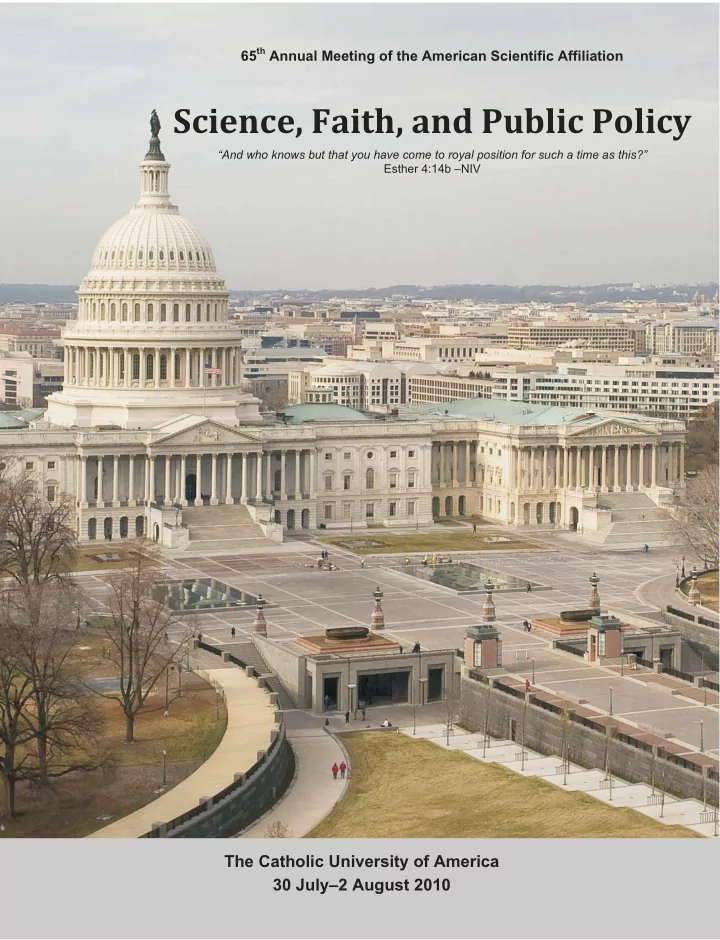
regional centers of diversity. Under- standing evolution and an old earth provides valuable insights into how to care for creation. Sunday 4:30 PM
Evaluating Macroinvertebrate Communities at the Nexus of Limestone and Freestone Streams
Jennifer K Hellmann and Jeff Erikson The Yellow Breeches, a tributary of the Susquehanna River, is a freestone stream flowing 49 miles through limestone-dominated valleys. The character of the stream changes as limestone streams join it at several points, altering the bedrock, formation, and water source. Stream chemistry and macroinvertebrate communities consequently change in conjunction with the physical and chemical trans-
chain and ecosystem, shifts in these populations can have widespread effects on the stream community as a whole. It is essential to determine factors promoting community changes to be able to accurately determine the conservation measures that can be safely taken without changing the
this project strives to assess whether there is significant difference between macroinvertebrate communities in the two streams as they join, and if one exists, to identify the chemical and physical parameters contributing to that shift. To accomplish this, visual assessments, nutrient analysis, and macro- invertebrate sampling were performed at eleven sites within thirty meters of the mixing site. Site location was deter- mined by conductivity representing limestone and freestone conditions as well as an intermediate mixing zone. Preliminary data reveals significant difference in macroinvertebrate communities in the limestone- and freestone-influenced sites in some keystone species, as well as significant differences in nearly all chemical parameters and only one physical parameter, substrate composition. Additional testing will be performed at this site and at two additional sites to further specify the cause of the change in community structure and composition. Sunday 11:15 AM
Public Policy from the Inside: Direct Involvement
William M Jordan In dealing with technically complex public policy issues, engineers have typically responded in one of three ways: 1.The engineer ignores the issue and keeps working solely on his own job. 2.The engineer offers his services as a consulting expert. This expert would explain the high technology issues and describe the implications of the various
recommendations are not made. 3.The engineer directly advocates one side of a specific public policy. In this paper these options will be analyzed as well as a fourth position called direct involvement advocacy. This perspective has the engineer being directly involved with political campaigns from the inside in an attempt to influence the public policy. This position will be defended using the traditional codes of engineering ethics as well as biblical passages concerning our involvement with the society around us. This paper will draw on the author’s personal experiences. One example will be when the author was the treasurer of a State Senate campaign for a candidate who was also a scien-
for party offices (on the public ballot). The final example will be running for and serving as a delegate at the national political convention of his
position four times and has served twice as a national convention
with practical recommendations as to how other engineers and scientists can become directly involved in the political process. Sunday 11:45 AM
Faith and Reason in Presidential Context
Robert Mann For the past year, I have been the presi- dent of the Canadian Association of Physicists, the Canadian counterpart to the American Physical Society. This position has provided me with interest- ing opportunities as a scientist and as a Christian in dealing with the relation- ship between science, public policy, and my own faith in Christ. This talk will summarize what I believe are the main issues in being a Christian in the context of serving as president of a scientific society, and what I have learned from this experience. Sunday 3:00 PM
The Human Impulse to Explore: Is There a Spiritual Component?
David S Leckrone Perhaps the most fundamental ration- ale offered for continued human space flight is that it is a manifestation of the age-old impulse of human beings to explore, to push back frontiers, to see what is on the other side of the next
into space, we also go exploring with robotic tools—from rovers on Mars to powerful space telescopes that are able to peer to the limits of space and time. Why do we feel compelled to accept the risks, and invest the resources and human energy to explore space, to explore the universe? For thousands of years, humans have gone exploring for reasons of commerce and for the gener- ation of wealth. Such motivations have, so far, played a relatively minor role within the context of space exploration. The development of an understanding
and the processes at work within it, is clearly only remotely related, if at all, to the human desire for economic gain. I will elaborate on the idea that the exploration of the universe, the search for basic understanding, is, at least in part, a spiritual quest that has signifi- cant religious implications. 20 2010 ASA Annual Meeting PUBLIC POLICY
PUBLIC POLICY SPACE POLICY
Sunday 3:30 PM
Examining the Metaphysical and Ideological Views in Space Policy Debates
Kamesh Sankaran Due to the magnitude of its resource requirements, its significance to national interests in the post-WWII era, and its relevance for all humanity, there have always been spirited debates associated with the space
entire spectrum, from the necessity and motivation for it, to specifics about which programs to pursue, and to methods for accomplishing these
arguments of “why,” “what,” and “how” questions in these policy debates lie significant worldview
lying metaphysical and ideological views that give rise to differing policy recommendations in debates on the issues, such as “science vs. human exploration” and “government vs. private sector.” Instead of simply evaluating the competing policy proposals, analyzing these issues by understanding the underlying assumptions will be helpful in guiding the debates on space policy. Sunday 4:00 PM
Our Place in God’s Universe: Perspectives from Human Space Flight
Mark Shelhamer Amazing discoveries in astronomy—
increasing pace—have told us much about the universe and the physical laws under which it works. Of even greater importance, these discoveries have helped us to understand the place
ent unique characteristics of Earth that promote life can be contrasted with the vastness of the heavens and the recent findings of other Earth-like planets. The fact that the expansion of the universe is accelerating, and that the creation of stars and galaxies continues to this day, give us pause to reflect on the ways in which God manifests
are arguably more important than any specific scientific findings, no matter how spectacular. Human spaceflight, too, has the poten- tial to provide a novel perspective on
the ecology movement in the 1970s is sometimes considered to be a direct result of the famous photograph of Earthrise from the moon taken by the crew of Apollo 8—an unplanned photograph of an unexpected sight. To see the Earth from space, to experi- ence personally the emptiness yet beauty of space, to contend with the dangers of the space environment, to experience weightlessness—reflections
insights into our place in the universe. If one considers astronomy and cosmology to be legitimate scientific endeavors, and understand that their greatest contribution is helping us understand the universe and our place in it, then understanding how humans adapt to space flight and respond to space flight are equally valid enter- prises, since they also help us understand our place in the universe. Thus, there is a justification for human life sciences in space beyond the practi- cal aspects of helping humans survive so that they can do productive work. Sunday 4:30 PM
The Origin of the Moon and the Origin of Humanity: An Analogy
Steven L Ball Our understanding of the moon’s
stages prior to the Apollo missions. The most popular theories could be categorized as “terrestrial” or “extra- terrestrial.” “Terrestrial” theories involved the Moon being formed out
earth, either by a co-creation process whereby both the earth and the moon accreted mass from the same region of the circumstellar disk, or by a rapidly spinning proto-Earth that flung matter
involved the earth somehow capturing a body that formed elsewhere in the early solar system. Each theory had its share of problematic considerations, but fortunately also some definitive predictions that could be tested by sampling lunar material. The lunar rocks from Apollo missions supported neither a strictly “terres- trial” nor “extraterrestrial” origin of the moon. They revealed both striking similarities and differences to the earth’s mantle. These findings led to consideration of a “collision-ejection” theory, which involved both terrestrial and extraterrestrial matter. Eventually it was determined that a Mars-sized planetesimal struck the early Earth at a glancing angle, throwing up large amounts of the early Earth mantle into orbit along with debris from the incoming object. Extremely high temperatures removed all volatiles and water, leaving a parched remnant of matter that eventually coalesced into the moon. Thus the moon inherited features of both a “terrestrial” and an “extraterrestrial” origin. In an analogous manner, our under- standing of human origins has tended to be either in terms of a “natural” process or a “supernatural” event. While evidence can be cited in favor of either scenario, it appears that to fully account for all observed aspects of our humanity, both physical and nonphysi- cal, we may find that a scenario involving both the natural and the supernatural is the best explanation. Sunday 2:30 PM
Systems Biology: A Sampling of Research Approaches and in Silico Tools
Hank D Bestman and Jordyn B Brandsma Systems biology research programs can employ several different approaches. The most routinely used research approach is a top-down one. This approach is looking at the biological system from the top by obtaining an exhaustive description of the inter- actions among the biological components, eventually leading to a decomposition of the system into its smaller parts. This approach has been used successfully in the genomic reconstruction of metabolic network models for microorganisms, algae, and humans. In a bottom-up approach, the aim is to reconstruct larger parts from individ- POSTERS The Catholic University of America, Washington, DC 21
POSTERS
ual components. This approach is exemplified by research programs designed to understand the regulatory mechanism in metabolic pathways on the basis of the properties of the constituent enzymes. Both research approaches rely heavily on data generated by such high throughput analytical techniques as genomic sequencing, microarray gene expres- sion analysis, proteome analysis, GC-MS, LC-MS, and NMR. All systems biology research approaches require a wide arsenal of mathematical and computational tools to explore and analyze large datasets. These tools range from software with very specific functions, such as the metabolic flux software FiatFlux and 13C-Flux , to software specifically designed to analyze and/or to integrate genomic, transcriptomic, and proteomic data sets, such as Gaggle and Genevestigator. Many of the systems biology in silico models are expressed in Systems Biology Markup Language (SBML) format and are available for download. Examples
several in silico tools and models will be demonstrated. Sunday 2:30 PM
The Benzene–OH Potential Energy Surface
David S Hollman The computational characterization of noncovalent interactions has always been difficult, particularly for reaction pathways with open shell intermedi-
energy calculations and geometry
complexes exist, they are prohibitively expensive for all but the simplest of
for the investigating of a number of systems, particularly biological ones. Almost any thorough study of DNA, for instance, must, in some way, account for the plethora of noncovalent interactions that are intimately associ- ated with its structure and interactions. In this study, the potential energy surface for the interaction of benzene with hydroxyl radical was investigated in detail along the two lowest tempera- ture reaction pathways, using several modern quantum chemistry packages. Geometries for first-order stationary points were obtained using the trusted second-order Mller–Plesset perturbation theory. A coupled cluster focal-point analysis was performed at each stationary point in both reaction pathways, including three transition
vibrational frequencies were compared to recently obtained experimental results for two of the intermediate complexes. This study is intended as a benchmark for further study of aromatic–radical interactions in larger molecules with less expensive density functional and perturbation methods. As such, a number of density functional calcula- tions were also performed on the same potential energy surface for compari- son with the benchmarks. The results show that most current density functional methods are insufficient to
for all components of the system. We conclude that for now it seems that the completely reliable methods for characterizing aromatic–radical interactions are high-accuracy wavefunction-based methods with large basis sets. This trend will have to change if significant high accuracy research is to be done on large molecules important for biological systems. Sunday 2:30 PM
Human Resting CD4+ T Cells Co-Cultured with Endothelial Cells Are Permissible for HIV-1 Infection without Signs of Activation
Anding Shen It is generally understood that HIV can
CD4+ T cells, because there are many blocks to viral life cycle in resting T cells, including reverse transcription, nuclear import, and transcription. However, in vivo resting T cells often encounter signals from professional antigen-presenting cells (APCs), which may alter the state of resting T cells to enable HIV infection. Human umbilical vein endothelial cells (HUVEC) serve as APCs in vivo and in vitro. Reports from previous studies showed that resting memory T cells co-cultured with HUVEC could be productively infected by HIV, and such infection was HLA-DR and CD58 dependent. Here, using a pseudotyped HIV system and spinoculation, we showed that resting naive and memory T cells could both be equally infected, and infected cells did not express any activation markers (CD25, CD69 or HLA-DR) nor did they proliferate (by expression of Ki67). In addition, the infection did not depend on the expression of HLA-DR. Co-culturing resting T cells from a HIV+ patient with HUVEC resulted in activation of latent HIV. Such results demonstrated an important role that endothelial cells play in HIV infection of T cells in vitro and suggest that endothelial cells may play a significant role in HIV infection and latency in vivo. Monday 9:00 AM
Cellular Complexity: The Cytoplasm Strikes Back
Harry Cook In the 20th century, as genetics became a legitimate branch of biology, attention focused on the activities of the nucleus and its chromosomes. Embryologists resisted the “nuclear monopoly,” knowing the contributions
tion. Genetics gained popularity in the English-speaking world, but in Continental Europe, cell biologists were reticent to ignore the role of the cytoplasm and mechanisms that link genes and their effects. Gender bias may also have been a cause of indiffer- ence toward the role of the cytoplasm. The discovery of the structure of DNA, and all the developments that followed once again drew attention to the nucleus. The Central dogma (DNARNA Protein) emphasized the role of the nucleus but also hinted at cytoplasmic processes that were yet to be discov-
also stressed the DNA-centered view. The cytoplasm, and its complex, multi-faceted function, was not to be
genome exerts its effects makes 22 2010 ASA Annual Meeting SYSTEMS BIOLOGY
SYSTEMS BIOLOGY
a simple one-gene-one-protein view untenable. As the DNA paradigm came to completion, the process of protein synthesis in the cytoplasm gained wider attention. Biotechnologies made detailed knowledge of cytoplasmic contributions necessary. Mitochondrial DNA and chloroplast DNA draw attention to the cytoplasm’s participa- tion in heritability. Epigenetic inheritance is also dependent on cytoplasmic mechanisms. A holistic view of the cell, which includes both nucleus and cytoplasm, does justice to the created complexity of the cell. Recognition of this complexity has led to important discussions of systems biology and of emergence in the biological realm. Monday 9:30 AM
Post-Genomic Biology: From Molecular to Systems?
Hank D Bestman The development of rapid genome sequencing and other high through-put analytical technologies provides biologists with the unprecedented
complexity of living organisms. Building on the traditional tools of molecular biology, these new technolo- gies are generating large amounts of data that require interpretation. Renewed attention is directed to the nature of the interpretative framework that should be used. Not satisfied with the allegedly molecule-centric linear view of causa- tion of traditional molecular biology, and armed with powerful mathemati- cal and computational tools, systems biologists claim that their approach will revolutionize our understanding
systems and transform a largely descriptive biology practiced along disciplinary lines into a quantitative, predictive interdisciplinary endeavor. A careful analysis of systems biology has identified two streams. The dominant stream is a molecular systems biology approach that has its roots in traditional molecular biology. It is characterized by the use of high through-put analytical technologies in the “wet” experimental phase alter- nating with a “dry” mathematical modeling phase. The claim is that this approach will achieve a complete material and mechanistic description
molecular level that is sufficiently accurate to allow for prediction. Although not shying away from a “wet” experimental phase, the less dominant systems theoretic stream is grounded more solidly in systems theory, paying particular attention to control theory and network topology, and it uses a more abstract mathemati- cal modeling approach. It is not clear whether systems biology as it is currently understood and practiced will lead biologists any closer to an understanding of biocomplexity. However, the question of the relation- ship between the physical/chemical and biological level of functioning has again become preeminent. Is a detailed knowledge of the molecular components and their relationships sufficient to understand the complexity
Monday 10:00 AM
Systems Biology and the Definition of Emergence
Jordyn B Brandsma Systems biologists claim to provide techniques and technologies that will enable them to calculate the emergent properties inherent to upward movement through hierarchical levels
the behavior of a complex system. A systems research approach pulls computational modeling and mathe- matics into the study of living
an in silico system that predicts and describes emergence. Emergence has historically been thought of as unpredictable and irreducible through the analysis of isolated components. Yet, this unknowability claim has been reputed by philosophers. The extreme claim of a few systems biologists, that all emergence can be accounted for by mathematics, should be approached with due caution. However, it is clear that many properties thought to be emergent under the historical defini- tion—for example, intelligence-like behavior in phosphoryl transfer and metabolic control pathways of E. coli— are currently being explained through computational modeling. The integration of mathematics and computation in a systems biology approach will challenge traditional views of biological emergence and
models will increase the predictive potential and capacity for the under- standing of biological systems, and certain aspects of the theories of emergence traditionally held might become increasingly difficult to maintain. Monday 9:00 AM
Intelligent Design on Trial
Ted Davis Davis, who attended parts of the Kitzmiller v. Dover trial, will examine “intelligent design” (ID), focusing on cultural and philosophical aspects, including its challenge to naturalism and the claim that ID is a scientific alternative to Darwinian evolution. He will explain some of the main ideas associated with ID, discuss the political and educational goals and strategies of the ID movement, and review the trial, closing with comments on evolution, public education, and the limits of science. Monday 10:05 AM
Evolving Beyond Lemon: The Use of the Lemon Test in Origin of Life Case Law
Samuel Chen The subject of science, faith, and public policy often takes two converging paths: faith and science seek integra- tion on the one, while public policy journeys down the other. The former seeks understanding, both scientifically and theologically, while the latter seeks practicality in implementing such understanding in society. The former descends from a scholarly history and continues to be debated by scholars today; the latter is the recent develop- SCIENCE EDUCATION ANDLAW The Catholic University of America, Washington, DC 23
SCIENCE EDUCATION AND LAW
ment of the past century, decided both then and now by judges in black robes. In addressing the role of religion in the public square, the US Supreme Court has developed a variety of tests and standards throughout its history. Most prominent in deciding matters of faith and science education, however, is the Lemon Test, as presented in Lemon v. Kurtzman (1971). Such is no different when addressing origin of life
policy with regards to the teaching of the origin of life, the courts have applied the Lemon Test to three specific, yet common, approaches: (1) to ban a particular teaching (namely, Darwinian evolution), (2) to require a particular teaching (namely, creation science), and (3) neither to ban nor to require a particular teaching but, rather, to inform students that such debate exists, along with a vast array
spectrum. A careful examination of these cases and the courts’ overall treatment of teaching origin-of-life science illumi- nates key, though often overlooked, aspects of the debate and offers valuable insights for crafting public policy on matters of faith and science. Monday 9:00 AM
Evolution, the Good Creation, and the Problem of Evil
Bethany N Sollereder For over one hundred and fifty years, evangelicals have been responding to Charles Darwin’s theory of evolution. Some have accepted evolution, others have rejected it, but everyone has acknowledged that Darwin has thrown forth a theological challenge to which Christians must reply. One of the most troubling aspects of Darwin’s theory is the vision of the natural world that it often portrays: the vicious and self-serving survive, while the weak and vulnerable are cut away. If Christians choose to accept evolu- tionary creation as God’s creative method, how are they to make sense of the inherent and necessary violence and selfishness found in the world? What about other natural evils? Are earthquakes, pain, and death part of God’s good creation? How can this be reconciled with the biblical witness about death as the “last enemy”? This talk attempts to demonstrate that the goodness of God can be under- stood in light of evolution by considering three proposals. First, pain and death are good and necessary realities in the existence of organic, living creatures. Second, an Irenaean understanding of the “good but not perfect” creation provides a suitable background context in which to under- stand evolutionary creation and the genesis of human sinfulness. Third, an evolutionary process of creation in no way diminishes the promise of an eschatological reality without pain and death. Understanding that the creation is still God’s “very good” world changes the way we must think about death, the use of analgesics, environmental responsibilities, and the nature of divine love. This presentation is based upon Sollereder’s masters thesis, entitled “Evolutionary Theodicy: Toward an Evangelical Perspective.” Monday 9:30 AM
Scriptural Modes of Creation Revisited
John C Munday Scripture describes God’s creative acts using select terms (including princi- pally bara, asah, and yatsar). The terms have overlapping yet distinctive meanings, and are applied to a great variety of cosmic and terrestrial
identified four modes of creation, resulting in at least five types of
The modes (distinctive but not always exclusive) include (1) acts that are miraculous, rapid, and ex nihilo; (2) development of preexisting material; (3) acts fitting into historical unfolding; and (4) newness resulting from natural process. The modes may be divided theologically between immediate and mediate, or creation prima and creation secunda. Scientifi- cally, the divide is between ex nihilo creation and material differentiation. Human activity may be recognized as creatio tertia. Creative acts result in (1) generation of absolutely novel items, (2) creation of souls, (3) selection
(4) sign miracles, and (5) new instances
Theistic evolution offers creation by descent with modification, an interme- diate between results (1) and (5). Creation’s domain broadly character- ized is nature, history, and spirit. From the context and distinctions among the creation terms, exegetical details of Genesis 1–2 and other passages have been drawn. A more complete taxonomy of acts of creation described scripturally is sought, in order to further elucidate Divine modes of action. A new possibility suggested here is that creation terminology distinctions in Genesis 1 were employed to answer early humans’ questions, an hypothe- sis called revelatory-response. The question of how God creates has
and theological realms. While reflec- tions illuminating scriptural modes of creation are available in each realm, the intersection of divine action with material outcome remains elusive. Theologically, creation involves a thing’s being educed from nonexis- tence, whether immediately or
arise via the Big Bang theory, involving the sudden appearance of the cosmic egg as a quantum fluctuation from nothing; in quantum theory, virtual particles appear and disappear
description focuses on God’s attributes in relation to creative accomplish- ments, not on how spiritual force is transduced. Conversely, efforts at the scientific end
ventionist and noninterventionist special divine action in a nondeter- ministic universe, in the context of quantum and chaos theories. A focus
ary processes. The intricate workings
control of material things are appar- ently beyond any hope of scientific proof, for two reasons. First, uncertain- ties abound in both metaphysical understanding and inherent quantum 24 2010 ASA Annual Meeting THEOLOGY
THEOLOGY
involve the immanent penetration of a nontemporal God into his temporal creation, and this penetration is inherently spiritual. While absolute
it produces, whenever discussed, such as in the Big Bang theory, a confronta- tion with the Divine, hence its intrigue within science, and the passion over its religious implications in the public school science classroom. Monday 10:00 AM
Ramm’s The Christian View of Science and Scripture Revisited
Paul H Seely In 1954, Bernard Ramm published The Christian View of Science and Scrip-
educated evangelicals, because it repudiated the obscurantism of Funda- mentalism, took science seriously, and tried to maintain the authority of
but like the Neo-Evangelical movement from which it sprang, it held on to a basically fundamentalist definition of biblical inspiration, namely, the Bible must be factually correct whenever it speaks of science or history. This doctrine has resulted in the left wing of Evangelicalism either ignoring parts of the Bible or taking the Bible
so that it agrees with modern science. It has caused the right wing of Evangelicalism to largely ignore or repudiate modern science in favor of a fundamentalist fideism. Indeed, the reaction of the right to Ramm’s book was The Genesis Flood by Whitcomb and Morris. Twenty-five years after writing The Christian View of Science and Scripture, Bernard Ramm said that if he were to write it over again, he would be more aware of the Ancient Near Eastern background of Genesis yet preserve its unique monotheism. Taking as my starting point, Ramm’s later awareness
Eastern literature for biblical interpre- tation, I will show how this literature helps us understand the biblical text and leads to a revision of Ramm’s approach to astronomy, geology, and
still be fully accepted. The “plus” is that interpretations of Scripture will be closer to the historical-grammatical meaning of the biblical text, more academically robust, and theologically
Monday 10:30 AM
The Tower of Babel: A Confusing Incident Made Less Confusing
Dick Fischer After the great flood, described variously in Genesis, Atrahasis, Ziusudra, the eleventh chapter of Gilgamesh, and Berossus, someone in southern Mesopotamia (present-day Iraq) got a brilliant idea. Why not build a mud brick platform in the city center to survive spring floods? Each major city in Sumer (Hebrew, “Shinar”) followed suit beginning after about 2900 BC. These grew to outlandish proportions during a period of ziggu- rat construction until Sumer was destroyed around 2000 BC. The incident described in Genesis 11 was what befell the Semite dwellers at
were engaged in a region-wide ziggu- rat-building contest with their
precedes the Babel incident in chapter 11, just as 10 normally precedes 11 in typical numerical fashion. Thus the scattering of Semitic peoples from Babel was among those in the line of Arphaxad—the Line of Promise, and some in the line of Cush which included Nimrod. Japhethites, however, were unrepresented at Babel. A confusion of tongues ensued among the Semite tower-builders, not a change in basic languages as has been the popular interpretation. It will be seen that this incident in biblical history has been placed in
mistranslated, misinterpreted, and misconstrued. Monday 11:00 AM
Is There Science in the Bible?
John A Bloom Conservative Christian confessions of faith affirm that the Bible is true in all that it teaches. This confidence leads some evangelicals to apply a concordist approach to the Bible, where they harmonize biblical statements about the natural world with our modern scientific understanding of it. Moreover, there are Christian apolo- gists who argue that some biblical statements reflect scientific truths that were unknown at the time the text was written, suggesting divine author- ship for the Bible. Other evangelical scholars have recently challenged this concordist approach by asserting that the Bible contains nothing indicative
cultural world of the Ancient Near East. This paper will review the strengths and merits of these claims, and conclude that a moderate concordism seems valid and of apologetic value. Sunday 7:30 PM
Challenges to Understanding Human Evolution in a Religious Context
Rick Potts Human evolution is one of the most vibrant fields of scientific research, with ongoing discoveries and evidence-based debates informed by many fields of science. At the same time, biblical understandings and scientific findings about human origins have posed especially strong challenges to one another, often framed solely in terms of conflict rather than as a profound opportunity for conversa- tion and reflection. After a survey of the fossil, archeological, and genetic findings that have shaped the study
approach of the Smithsonian exhibition in creating a respectful place for explo- ration and dialogue concerning the scientific discoveries. This presentation focuses on the question: If science is important to people’s understanding
is part of the core of scientific investi- gation and understandings today, how may we transcend the conflict mode to find ways of conversing productively about the science of human evolution in the context of religious awareness SPECIAL LECTURE The Catholic University of America, Washington, DC 25
SPECIAL LECTURE
and insight? The diversity and extinc- tion of early human species, the genetic relationship of humans to all other
basic process of evolutionary adapta- tion, all present substantial challenges to the conversation—and important and largely unrecognized
Friday 7:30 PM
“A Higher Calling for Scientists: Stewardship, Governance, and Leadership”
Vernon J Ehlers Congressman Ehlers will talk about the responsibility Christian scientists have for participation in the political arena. Based on his experience in local, state, and federal government, he will discuss the need for leadership, aspects of governance, and how
characteristics of Christian leadership, and share some of the challenges he has faced during his career. Saturday 9:00 AM
From Limping to Walking
Sara Joan Miles Where is the biblical passage that commands us to explore the rings of Saturn or not explore them? Where are the verses that encourage us to create
provide guidelines for environmental action? If our Christian faith is supposed to guide us in making personal and public scientific and technological decisions—and policies—then how do we go about developing a scripturally based theology to shape our scientific and political work? The answer is, “Carefully, very carefully.” We must be clear about our core values and these must be based on the biblical revelation. In this talk, several biblically based core values will be identified and applied to scientific/technological
show how different decisions may be reached depending on the priorities given to individual core values. The approach demonstrated may be able to help us both to develop and to articulate a faith-based approach to policy matters, but it can also offer a means for determining why Chris- tians who claim that their positions are biblically informed sometimes, even frequently, disagree. Saturday 1:30 PM
Renewable Energy: A Walk through Time and into the Future
Stanley R Bull The Creation put on this earth not only man and woman, but an abundance of natural resources to nurture and sustain their life. These natural resources included plants, animals, sunlight, water, and wind. Throughout the ages, humans have made use of these resources in their fundamental form, but with an apparent intelligence for their application. Over time the high energy density form of what we know today as fossil fuels resulted from nature’s action on the remains of plants and animals. And while a product of nature, our current use of these resources reminds us, for every action there is a reaction. In this case, while the benefits have been enormous, the environmental conse- quences have also become enormous. As we look into the future, what will provide fuel and power for our life, what will be the natural resources we will rely on, what are the implications
entirely on clean and sustainable resources? Will new technologies be
additional environmental challenges? The challenge of providing large quantities of clean energy for the world’s expanding population is recog- nized, and this and other challenges will likely test our basic beliefs, attitudes, and values. With a future based on renewable energy there is a compelling case for optimism. Saturday 7:30 PM
Experiences of a Scientist-Christian in the Washington Fishbowl
Francis S Collins Recently, it seems that many voices in the community are proclaiming that the scientific and spiritual worldviews are simply incompatible, and that one must make a decision which frame- work to follow. As a scientist and a believer, I find such a demand for a choice both unnecessary and unfortu- nate—these are different approaches to answering different questions, but both can lead to truth. While that view is actually shared broadly by many members of the public, my recent appointment by President Obama as the 16th Director of the National Institutes of Health has certainly flushed out some interesting responses. I will review some of the most exciting research opportunities in biomedical research right now, reflect upon their ethical implications, and suggest a few ways that the current tensions between science and faith might be reduced— though this will take patience, love, and forbearance by all. Sunday 10:10 AM
Evangelicals and Science: Overcoming Our Past
Richard Cizik Not available at press time. Sunday 1:30 PM
Seeking Other Earths: Exoplanets and the Significance of Life
Jennifer Wiseman No longer just science fiction, astronomers are suddenly finding hundreds of extrasolar gaseous planets, and the search for Earth-like planets and life beyond Earth is well
(or nowhere else) shake our view of human existence, and societal perceptions of God? I will describe the ingenious techniques astronomers are using to detect extrasolar planets and evidence of life beyond Earth, discussing the theological and philosophical implications of
26 2010 ASA Annual Meeting PLENARY SESSIONS
PLENARY SESSIONS
Georgia Arbuckle-Keil
Department of Chemistry Rutgers University 315 Penn St Camden NJ 08102 arbuckle@camden.rutgers.edu
Paul T Arveson
6902 Breezewood Ter Rockville MD 20852 paul@arveson.com
Jon Bailey
Fermilab Theoretical Physics Department PO Box 500 - MS 106 Batavia IL 60510 jabailey@fnal.gov
Jim Ball
680 I St SW Washington DC 20024 jim@creationcare.org
Steven L Ball
LeTourneau University 2100 Mobberly Ave Longview TX 75607 StevenBall@letu.edu
Jay D Bernheisel
Union University 1050 Union University Dr Box 1887 Jackson TN 38305 jbernheisel@uu.edu
Hank D Bestman
Department of Biology The King’s University College 9125 - 50 St Edmonton AB T6B 2H3 Canada hank.bestman@kingsu.ca
Lynn Billman
NREL 1617 Cole Blvd Golden CO 80401 lynn.billman@nrel.gov
John A Bloom
12631 Biola Ave La Mirada CA 90638 john_bloom@peter.biola.edu
Jordyn B Brandsma
Department of Biology The King’s University College 9125 - 50 St Edmonton AB T6B 2H3 Canada jordyn.brandsma@gmail.com
Stanley R Bull
Associate Director Emeritus Science and Technology NREL 1617 Cole Blvd Golden CO 80401-3393 Stan.Bull@nrel.gov
David C Campbell
425 Scientific Collections Box 870345 University of Alabama Tuscaloosa AL 35487-0345 pleuronaia@gmail.com
Soo Y Chang
Industrial and Management Engineering Pohang Univ of Science and Technology Hyoja San 31 Namgu Pohang Kyungbuk 790-784 Republic of Korea syc@postech.ac.kr
Samuel Chen
1306 Speight Ave Waco TX 76707 Sam_Chen@baylor.edu
William P Cheshire
Mayo Clinic 4500 San Pablo Rd Jacksonville FL 32224 cheshire@mayo.edu
Elizabeth Chmielewski
2104 Leroy Dr Woodbine MD 21797 lizc2008@gmail.com
Richard Cizik
United Nations Foundation 1800 Massachusetts Ave NW, Ste 400 Washington DC 20036 rcizik@aol.com
Francis S Collins
5908 Tudor Ln Rockville MD 20852-2853 Francis.Collins@gmail.com
Harry Cook
15032 - 84 Ave NW Edmonton AB T5R 3X5 Canada hacook@shaw.ca
David C Daniels
501 Garden View Way Rockville MD 20850 ddaniels@dsbox.com
Susan A Daniels
501 Garden View Way Rockville MD 20850 susanchandradaniels@gmail.com
Ted Davis
Box 3030 Messiah College One College Ave Grantham PA 17027 tdavis@messiah.edu
Vernon J Ehlers
1848 Morningside Dr SE Grand Rapids MI 49506-5121 Vernon.Ehlers@mail.house.gov
Dick Fischer
PO Box 2245 Centreville VA 20122 dickfischer@verizon.net
Paula R Gossard
Philadelphia Biblical University School of Arts and Sciences 200 Manor Ave Langhorne PA 19047 pgossard@pbu.edu
Arvin M Gouw
218 N Charles St, Ste 1607 Baltimore MD 21201 arvingouw@jhmi.edu
Terry M Gray
Chemistry Department Colorado State University Fort Collins CO 80523 grayt@lamar.colostate.edu
Jennifer K Hellmann
306 Meadowview Dr Trappe PA 19426 jehellmann45@gmail.com
Peter M J Hess
420 40th St, Ste 2 Oakland CA 94609-2509 hess@ncse.com
David S Hollman
1004 Cedar St The University of Georgia Athens GA 30602-2556 dhollman@uga.edu
Elisha R Injeti
251 N Main St Cedarville OH 45314 einjeti@cedarville.edu
Brian V Johnstone
3112 7th St NE Washington DC 20017 johnstob@cua.edu
Nancy L Jones
15414 Manor Village Ln Rockville MD 20853 njones@wfubmc.edu
William M Jordan
Baylor University One Bear Place #97356 Waco TX 76798-7356 bill_jordan@baylor.edu
Robert Kaita
Princeton University Plasma Physics Laboratory Box 451 Princeton NJ 08543 kaita@pppl.gov
Gladys V Kober
28322 Kemptown RD Damascus MD 20872-1327 gkober@milkyway.gsfc.nasa.gov
Mary H Korte
Department of Natural Sciences Concordia University Wisconsin 12800 N Lakeshore Dr Mequon WI 53097 Mary.Korte@cuw.edu
Chong-Min Kyung
Department of EE KAIST 335 Gwahak-ro Yuseong-gu Daejeon 305-701 Korea kyung@ee.kaist.ac.kr
Denis O Lamoureux
#1106 8510 - 111 St Edmonton AB T6G 1H7 Canada dlamoure@ualberta.ca
David S Leckrone
10903 Rocky Mount Way Silver Spring MD 20902 david.leckrone@nasa.gov
Benjamin G Lee
NREL 1617 Cole Blvd, M/S 3219 Golden CO 80401 benjamin.lee@nrel.gov
The Catholic University of America, Washington, DC 27
Jimmy Lin
820 N Broadway Baltimore MD 21205 jimmy.lin@jhmi.edu
Johnny Wei-Bing Lin
PO Box 16385 Chicago IL 60616 johnny@johnny-lin.com
Casey Luskin
Discovery Institute Center for Science and Culture 1511 3rd Ave Ste 808 Seatlle WA 98101 casey@ideacenter.org
Heather Looy
The King’s University College 9125 - 50th St Edmonton AB T6B 2H3 Canada heather.looy@kingsu.ca
Robert Mann
Department of Physics and Astronomy University of Waterloo Waterloo ON N2L 3G1 Canada rbmann@sciborg.uwaterloo.ca
Benjamin J McFarland
Seattle Pacific University Department of Chemistry and Biochemistry 3307 Third Ave W, Ste 205 Seattle WA 98119 bjm@spu.edu
Sara Joan Miles
318 57th St #303 Kenosha WI 53140-4249 SMiles303@wi.rr.com
Keith B Miller
108 Thompson Hall Department of Geology Kansas State University Manhattan KS 66506 keithbmill@gmail.com
Roman J Miller
Eastern Mennonite University 1200 Park Rd Harrisonburg VA 22802 millerrj@emu.edu
Ruth Douglas Miller
Department of Electrical and Computer Engineering 261 Rathbone Hall Kansas State University Manhattan KS 66506-5204 rdmiller@ksu.edu
John C Munday
1204 Murray Dr Chesapeake VA 23322 jmunday@avantrex.com
George L Murphy
538 Cynthia Ln Tallmadge OH 44278 gmurphy10@neo.rr.com
James Peterson
McMaster Divinity College and Faculty of Health Sciences McMaster University 1280 Main St W Hamilton ON L8S 4K1 Canada peterso@mcmaster.ca
Rick Potts
Director, Human Origins Program Curator, David H Koch Hall of Human Origins National Museum of Natural History Smithsonian Institution Washington DC 20013 pottsr@si.edu
Heather Prior
The King’s University College 9125 - 50th St Edmonton AB T6B 2H3 Canada heather.prior@kingsu.ca
Jason M Rampelt
317 Windsor Dr Coraopolis PA 15108 jmrampelt@gmail.com
Christopher M Rios
2000 N Speegleville Rd Waco TX 76712 chris_rios@baylor.edu
Ward Sanford
12611 Glenbrooke Woods Dr Oak Hill VA 20171 wsanford@usgs.gov
Kamesh Sankaran
Physics Department 300 W Hawthorne Rd Spokane WA 99251 ksankaran@whitworth.edu
Rodney J Scott
Biology Department Wheaton College Wheaton IL 60187 rodney.j.scott@wheaton.edu
Paul H Seely
1544 SE 34th Ave Portland OR 97214 PHSeely@msn.com
Mark Shelhamer
16 Folly Farms Ct Reisterstown MD 21136 mjs@dizzy.med.jhu.edu
Anding Shen
2700 Ridgecroft Dr SE Grand Rapids MI 49546 as28@calvin.edu
Bethany N Sollereder
12704-102 Ave Edmonton AB T5N 0M5 Canada bsollereder@gmail.com
John R Staver
Center for Research and Engagement in Science and Mathematics Education Felix Haas Hall, Rm 202 250 N University St West Lafayette IN 47907 jstaver@purdue.edu
Mark A Strand
1014 15th Ave South Fargo ND 58103 MarkStrand3@gmail.com
Jason E Summers
1222 4th St SW Washington DC 20024 jason.e.summers@gmail.com
Jack C Swearengen
3324 Parker Hill Rd Santa Rosa CA 95404-1733 jcswear@sbcglobal.net
Ann Marie Thro
800 9th St SW, Rm 3462 Washington DC 20024 athro@nifa.usda.gov
Kenell J Touryan
PO Box 713 Indian Hills CO 80454 kenell@comcast.net
Thomas L Walters
The Department of Biology and Chemistry Azusa Pacific University 901 East Alosta Ave PO Box 7000 Azusa CA 917012 twalters@apu.edu
Jennifer Wiseman
Goddard Space Flight Center Code 667 Greenbelt MD 20771 jennifer.j.wiseman@nasa.gov
B Ashley Zauderer
980 Cold Harbor Dr Roswell GA 30075 bevinashley@gmail.com
28 2010 ASA Annual Meeting
Sunday, 1 August 2010, 6:15–7:15 PM, Great Hall 320B
Jennifer Wiseman
Randy Isaac
Randy Isaac
Randy Isaac
Randy Isaac
Randy Isaac
Robert Kaita
Randy Isaac
Jennifer Wiseman
Jennifer Wiseman
Jennifer Wiseman
The Catholic University of America, Washington, DC 29
Arbuckle-Keil, Georgia ................................................................................................... 3, 14, 27 Arveson, Paul T .............................................................................................................. 3, 12, 27
Bailey, Jon ...................................................................................................................... 3, 13, 27 Ball, Jim........................................................................................................................... 5, 19, 27 Ball, Steven L ................................................................................................................. 5, 21, 27 Bernheisel, Jay D ............................................................................................................. 3, 6, 27 Bestman, Hank D ................................................................................................. 4, 5, 21, 23, 27 Billman, Lynn .................................................................................................................. 3, 12, 27 Bloom, John A ................................................................................................................ 5, 25, 27 Brandsma, Jordyn B ............................................................................................. 4, 5, 21, 23, 27 Bull, Stanley R ............................................................................................................ 1, 3, 26, 27
Campbell, David C ......................................................................................................... 5, 19, 27 Chang, Soo Y ................................................................................................................. 3, 14, 27 Chen, Samuel ................................................................................................................ 5, 23, 27 Cheshire, William P ........................................................................................................ 3, 10, 27 Chmielewski, Elizabeth .................................................................................................... 3, 6, 27 Cizik, Richard ............................................................................................................. 1, 4, 26, 27 Collins, Francis S ....................................................................................................... 1, 4, 26, 27 Cook, Harry .................................................................................................................... 5, 22, 27
Daniels, David C ............................................................................................................... 3, 9, 27 Daniels, Susan A ............................................................................................................ 3, 17, 27 Davis, Ted ............................................................................................................ 2, 5, 16, 23, 27
Ehlers, Vernon J ......................................................................................................... 1, 2, 26, 27
Fischer, Dick .................................................................................................................. 5, 25, 27
Gossard, Paula R ........................................................................................................... 3, 13, 27 Gouw, Arvin M ................................................................................................................ 4, 10, 27 Gray, Terry M ................................................................................................................. 3, 13, 27 30 2010 ASA Annual Meeting
Hellmann, Jennifer K ...................................................................................................... 5, 20, 27 Hess, Peter M J .............................................................................................................. 3, 11, 27 Hollman, David S ............................................................................................................ 4, 22, 27
Injeti, Elisha R .................................................................................................................. 4, 7, 27
Johnstone, Brian V ........................................................................................................... 3, 8, 27 Jones, Nancy L ................................................................................................................. 3, 8, 27 Jordan, William M ........................................................................................................... 4, 20, 27
Kaita, Robert .................................................................................................................. 3, 16, 27 Kober, Gladys V ............................................................................................................. 3, 14, 27 Korte, Mary H ................................................................................................................. 4, 18, 27 Kyung, Chong-Min .......................................................................................................... 4, 18, 27
Lamoureux, Denis O .................................................................................................. 2, 5, 16, 27 Leckrone, David S .......................................................................................................... 5, 20, 27 Lee, Benjamin G ............................................................................................................. 3, 12, 27 Lin, Jimmy ........................................................................................................................ 3, 7, 28 Lin, Johnny Wei-Bing ..................................................................................................... 4, 18, 28 Looy, Heather ................................................................................................................... 4, 7, 28 Luskin, .................................................................................................................................. 5, 28
Mann, Robert ................................................................................................................. 4, 20, 28 McFarland, Benjamin J ................................................................................................... 4, 15, 28 Miles, Sara Joan ......................................................................................................... 1, 2, 26, 28 Miller, Keith B ................................................................................................................. 5, 19, 28 Miller, Roman J ................................................................................................................ 3, 9, 28 Miller, Ruth Douglas ....................................................................................................... 3, 11, 28 Munday, John C ............................................................................................................. 5, 24, 28 Murphy, George L ............................................................................................................ 3, 8, 28
Peterson, James .............................................................................................................. 3, 8, 28 Potts, Richard ............................................................................................................. 1, 5, 25, 28 Prior, Heather ................................................................................................................... 4, 7, 28
Rampelt, Jason M .......................................................................................................... 3, 16, 28 Rios, Christopher M ........................................................................................................ 3, 15, 28 Index of Presenters The Catholic University of America, Washington, DC 31
Sanford, Ward ................................................................................................................ 4, 17, 28 Sankaran, Kamesh ......................................................................................................... 5, 21, 28 Scott, Rodney J .............................................................................................................. 4, 10, 28 Seely, Paul H .................................................................................................................. 5, 25, 28 Shelhamer, Mark ............................................................................................................ 5, 21, 28 Shen, Anding .................................................................................................................. 4, 22, 28 Sollereder, Bethany N .................................................................................................... 5, 24, 28 Staver, John R ............................................................................................................... 3, 14, 28 Strand, Mark A ................................................................................................................. 3, 6, 28 Summers, Jason E ........................................................................................................... 3, 9, 28 Swearengen, Jack C ...................................................................................................... 3, 12, 28
Thro, Ann M ................................................................................................................... 4, 17, 28 Touryan, Kenell J ........................................................................................................... 3, 11, 28
Walters, Thomas L ......................................................................................................... 3, 15, 28 Wiseman, Jennifer ...................................................................................................... 1, 4, 26, 28
Zauderer, B Ashley ......................................................................................................... 3, 14, 28 32 2010 ASA Annual Meeting Index of Presenters
Photo courtesy: Architect of the Capitol. On the front cover, the the bottom and the right side of the photo were cropped.
Photo courtesy: Architect of the Capitol.