SCHOOLS MAKE A CHILDHOOD ORIGINS WHAT SCHOOLS HUGE DIFFERENCE OF - - PowerPoint PPT Presentation

schools make a
SMART_READER_LITE
LIVE PREVIEW

SCHOOLS MAKE A CHILDHOOD ORIGINS WHAT SCHOOLS HUGE DIFFERENCE OF - - PowerPoint PPT Presentation

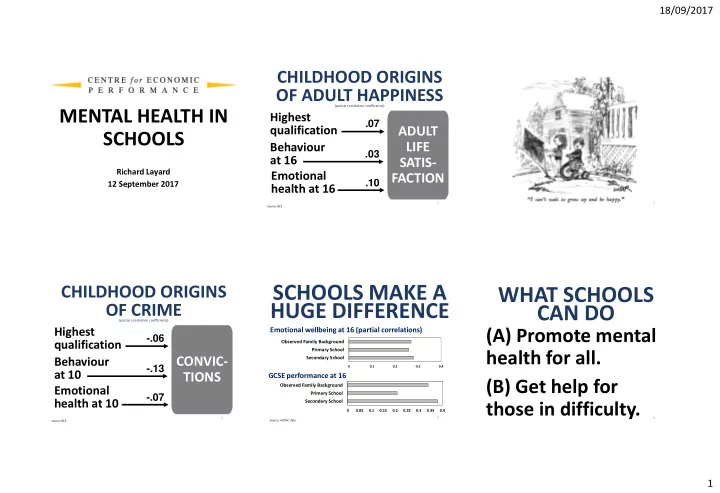
18/09/2017 CHILDHOOD ORIGINS OF ADULT HAPPINESS (partial correlation coefficients) MENTAL HEALTH IN Highest .07 qualification ADULT SCHOOLS LIFE Behaviour .03 at 16 SATIS- Richard Layard Emotional FACTION .10 12 September 2017


slide-1
SLIDE 1

18/09/2017 1

MENTAL HEALTH IN SCHOOLS

Richard Layard 12 September 2017

Emotional health at 16

ADULT LIFE SATIS- FACTION

Highest qualification Behaviour at 16

.07

(partial correlation coefficients)

.03 .10

CHILDHOOD ORIGINS OF ADULT HAPPINESS

2 Source: BCS. 3

Emotional health at 10

CONVIC- TIONS

Highest qualification Behaviour at 10

  • .06

(partial correlation coefficients)

  • .13
  • .07

CHILDHOOD ORIGINS OF CRIME

4 Source: BCS. 5

0.05 0.1 0.15 0.2 0.25 0.3 0.35 0.4

Secondary School Primary School Observed Family Background

0.1 0.2 0.3 0.4

Secondary School Primary School Observed Family Background

GCSE performance at 16

Source: ALSPAC data.

Emotional wellbeing at 16 (partial correlations)

SCHOOLS MAKE A HUGE DIFFERENCE WHAT SCHOOLS CAN DO

(A) Promote mental health for all. (B) Get help for those in difficulty.

6

slide-2
SLIDE 2

18/09/2017 2

  • 1. An explicit goal.
  • 2. Measure it.
  • 3. Wellbeing Code.
  • 4. Evidence-based life skills
  • nce a week.
  • 5. Good discipline.

(A) PROMOTING MENTAL HEALTH

7

  • 1. GOALS
  • Intellectual and

emotional/pro-social – not in conflict.

  • Ofsted should follow the

Independent Schools Inspectorate in giving equal weight.

8

  • 2. MEASUREMENT
  • Annual – key measure is

average improvement.

  • Voluntary?
  • Pilot
  • Qs to teachers (SDQ)

to pupils (PTO)

9

Qs TO CHILDREN OVER 9

10

  • No. of questions
  • Happiness: Heubner + WEBWMS

14

  • Emotional and behavioural

problems: SDQ 25

  • School: School Connection

Subscale of the Student Resilience Scale 4

  • Bullying

5 48

  • 3. CODE (FOR CHILDREN,

PARENTS, TEACHERS)

  • Value of the month - no rule by

fear.

  • Teachers comfortable discussing

values and mental health.

  • Bullying is out.
  • Senior teacher to lead on mental

health.

  • Life skills 1 hour per week.

11

  • 4. LIFE SKILLS
  • Manualised with trained

teachers (like surgeons).

  • Weekly from age 5 to 18.

12

slide-3
SLIDE 3

18/09/2017 3

HEALTHY MINDS (IN SECONDARY SCHOOLS)

13

Weekly for 4 years. Manualised, with trained teachers. 10 pre-existing modules, successfully trialled. Covers SEL, SRE, Healthy Living + Parenting, Life Goals, Mental disorders, Media, Mindfulness.

Topic Programme used Resilience Penn Resilience Program; MoodGym Compassion Relationship Smarts Sexual relationships SexEd Sorted Drugs Unplugged Eating and alcohol SHAHRP Parenting Parents under Construction Life goals Schools to Life Mental disorders Science of Mental Illness Media awareness Media Navigator Mindfulness .Breathe

HEALTHY MINDS CURRICULUM (11-14)

14

howtothrive.org/healthy-minds/ Email: info@howtothrive.org

15

PROBLEM: 43% of 11-14 children say others often so noisy it’s difficult to work. SOLUTION: Webster-Stratton

  • 5. SCHOOL DISCIPLINE

16

  • PSHE will be a specialist

subject in PGCE.

  • All teachers will have

basic MH and W-S training.

  • A mass of e-materials will

help.

EVENTUALLY

17

(B) HELPING CHILDREN IN DIFFICULTY

18

  • Over 1,000,000 children diagnosable.
  • CAMHS treat 200,000 p.a. – seriously
  • sick. Quality improved by CYP IAPT.
  • For mild to moderate, no NHS service

to implement NICE-guidelines. (There are school counsellors, Place2Be etc., but patchy + variable quality). → Situation very similar to adults pre-IAPT.

slide-4
SLIDE 4

18/09/2017 4

THE NEXT BIG STEP

  • New school-based wing of

every CAMHS service. Direct access for children and

  • parents. Schools provide
  • space. All teachers get basic

MH training.

  • School-based departments,

with own lead, ROM system, way of working and commissioned budget.

19

  • National training initiative

(1,000 p.a.) + coordination.

  • Aim: treat 200,000 a year

by 2022. £250m in 2022

20 21 22

CONCLUSIONS

  • Emotional health matters.
  • Schools can make a huge

difference to it.

  • Their job includes

promoting mental health (and measuring it).

  • The NHS should lead on

school-based treatment.

23

References

Slides 2,4,5 Clark, A.E., Flèche, S., Layard, R., Powdthavee, N. and Ward, G. (forthcoming). The Origins of Happiness: The Science of Wellbeing over the Life Course: Princeton University Press. Slide 14 Bailey, L. (2014). Healthy Minds – The Curriculum Journey. How To Thrive. howtothrive.org/healthy-minds/ Slide 16 Wilson, S., Benton, T., Scott, E. and Kendall, L. (2007). London challenge: survey of pupils and teachers 2006. Slough: National Foundation for Educational Research Webster-Stratton, C., Reinke, W.M., Herman, K.C. and Newcomer, L.L. (2011). 'The Incredible Years Teacher Classroom Management training: The methods and principles that support fidelity of training delivery', School Psychology Review, 40(4): 509-529. Slide 22 Layard, R. and Clark, D.M. (2014). Thrive: The power of evidence-based psychological therapies, London: Penguin.

24