Schema Design and Normal Forms Database Management Systems, 2 nd - - PDF document

schema design and normal forms
SMART_READER_LITE
LIVE PREVIEW

Schema Design and Normal Forms Database Management Systems, 2 nd - - PDF document

Schema Design and Normal Forms Database Management Systems, 2 nd Edition. R. Ramakrishnan and J. Gehrke 1 Entity-Relationship Diagram Sid Name Level Rating Wage Hours Sailor Database Management Systems, 2 nd Edition. R. Ramakrishnan and J.


slide-1
SLIDE 1

Database Management Systems, 2nd Edition. R. Ramakrishnan and J. Gehrke 1

Schema Design and Normal Forms

Database Management Systems, 2nd Edition. R. Ramakrishnan and J. Gehrke 2

Entity-Relationship Diagram

Sailor Sid Name Level Rating Wage Hours

Database Management Systems, 2nd Edition. R. Ramakrishnan and J. Gehrke 3

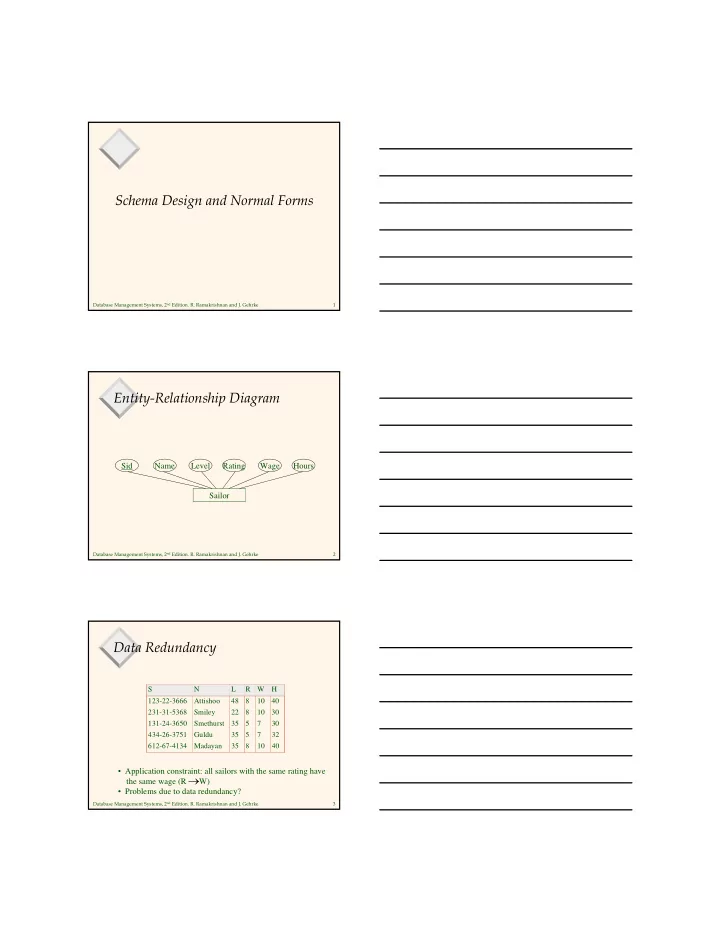
S N L R W H 123-22-3666 Attishoo 48 8 10 40 231-31-5368 Smiley 22 8 10 30 131-24-3650 Smethurst 35 5 7 30 434-26-3751 Guldu 35 5 7 32 612-67-4134 Madayan 35 8 10 40

Data Redundancy

  • Application constraint: all sailors with the same rating have

the same wage (R W)

  • Problems due to data redundancy?

slide-2
SLIDE 2

Database Management Systems, 2nd Edition. R. Ramakrishnan and J. Gehrke 4

Problems due to Data Redundancy

v Problems due to R W : – Update anomaly: Can we change W in just the first

tuple of SNLRWH?

– Insertion anomaly: What if we want to insert an

employee and don’t know the hourly wage for his rating?

– Deletion anomaly: If we delete all employees with

rating 5, we lose the information about the wage for rating 5!

v Solution?

Database Management Systems, 2nd Edition. R. Ramakrishnan and J. Gehrke 5

Relation Decomposition

S N L R W H 123-22-3666 Attishoo 48 8 10 40 231-31-5368 Smiley 22 8 10 30 131-24-3650 Smethurst 35 5 7 30 434-26-3751 Guldu 35 5 7 32 612-67-4134 Madayan 35 8 10 40 S N L R H 123-22-3666 Attishoo 48 8 40 231-31-5368 Smiley 22 8 30 131-24-3650 Smethurst 35 5 30 434-26-3751 Guldu 35 5 32 612-67-4134 Madayan 35 8 40 R W 8 10 5 7

Wages

Problem?

Database Management Systems, 2nd Edition. R. Ramakrishnan and J. Gehrke 6

Modifying ER Diagram

Sailor Sid Name Level Rating Wage Hours Sailor Sid Name Level Rating Wage Hours Wages Sailor-Rating

slide-3
SLIDE 3

Database Management Systems, 2nd Edition. R. Ramakrishnan and J. Gehrke 7

Normal Forms

v First question is to ask whether any schema

refinement is needed

v If a relation is in a normal form (BCNF, 3NF etc.),

certain anomalies are avoided/minimized

v If not, decompose relation to normal form v Role of FDs in detecting redundancy:

– Consider a relation R with 3 attributes, ABC.

u No FDs hold: There is no redundancy here. u Given A B: Several tuples could have the same A value,

and if so, they’ll all have the same B value!

Database Management Systems, 2nd Edition. R. Ramakrishnan and J. Gehrke 8

Outline

v Functional Dependencies v Decompositions v Normal Forms

Database Management Systems, 2nd Edition. R. Ramakrishnan and J. Gehrke 9

Functional Dependencies (FDs)

v A functional dependency X Y holds over relation R

if, for every allowable instance r of R:

– t1 r, t2 r, (t1) = (t2) implies (t1) = (t2) – i.e., given two tuples in r, if the X values agree, then the Y

values must also agree. (X and Y are sets of attributes.)

v An FD is a statement about all allowable relations.

– Must be identified based on semantics of application. – Given some allowable instance r1 of R, we can check if it

violates some FD f, but we cannot tell if f holds over R!

v K is a candidate key for R means that K R

– However, K R does not require K to be minimal!

∈ ∈ π X

π X π Y πY →

slide-4
SLIDE 4

Database Management Systems, 2nd Edition. R. Ramakrishnan and J. Gehrke 10

Reasoning About FDs

v Given some FDs, we can usually infer additional FDs:

– ssn

did, did lot implies ssn lot

v An FD f is implied by a set of FDs F if f holds

whenever all FDs in F hold.

= closure of F is the set of all FDs that are implied by F.

v Armstrong’s Axioms (X, Y, Z are sets of attributes):

– Reflexivity: If X Y, then X Y – Augmentation: If X Y, then XZ YZ for any Z – Transitivity: If X Y and Y Z, then X Z

v These are sound and complete inference rules for FDs!

→ → →

F +

→ → → → → →

Database Management Systems, 2nd Edition. R. Ramakrishnan and J. Gehrke 11

Reasoning About FDs (Contd.)

v Couple of additional rules (that follow from AA):

– Union: If X Y and X Z, then X YZ – Decomposition: If X YZ, then X Y and X Z

v Example: Contracts(cid,sid,jid,did,pid,qty,value), and:

– C is the key: C CSJDPQV – Project purchases each part using single contract: JP C – Dept purchases at most one part from a supplier: SD P

v Can you infer SDJ CSJDPQV ?

→ → → → → → →

→ → →

Database Management Systems, 2nd Edition. R. Ramakrishnan and J. Gehrke 12

Reasoning About FDs (Contd.)

v Computing the closure of a set of FDs can be

  • expensive. (Size of closure is exponential in # attrs!)

v Typically, we just want to check if a given FD X Y is

in the closure of a set of FDs F. An efficient check:

– Compute attribute closure of X (denoted ) wrt F:

u Set of all attributes A such that X A is in u There is a linear time algorithm to compute this.

– Check if Y is in

v Does F = {A B, B C, C D E } imply A E?

– i.e, is A E in the closure ? Equivalently, is E in ? – Can be used to find keys!!!

X+

X+ F+ A+ F+

→ → → → →

slide-5
SLIDE 5

Database Management Systems, 2nd Edition. R. Ramakrishnan and J. Gehrke 13

Outline

v Functional Dependencies v Decompositions v Normal Forms

Database Management Systems, 2nd Edition. R. Ramakrishnan and J. Gehrke 14

Decomposition of a Relation Scheme

v Suppose that relation R contains attributes A1 ... An.

A decomposition of R consists of replacing R by two or more relations such that:

– Each new relation scheme contains a subset of the attributes

  • f R (and no attributes that do not appear in R), and

– Every attribute of R appears as an attribute of one of the

new relations.

v Intuitively, decomposing R means we will store

instances of the relation schemes produced by the decomposition, instead of instances of R.

v E.g., Can decompose SNLRWH into SNLRH and RW.

Database Management Systems, 2nd Edition. R. Ramakrishnan and J. Gehrke 15

Example Decomposition

v Decompositions should be used only when

needed.

– SNLRWH has FDs S SNLRWH and R W – Data duplication due to second FD – Will make this more precise during the definition of

normal forms

v Decompose to SNLRH and RW

– What should we be careful about?

→ →

slide-6
SLIDE 6

Database Management Systems, 2nd Edition. R. Ramakrishnan and J. Gehrke 16

Problems with Decompositions

v There are three potential problems to consider:

฀ Some queries become more expensive.

u e.g., How much did sailor Joe earn? (salary = W*H)

฀ Given instances of the decomposed relations, we may not

be able to reconstruct the corresponding instance of the

  • riginal relation!

u Fortunately, not in the SNLRWH example.

฀ Checking some dependencies may require joining the

instances of the decomposed relations.

u Fortunately, not in the SNLRWH example.

v Tradeoff: Must consider these issues vs. redundancy.

Database Management Systems, 2nd Edition. R. Ramakrishnan and J. Gehrke 17

Lossless Join Decompositions

v Decomposition of R into X and Y is lossless-join w.r.t.

a set of FDs F if, for every instance r that satisfies F:

(r) (r) = r

v It is always true that r (r) (r)

– In general, the other direction does not hold! If it does, the

decomposition is lossless-join.

v Definition extended to decomposition into 3 or more

relations in a straightforward way.

v It is essential that all decompositions used to deal with

redundancy be lossless! (Avoids Problem (2).) π X π Y

> <

⊆ π X

> < π Y

Database Management Systems, 2nd Edition. R. Ramakrishnan and J. Gehrke 18

More on Lossless Join

v The decomposition of R into

X and Y is lossless-join wrt F if and only if the closure of F contains:

– X Y X, or – X Y Y

v In particular, the

decomposition of R into UV and R - V is lossless-join if U V holds over R. → →

∩ ∩

→ A B C 1 2 3 4 5 6 7 2 8 1 2 8 7 2 3 A B C 1 2 3 4 5 6 7 2 8 A B 1 2 4 5 7 2 B C 2 3 5 6 2 8

slide-7
SLIDE 7

Database Management Systems, 2nd Edition. R. Ramakrishnan and J. Gehrke 19

Dependency Preserving Decomposition

v Consider CSJDPQV, C is key, JP C and SD P.

– Decomposition: CSJDQV and SDP – (Is it lossless join?) – Problem: Checking JP C requires a join!

v Dependency preserving decomposition (Intuitive):

– If R is decomposed into X, Y and Z, and we enforce the FDs

that hold on X, on Y and on Z, then all FDs that were given to hold on R must also hold. (Avoids Problem (3).)

v Projection of set of FDs F: If R is decomposed into X, ...

projection of F onto X (denoted FX ) is the set of FDs U V in F+ (closure of F ) such that U, V are in X. → → → →

Database Management Systems, 2nd Edition. R. Ramakrishnan and J. Gehrke 20

Dependency Preserving Decompositions (Contd.)

v Decomposition of R into X and Y is dependency

preserving if (FX union FY ) + = F +

– i.e., if we consider only dependencies in the closure F + that

can be checked in X without considering Y, and in Y without considering X, these imply all dependencies in F +.

v Important to consider F +, not F, in this definition:

– ABC, A B, B C, C A, decomposed into AB and BC. – Is this dependency preserving? Is C A preserved?????

v Dependency preserving does not imply lossless join:

– ABC, A B, decomposed into AB and BC.

v And vice-versa! (Example?)

→ → → → →

Database Management Systems, 2nd Edition. R. Ramakrishnan and J. Gehrke 21

Outline

v Functional Dependencies v Decompositions v Normal Forms

slide-8
SLIDE 8

Database Management Systems, 2nd Edition. R. Ramakrishnan and J. Gehrke 22

Boyce-Codd Normal Form (BCNF)

v Reln R with FDs F is in BCNF if, for all X A in

– A X (called a trivial FD), or – X contains a key for R.

v In other words, R is in BCNF if the only non-trivial

FDs that hold over R are key constraints.

– No dependency in R that can be predicted using FDs alone. – If we are shown two tuples that agree upon

the X value, we cannot infer the A value in

  • ne tuple from the A value in the other.

– If example relation is in BCNF, the 2 tuples

must be identical (since X is a key).

F+ →

X Y A x y1 a x y2 ?

Database Management Systems, 2nd Edition. R. Ramakrishnan and J. Gehrke 23

Decomposition into BCNF

v Consider relation R with FDs F. If X Y violates

BCNF, decompose R into R - Y and XY.

– Repeated application of this idea will give us a collection of

relations that are in BCNF; lossless join decomposition, and guaranteed to terminate.

– e.g., CSJDPQV, key C, JP C, SD P, J S – To deal with SD P, decompose into SDP, CSJDQV. – To deal with J S, decompose CSJDQV into JS and CJDQV

v In general, several dependencies may cause violation

  • f BCNF. The order in which we ``deal with’’ them

could lead to very different sets of relations! → → → → → →

Database Management Systems, 2nd Edition. R. Ramakrishnan and J. Gehrke 24

BCNF and Dependency Preservation

v In general, there may not be a dependency

preserving decomposition into BCNF.

– e.g., CSZ, CS Z, Z C – Can’t decompose while preserving 1st FD; not in BCNF.

v Similarly, decomposition of CSJDQV into SDP, JS

and CJDQV is not dependency preserving (w.r.t. the FDs JP C, SD P and J S).

– However, it is a lossless join decomposition.

→ → → → →

slide-9
SLIDE 9

Database Management Systems, 2nd Edition. R. Ramakrishnan and J. Gehrke 25

Third Normal Form (3NF)

v Reln R with FDs F is in 3NF if, for all X A in

– A X (called a trivial FD), or – X contains a key for R, or – A is part of some key for R.

v Minimality of a key is crucial in third condition above! v If R is in BCNF, obviously in 3NF. v If R is in 3NF, some redundancy is possible. It is a

compromise, used when BCNF not achievable (e.g., no ``good’’ decomp, or performance considerations).

– Lossless-join, dependency-preserving decomposition of R into a

collection of 3NF relations always possible.

F+ →

Database Management Systems, 2nd Edition. R. Ramakrishnan and J. Gehrke 26

What Does 3NF Achieve?

v If 3NF violated by X A, one of the following holds:

– X is a subset of some key K

u We store (X, A) pairs redundantly.

– X is not a proper subset of any key.

u There is a chain of FDs K X A, which means that we cannot

associate an X value with a K value unless we also associate an A value with an X value. v But: even if reln is in 3NF, these problems could arise.

– e.g., Reserves SBDC, S C, C S is in 3NF, but for

each reservation of sailor S, same (S, C) pair is stored.

v Thus, 3NF is indeed a compromise relative to BCNF.

→ → → → →

Database Management Systems, 2nd Edition. R. Ramakrishnan and J. Gehrke 27

Decomposition into 3NF

v Obviously, the algorithm for lossless join decomp into

BCNF can be used to obtain a lossless join decomp into 3NF (typically, can stop earlier).

v To ensure dependency preservation, one idea:

– If X Y is not preserved, add relation XY. – Problem is that XY may violate 3NF! e.g., consider the

addition of CJP to `preserve’ JP C. What if we also have J C ?

v Refinement: Instead of the given set of FDs F, use a

minimal cover for F. → → →
slide-10
SLIDE 10

Database Management Systems, 2nd Edition. R. Ramakrishnan and J. Gehrke 28

Minimal Cover for a Set of FDs

v Minimal cover G for a set of FDs F:

– Closure of F = closure of G. – Right hand side of each FD in G is a single attribute. – If we modify G by deleting an FD or by deleting attributes

from an FD in G, the closure changes.

v Intuitively, every FD in G is needed, and ``as small as

possible’’ in order to get the same closure as F.

v e.g., A B, ABCD E, EF GH, ACDF EG

has the following minimal cover:

– A B, ACD E, EF G and EF H

v M.C. → Lossless-Join, Dep. Pres. Decomp!!! (in book)

→ → → → → → → →

Database Management Systems, 2nd Edition. R. Ramakrishnan and J. Gehrke 29

Summary of Schema Refinement

v BCNF implies free of redundancies due to FDs v If a relation is not in BCNF, we can try to

decompose it into a collection of BCNF relations.

v If a lossless-join, dependency preserving

decomposition into BCNF is not possible, consider 3NF

v Decompositions should be carried out and/or

re-examined keeping performance issues in mind