SLIDE 2 Database Management Systems 3ed, R. Ramakrishnan and J. Gehrke 4
Alternative Plans 1 (No Indexes)
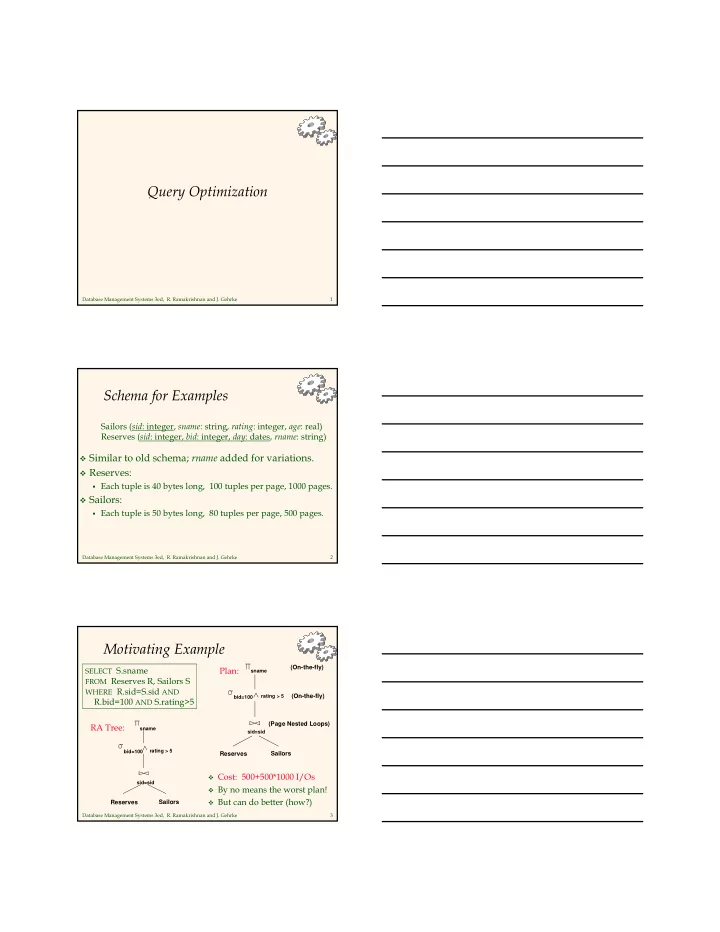
Main difference: push selects. With 5 buffers, cost of plan:
Scan Reserves (1000) + write temp T1 (10 pages, if we have 100 boats,
uniform distribution).
Scan Sailors (500) + write temp T2 (250 pages, if we have 10 ratings). Sort T1 (2*2*10), sort T2 (2*3*250), merge (10+250) Total: 3560 page I/Os.
If we used BNL join, join cost = 10+4*250, total cost = 2770. If we `push’ projections, T1 has only sid, T2 only sid and sname:
T1 fits in 3 pages, cost of BNL drops to under 250 pages, total < 2000.
Reserves Sailors
sid=sid bid=100 sname(On-the-fly) rating > 5
(Scan; write to temp T1) (Scan; write to temp T2) (Sort-Merge Join)
Database Management Systems 3ed, R. Ramakrishnan and J. Gehrke 5
Alternative Plans 2 With Indexes
With clustered index on bid of
Reserves, we get 100,000/100 = 1000 tuples on 1000/100 = 10 pages.
INL with pipelining (outer is not
materialized).
Decision not to push rating>5 before the join is based on
availability of sid index on Sailors.
Cost: Selection of Reserves tuples (10 I/Os); for each,
must get matching Sailors tuple (1000*1.2); total 1210 I/Os.
Join column sid is a key for Sailors.
–At most one matching tuple, unclustered index on sid OK. –Projecting out unnecessary fields from outer doesn’t help.
Reserves Sailors sid=sid bid=100 sname (On-the-fly) rating > 5 (Use hash index; do not write result to temp) (Index Nested Loops, with pipelining ) (On-the-fly)
Database Management Systems 3ed, R. Ramakrishnan and J. Gehrke 6
Overview of Query Optimization
Plan: Tree of R.A. ops, with choice of alg for each op.
Each operator typically implemented using a `pull’
interface: when an operator is `pulled’ for the next
- utput tuples, it `pulls’ on its inputs and computes them.
Two main issues:
For a given query, what plans are considered?
- Algorithm to search plan space for cheapest (estimated) plan.
How is the cost of a plan estimated?
Ideally: Want to find best plan. Practically: Avoid
worst plans!
We will study the System R approach.