
11/6/16 1
COMP 530: Operating Systems
Scheduling Processes
Don Porter Portions courtesy Emmett Witchel
1
COMP 530: Operating Systems
- Each process has state, that includes its text and data, procedure
call stack, etc. This state resides in memory.
- The OS also stores process metadata for each process. This
state is called the Process Control Block (PCB), and it includes the PC, SP, register states, execution state, etc.
- All of the processes that the OS is currently managing reside in
- ne and only one of these states.
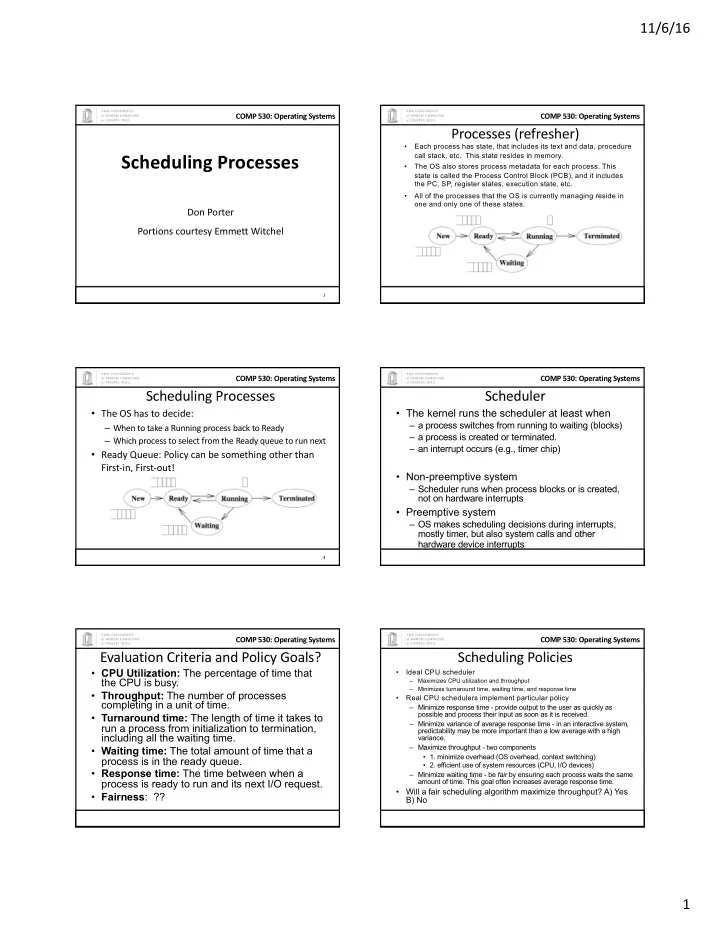
Processes (refresher)
COMP 530: Operating Systems
Scheduling Processes
- The OS has to decide:
– When to take a Running process back to Ready – Which process to select from the Ready queue to run next
- Ready Queue: Policy can be something other than
First-in, First-out!
3
COMP 530: Operating Systems
Scheduler
- The kernel runs the scheduler at least when
– a process switches from running to waiting (blocks) – a process is created or terminated. – an interrupt occurs (e.g., timer chip)
- Non-preemptive system
– Scheduler runs when process blocks or is created, not on hardware interrupts
- Preemptive system
– OS makes scheduling decisions during interrupts, mostly timer, but also system calls and other hardware device interrupts
COMP 530: Operating Systems
Evaluation Criteria and Policy Goals?
- CPU Utilization: The percentage of time that
the CPU is busy.
- Throughput: The number of processes
completing in a unit of time.
- Turnaround time: The length of time it takes to
run a process from initialization to termination, including all the waiting time.
- Waiting time: The total amount of time that a
process is in the ready queue.
- Response time: The time between when a
process is ready to run and its next I/O request.
- Fairness: ??
COMP 530: Operating Systems
Scheduling Policies
- Ideal CPU scheduler
– Maximizes CPU utilization and throughput – Minimizes turnaround time, waiting time, and response time
- Real CPU schedulers implement particular policy
– Minimize response time - provide output to the user as quickly as possible and process their input as soon as it is received. – Minimize variance of average response time - in an interactive system, predictability may be more important than a low average with a high variance. – Maximize throughput - two components
- 1. minimize overhead (OS overhead, context switching)
- 2. efficient use of system resources (CPU, I/O devices)
– Minimize waiting time - be fair by ensuring each process waits the same amount of time. This goal often increases average response time.
- Will a fair scheduling algorithm maximize throughput? A) Yes
B) No