
SLIDE 1
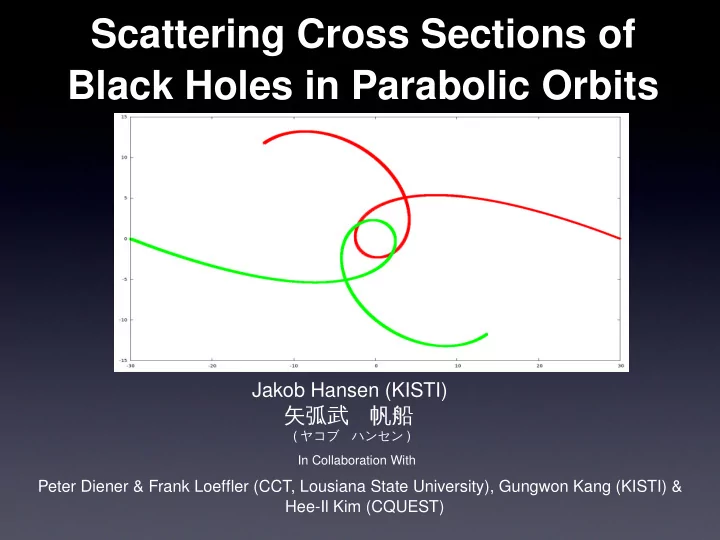
Scattering Cross Sections of Black Holes in Parabolic Orbits
Jakob Hansen (KISTI)
矢弧武 帆船
( ヤコブ ハンセン ) In Collaboration With
Peter Diener & Frank Loeffler (CCT, Lousiana State University), Gungwon Kang (KISTI) & Hee-Il Kim (CQUEST)
Scattering Cross Sections of Black Holes in Parabolic Orbits Jakob - - PowerPoint PPT Presentation
Scattering Cross Sections of Black Holes in Parabolic Orbits Jakob Hansen (KISTI) ) ( In Collaboration With Peter Diener & Frank Loeffler (CCT, Lousiana State University), Gungwon Kang (KISTI) &
( ヤコブ ハンセン ) In Collaboration With
Peter Diener & Frank Loeffler (CCT, Lousiana State University), Gungwon Kang (KISTI) & Hee-Il Kim (CQUEST)
The study of scattering processes of two black holes is of interest for various reasons. For instance, the estimation of the cross sections with varying impact parameters is very important for understanding the evolution of black holes in galactic centers, in particular, the formation of super-massive black holes.
A) To study black holes moving in parabolic / weakly hyperbolic orbits, calculating capturing cross sections for such encounters B) To use KISTI supercomputers to do binary black hole simulations C) To gain experience in doing binary black hole simulations
The radial equation of motion for a test particle can be written as :
For a given energy at infinity, E∞ we can find a critical angular momentum value L crit that satisfies :
Any black hole configuration with and will radiate more energy and will thus be captured.
The radial equation of motion for a test particle : At large distances, we find that : The (specific) angular momentum at infinity can be expressed as : Hence, we can write the impact parameter and cross section as :
We can then write the critical impact parameter as : And thus the energy dependent radiation capture cross section as :
Option 1 ) For a given E∞, we may do a series of simulation to find Lcrit(E∞), measure Erad for each simulation and compare with E∞ to find Lcrit(E∞). We do this for many E∞ until we have covered parameter space to our satisfaction.
Option 2 ) If v∞ << 1, a hyperbolic orbit near periastron is almost indistinguishable from a parabolic orbit. This means that amount of emitted gravitational radiation is almost same. Thus we may make the assumption that the radiation emitted in a parabolic orbit is practically the same amount of radiation emitted in in a weakly hyperbolic orbit. I.e. we assume that Erad (E∞ =1) ~ Erad (E∞ =1 + ε), ε<<1.
Try it, it’s free :
(from gr-qc://0707.4654)
Almost half of radiated energy is emitted in modes higher than l=2 mode!
l=2 l=4 l=6 l=32 l=3 l=5
To achieve maximum accuracy, we need high numerical resolution
Junk radiation will disturb our results and thus should be minimized. This can be achieved by having large initial separation.
Because of large separation between BH after meeting, we need to extract gravitational waves at high radii and/or extrapolate results.
We use spherical harmonics decomposition to extract gravitational waves. However, because of non-circular orbits of BH, we need to extract waves at very high modes and/or extrapolate results.