
SLIDE 1
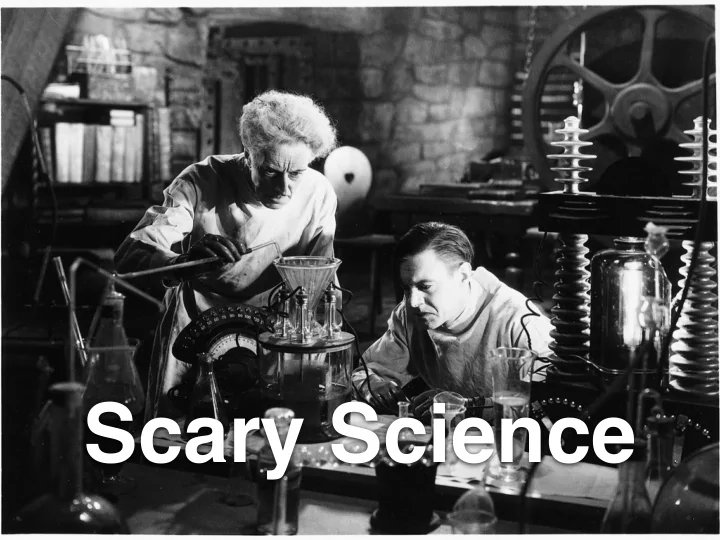
Scary Science Spinach is rich in iron, right? 19-26 DECEMBER 1981 - - PowerPoint PPT Presentation
Scary Science Spinach is rich in iron, right? 19-26 DECEMBER 1981 BRITISH MEDICAL JOURNAL VOLUME 283 1671 Fake! T J HAMBLIN Thou shalt not steal, an empty feat line the border of the heart. Other workers, however, in various The discovery that
Fake!
T J HAMBLIN
19-26 DECEMBER 1981Thou shalt not steal, an empty feat When it's so lucrative to cheat.-
ARTHUR HUGH CLOUGH, The Latest Decalogue In the year that Popeye became once again a major movie star it is salutary to recall that his claims for spinach are spurious.Popeye's superhuman strength for deeds of derring-do comes
from consuming a can of the stuff. The discovery that spinach was as valuable a source of iron as red meat was made in the
1890s, and it proved a useful propaganda weapon for the meatlessdays of the second world war. A statue of Popeye in Crystal
City, Texas, commemorates the fact that single-handedly he raised the consumption of spinach by 33 7,. America was "strong to finish 'cos they ate their spinach" and duly defeated the Hun. Unfortunately, thepropaganda was
fraudulent;German
chemists reinvestigating the iron content of spinach had shown in the 1930s that the original workers had put the decimal point in the wrong place and made a tenfold overestimate of its value.Spinach is no better for you than cabbage, Brussels sprouts, or
chewing the cans (fig 1). Frauds, hoaxes, fakes, and widely popularised mistakes run through the warp and woof of the history of science and medicine.
FIG 1-Popeye .. would have done better to eat the cans.National pride Sometimes they become a matter of national pride. In 1903 Rene Blondlot, a distinguished French physicist at the Univer-
sity of Nancy, discovered N-rays, a new type of radiation. The rays were originally detected in the emissions of an electrical discharge tube but later were found to issue from a type of home gas light known as a Welsbach mantle and also from heated pieces of silver or iron, from the Nernst glower, and, more surprisingly, from the human body. They could be bent by analuminium prism and were immediately put to use by Augustin
Charpentier, the professor of medical physics at Nancy, to out-
line the border of the heart. Other workers, however, in various laboratories around the world could not find N-rays. Blondlot hitpossessed only by the French. Anglo-Saxon powers of perception
were dulled by continued exposure to fog and Teutonic ones were blunted by constant ingestion of beer. Eventually the American physicist, R W Wood, set out to
discredit N-rays. On a visit to Blondlot's laboratory he sur- reptitiously removed the aluminium prism from the N-raycontinued to bend. Wood concluded that N-rays, like beauty, were in the eye of the beholder.
The inscrutable Chinese also have their mysterious methods. What are we to make of the report in the Shanghai newspaper Wen Hui Bao that patients who were shown to Western doctors
as undergoing major surgery under anaesthesia by acupuncturehad, in fact, secretly been given large doses of pain killing drugs ?
As the pace of research increases so does the frequency of fraud.
We have recently been shocked by stories of general practitioners
conducting drug trials on mythical
patients for money and astonished by the redoubtable Dr Alsabti. Elias A K Alsabti, a Jordanian in the United States for post-graduate training, has published over 60 papers. It now seems
likely that all were plagiarised. His technique was to raid thename, mainly in Japanese and European journals. One grant
application became the basis of three separate but identical re-view articles. Surprisingly, some of his papers were rejected.
Not surprisingly the original authors began to realise that their work had been hijacked, and Alsabti was exposed. His explana-
tions (a) that someone else had submitted the papers and forged his name and (b) that the original authors had, in fact, plagiarisedhim were mutually incompatible and implausible. Plagiarism plus dishonesty
A more worrying case of plagiarism has also recently been
by dishonesty, which caused heads to roll and a deep unease to
settle over scientific medicine.In 1978 Dr Helena Rodbard submitted a manuscript to the
New England Journal of Medicine which reported her studies on
insulin receptors in anorexia nervosa. After a long delay hermanuscript was rejected. Some months later she was shown a
similar paper sent to a colleague for his opinion by the AmericanJ7ournal of Medicine. Not only did this paper show similar results
to her own, but some of the wording was identical. It turned out that one of its authors, Dr Philip Felig of Yale, was the very referee who had recommended that her paper be rejected by theNew England Journal of Medicine.
After some argument and extensive investigation,
Felig's associate, Dr Vijay Soman, was found to be the culprit. He had seen a copy of Dr Rodbard's paper when it was sent to Felig forreview and had lifted some of the prose. The plagiarism was
trivial, amounting only to some 60 words. What was worse was that the data in the Soman-Felig paper were imaginary. Thispaper was later withdrawn together with ten others written by
Soman for which the raw results were either fudged, faked, or
innocent of everything except adding
his name to Soman'spapers and of failing to supervise his juniors. Nevertheless, he
was forced to relinquish his chair of medicine at Columbia, a
post he had occupied for just two months. Royal Victoria Hospital, Boscombe, BournemouthT J HAMBLIN, MB, MRCP, consultant haematologist 1671
The discovery that spinach was as valuable a source of iron as red meat was made in the 1890s Useful propaganda weapon for the meatless days of the second world war. Popeye was commemorated for single- handedly raising the consumption of spinach by 33% German chemists … had shown in the 1930s that the original [study] put the decimal point in the wrong place. For a source of iron Popeye would have been better off chewing the cans
1674
BRITISH MEDICAL JOURNAL
VOLUME 283
19-26 DECEMBER 1981
Most people forget about the
third worker on the
site,
mistakenly thinking him to have
left England permanently
before the excavations were complete or being unwilling to implicate such a famous man. In fact, Teilhard de Chardin returned to England in 1914 before the last fossils were found.
He was an anthropologist who had lectured on chemistry at
Cairo University. There are two further pieces of evidence that point in his direction. One is a Stegadon tooth "found" at Pilt-
down and now shown to be radioactive. Such teeth come only
from Ichkeul near Bizerta in Northern Tunisia. Teilhard
isknown to have camped near there while in North Africa. The
was born not a hundred miles away and was familiar with local
artefacts.
His motive ? To support his strange harmonisation of evolu-
tion and religion which he described in The Phenomenon of Man.
Malcolm Bowden in his book Apeman-Fact or Fallacy has
further implicated Teilhard in covering up evidence that would
have discredited Peking man and with planting further evidence
in Java. If Bowden is right then Teilhard certainly deserved the
title "Faker of the century."Underside of a stone
How secure is our body of scientific knowledge ? Is more of it
fraudulent than we suspect? In his book Advice to a Young
Scientist Sir Peter Medawar writes of a scientist who plagiarised a number of photographs and several paragraphs of text from a
fellow worker and included them in a prize essay. One of his judges was the man from whom the work had been stolen. In the furore that followed the culprit was quietly redeployed into another institution and has pursued a moderately successful
career of petty crime ever since. Medawar does not name the criminal, but if he is known about, how is he allowed to prosper?
Is it that he is showing the underside of a stone that none of us
would like to turn over in our own lives ? A questionnaire in New
Scientist in 1976 uncovered 189 instances of fraud known to its
readership.
Sometimes in the long nights this worries me. Christmas is a good time for confession. If you have a nagging secret in your curriculum vitae that worries you write and tell me about it.
If you prefer to do it anonymously I won't betray your con-
Having spent so much of my time talking about people whose work was unoriginal, I should mention that little of my article is based on
Among these I should particularly like to mention:
Arther Koestler: Case of the Midwife Toad. London, Hutchinson.
Malcolm Bowden: Ape Men-Fact or Fallacy. Bromley, Sovereign
Publications.
William J Broad: Science 208:1438-40,209:249,210:38-41, 171-3. Colin Tudge: World Medicine 1974 Jul 17:34.
Leon Kamin: New Society 1976 Dec 2:460-1.
Marjorie Sun: Science 1981 ;212:1366-7.
D D Dorfman: Science 1978;201:1177-88.
Ian St James Roberts: New Scientist 1976 Nov 25:466-7.
C Joyce: New Scientist 1981 Apr 9:68-9.
D Dickson: Nature 1981 ;289:227.
Nature 1980;286:433, 831-2. Lancet 1976;ii: 1066-7.
British Medical Journal 1980 ;281 :41-2. (Accepted 22 September 1981)
Good servants are scarce
R G GUEST-GORNALL
"The cook was a good cook as cook's go, and as cooks go
she went. -SAKI.
In the 1880s the newly established post of medical officer of
health was looked on with suspicion both by the general public
and by the profession, and it was still a time when people would
enter wholeheartedly into medical controversies in the "Wakley" tradition.
It made it so easy to put a foot wrong, as my grandfather found
when, recently appointed to such a post, he attended the Inter-
national Congress of Hygiene, where he drew attention to the
heavy pall of black smoke that hung perpetually over the borough he represented. On his return he found that his remarks had brought down on him the full wrath of the "city fathers"; for was not this heavily polluted atmosphere the finest sign of the town's prosperity.
It was not until 70 years later that he received some belated
recognition of his stand from Dr Edith Summerskill' in the debate on the Clean Air Bill when she quoted that "the scene
from the top of the parish church spire, far away below you, is
exactly like the three weird sisters in Macbeth. The adjacent
Warrington, Cheshire
R G GUEST-GORNALL, MD, MRCP, retired physician chimneys belch their blackness out into the poisoned air; a score
cloud; and over the remoter portions of the town it broods in
this frightful local scourge at a sanitary congress."
Compulsory vaccination
Having learnt his lesson on that, surely he could not be faulted
despite the absurd charges made by the anti-vaccination league
and even the opposition of some leaders of the profession. The
first Vaccination Act (1840) had not been very successful but it
did prohibit the more dangerous practice of variolation: small-
pox was still endemic with occasional fierce outbreaks, but com-
pulsory vaccination (1853) had come in while he was training,
and he had learnt the arm-to-arm technique from his uncle, to
whom he was apprenticed; dry points were often in short supply.
Before he had been in office many years as medical officer of
health and public vaccinator, the Government established an
animal vaccine depot and the arm-to-arm procedure was for- bidden (1881). The supply of lymph (some of it calf) now being
assured and, despite much evasion of the compulsory vaccina-
tion, he thought he was all set to make a good showing if an
epidemic hit the town. There was also a bonus for him in the help of his son, straight from the pioneer pathological labora-
Turns out, there’s a reason that there was no reference…
SPINACH, IRON and POPEYE:
Ironic lessons from biochemistry and history on the importance of healthy eating, healthy scepticism and adequate citation
By Dr Mike Sutton∗
∗ ∗ ∗♣Student: “Why does Popeye eat spinach?” Professor: “For iron.” Student: “Show me the evidence.” Abstract To inform knowledge in research methods and dissemination ethics for the natural and social sciences, this article reinforces the importance of citation to support all assertions of fact. New findings are presented for the history of biochemistry, nutrition, psychology, medicine, and the social sciences. Bio-chemistry papers and scientific news reports from the 1930’s seriously undermine a long standing truism that in the 1920s and 30s, bio-chemists, nutrition experts, public health policy makers, and E. Segar the creator of the newspaper comic strip Popeye were misled either by a decimal place error in 19th Century published research, or else by erroneous interpretation of 19th Century scientific findings, to exaggerate the iron content of spinach tenfold. Further, the failure to study original sources is evidenced in a multitude of completely erroneous publications claiming that these apocryphal errors caused Segar to choose spinach for Popeye’s super human strength. In fact, Segar chose and promoted spinach for its vitamin A content alone.
the “Spinach Popeye Iron Decimal Error Story” in the search for the origin of the decimal error.
for the source…
but that he was sure he had not made it up…
British Medical Journal, the comedy issue…
Consumption of spinach in the USA increased long before Popeye had begun to eat it in 1932. Spinach actually contains about 50 per cent more iron than meat (and 10 times that in dried form). But, only about half of this iron is easily enters the human body Popeye eats some spinach because 'Spinach is full of vitamin A an' tha's what makes hoomans strong an' helty’.
Academic myths have a tendency to propagate especially if people don’t cite original sources. Perhaps we are biased towards a good story… See Academic urban legends by Ole Bjørn Rekdal for details on how to avoid the citation errors that propagate myths.
Since early 2000s there’s been a push to open access publishing. This is a good thing, but… There’s a dark side to open access - because payments are made by author, it creates an incentive to accept all papers.
Who's Afraid of Peer Review?
http://www.krepublishers.com
Algorithm for questionable success in academia
locate research institute that pays per published paper for duration_of_your_career: if (found_out): break #move countries else: generate random_paper submit and pay for publication if fee < publication_reward profit = profit + publication_reward - fee
Academic urban legends - Ole Bjørn Rekdal Fake! - T J Hamblin Spinach, Iron and Popeye - Dr Mike Sutton Who's Afraid of Peer Review? - John Bohannon