Scanning and Parsing Announcements Pick a partner by Monday - - PDF document

scanning and parsing
SMART_READER_LITE
LIVE PREVIEW

Scanning and Parsing Announcements Pick a partner by Monday - - PDF document

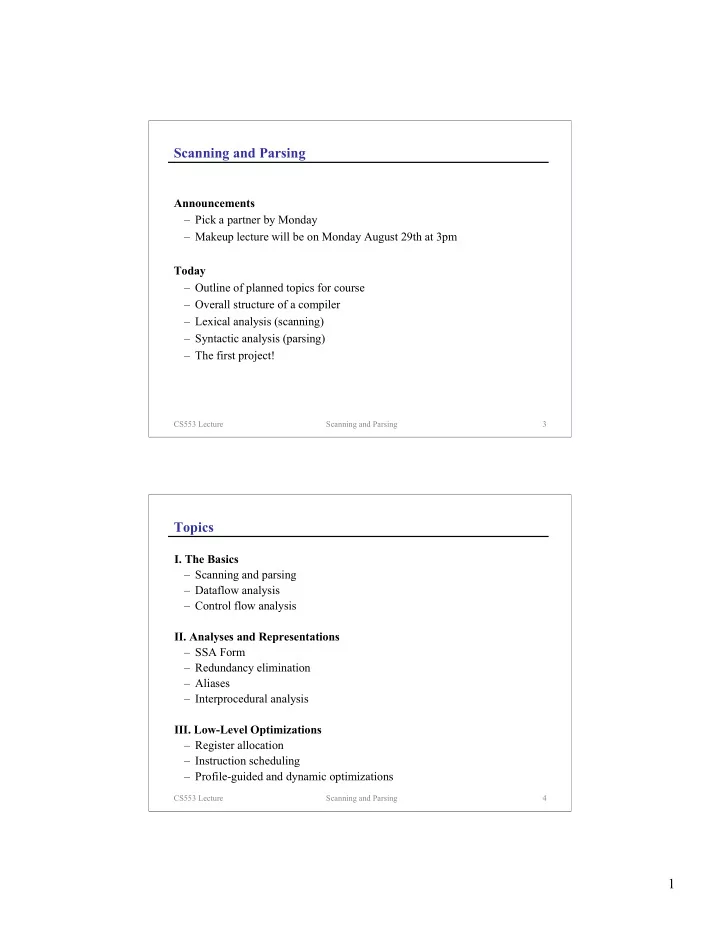
Scanning and Parsing Announcements Pick a partner by Monday Makeup lecture will be on Monday August 29th at 3pm Today Outline of planned topics for course Overall structure of a compiler Lexical analysis (scanning)


slide-1
SLIDE 1

1

CS553 Lecture Scanning and Parsing 3

Scanning and Parsing

Announcements – Pick a partner by Monday – Makeup lecture will be on Monday August 29th at 3pm Today – Outline of planned topics for course – Overall structure of a compiler – Lexical analysis (scanning) – Syntactic analysis (parsing) – The first project!

CS553 Lecture Scanning and Parsing 4

Topics

  • I. The Basics

– Scanning and parsing – Dataflow analysis – Control flow analysis

  • II. Analyses and Representations

– SSA Form – Redundancy elimination – Aliases – Interprocedural analysis

  • III. Low-Level Optimizations

– Register allocation – Instruction scheduling – Profile-guided and dynamic optimizations

slide-2
SLIDE 2

2

CS553 Lecture Scanning and Parsing 5

Topics (cont)

  • IV. High-Level Optimizations

– Dependence analysis – Loop transformations – Tiling – Object-oriented optimizations

  • V. Emerging Topics

– Run-time reordering transformations – Security and program checking – Domain-specific program analysis and transformation

CS553 Lecture Scanning and Parsing 6

Structure of a Typical Interpreter

“sentences” Synthesis

  • ptimization

code generation target language IR IR code generation IR Analysis character stream lexical analysis “words” tokens semantic analysis syntactic analysis AST annotated AST interpreter

Compiler

slide-3
SLIDE 3

3

CS553 Lecture Scanning and Parsing 7

Lexical Analysis (Scanning)

Break character stream into tokens (“words”)

– Tokens, lexemes, and patterns – Lexical analyzers are usually automatically generated from patterns (regular expressions) (e.g., lex)

Examples

“.*” “hi”, “mom” string [0-9]+ | [0-9]*.[0-9]+ 3.14159,570 number [a-zA-Z_]+[a-zA-Z0-9_]* foo,index identifier < | <= | = | != | ... <,<=,=,!=,... relation if if if const const const pattern lexeme(s) token const pi := 3.14159 ⇒ const, identifier(pi), assign,number(3.14159)

CS553 Lecture Scanning and Parsing 8

Interaction Between Scanning and Parsing

Lexical analyzer Parser character stream yylex() token IR

slide-4
SLIDE 4

4

CS553 Lecture Scanning and Parsing 9

Specifying Tokens with Flex

Theory meets practice:

– Regular expressions, formal languages, grammars, parsing…

Flex example input file: %{ #include <stdlib.h> #include "top-token.h"

%}

DIGIT [0-9] ID [a-zA-Z][a-zA-Z0-9]* %% [=\{\}] { return yytext[0]; } if { return T_IF; } => { return T_MAPSTO; }

"\/\/"[^\n]*"\n" // eat up one-line comments

[ \t\n]+ // eat up whitespace {ID} { char *retstr; retstr = malloc(strlen(yytext)+1); strcpy(retstr,yytext); yylval.sval = retstr; return T_ID; } %%

CS553 Lecture Scanning and Parsing 10

Recognizing Tokens with DFAs

[a-zA-Z][a-zA-Z0-9]* <= [=\{\}]

  • ther

letter or digit letter 1 2 3

  • ther

= < 1 4 6 5 T_LTE T_ID

slide-5
SLIDE 5

5

CS553 Lecture Scanning and Parsing 11

Impose structure on token stream

– Limited to syntactic structure (⇒ high-level) – Structure usually represented with an abstract syntax tree (AST) – Parsers are usually automatically generated from grammars (e.g., yacc, bison, cup, javacc)

Example for i = 1 to 10 do a[i] = x * 5; for id(i) equal number(1) to number(10) do id(a) lbracket id(i) rbracket equal id(x) times number(5) semi

Syntactic Analysis (Parsing)

for i 1 10 asg a i tms x 5 arr

CS553 Lecture Scanning and Parsing 12

Interaction Between Scanning and Parsing

Lexical analyzer Parser character stream yylex() token IR

slide-6
SLIDE 6

6

CS553 Lecture Scanning and Parsing 13

Using bison or yacc with flex or lex

bison assumes that yylex() function has been defined. bison example input file:

%union { char* sval; int ival; Expr* exprptr; std::list<Stmt*> stmtlistptr; }; %token <sval> T_STR_LITERAL %token <ival> T_INT_LITERAL %token T_IF T_THEN T_ELSE %type <exprptr> Expr %type <stmtlistptr> StmtList Proc: StmtList ; StmtList: StmtList Stmt | /*empty*/ ; Stmt: T_IF Expr T_THEN StmtList T_ELSE StmtList | /*other stmts*/ ;

CS553 Lecture Scanning and Parsing 14

Shift-Reduce Parsing

slide-7
SLIDE 7

7

CS553 Lecture Scanning and Parsing 15

Parsing Terms

CFG (Context-free Grammer) BNF (Backus-Naur Form) and EBNF (Extended BNF): equivalent to CFG

CS553 Lecture Scanning and Parsing 16

Parsing Terms cont …

Top-down parsing

– LL(1): left-to-right reading of tokens, leftmost derivation, 1 symbol lookahead – Predictive parser: an efficient non-backtracking top-down parser that can handle LL(1) – More generally recursive descent parsing may involve backtracking

Bottom-up Parsing

– LR(1): left-to-right reading of tokens, rightmost derivation in reverse, 1 symbol lookahead – Shift-reduce parsers: for example, bison and yacc generated parsers – Methods for producing an LR parsing table – SLR, simple LR – Canonical LR, most powerful – LALR(1)

slide-8
SLIDE 8

8

CS553 Lecture Scanning and Parsing 17

Project 1: Scanners and Parsers for OpenAnalysis Test Input

// int main() { PROCEDURE = { < ProcHandle("main"), SymHandle("main") > } // int x; LOCATION = { < SymHandle("x"), local > } // int *p; LOCATION = { < SymHandle("p"), local > } // all other symbols visible to this procedure LOCATION = { < SymHandle("g"), not local > } // x = g; MEMREFEXPRS = { StmtHandle("x = g;") => [ MemRefHandle("x_1") => < SymHandle("x"), DEF > MemRefHandle("g_1") => < SymHandle("g"), USE > ] }

CS553 Lecture Scanning and Parsing 18

OpenAnalysis

Problem: Insufficient analysis support in existing compiler

infrastructures due to non-transferability of analysis implementations

Decouples analysis algorithms from intermediate representations

(IRs) by developing analysis-specific interfaces

Analysis reuse across compiler infrastructures

– Enable researchers to leverage prior work – Enable direct comparisons amongst analyses – Increase the impact of compiler analysis research

slide-9
SLIDE 9

9

CS553 Lecture Scanning and Parsing 19

Software Architecture for OpenAnalysis Clients Toolkit Intermediate Representation

CS553 Lecture Scanning and Parsing 20

Project 1: Basic Outline

1) Download and build OpenAnalysis 2) Copy Project1.tar to your CS directory and build 3) Implement 3 parsers that build up certain parts of a subsidiary IR using the examples in testSubIR.cpp and Input/testSubIR.oa 4) Next week start testing FIAlias implementation in OpenAnalysis

slide-10
SLIDE 10

10

CS553 Lecture Scanning and Parsing 21

Concepts

Compilation stages in a compiler

– Scanning, parsing, semantic analysis, intermediate code generation,

  • ptimization, code generation

Lexical analysis or scanning

– Tools: lex, flex, etc.

Syntactic analysis or parsing

– Tools: yacc, bison, etc.

CS553 Lecture Scanning and Parsing 22

Next Time

Lecture – Undergrad compilers in a day!