Scaling up phylogene/c networks to genome-size data - - PowerPoint PPT Presentation

scaling up phylogene c networks to genome size data
SMART_READER_LITE
LIVE PREVIEW

Scaling up phylogene/c networks to genome-size data - - PowerPoint PPT Presentation

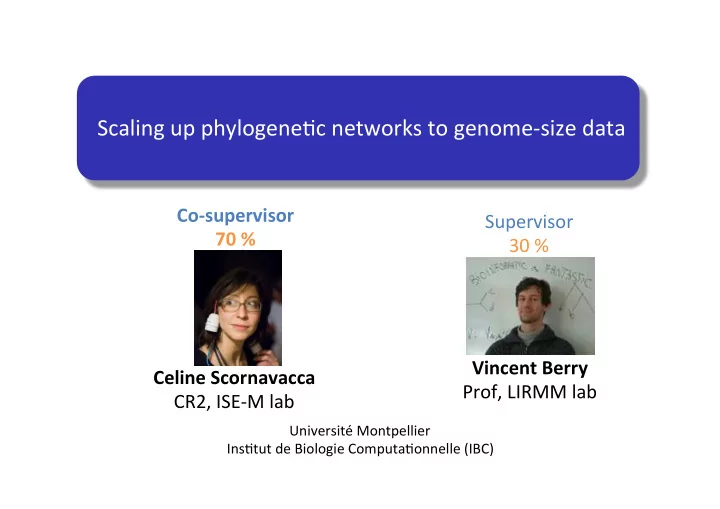
Scaling up phylogene/c networks to genome-size data Co-supervisor Supervisor 70 % 30 % Vincent Berry Celine Scornavacca Prof, LIRMM lab CR2,


slide-1
SLIDE 1

Scaling ¡up ¡phylogene/c ¡networks ¡to ¡genome-­‑size ¡data ¡

Université ¡Montpellier ¡ Ins/tut ¡de ¡Biologie ¡Computa/onnelle ¡(IBC) ¡ ¡

Vincent ¡Berry ¡ Prof, ¡LIRMM ¡lab ¡ Supervisor ¡ 30 ¡% ¡ Celine ¡Scornavacca ¡ CR2, ¡ISE-­‑M ¡lab ¡

¡

Co-­‑supervisor ¡ 70 ¡% ¡

slide-2
SLIDE 2

Rooted ¡phylogene/c ¡trees ¡are ¡used ¡to ¡depict ¡the ¡evolu/onary ¡history ¡of ¡a ¡ set ¡of ¡taxa, ¡whose ¡internal ¡nodes ¡represent ¡specia/on ¡events. ¡

¡ ¡ ¡ ¡ ¡ ¡ ¡ ¡ ¡ ¡ ¡ ¡ ¡ ¡ ¡ ¡ ¡

  • ut-­‑branching ¡trees ¡with ¡no ¡indegree-­‑1 ¡outdegreee-­‑1 ¡nodes ¡and ¡whose ¡leaves ¡are ¡each ¡

associated ¡to ¡a ¡species ¡or ¡gene ¡(taxa) ¡ ¡

Phylogene/c ¡trees ¡

slide-3
SLIDE 3

Rooted ¡phylogene/c ¡trees ¡are ¡used ¡to ¡depict ¡the ¡evolu/onary ¡history ¡of ¡a ¡ set ¡of ¡taxa, ¡whose ¡internal ¡nodes ¡represent ¡specia/on ¡events. ¡ ¡ But ¡… ¡Darwin ¡described ¡evolu/on ¡as ¡‘descent ¡with ¡modifica/on’ ¡ ¡ (does ¡not ¡necessarily ¡imply ¡a ¡tree ¡representa;on…) ¡

Phylogene/c ¡trees ¡

The ¡Origin ¡of ¡ Species ¡(1859) ¡

The ¡implicit ¡assump/on ¡of ¡using ¡trees ¡is ¡that, ¡at ¡a ¡macroevolu/onary ¡scale, ¡ each ¡(current ¡or ¡ex/nct) ¡species ¡or ¡gene ¡only ¡descends ¡from ¡one ¡ancestor ¡ ¡

slide-4
SLIDE 4

Re/culate ¡evolu/on ¡

1) Hybrid ¡specia;on ¡ 2) Lateral ¡gene ¡transfer ¡ 3) Recombina/on ¡ However, ¡at ¡a ¡larger ¡scale, ¡genomes ¡some/mes ¡inherit ¡from ¡mul/ple ¡ ancestors, ¡because ¡of ¡re/culate ¡events, ¡e.g: ¡ ¡ ¡ ¡

slide-5
SLIDE 5

Re/culate ¡evolu/on ¡

1) Hybrid ¡specia;on ¡ 2) Lateral ¡gene ¡transfer ¡ 3) Recombina/on ¡ However, ¡at ¡a ¡larger ¡scale, ¡genomes ¡some/mes ¡inherit ¡from ¡mul/ple ¡ ancestors, ¡because ¡of ¡re/culate ¡events, ¡e.g: ¡ ¡ ¡ ¡

slide-6
SLIDE 6

Re/culate ¡evolu/on ¡

1) Hybrid ¡specia/on ¡ 2) Lateral ¡gene ¡transfer ¡ 3) Recombina/on ¡ However, ¡at ¡a ¡larger ¡scale, ¡genomes ¡some/mes ¡inherit ¡from ¡ mul/ple ¡ancestors, ¡because ¡of ¡re/culate ¡events, ¡e.g: ¡ ¡ ¡ ¡

slide-7
SLIDE 7

Re/culate ¡evolu/on ¡

1) Hybrid ¡specia/on ¡ 2) Lateral ¡gene ¡transfer ¡ 3) Recombina;on ¡

Puta/ve ¡phylogeny ¡of ¡HIV/SIV ¡ infec/ng ¡primates ¡ ¡ (Bailes ¡et ¡al. ¡Science ¡2003) ¡

However, ¡at ¡a ¡larger ¡scale, ¡genomes ¡some/mes ¡inherit ¡from ¡mul/ple ¡ ancestors, ¡because ¡of ¡re/culate ¡events, ¡e.g: ¡ ¡ ¡ ¡

slide-8
SLIDE 8

In ¡the ¡presence ¡of ¡re/culate ¡events, ¡ phylogenies ¡are ¡networks ¡(DAGs), ¡not ¡ trees ¡

Phylogene/c ¡networks ¡

The ¡study ¡of ¡phylogene/c ¡networks ¡is ¡ a ¡recent ¡interdisciplinary ¡field: ¡maths, ¡ CS, ¡biology… ¡

Dooli`le ¡ Science ¡ ¡ 1999 ¡

2011 ¡ 2010 ¡ 2013 ¡ 2008 ¡

slide-9
SLIDE 9

Phylogene/c ¡network ¡inference ¡

a b c d e f

N

? ¡

The ¡phylogene/c ¡network ¡ community ¡considers ¡that ¡the ¡ ra/o ¡data/re/cula/on ¡events ¡is ¡ ‘large ¡enough’ ¡to ¡allow ¡the ¡ inference ¡of ¡the ¡network ¡itself. ¡

slide-10
SLIDE 10

Phylogene/c ¡network ¡inference ¡

a b c d e f

N

? ¡

The ¡phylogene/c ¡network ¡ community ¡considers ¡that ¡the ¡ ra/o ¡data/re/cula/on ¡events ¡is ¡ ‘large ¡enough’ ¡to ¡allow ¡the ¡ inference ¡of ¡the ¡network ¡itself. ¡

¡However, ¡most ¡biological ¡literature ¡s/ll ¡uses ¡trees ¡even ¡when ¡a ¡network ¡ would ¡be ¡more ¡suitable ¡because ¡network ¡methods ¡developed ¡so ¡far ¡ ¡

  • do ¡not ¡yet ¡take ¡the ¡full ¡biological ¡complexity ¡into ¡account, ¡and ¡ ¡
  • do ¡not ¡scale ¡up ¡to ¡genomic ¡data ¡(based ¡on ¡op/miza/on ¡problems ¡that ¡

are ¡computa/onally ¡hard, ¡oben ¡even ¡to ¡approximate). ¡

slide-11
SLIDE 11

Training ¡period ¡at ¡ISEM/LIRMM ¡

  • Phylogene/c ¡networks ¡have ¡been ¡intensively ¡studied ¡from ¡a ¡mathema/cal ¡and ¡

computa/onal ¡perspec/ve ¡in ¡the ¡last ¡years; ¡the ¡bibliographic ¡part ¡of ¡the ¡stage ¡will ¡ thus ¡focus ¡on ¡the ¡literature ¡on ¡phylogene/c ¡networks ¡published ¡since ¡the ¡ appearance ¡of ¡[1], ¡and ¡will ¡lead ¡to ¡the ¡produc/on ¡of ¡a ¡report ¡upda/ng ¡the ¡survey ¡ provided ¡in ¡[Scornavacca ¡et ¡al ¡2012] ¡

  • ¡A ¡possible ¡approach ¡is ¡to ¡iden/fy ¡subsets ¡of ¡varie/es ¡that ¡encompass ¡maximum ¡

diversity ¡and ¡for ¡which ¡largest ¡regions ¡of ¡consecu/ve ¡loci ¡in ¡the ¡genome ¡have ¡a ¡ tree-­‑like ¡evolu/onary ¡history. ¡These ¡ground ¡trees ¡will ¡then ¡serve ¡to ¡compute ¡a ¡ phylogene/c ¡network ¡[1] ¡represen/ng ¡hybridiza/on ¡events ¡through ¡which ¡these ¡ trees ¡were ¡obtained ¡from ¡the ¡ini/al ¡founders. ¡ ¡

slide-12
SLIDE 12

1. Speed ¡up ¡the ¡phylogene;c ¡networks ¡reconstruc;on: ¡

  • Design ¡models ¡taking ¡more ¡into ¡account ¡the ¡biological ¡complexity ¡: ¡

duplica/on, ¡loss, ¡transfers ¡in ¡gene ¡family ¡evolu/on ¡; ¡syntenies ¡in ¡ genome ¡architecture ¡; ¡regulatory ¡networks ¡; ¡… ¡

  • More ¡factors ¡-­‑> ¡reduced ¡combinatorics ¡
  • Leverage ¡these ¡new ¡features ¡to ¡design ¡algorithms ¡with ¡reasonable ¡

running ¡/mes. ¡ 2. Obtain ¡a ¡realis;c ¡picture ¡of ¡ancestral ¡genomes' ¡composi/on ¡(which ¡genes, ¡

  • n ¡which ¡chromosomes,...) ¡ ¡for ¡ancestral ¡species ¡involved ¡in ¡re;culate ¡

evolu;on: ¡

  • Extend ¡available ¡methods ¡designed ¡for ¡trees ¡to ¡networks, ¡while ¡

limi/ng ¡the ¡combinatorial ¡explosion ¡ ¡ 3. Apply ¡methods ¡on ¡plant ¡real ¡data ¡(Oryza, ¡Banana, ¡…) ¡to ¡explain ¡the ¡ composi/on ¡of ¡current ¡genomes ¡through ¡large-­‑scale ¡evolu/onary ¡events ¡ (duplica/ons ¡or ¡losses ¡of ¡chromosome ¡fragments). ¡

PhD ¡Thesis ¡plan ¡

slide-13
SLIDE 13
  • ¡PhD ¡thesis ¡on ¡combinatorial ¡algorithms ¡(combinatorial ¡modeliza/on, ¡

graphs, ¡parameterized ¡complexity, ¡approxima/on ¡algorithms), ¡with ¡an ¡ applica;ve ¡side ¡(programming, ¡real ¡data ¡analysis) ¡

  • Hosted ¡inside ¡the ¡ANCESTROME ¡(ANR) ¡& ¡GenomeHarvest ¡(Agropolis ¡

fonda/on) ¡projects ¡

In ¡prac/ce ¡ Scaling ¡up ¡phylogene/c ¡networks ¡to ¡genome-­‑size ¡data ¡

Vincent ¡Berry ¡

  • Prof. ¡LIRMM ¡

Supervisor ¡ 30 ¡% ¡ Celine ¡Scornavacca ¡ CR2 ¡ISE-­‑M ¡

¡

Co-­‑supervisor ¡ 70 ¡% ¡

slide-14
SLIDE 14

Recent ¡publica/ons ¡

  • 2015 ¡Inferring ¡gene ¡duplica/ons, ¡transfers ¡and ¡losses ¡can ¡be ¡done ¡in ¡a ¡discrete ¡framework ¡
  • V. ¡Ranwez, ¡S. ¡Scornavacca, ¡J.-­‑P. ¡Doyon, ¡V. ¡Berry, ¡Journal ¡of ¡Mathema/cal ¡Biology ¡
  • 2015 ¡Thu-­‑Hien ¡To, ¡Edwin ¡Jacox, ¡Vincent ¡Ranwez, ¡Celine ¡Scornavacca. ¡A ¡Fast ¡Method ¡for ¡Calcula/ng ¡Reliable ¡Event ¡Supports ¡in ¡

Tree ¡Reconcilia/ons ¡via ¡Pareto ¡op/mality. ¡BMC ¡Bioinforma;cs ¡ ¡

  • 2015 ¡Mareike ¡Fischer, ¡Leo ¡van ¡Iersel, ¡Steven ¡Kelk, ¡and ¡Celine ¡Scornavacca. ¡ ¡On ¡Compu/ng ¡the ¡Maximum ¡Parsimony ¡Score ¡of ¡a ¡

Phylogene/c ¡Network. ¡SIAM ¡Journal ¡on ¡Discrete ¡Mathema;cs ¡29, ¡no. ¡1, ¡pp. ¡559-­‑585. ¡

  • 2015 ¡Fabio ¡Pardi, ¡Celine ¡Scornavacca. ¡Reconstruc/ble ¡phylogene/c ¡networks: ¡do ¡not ¡dis/nguish ¡the ¡indis/nguishable. ¡PLOS ¡

Computa;onal ¡Biology. ¡ ¡(11), ¡no ¡4:e1004135. ¡doi:10.1371/journal.pcbi.1004135. ¡

  • 2015 ¡Thu-­‑Hien ¡To ¡and ¡Celine ¡Scornavacca. ¡ ¡Efficient ¡algorithms ¡for ¡reconciling ¡gene ¡trees ¡and ¡species ¡networks ¡via ¡duplica/on ¡

and ¡loss ¡events. ¡BMC ¡genomics ¡2015(16) ¡no. ¡10, ¡S6 ¡

  • 2015 ¡Katharina ¡Huber, ¡Leo ¡van ¡Iersel, ¡Vincent ¡Moulton, ¡Celine ¡Scornavacca, ¡Taoyang ¡Wu. ¡Reconstruc/ng ¡phylogene/c ¡level-­‑1 ¡

networks ¡from ¡nondense ¡binet ¡and ¡trinet ¡sets. ¡Algorithmica ¡ ¡

  • 2015 ¡Ancestral ¡gene ¡synteny ¡reconstruc/on ¡improves ¡extant ¡species ¡scaffolding ¡
  • Y. ¡Anselmet, ¡V. ¡Berry, ¡C. ¡Chauve, ¡A. ¡Chateau, ¡E. ¡Tannier ¡and ¡S. ¡Berard ¡BMC ¡Genomics, ¡16 ¡Suppl ¡10:S11, ¡
  • 2015 ¡François ¡Chevenet, ¡Jean-­‑Philippe ¡Doyon, ¡Celine ¡Scornavacca, ¡Emmanuelle ¡Jousselin, ¡ ¡Vincent ¡Berry. ¡SylvX: ¡a ¡viewer ¡for ¡

phylogene/c ¡tree ¡reconcilia/ons. ¡Bioinforma;cs ¡ ¡

  • 2014 ¡Yao-­‑ban ¡Chan, ¡Vincent ¡Ranwez, ¡Celine ¡Scornavacca. ¡Exploring ¡the ¡space ¡of ¡gene/species ¡reconcilia/ons ¡with ¡
  • transfers. ¡Journal ¡of ¡Mathema;cal ¡Biology ¡
  • 2014 ¡Celine ¡Scornavacca, ¡Edwin ¡Jacox ¡and ¡Gergely ¡Szöllősi. ¡Joint ¡amalgama@on ¡of ¡most ¡parsimonious ¡reconciled ¡gene ¡
  • trees. ¡Bioinforma;cs ¡
  • 2013 ¡Support ¡Measures ¡to ¡Es/mate ¡the ¡Reliability ¡of ¡Evolu/onary ¡Events ¡Predicted ¡by ¡Reconcilia/on ¡Methods, ¡

Nguyen ¡T-­‑H, ¡Ranwez ¡V, ¡Berry ¡V, ¡Scornavacca ¡C, ¡PLoS ¡ONE ¡8(10) ¡

  • 2013 ¡Reconcilia/on ¡and ¡local ¡gene ¡tree ¡rearrangement ¡can ¡be ¡of ¡mutual ¡profit. ¡

T.H. ¡Nguyen, ¡J.-­‑P. ¡Doyon, ¡S. ¡Pointet, ¡A.-­‑M. ¡Arigon ¡Chifolleau, ¡V. ¡Ranwez, ¡V. ¡Berry, ¡Algorithms ¡for ¡Molecular ¡Biology, ¡8:12. ¡

  • 2013 ¡Represen/ng ¡a ¡set ¡of ¡reconcilia/ons ¡in ¡a ¡compact ¡way ¡
  • C. ¡Scornavacca, ¡V. ¡Berry, ¡V. ¡Ranwez, ¡Journal ¡of ¡Bioinforma@cs ¡and ¡Computa@onal ¡Biology ¡Vol. ¡11, ¡No. ¡2 ¡