SBIRT IN VARIOUS SETTINGS: DIFFERENCES & COMMON THREADS Tracy - - PDF document

sbirt in various settings
SMART_READER_LITE
LIVE PREVIEW

SBIRT IN VARIOUS SETTINGS: DIFFERENCES & COMMON THREADS Tracy - - PDF document

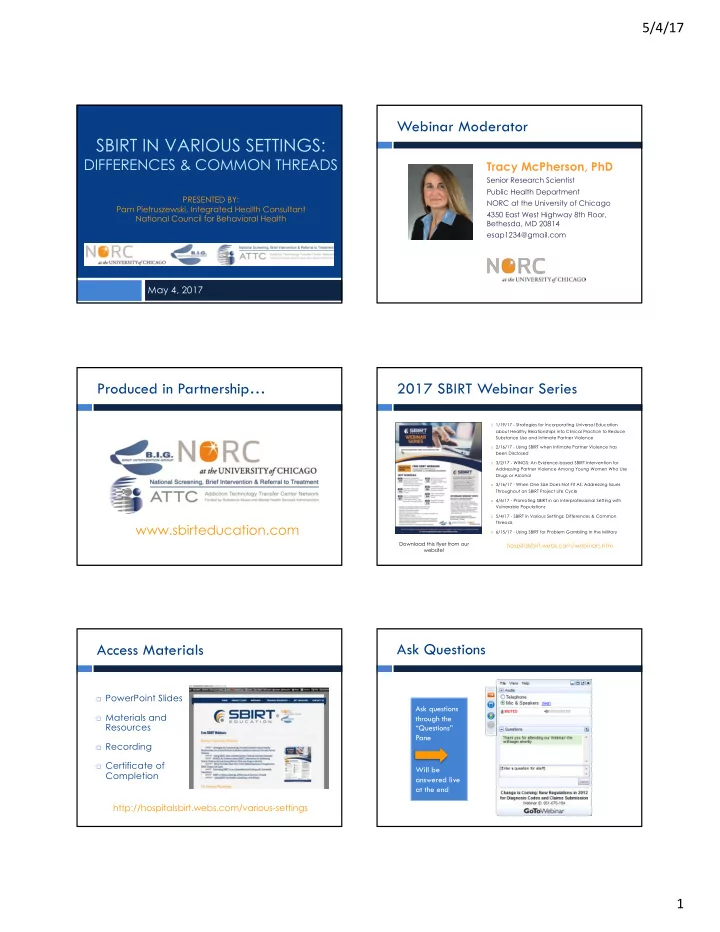
5/4/17 Webinar Moderator SBIRT IN VARIOUS SETTINGS: DIFFERENCES & COMMON THREADS Tracy McPherson, PhD Senior Research Scientist Public Health Department PRESENTED BY: NORC at the University of Chicago Pam Pietruszewski, Integrated


slide-1
SLIDE 1

5/4/17 1

SBIRT IN VARIOUS SETTINGS:

DIFFERENCES & COMMON THREADS

PRESENTED BY: Pam Pietruszewski, Integrated Health Consultant National Council for Behavioral Health

May 4, 2017

Webinar Moderator

Tracy McPherson, PhD

Senior Research Scientist Public Health Department NORC at the University of Chicago 4350 East West Highway 8th Floor, Bethesda, MD 20814 esap1234@gmail.com

Produced in Partnership…

www.sbirteducation.com

2017 SBIRT Webinar Series

¨ 1/19/17 - Strategies for Incorporating Universal Education

about Healthy Relationships into Clinical Practice to Reduce Substance Use and Intimate Partner Violence

¨ 2/16/17 - Using SBIRT when Intimate Partner Violence has

been Disclosed

¨ 3/2/17 - WINGS: An Evidence-based SBIRT Intervention for

Addressing Partner Violence Among Young Women Who Use Drugs or Alcohol

¨ 3/16/17 - When One Size Does Not Fit All: Addressing Issues

Throughout an SBIRT Project Life Cycle

¨ 4/6/17 - Promoting SBIRT in an Interprofessional Setting with

Vulnerable Populations

¨ 5/4/17 - SBIRT in Various Settings: Differences & Common

Threads

¨ 6/15/17 - Using SBIRT for Problem Gambling in the Military

hospitalsbirt.webs.com/webinars.htm

Download this flyer from our website!

Access Materials

http://hospitalsbirt.webs.com/various-settings

¨ PowerPoint Slides ¨ Materials and

Resources

¨ Recording ¨ Certificate of

Completion

Ask Questions

Ask questions through the “Questions” Pane Will be answered live at the end

slide-2
SLIDE 2

5/4/17 2

Technical Facilitator

Misti Storie, MS, NCC

Technical Consultant misti.storie@gmail.com www.mististorie.com

Webinar Presenter

Pam Pietruszewski, MA

Integrated Health Consultant National Council for Behavioral Health pamp@thenationalcouncil.org

The National Council for Behavioral Health is the unifying voice of America’s mental health and addictions treatment organizations. Together with 2,900 member

  • rganizations, serving 10 million adults, children and

families living with mental illnesses and addictions, the National Council is committed to all Americans having access to comprehensive, high-quality care that affords every opportunity for recovery. www.TheNationalCouncil.org

“Eighty percent of life is showing up.”

Woody Allen

Join us at National Council Hill Day October 2 & 3, 2017

Register here.

Differences & Common Threads

SBIRT in Various Settings Today’s webinar

¨ Explore SBIRT components in the context of differing

geographies and how community partnerships can share resources and solutions.

¨ Identify strengths and opportunities among your

workforce to optimize conversations about motivation and behavior change.

¨ Determine workflow efficiencies that leverage

  • pportunities to connect physical health, mental health

and substance use.

slide-3
SLIDE 3

5/4/17 3

“How are we impacted by substance use?” #2 Local data #3 Shared problem, shared solutions

§ Primary care § Behavioral health § Hospitals § Public health

  • Schools
  • Law enforcement
  • Social services
  • Media
  • Chamber of commerce

SBIRT in Medical Settings

¨ Culture: Fast paced, appts every 15 min, “patient” ¨ Champions: PCP

, Clinic Manager

¨ SU connection: Medical condition(s), treatment effectiveness ¨ Meaningful data: Improvement in related medical

conditions, ED use, accident/injury reduction

Partners in Integrated Care Dissemination & Implementation Project, funded by AHRQ: http://www.prhi.org/initiatives/pic Facilitating Change for Excellence in SBIRT, funded by the Conrad N. Hilton foundation: https://www.thenationalcouncil.org/press-releases/conrad-n-hilton-foundation-awards-national-council- 2m-screening-brief-intervention-referral-treatment-sbirt-learning-initiative/ Achieving SBIRT Practice Transformation, SAMHSA contract #HHSP233201600258A

Consider this….

Flu shot Blood pressure Early stage cancer

Highest Ranked Preventive Services

Based on Clinically Preventable Burden + Cost Effectiveness

Maciosek et al, Annals of Family Medicine 2017

Childhood immunization series Tobacco use brief prevention counseling - youth Tobacco use screening & brief counseling - adults #1 Alcohol SBI – adults Aspirin prevention for adults at higher risk for CVD Cervical cancer screening Colorectal cancer screening #2 Chlamydia & gonorrhea screening Cholesterol screening Hypertension (BP) screening #3

PC Workforce & Workflow

Brief screening on paper or tablet given at front desk check in Rooming nurse reviews results and administers full screen if score warrants PCP education & collaborative conversation with patient Warm handoff to BHC/care manager/health educator if score warrants Considerations

  • “Everyone working at

the top of their license”

  • Messaging for front

desk

  • Treatment referral with

coordination and follow up

SBIRT in the Courts

¨ Culture: Judicial process can be lengthy, mandated,

“offender”

¨ Champions: DOT, judge, sheriff, public health ¨ SU connection: Arrests, incarceration, fees, penalties ¨ Meaningful data: Recidivism

Moving away from One-Size-Fits-All Handling of DWI offenders. Judge Shaun R. Floerke, Foundation for Advancing Alcohol Responsibility https://responsibility.org

slide-4
SLIDE 4

5/4/17 4

Judicial Workforce & Workflow

Court date

Report to probation for SBIRT Report to courtroom for arraignment Judge reinforces SBIRT program Probation follow up phone call at 3 months

Court date

Report to courtroom for arraignment Interventionist conducts SBIRT Judge introduces SBIRT program Interventionist follow up phone call at 3 months

Considerations

  • Public health, SUD

treatment

  • Teachable moment
  • Paperwork,

streamlining, timing and process flow

SBIRT in Mental Health Settings

¨ Culture: Assumption that MH/SU expertise is the same,

brief is hard, “client” or “consumer”

¨ Champions: Executive director, program & clinical

directors

¨ SU connection: Co-occurring capabilities, referral

relationship

¨ Meaningful data: Improvement in related mental health

conditions, employment, stable housing, social/relationships

Reducing Adolescent Substance Abuse Initiative, funded by the Conrad N. Hilton foundation: https://www.hiltonfoundation.org/learning/substance-use- prevention-initiative-2016-evaluation-report

  • People with mental health issues

are disproportionately affected by substance use issues.

  • Benefits to individual health
  • Reduction in health-related and

societal costs

  • Mental health practitioners are

well-placed for screening and counseling

Why Screen in Mental Health Settings?

MH Workforce & Workflow

New Intake: Primary clinician screens during the first 30 day assessment period Rescreen: Primary clinician adds 90 day reminder in their email calendar for a week prior to the 90 days Screening and other paperwork is emailed prior to first visit Counselor reviews with client at first visit BI done by therapist Screening administered by intake coordinator Rescreen done by intake coordinator if no longer receiving therapy services If RT, counselor monitors progress with SUD program and checks in regularly as part of therapy

MH Considerations

¨ Often already

long intake process

¨ How to integrate

BI with therapy

¨ “Harm

reduction” resonates We saw a cognitive shift in staff thinking about and buying into consistently conducting screening and brief interventions for substance misuse. Their initial doubts about their capability and competence in addressing substance use has significantly improved.

Adolescents

¨ Confidentiality ¨ Rapport & Engagement

School based services:

¨ More opportunity for follow up ¨ School-based clinic vs school system ¨ Recent legislation in MA, NJ in process https://malegislature.gov/Laws/SessionLaws/Acts/2016/Chapter52 http://www.masbirt.org/schools http://www.njleg.state.nj.us/2016/Bills/S3000/2967_I1.PDF

slide-5
SLIDE 5

5/4/17 5

¨ Build into existing services rather than bringing it in as

something new

¨ Traditional model - kids only identified if they get into trouble ¨ SBIRT model - systematic screening, more potential to detect

unmet needs

SBIRT

Schools are major source of behavioral health care for many students – 21x more likely to visit a school-based health center for behavioral health than a community-based health center

NIDA 2016, Weinstein 2006

In Schools

Resources for Other Settings

HIV/AIDS Treatment Centers AIDS Education & Training Center Program https://aidsetc.org/resource/short-and-simple-substance-use- screening-and-brief-intervention-hiv-care-settings Emergency Departments Institute for Research, Education and Training in Addictions (IRETA) http://www.integration.samhsa.gov/clinical-practice/sbirt Trauma Centers CDC & National Center for Injury Prevention and Control http://www.integration.samhsa.gov/clinical-practice/CDC- Screening_and_Brief_Interventions.pdf

Common Thread: Champions & Supervisors

Connecting data to actions

Data to Inform

Awesome, we increased

  • ur SBIRT enrollment!

What organizational factors contributed? Which staff were part of this increase? What is working? Great! No one received only an RT! Who were the clients that didn’t receive a BI or RT when it was indicated? What were the circumstances? Hey we’ve had 7 clients with documented improvement! What can we learn from the staff who worked with them? Where can we promote these results to demonstrate

  • ur value?
slide-6
SLIDE 6

5/4/17 6 Baseline and Benchmarking

To evaluate or check something based on a standard

In 2015: Our health center screened 20% of

  • ur clients for

substance use GoaI in 2017: Our health center will screen 80%

  • f our clients for

substance use

Policies & Procedures

¨ Roles & Responsibilities of SBIRT Staff ¨ Ongoing Training & Supervision ¨ Workflow ¨ Using SBIRT Tools ¨ Referral & Follow Up ¨ Documentation ¨ Quality Improvement to Measure Efficiency &

Effectiveness

Sustainability Factors

Champions

  • Facilitate relationships, presentations, workshops
  • Help secure funds
  • Dedicated time, continuity beyond start-up phase

Program Staffing

  • In-house specialist staff with dedicated time
  • Coordination/integration with other screens & services

System changes and adaptability

  • 67% adapted SBIRT b/c of changing partner relationships,

administrative staff turnover, re-allocation of funding & resources

Singh et al. Addictions 2017

Why SBIRT Sticks

¨ Improves clinical care ¨ Transforms culture ¨ Prepares your organization for health care changes ¨ Prepares your workforce for health care changes ¨ Expands reach to new audiences ¨ Replaces less effective screening methods ¨ Substance Use as a Bio-Behavioral Disorder and a Chronic

Health Condition

Common Thread

“SBIRT encouraged programmatic changes center-wide. We reviewed all current practices for screening and as a result, now ensure proper screening occurs in several areas for both adult and adolescent populations.”

1.

What challenges does SBIRT have the potential to solve for us?

2.

Where can we capitalize on existing opportunities?

3.

Who are the champions, my friends?

4.

How do we build a “continuum of use” culture?

5.

Where does SBIRT fit in?

6.

How do we pay for it?

7.

How will we know SBIRT is working?

8.

How will we know if we need to change course?

9.

What are our strengths that can drive sustainability?

No Matter Where You Are…

slide-7
SLIDE 7

5/4/17 7

SWOT

Strengths Weaknesses Opportunities Threats

Based on national lessons, what similar strengths exist in our state/clinic/organization? What

  • ther strengths exist here that are

lacking in national lessons? Based on national lessons, what similar weaknesses exist in our state/clinic/organization? What

  • ther weaknesses exist here that

are not lacking in national lessons? What opportunities does SBIRT

  • pen up for us?

What threats could hinder SBIRT adoption, implementation and sustainability?

Facilitating Change for Excellence in SBIRT (FaCES) Learning Collaborative

RFA due May 9, 2017. Questions: ShardayL@thenationalcouncil.org

  • Adolescent SBIRT Change Package developed for FQHC’s

ü Comprehensive set of tools and guidance on implementing adolescent SBIRT in FQHCs ü Developed over the past year by experts in the field

  • Tangible, replicable guidance specifically for FQHCs and

FQHC lookalikes

  • Partnership with internal or external behavioral health

providers is required

Opportunity!

Thank You!

Pam Pietruszewski, MA

Integrated Health Consultant National Council for Behavioral Health pamp@thenationalcouncil.org

Ask Questions

Ask questions through the “Questions” Pane Will be answered live at the end

In Our Last Few Moments…

¨ PowerPoint Slides ¨ Certificate of

Completion

¨ On Demand

Recording

¨ Evaluation Survey ¨ Follow-up Email

http://hospitalsbirt.webs.com/various-settings

SBIRT Technical Assistance

Do you have questions about SBIRT implementation, evaluation, or training? Schedule a free telephonic Technical Assistance session with Tracy McPherson, co- lead of The BIG SBIRT Initiative.

Email Dr. McPherson at esap1234@gmail.com

slide-8
SLIDE 8

5/4/17 8

Thank You for Attending!

www.sbirteducation.com