
SLIDE 1
Professor Jonathan Grant The Policy Institute, King’s College London jonathan.grant@kcl.ac.uk @jonathancgrant
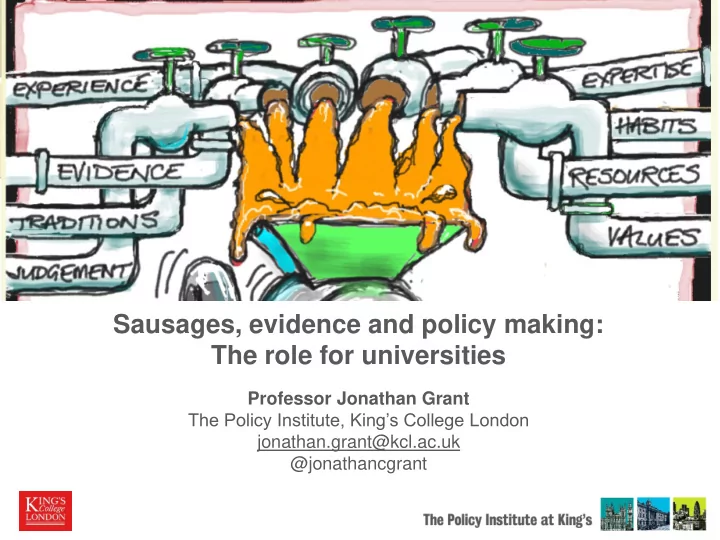
Sausages, evidence and policy making: The role for universities
Sausages, evidence and policy making: The role for universities - - PowerPoint PPT Presentation
Sausages, evidence and policy making: The role for universities Professor Jonathan Grant The Policy Institute, Kings College London jonathan.grant@kcl.ac.uk @jonathancgrant Key arguments Examine the role of universities in supporting
Professor Jonathan Grant The Policy Institute, King’s College London jonathan.grant@kcl.ac.uk @jonathancgrant
Sausages, evidence and policy making: The role for universities
Key arguments
Examine the role of universities in supporting better policy making Through the lens of ‘post-truth politics’ Make case that the role of the university in society is under serious threat
Analysis of REF impact case studies
REF is the Research Excellence Framework, the successor to the Research Assessment Exercise (RAE), which has assessed the quality of research in UK universities every five years since 1986 For the first time, REF assessed the impact of research Impact is defined as: “any effect on, change or benefit to the economy, society, culture, public policy or services, health, the environment or quality of life, beyond academia”
Better image
‘Informing government policy’
(develop polici nation plan govern inform work strategi assess)
(n=1233) ‘Parliamentary scrutiny’
(polit elect parti democraci elector vote candid poll pd )
(n= 983)
Overlap between these two topics was 192 case studies (small in number, but this is largest overlap overall)
The most frequent impacts were on informing public policy and parliamentary scrutiny
Take-home messages
Universities make a significant contribution to informing public policy and parliamentary scrutiny That contribution arises from the majority of disciplines (Suspect argument applicable to other impacts)
Political commitment to ‘evidence’ for nearly a generation
“New Labour is a party of ideas and ideals but not of
– New Labour election manifesto, 1997 “We'll stop the health department endlessly measuring processes, and concentrate on outcomes – the 'what' not the 'how‘ … that means that health policy can become evidence-based rather than target-driven – delivering not only equity, but excellence and value for money too.” – David Cameron, 2003 “We will put evidence at the heart of what we do. We will improve our data, analysis and research capability, so that we can give officials and frontline staff access to evidence about what works, helping to deliver the best
– UK Ministry of Justice Departmental Plan, 2016
Policy makers use multiple inputs …
… and have different notions of evidence
reasonable
(context-free)
qualifications
Source: Lomas, 2005
… which is used in different ways ...
knowledge that impels action
‘customer’ who requests solutions from research
researcher and policy maker; exposed to each other’s worlds
ideas
in an adversarial system
action by policy maker
Source: Hanney et al 2002
… with different consequences
Source: Oliver (2014)
Translation Trust Timing
“Translation is always a shift, not between two languages but between two cultures –
take into account rules that are not strictly linguistic but, broadly speaking, cultural.”
Knowledge needs to be ‘localised’ into the language and context of the policy maker
… with different consequences
Source: Oliver (2014)
Translation Trust Timing
Mission: Improving evidence- informed policy & practice by facilitating engagement between academic, business and policy communities around current and future policy needs in the UK and globally
achieved by Delivering policy analysis Building partnerships Mobilising policy impact
The Policy Institute at King’s
Take-home messages
Universities make a significant contribution to informing public policy and parliamentary scrutiny That contribution arises from the majority of disciplines The translation of research to policy is messy and complicated, requiring skills that are not valued or abundant in universities
The existential threat to universities
‘Nothing works’ fatalism Political opportunism of anti-intellectualism, ie Brexit and Trump ... In the context of ‘instrumental’ view of a universitiy
Observed in the US through ‘Trumpism’ “I think a lot of us are simply dumfounded that we’ve seen the support that’s been evidenced for Mr Trump ... On the core issue of the role of ideas, of facts, and whether they matter in contemporary political discourse, we are observing something that is deeply unsettling.”
– Robert Daniels, President of Johns Hopkins University Source: THES (2016)
Donald Trump, US Presidential Candidate, 2016
Observed in the US through ‘Trumpism’ “Have universities in the United States and indeed internationally been successful in mustering up analysis [and] policy recommendations that are able to infiltrate the political process and bring our practical ideas to bear? … Have we been effective as institutions … in [producing a] comprehensive package that could respond to these issues?”
Donald Trump, US Presidential Candidate, 2016
– Robert Daniels, President of Johns Hopkins University Source: THES (2016)
And in the UK through Brexit “People in this country have had enough of experts”.
Michael Gove, former UK Secretary of State for Education, 2010-2014, Secretary of State for Justice, 2015-2016. Key campaigner to leave EU
And in the UK through Brexit “People in this country have had enough of experts”. “We will put evidence at the heart of what we do. We will improve our data, analysis and research capability, so that we can give officials and frontline staff access to evidence about what works, helping to deliver the best
– UK Ministry of Justice Departmental Plan, 2016
Michael Gove, former UK Secretary of State for Education, 2010-2014, Secretary of State for Justice, 2015-2016. Key campaigner to leave EU
Playing the blame game
But citizens want experts involved in decision-making
Source: Institute for Government (2016)
“Thinking about how politicians make [difficult decisions about new infrastructure projects], to what extent do you agree or disagree with the following statements?” It is important to me that when making difficult decisions politicians consult a wide range of professionals and experts It is important to me that when making difficult decisions politicians demonstrate that the decision is based on objective evidence Agree 2014 Agree 2016
And expertise is equally important to Remainers and Leavers
Source: Institute for Government (2016)
“Thinking about how politicians make [difficult decisions about new infrastructure projects], to what extent do you agree or disagree with the following statements?” It is important to me that when making difficult decisions politicians consult a wide range of professionals and experts It is important to me that when making difficult decisions politicians demonstrate that the decision is based on objective evidence Agree – leave Agree – remain
Take-home messages
Universities make a significant contribution to informing public policy and parliamentary scrutiny That contribution arises from the majority of disciplines The translation of research to policy is messy and complicated, requiring skills that are not valued or abundant in universities People have not had enough of experts
But ‘post-truth politics’ is a challenge to universities
Growth of social media as the main source of ‘evidence’
Source: Reuters Institute for the Study of Journalism (2016)
Analysis by BuzzFeed illustrates the level of false information
Source: Silverman et al. (2016)
With risk of misinformation amplified through ‘echo chambers’
Scientific information 35 public Facebook pages about science news Conspiracy theories 32 public Facebook pages about conspiracy theories
(2010-14)
homogeneous and polarised communities (ie echo chambers) but have similar information consumption patterns
Source: Del Vicario et al. (2014)
Which suggests a more nuanced understanding of ‘experts’ is needed
Merit-based expert
Unmeritocratic elite
Civically disengaged Citizen expert Expertise Elite
Which suggests a more nuanced understanding of ‘experts’ is needed
Merit-based expert
Unmeritocratic elite
Civically disengaged Citizen expert Expertise Elite
Attack lies, and advocate truth
Which suggests a more nuanced understanding of ‘experts’ is needed
Attack lies, and advocate truth Increased porosity, social mobility and openness
Merit-based expert
Unmeritocratic elite
Civically disengaged Citizen expert Expertise Elite
Which suggests a more nuanced understanding of ‘experts’ is needed
Merit-based expert
Unmeritocratic elite
Civically disengaged Citizen expert Expertise Elite
Work with and respect multiple truths through co-creation and co-production of policy Attack lies, and advocate truth Increased porosity, social mobility and openness
Which suggests a more nuanced understanding of ‘experts’ is needed
Merit-based expert
Unmeritocratic elite
Citizen expert Expertise Elite
Work with and respect multiple truths through co-creation and co-production of policy Attack lies, and advocate truth Increased porosity, social mobility and openness
Mediated through a ‘multi truth’ democracy – the case of antiretroviral treatment (ART) to prevent HIV/AIDS
Source: Morgan Jones et al. (2013)
Take home messages
Universities make a significant contribution to informing public policy and parliamentary scrutiny That contribution arises from the majority of disciplines The translation of research to policy is messy and complicated, requiring skills that are not valued or abundant in universities People have not had enough of experts Universities have a lot to offer in this ‘multiple-truth’ world, but need to adapt in vision, structure, process and incentives to a new, challenging reality, otherwise risk becoming irrelevant
What does this mean for universities
do and how we do it
perspectives to a ‘problem’. It is about working together
References
King’s College London and Digital Science (2015). The nature, scale and beneficiaries of research impact: An initial analysis of Research Excellence Framework (REF ) 2014 impact case studies. Bristol, United Kingdom:
Lomas J (2005). Using Research to Inform Healthcare Managers’ and Policy Makers’ Questions: From Summative to Interpretive Synthesis. Healthcare Policy, 1(1):55–71. https://www.ncbi.nlm.nih.gov/pmc/articles/PMC2585236/ Hanney S et al (2003). The utilization of health research in policy-making: concepts, examples and methods of
Oliver et al. (2016). A systematic review of barriers to and facilitators of the use of evidence by policymakers. BMC Health Services Research, 14:2. THES (2016). Johns Hopkins University chief ‘dumbfounded’ by support for Trump. October 14, 2016. https://www.timeshighereducation.com/news/johns-hopkins-university-chief-dumbfounded-support-trump Ministry of Justice (2016). Single departmental plan: 2015 to 2020. https://www.gov.uk/government/publications/moj- single-departmental-plan-2015-to-2020/single-departmental-plan-2015-to-2020 Institute for Government (2016). Trust in government is growing but it needs to deliver. http://www.instituteforgovernment.org.uk/sites/default/files/publications/IfG_polling_note_WEB3.pdf Reuters Institute for the Study of Journalism (2016). Digital news report. http://reutersinstitute.politics.ox.ac.uk/sites/default/files/Digital-News-Report-2016.pdf Silverman et al. (2016) Hyperpartisan Facebook Pages Are Publishing False And Misleading Information At An Alarming Rate. BuzzFeed News, 20.10.16. https://www.buzzfeed.com/craigsilverman/partisan-fb-pages-analysis Del Vicario et al. (2016). The spreading of misinformation online. Proceeding of the National Academies of Science, January http://www.pnas.org/content/113/3/554.abstract Morgan Jones et al. (2013). Mapping Pathways: Developing evidence-based, people- centred strategies for the use