Evidence-Based Decision Making in Health Bethany Park Policy - - PowerPoint PPT Presentation

evidence based decision making in health
SMART_READER_LITE
LIVE PREVIEW

Evidence-Based Decision Making in Health Bethany Park Policy - - PowerPoint PPT Presentation

Evidence-Based Decision Making in Health Bethany Park Policy Manager 20 March, 2018 In Brief IPA : high-quality evidence better programs and policies Co-creation of evidence After the research : What now? Strengths : Engaged


slide-1
SLIDE 1

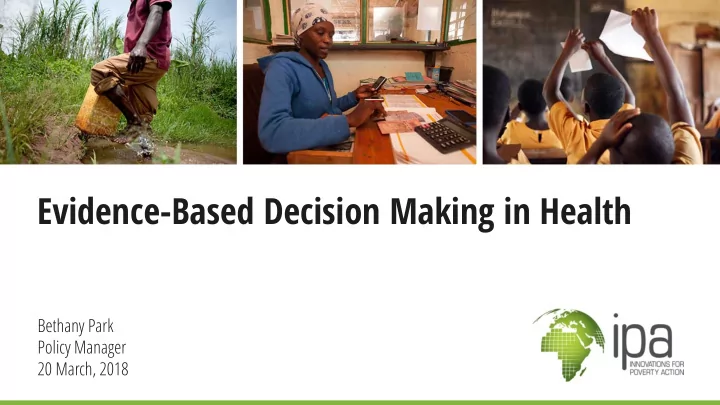
Evidence-Based Decision Making in Health

Bethany Park Policy Manager 20 March, 2018
slide-2
SLIDE 2
  • IPA: high-quality evidence à

better programs and policies

  • Co-creation of evidence
  • After the research: What

now?

  • Strengths: Engaged policy

sector, quality research

  • Gaps: Delivery,

Communication, Partnership

In Brief

slide-3
SLIDE 3

OUR MISSION

To disco cover and promote effe ffect ctive so soluti tions to s to g global p poverty ty pr proble blems.

slide-4
SLIDE 4

1 2

We help turn that evidence into better programs and policies for the poor. We create high-quality evidence.

slide-5
SLIDE 5

Academics

e.g. MIT, Harvard, Yale, University of Ghana

Service Providers

e.g. CARE, Oxfam, local nonprofits & businesses

Government Agencies

e.g. Ministry of Education, Ghana & Ministry of Health, Zambia

Funders

e.g. Gates, USAID, Hewlett, Family Foundations, Individuals

Extensive Collaboration

slide-6
SLIDE 6

Innovations for Poverty Action

​More evidence, less poverty

studies

650+

studies

33

slide-7
SLIDE 7
  • 33 studies across all sectors (18 complete, 15 in progress)
  • 14 health studies (9 complete, 5 in progress)
  • More in development

IPA Zambia

slide-8
SLIDE 8

Evidence-Based Decision-Making in Health

IPA’s approach

slide-9
SLIDE 9
  • Research questions that

address decision-makers’ felt needs

  • Maintaining stakeholder

engagement throughout the duration of a project

  • Preparing partners for “bad”

(and good) news

Co-Creation of Evidence

slide-10
SLIDE 10
  • Dissemination… and beyond
  • Pressure testing
  • Field replications
  • Technical assistance
  • Scale up
  • Process monitoring of the

scale up

  • Capacity building

After the Research: What Now?

​The spectrum from results à scale up

slide-11
SLIDE 11

​Community Health Assistants: Which recruitment strategy attracts more qualified, higher- performing workers? ​Recruitment posters emphasizing career incentives

  • vs. community incentives

​CHAs who responded to career incentives worked harder and got better results

Examples

​Co-Creation of Evidence: Community Health Assistants

slide-12
SLIDE 12

Examples

​Impact: CHAI and MoH have used these posters to recruit 1,400 CHAs ​Challenges beyond dissemination:

  • Will the CHA program continue/grow?
  • Who can pay for these posters?
  • Who can ensure they are displayed?
  • Can we deliver on the career promises?

​After the Research: Community Health Assistants

slide-13
SLIDE 13

Examples

​Easy-to-use growth charts installed in homes ​Small, geographically targeted sample ​In-home growth charts reduced stunting among previously malnourished children by 22 percentage points.

​Co-Creation of Evidence: Growth Charts

slide-14
SLIDE 14

Examples

​Impact: Evidence Action, IPA, and others working to (1) pressure test this tool in Zambia; and (2) evaluate it at a larger scale in Zambia and elsewhere ​Challenges beyond dissemination:

  • Will this work at scale, in other locales?
  • How do growth charts work—what do

they do to food distribution in the family?

  • How can this be distributed at scale?

​After the Research: Growth Charts

2 year 6 months __________ 2 years 3 months _________ 2 years _________ 1 year 9 months _________ 1 year 6 months _________ 1 year 3 months _________ 1 year _________ 9 months _________

Ngati mwana wanu ali mugawo lofiira, chonde pitani naye ku chipatala chili pafupi ndi inu kapena munga tume lamya ku IPA Zambia pa nambala iyi 0976703901.

65 60 55 155 150 90 85 80 75 70 120 115 110 105 100 95 145 140 135 130 125

Satilani kakulidwe ka mwana kuti afike pa muyeso wake

Kumbukani:
  • Nthawi zonse muyenera kusewenzesa ufa wa mgaiwa
kudyesa mwana wanu
  • Mwana wa thanzi ayenera kudya kanai kufikira kasanu (4-5)
pa tsiku
  • Ana a thanzi ndi mphavu ayenera zolimbitsa thupi, zomwe
apezamo muzakudya monga nsomba, nyama,mazira kapena soya beans Sebenzesani zakudya zosiyana-siyana zomwe zipezeka kuno kwanu monga ndiwo za masamba, kapenta, kayela, shawa, kachamba, chinangwa, mapila, mpunga, mkaka wa fresh kapena mawisi, zipaso ndi mafuta ophikila.
slide-15
SLIDE 15

Evidence in Health in Zambia: Strengths

  • High quality research
  • Researchers who care about policymaking

and high-quality healthcare

  • An engaged policymaking sector
  • Excellent partners in NGO, government,

and funding space

​An engaged ecosystem of partners and researchers

slide-16
SLIDE 16

Research Gap: Health Delivery ​Better data + better leveraging of existing data for better decision-making ​Improved capacity for understanding data & evidence ​1. Funding for research ​2. Funding for research- backed innovations ​3. Funding for the in- between: advocacy, technical support, capacity-building, etc. ​Beyond dissemination, more conversation and convening: researchers, implementers, funders. ​More consensus on what works & priorities Health Management Information Systems Funding for Moving Evidence to Policy Even Deeper Partnerships ​Additional research on how to deliver high- quality health service, at scale, especially in rural areas

Gaps: What Will It Take?

slide-17
SLIDE 17

Thank you

poverty-action.org

System icon created by Deepz from Noun Project. Graph icon created by Zoie Kim from Noun Project. Medicine icon created by Viktor Fedyuk (Tim P) from Noun Project. Funding icon created by Gregor Cresnar from Noun Project. Consensus icon created by AlfredoCreates from Noun Project.