
SLIDE 1
CS500
Satisfiability
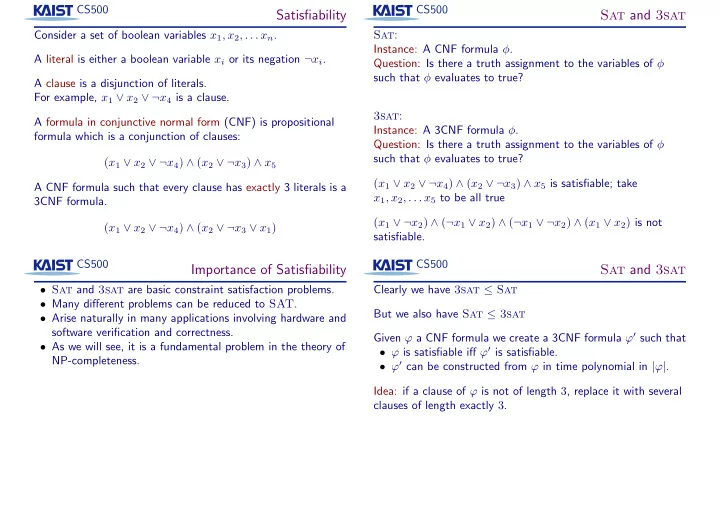
Consider a set of boolean variables x1, x2, . . . xn. A literal is either a boolean variable xi or its negation ¬xi. A clause is a disjunction of literals. For example, x1 ∨ x2 ∨ ¬x4 is a clause. A formula in conjunctive normal form (CNF) is propositional formula which is a conjunction of clauses: (x1 ∨ x2 ∨ ¬x4) ∧ (x2 ∨ ¬x3) ∧ x5 A CNF formula such that every clause has exactly 3 literals is a 3CNF formula. (x1 ∨ x2 ∨ ¬x4) ∧ (x2 ∨ ¬x3 ∨ x1) CS500
Sat and 3sat
Sat: Instance: A CNF formula φ. Question: Is there a truth assignment to the variables of φ such that φ evaluates to true? 3sat: Instance: A 3CNF formula φ. Question: Is there a truth assignment to the variables of φ such that φ evaluates to true? (x1 ∨ x2 ∨ ¬x4) ∧ (x2 ∨ ¬x3) ∧ x5 is satisfiable; take x1, x2, . . . x5 to be all true (x1 ∨ ¬x2) ∧ (¬x1 ∨ x2) ∧ (¬x1 ∨ ¬x2) ∧ (x1 ∨ x2) is not satisfiable. CS500
Importance of Satisfiability
- Sat and 3sat are basic constraint satisfaction problems.
- Many different problems can be reduced to SAT.
- Arise naturally in many applications involving hardware and
software verification and correctness.
- As we will see, it is a fundamental problem in the theory of
NP-completeness. CS500
Sat and 3sat
Clearly we have 3sat ≤ Sat But we also have Sat ≤ 3sat Given ϕ a CNF formula we create a 3CNF formula ϕ′ such that
- ϕ is satisfiable iff ϕ′ is satisfiable.
- ϕ′ can be constructed from ϕ in time polynomial in |ϕ|.