
SLIDE 1
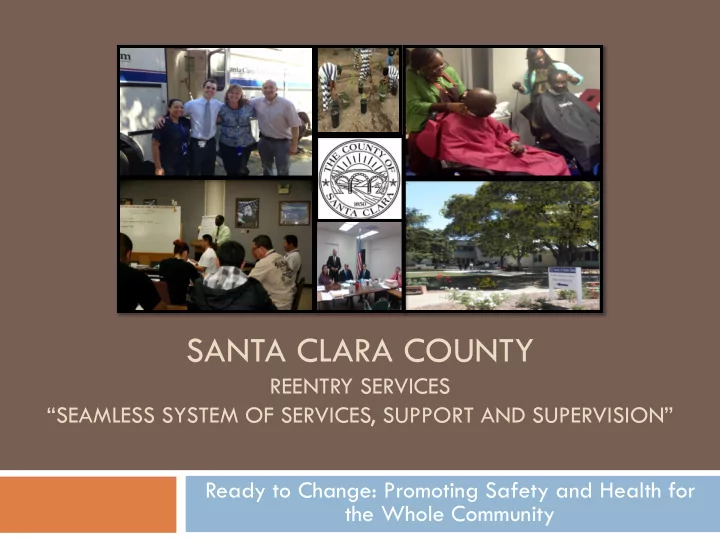
SANTA CLARA COUNTY REENTRY SERVICES SEAMLESS SYSTEM OF SERVICES, - - PowerPoint PPT Presentation
SANTA CLARA COUNTY REENTRY SERVICES SEAMLESS SYSTEM OF SERVICES, SUPPORT AND SUPERVISION Ready to Change: Promoting Safety and Health for the Whole Community Why are we here? 2 Celebrate our achievements Share our challenges and
Celebrate our achievements Share our challenges and
Listen to client testimonials
Understand case planning
Engage in frank
2
Welcome & Purpose Client’s Testimonials Reentry Efforts in Santa
Frontline Perspective on
Applying Case Planning
Discuss Next Steps &
3
4
Reentry and reintegration begin while the individual is
incarcerated.
Evidence-based practices are utilized when developing programs
and policies.
Collaboration, coordination, information, and communication are
critical to the success and sustainability of the Reentry Network.
Formerly incarcerated individuals with a risk level of high to
moderate are targeted through the use of validated assessment tools.
Assessment and case management tools are utilized to provide
continuous reentry planning, and are incorporated at the point of entry into the criminal justice systems and continue to be used throughout pre- and post-release.
The strategic plan is designed to be gender-responsive, trauma-
informed, and culturally competent.
5
Successfully executed the Adult Reentry
Services RFP & Service Agreements
Established the Office of Reentry Services Developed the Reentry Systems Mapping
Process
Enhanced communication between cross-
functional teams
Promoted evidence-based approaches as a
guiding force towards developing Reentry Programs
Board approved FY 2014 Budget that
included $4 million for housing programs
6
Identify system needs and structural
changes in order to improve service delivery
Measure the nature and impact of peer
support and faith community engagement as essential components to an effective system of care.
Rebrand MAP and create a new
welcome center
Complete the outcome measurement
analysis of AB 109 individuals
Establish a quarterly reentry data
dashboard
Develop ongoing Professional
Development Training with Partner Agencies
Cultivate the continued growth of a
Reentry Team Concept
7
Recidivism has been established
and now requires consensus on reporting.
The individual client services and
this time.
How to address the most critical
clients with highest needs?
How to collaborate with the
Cities’ AB 109 Task Force and sharing of information?
How to maintain current level of
service and fund critical residential treatment with potential lower revenue projections?
8
9
What are the effects of realignment on crime,
Do the services we refer people to decrease their
Is flash incarceration leading to behavioral change? Do offenders given split sentences do better, worse, or
Are the substance abuse and mental health programs
Are there promising evidence based practices being
The Community Corrections Partnership and the Public
The occurrence of convictions or sustained petitions of new law
violations (both misdemeanors and felonies) within five years of existing custody or entering supervision, whichever is later.
Additional contextual measures include: Arrests, demographic factors such as race/ethnicity, risk level,
and sentencing or dispositional outcomes.
Recidivism can be tracked by offense type: Misdemeanor; General Felony; Serious Felony; and Violent Felony
10
Study Population: PRCS and 1170h(MS) individuals entering
supervision & 1170h leaving County Jail between October 1, 2011 and December 31, 2011.
Each client has a 12-month and 24-month timeline to re-offend Timeline: As reported to the Board on August 8, 2013 we will
develop a recidivism tracking report for AB 109 clients and work with RDA to include in the Process Evaluation and Performance Report due in April 2014.
11
Support process and outcome evaluation and analysis of
PSJC – April 2014 Share lessons learned on effective case management and
Prioritize enrollment of inmates in the jail to take
Examine the outcomes and efficacy of the assessment and
Consider a Spring/Fall Summit with community based
12