SAN DIEGO COMMUNITY COLLEGE DISTRICT SAN DIEGO UNIFIED SCHOOL - - PowerPoint PPT Presentation

san diego community college district san diego unified
SMART_READER_LITE
LIVE PREVIEW

SAN DIEGO COMMUNITY COLLEGE DISTRICT SAN DIEGO UNIFIED SCHOOL - - PowerPoint PPT Presentation

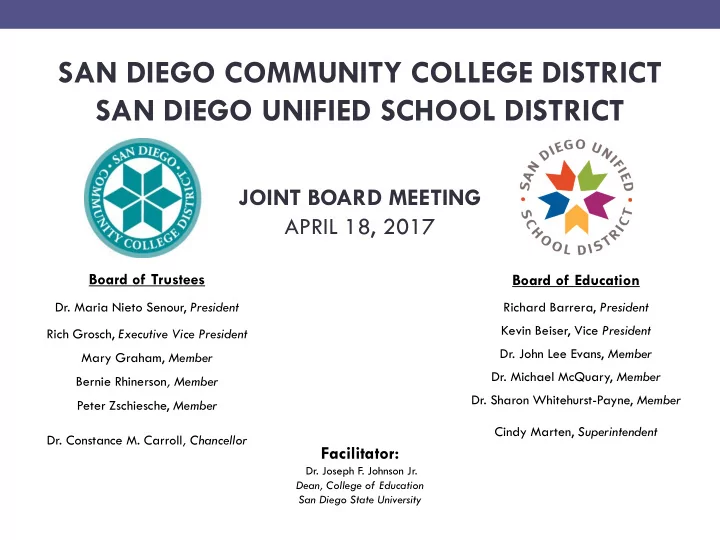
SAN DIEGO COMMUNITY COLLEGE DISTRICT SAN DIEGO UNIFIED SCHOOL DISTRICT JOINT BOARD MEETING APRIL 18, 2017 Board of Trustees Board of Education Dr. Maria Nieto Senour, President Richard Barrera, President Kevin Beiser, Vice President Rich


slide-1
SLIDE 1

SAN DIEGO COMMUNITY COLLEGE DISTRICT SAN DIEGO UNIFIED SCHOOL DISTRICT

JOINT BOARD MEETING APRIL 18, 2017

Board of Trustees

  • Dr. Maria Nieto Senour, President

Rich Grosch, Executive Vice President Mary Graham, Member Bernie Rhinerson, Member Peter Zschiesche, Member

  • Dr. Constance M. Carroll, Chancellor

Board of Education

Richard Barrera, President Kevin Beiser, Vice President

  • Dr. John Lee Evans, Member
  • Dr. Michael McQuary, Member
  • Dr. Sharon Whitehurst-Payne, Member

Cindy Marten, Superintendent

Facilitator:

  • Dr. Joseph F. Johnson Jr.

Dean, College of Education San Diego State University

slide-2
SLIDE 2

STATUS REPORT ON 2015-2016

2

JOINT BOARD GOALS

slide-3
SLIDE 3

INTRODUCTION

SIGNIFICANT PROGRESS HAS BEEN MADE

  • College and Career Access Pathway Partnership Programs

(CCAP) at 17 high schools

  • Monitoring student placements in English and mathematics
  • Strong community presence
  • Improvement in processes to facilitate student enrollment
  • San Diego Promise Program

3

A CULTURE OF STRONG COLLABORATION

  • Regular meetings among key leaders
  • Ongoing dialog among faculty leaders
  • Collaborative approach to problem solving
slide-4
SLIDE 4

STUDENT SPOTLIGHT

MORSE HIGH SCHOOL

Student: Jasmine Canedo

  • Attends Mesa College & City College
  • Concurrent Enrollment
  • City: English 47A & English 101
  • Mesa: Math 141
  • Post-Secondary Goals:
  • Major in BioChemistry
  • Pursuing a Doctorate Degree in the medical field

exploring Pediatrics or Optometry

4

Student: Jacob Gonzalez

  • Attends Mesa College
  • Taking Political Science 101 & Political Science 102
  • Post-Secondary Goals:
  • Join Navy
  • Major in Biology
  • Pursuing a Doctorate Degree in the medical field,

upon completion of 4-year service

slide-5
SLIDE 5

5

CONCURRENT ENROLLMENT STUDENT PLACEMENT AND OUTCOMES

PRESENTERS: Cheryl Hibbeln, SDUSD Lynn Ceresino Neault, SDCCD

slide-6
SLIDE 6

ENROLLMENT HIGHLIGHTS

  • Total concurrent enrollment of high school students in 2016-2017: 2,807

students

  • 26% increase compared to 2015-2016
  • 35% increase in concurrent students enrolled in college classes on the high

school campuses from 2015/16 to 2016/17

  • Increase largely due to

CCAP agreements

  • On average, approximately 36% of San Diego Unified students concurrently

enrolled at City, Mesa or Miramar colleges participate in the Accelerated College Program (ACP) at Mesa College

  • On average, approximately 2,400 (32%) high school graduates from San

Diego Unified School District enroll annually at City, Mesa or Miramar colleges within one year following their high school graduation

  • The percentage of graduates enrolling in 2015-16 was the same as 2014-15 (32%)

6

slide-7
SLIDE 7
  • On average, 50% of SDUSD first-time to college students at

SDCCD who take the reading placement test within the first year, place at transfer level English reading

  • 5% increase in transfer level placements from 2014/2015

to 2015/2016

  • 3% increase in transfer level placements from 2015/2016

to 2016/2017

  • Within transfer level placements in 2015/16, there was a

34% increase due to Multiple Measures Assessment Project (MMAP)

7

PLACEMENT

ENGLISH: READING

slide-8
SLIDE 8

PLACEMENT

ENGLISH: WRITING

8

  • On average, 22% of SDUSD first-time to college students at

SDCCD who take the writing placement test within the first year, place at transfer level English writing

  • 2% increase in transfer level placements from 2014/2015

to 2015/2016

  • No change in transfer level placements from 2015/2016 to

2016/2017

  • Within transfer level placements in 2015/16, there was a

78% increase due to MMAP

slide-9
SLIDE 9

PLACEMENT

MATHEMATICS

9

  • On average, 38% of SDUSD first-time to college students at

SDCCD who take the math placement test within the first year, place at transfer or college level math

  • 1% increase in transfer or college level from 2014/2015

to 2015/2016

  • 2% decrease in transfer or college level from 2015/2016

to 2016/2017

  • Within transfer level placements in 2015/16, there was a

50% increase due to MMAP

slide-10
SLIDE 10

10

  • Program with SDUSD students implemented Fall 2015
  • More comprehensive evidence-based set of measures of student capacity

in English or math course using high school transcript data (e.g., GPA & CST scores) and standardized assessment results for placement

  • Students placed at highest level between assessment test and transcript

data

  • More first-time to college high school graduates have placed in college

level math and English courses since MMAP implementation. In 2015/2016 MMAP increased transfer level placements as follows:

2015/16 SDUSD Accuplacer Transfer Placed 2015/16 MMAP Placements Total 15/16 Transfer Placements MMAP 15/16 % Increase in Transfer

Math 769 388 1,157 50% Reading 1,044 352 1,395 34% Writing 452 352 804 78%

MULTIPLE MEASURES ASSESSMENT PROJECT

slide-11
SLIDE 11

TRANSFER LEVEL PLACEMENTS FALL 2016

SDUSD Accuplacer Placement at Transfer MMAP Placement at Transfer Combined Accuplacer and MMAP Placement at Transfer Percent Difference Math 645 219 864 34% Reading 836 372 1,208 45% Writing 505 372 877 74%

11

  • Overall, 34% more students were placed in transfer/associate level math

in Fall 2016 due to MMAP

  • Overall, 45% more students were placed in transfer level reading in Fall

2016 due to MMAP

  • Overall, 74% more students were placed in transfer level writing in Fall

2016 due to MMAP

Note 2. MMAP placement provides a single English placement, rather than separate reading and writing placements. Note 1. The Accuplacer comparison group include former SDUSD students who applied to SDCCD for the Fall 2016 term, completed the Accuplacer test, but may not have registered.

slide-12
SLIDE 12

CLOSING THE EQUITY GAP

12

4% 15% 9% 46% 7% 11% 5% 43%

African American Asian/PI Filipino Latino

MMAP English Cohort General English Population 2% 22% 10% 41% 5% 14% 7% 36%

African American Asian/PI Filipino Latino

MMAP Math Cohort General Math Population

slide-13
SLIDE 13

13

ENGLISH TRANSFER LEVEL OUTCOMES

93% 78% 85% 65%

Retention Success

MMAP Placement Accuplacer Placement

slide-14
SLIDE 14

14

TRANSFER ENGLISH RETENTION

  • Asian/Pacific Islander, Latino, White, and Other/Unreported MMAP students had

higher retention rates compared to the general population of SDUSD English students.

  • Filipino MMAP students had comparable retention rates to SDUSD English students.

63% 50% 92% 90% 94% 97% 100% 85% 100% 88% 89% 84% 84% 88% African American American Indian Asian/Pacific Islander Filipino Latino White Other/Unreported

MMAP Students SDUSD Students

slide-15
SLIDE 15

15

TRANSFER ENGLISH SUCCESS

  • Asian/Pacific Islander, Filipino, Latino, White, and Other/Unreported MMAP students

had higher success rates compared to the general population of SDUSD English students.

50% 50% 86% 76% 73% 88% 88% 64% 60% 76% 74% 63% 69% 76% African American American Indian Asian/Pacific Islander Filipino Latino White Other/Unreported

MMAP Students SDUSD Students

slide-16
SLIDE 16

16

MATH TRANSFER LEVEL OUTCOMES

89% 62% 84% 62% Retention Success

MMAP Placement Accuplacer Placement

slide-17
SLIDE 17

17

TRANSFER MATH RETENTION

100% 100% 100% 100% 88% 79% 60% 81% 100% 87% 86% 79% 85% 87% African American American Indian Asian/Pacific Islander Filipino Latino White Other/Unreported

MMAP Students SDUSD Students

  • African American, Asian/Pacific Islander, and Latino MMAP students have higher retention rates

compared to the general population of SDUSD math students, although some ethnic groups in the MMAP cohort are very small.

slide-18
SLIDE 18

18

TRANSFER MATH SUCCESS

0% 100% 72% 88% 52% 71% 40% 53% 0% 73% 70% 52% 68% 59%

African American American Indian Asian/Pacific Islander Filipino Latino White Other/Unreported

MMAP Students SDUSD Students

  • White MMAP students have higher success rates compared to SDUSD math students.
  • Asian/Pacific Islander and Latino MMAP students have comparable success rates to SDUSD math

students.

  • African American, American Indian, Filipino, and Other/Unreported ethnic groups in the MMAP math

cohort include fewer than 10 students.

slide-19
SLIDE 19

19

COLLEGE AND CAREER ACCESS PATHWAY PARTNERSHIP PROGRAM (CCAP)

PRESENTERS: Cheryl Hibbeln, SDUSD Lynn Ceresino Neault, SDCCD

Tim McGrath, SDCCD Ana Diaz-Booz, SDUSD

slide-20
SLIDE 20

COLLEGE AND CAREER ACCESS PATHWAYS (CCAP) PARTNERSHIP PROGRAM

Goals:

  • To develop seamless pathways from high school to community

college, career technical education preparation for transfer, improving high school graduation rates, or helping high school students achieve college and career readiness.

  • Dual enrollment has historically targeted high-achieving students;

however, educators and policymakers are looking to dual enrollment as a strategy to help students who struggle academically or are at risk of dropping out.

20

slide-21
SLIDE 21

COLLEGE AND CAREER ACCESS PATHWAYS AGREEMENTS

21

  • In 2015-2016, agreements were developed between San Diego

City College, San Diego Mesa College, San Diego Miramar College and 20 high schools in the SDUSD.

  • City College agreements with 6 high schools

2016-17 Enrollments: 393

  • Mesa College agreements with 10 high schools

2016-17 Enrollments: 2,495

  • Miramar College agreements with 4 high schools

2016-17 Enrollments: 1,442

  • Total Program: 4,330 student enrollments
slide-22
SLIDE 22

22

Health Information Programs: PATHWAY TO THE HEALTH INFORMATION MANAGEMENT BACCALAUREATE DEGREE

Requirement Unit Requirement Prerequisites

9 units

Health Information Technology Associate Degree

Leads to RHIT careers such as Release of Information Specialist, Data Integrity Specialist, Health Information Technician, Cancer Registrar: salary range $35,200-$49,075

(Lower Division)

30 units plus 30 units of general education for Associate of Science degree

Health Information Management

Leads to RHIA careers such as Quality Improvement Analyst, Clinical Informatics Specialist, HIM Supervisor/Manager, HIM Director: salary range $60,000-$146,000

(Upper Division)

54 units

Total Units for Bachelor of Science

123 units

slide-23
SLIDE 23

PATHWAY TO HEALTH INFORMATION MANAGEMENT BACCALAUREATE DEGREE

23

Fall 2017:

  • Mesa College and Kearny High School
  • Kearny High School will identify 30 - 35 concurrently enrolled

students that will select the Allied Health Pathway as their major area of emphasis

  • Mesa College will identify a number of admission spaces in the

Four-Year Baccalaureate Degree Program for Kearny High School students

  • The first two years lead to an Associate Degree in Health

Information Technology Program (HEIT); and the second two years lead to a Bachelor’s Degree in Health Information Management (HIM)

slide-24
SLIDE 24

24

High school students will concurrently enroll in the following Mesa College classes:

  • Freshman or Sophomore
  • Allied Health 49 – Introduction to Health Careers
  • Junior
  • English 101 – Reading and Composition
  • Math 96 – Intermediate Algebra and Geometry
  • Senior
  • Medical Assisting 110 – Medical Terminology
  • Biology 160 – Elements of Human Anatomy and Physiology
  • Summer Preceding First Year at Mesa
  • Medical Assisting 115 – Pathophysiology

PATHWAY TO THE HEALTH INFORMATION MANAGEMENT BACCALAUREATE DEGREE

slide-25
SLIDE 25

25

SAN DIEGO PROMISE 2017-2018 COHORT

PRESENTERS: Cheryl Hibbeln, SDUSD Lynn Ceresino Neault, SDCCD

slide-26
SLIDE 26

2017-2018 COHORT

26

  • 600 participants selected by San Diego Unified School

District

  • 6 participants selected by the Monarch School
  • 75 participants selected by San Diego Continuing

Education Feeder High Schools

  • 43% of the participants are from City College feeder

high schools

  • 37% of the students are from Mesa College feeder high

schools

  • 18% of the students are from Miramar College feeder

high schools

slide-27
SLIDE 27

2017-2018 COHORT

27

Demographic Profile

  • 89% students of color
  • Latino/Hispanic is the largest ethnic group (53%)
  • 10.2% are African American
  • African Americans represent 8% of the total general

student population

  • The cumulative high school GPA is fairly representative
  • 78% of the participants fall within 2.5 – 4.0 GPA range
slide-28
SLIDE 28

2017-2018 COHORT

28

33% selected CITY COLLEGE

About CITY COLLEGE Educating students for more than 100 years, San Diego City College is the flagship campus of the San Diego Community College District. Located in downtown San Diego’s flourishing East Village neighborhood, the 60-acre campus offers a welcoming environment to a diverse student body, award-winning support services, and a range of degrees and certificate programs developed to ensure students are prepared to enter San Diego’s workforce or transfer to a four-year university.

slide-29
SLIDE 29

About MESA COLLEGE San Diego Mesa College is one of the largest community colleges in California, the first in the state to offer a bachelor’s degree, and transfers more students to the California State University system through the Associate Degree for Transfer program than any other California community college. Mesa College is a comprehensive community college committed to access, success, and equity. Situated in the geographic heart of San Diego County, Mesa’s award-winning faculty, small classes, and flourishing and diverse campus life are matched by a personal approach to help each and every student reach his or her educational and career goals, changing futures and enriching San Diego’s workforce.

29

2017-2018 COHORT

48% selected MESA COLLEGE

slide-30
SLIDE 30

18% selected MIRAMAR COLLEGE

30

2017-2018 COHORT

About MIRAMAR COLLEGE Ranked as one of the nation’s fastest-growing community colleges, San Diego Miramar College blends a strong focus on new and emerging fields of study with its long-standing public safety training work. The dynamic 120-acre campus has undertaken a significant renovation to provide its diverse student body access to an even more comprehensive curriculum of educational opportunities.

slide-31
SLIDE 31

11% of the participants are from SAN DIEGO CONTINUING EDUCATION

31

About San Diego CONTINUING EDUCATION Serving more than 44,000 students each year, San Diego Continuing Education has a celebrated history of connecting students from all backgrounds to the skills they need for successful lives and careers. With seven conveniently located campuses and free coursework designed to provide ongoing learning opportunities, San Diego Continuing Education is a powerful example of the transformative impact of education.

2017-2018 COHORT

slide-32
SLIDE 32

32

CAREER TECHNICAL EDUCATION

PRESENTERS: Lorraine Collins, SDCCD Al Love, SDUSD

slide-33
SLIDE 33

STUDENT SPOTLIGHT:

Lincoln High School

33

Fire Technology Program

  • Enrolled at Miramar College (Major Fire Science)
  • Completed 4 CTE Fire Science pathway courses
  • 2 Time San Diego Teen Fire Competition competitor
  • Acquired strong leadership & communication skills
  • Fire Tech program inspired Lindsey to attend college

______________________________________________________ Legal Practices

Lindsey Laston - Senior at Lincoln Megan Stern - Senior at Lincoln

  • Accepted to UCSD fall 2017
  • Completed 3 CTE Legal Pathway courses
  • Legal practices courses “Truly Inspirational”
  • Real world experiences, Teen Court & Mock Trials
  • Coordinates Restorative Practice Circles
  • Trained Peer Mediator Facilitator
slide-34
SLIDE 34

Source: National Student Clearinghouse

Among 2014-15 San Diego Unified graduates from non-charter schools who earned at least one CTE credit in high school, 1,912 of 5,472 (34.9%) attended SDCCD in 2015-16 CTE Credits in High School San Diego Unified Graduates Attended SDCCD Percent at SDCCD None 897 240 26.8 1 or 2 1,619 496 30.6 3 or 4 1,471 515 35.0 5 or 6 1,072 408 38.1 7+ 1,310 493 37.6 Total Graduates 6,369 2,152 33.8 Graduates with CTE credits 5,472 1,912 34.9

2014–15 SAN DIEGO UNIFIED GRADUATES WHO ATTENDED SDCCD IN 2015–16

Source: National Student Clearinghouse

SAN DIEGO UNIFIED CTE STUDENTS AT SDCCD

34

slide-35
SLIDE 35

SAN DIEGO UNIFIED SCHOOL DISTRICT AND SAN DIEGO COMMUNITY COLLEGE DISTRICT CTE ALIGNMENT BY REGIONAL INDUSTRY SECTORS

CBE = Credit-by-Exam Agreement N/A = Not part of San Diego Regional Industry Sector

CA CTE Industry Sectors SDUSD CBE SDCCD San Diego Regional Industry Sectors Agriculture and Natural Resources √ N/A Arts, Media, and Entertainment √ √ √ Small Business Building and Construction Trades √ √ Advanced Manufacturing Business and Finance √ √ √ Small Business | Global Trade & Logistics Education, Child Development, and Family Services √ √ √ N/A Energy, Environment, and Utilities √ √ Advanced Transportation/Clean Energy Engineering and Architecture √ √ √ Advanced Manufacturing | Small Business Health Science and Medical Technology √ √ Life Sciences & Biotech | Health Hospitality, Tourism, and Recreation √ √ √ N/A Information and Communication Technologies √ √ √ ICT and Digital Media Manufacturing and Product Development √ √ √ Advanced Manufacturing Marketing Sales and Service √ √ ICT and Digital Media | Small Business | Global Trade & Logistics Public Services √ √ √ N/A Transportation √ √ √ Advanced Transportation

slide-36
SLIDE 36

CTE ARTICULATED STUDENTS ENROLLED IN A CITY, MESA, AND MIRMAR COLLEGE COURSE

Source: CATEMA and SDCCD Student Information System

36

2011/12 2012/13 2013/14 2014/15 City College/ ECC 306 10% 268 9% 218 7% 105 5% Mesa College 444 15% 401 14% 377 13% 293 14% Miramar College 195 7% 208 7% 159 5% 138 7% All Colleges 789 26% 736 25% 543 18% 451 21%

The CTE HS cohorts are San Diego Unified graduates who were enrolled in an articulated course or program between San Diego Unified and SDCCD, and were eligible or received at least one college credit, and subsequently enrolled in any course at SDCCD within one year of graduating.

slide-37
SLIDE 37

2014-2015 CTE ARTICULATED STUDENTS ENROLLED IN A CTE COURSE AT SAN DIEGO COMMUNITY COLLEGE DISTRICT

Source: CATEMA SDCCD Student Information System

The CTE HS cohorts are San Diego Unified graduates who were enrolled in an articulated course or program between San Diego Unified and SDCCD, and were eligible or received at least one college credit and then enrolled in any of the CTE courses in the Articulated Pathways. 37

San Diego Unified & SDCCD Articulated Pathways % of San Diego Unified Students in Aligned SDCCD Course Arts, Media, and Entertainment 6% Business and Finance 7% Education, Child Development, and Family Services 9% Engineering and Architecture 2% Health Science and Medical Technology 7% Hospitality, Tourism and Recreation 0% Information and Communication Technologies 2% Manufacturing and Product Development 2% Transportation 11%

slide-38
SLIDE 38

38

FUTURE EDUCATORS PIPELINE

PRESENTER: Acacia Thede, SDUSD

slide-39
SLIDE 39

39

TEACHER PIPELINE DEVELOPMENT

  • The teacher workforce is the lifeblood of any educational system
  • San Diego Unified is committed to proactively combating the

recruitment issues associated with the nationwide teacher shortage to ensure high quality teachers are in every classroom

  • Retention of effective teachers and leaders ensures quality schools in

every neighborhood

  • SDCCD can play a vital role in this endeavor and serve as a valuable

partner for SDUSD students who choose to enter the teaching profession

slide-40
SLIDE 40

40

  • The 2014 Teacher Pipeline Taskforce Final Report identified sustainable

strategies to ensure that the SDUSD teaching force is representative of the students it serves:

  • National recruitment focused on programs with large numbers of

diverse candidates enrolled in education programs

  • College and university partnerships to interview candidates prior to

graduation

  • Partnerships with the military that provide increased numbers of

diverse candidates

  • Early employment contracts
  • Scholarship opportunities such as those offered through the San Diego

Education Fund to recruit SDUSD student graduates into the field of education

  • Early recruitment allows the district to hire ethnically diverse/culturally

proficient teachers; 43% of new hires identify themselves as ethnically diverse

TEACHER PIPELINE DEVELOPMENT

slide-41
SLIDE 41

41

  • Build interest in and capacity for the teaching profession
  • Educators Rising Clubs
  • CCTE Pathways
  • San Diego Teacher Academy (apprenticeship)
  • District Intern Program
  • San Diego Education Fund Scholarships
  • Utilize a strategic, systematic marketing program to attract

and maintain qualified candidates

TEACHER PIPELINE DEVELOPMENT

slide-42
SLIDE 42
  • Immediate and ongoing early recruitment through college and

university partnerships and national recruitment

  • Long-term (one to five years):
  • Reestablish District Intern Program
  • College and university partnerships encourage current SDUSD

classified staff to enter the field of teaching

  • SDUSD students complete pipeline programs and are hired by

the District

42

TIMELINE

slide-43
SLIDE 43

43

NEW INITIATIVES FOR 2017-2018

PRESENTERS: Constance M. Carroll,

Chancellor , SDCCD

Cindy Marten,

Superintendent, SDUSD Stanley Anjan, SDUSD Shakerra Carter, SDCCD

slide-44
SLIDE 44

NEW INITIATIVES FOR 2017-2018

  • Support for ALL students
  • Immigration efforts
  • Collaborative outreach and engagement
  • Joint legislative efforts

44

slide-45
SLIDE 45

IMMIGRATION EFFORTS

45

San Diego Community College District

  • Board Resolution
  • Letters to students
  • Information to employees
  • Workshops
  • FAQs – DACA & Protocols

San Diego Unified School District

  • Board Resolution
  • Hosted county-wide press conference
  • Letter to families and staff
  • Workshops
  • DACA support
  • Celebration of Light: Celebrating Diversity
slide-46
SLIDE 46

46

The SDUSD Family and Community Engagement (FACE) Team and SDCCD Outreach have collaborated on the following initiatives in support of undocumented and refugee students and families:

  • Equity Coalition
  • Immigration Forums
  • Joint Partnership with Mexican Consulate
  • DACA Office
  • Alignment of AB 540 resources and information
  • Community Partners Think-Tank
  • Monthly joint department staff meetings
  • SDCCD educational outreach workshops in SDUSD

neighborhood center

OUTREACH TO STUDENTS AND FAMILIES

slide-47
SLIDE 47

JOINT LEGISLATIVE EFFORTS

47

  • SB 769 – Baccalaureate Degree Pilot Program

Amendments

  • AB 19 – State-Funded Promise Program
  • Local Control Funding Formula
  • Prop 51 – Authorization for Construction Facilities
  • State Legislature to designate funds to Increase Income

Eligibility Level for Early Childhood Education

slide-48
SLIDE 48

48

QUESTIONS?