
SLIDE 1
Sailplane Thermal Detector
Team 1723 UConn ECE Dept; Advisor Dr. Helena Silva Nicholas Chapman Alex Dawkins William Pawelcyzk Kevin Waligora
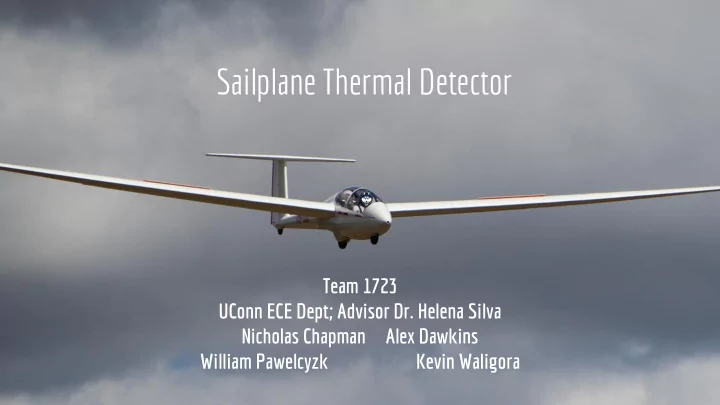
Sailplane Thermal Detector Team 1723 UConn ECE Dept; Advisor Dr. - - PowerPoint PPT Presentation
Sailplane Thermal Detector Team 1723 UConn ECE Dept; Advisor Dr. Helena Silva Nicholas Chapman Alex Dawkins William Pawelcyzk Kevin Waligora Overview: What is a glider? Its an airplane without an engine. It is heavier than air. It uses
Team 1723 UConn ECE Dept; Advisor Dr. Helena Silva Nicholas Chapman Alex Dawkins William Pawelcyzk Kevin Waligora
It’s an airplane without an engine. It is heavier than air. It uses the surrounding air (thermals) as its source of lift.
A column of rising air Caused by sun’s heating
Thermals are invisible Increased flight time and safety Helps students and competitive pilots
We aren’t glider pilots. We went to meet some and see what features they’d like.
Sensors shall not modify the wing Has to be wireless per request Interface must be simple Must fit onto multiple wing shapes Must be somewhat aerodynamic
Incremental display to show strength of thermal
Detector works by comparing wingtip conditions.
Three microcontrollers: one per wingtip, one in the cockpit. Selected the Adafruit Feather line (Arduino)
3-D printed PLA Semi- Aerodynamic Interior hole allows airflow Rubber seal on bottom Secured with bendable sheet Further secured with tape
Car Mirrors simulate wings and car moves at glider speed.
Car Test Video:
Temp Sensors are GOOD! Temperatures drift apart at low speeds Quick deviations are visible Conclusion: good for sensing thermals
Make sensor and logging equipment more robust Test on an airplane to log flight data Analyze data to see what thermals look like Design a display and code thermal sensing logic Test again in flight Refine
1738
Relatively quick temperature reading Inexpensive Only as good as your ADC