Sage-grouse and West Nile virus Prineville LIT May 20, 2020 Emily - - PowerPoint PPT Presentation

sage grouse and west nile virus prineville lit may 20 2020
SMART_READER_LITE
LIVE PREVIEW

Sage-grouse and West Nile virus Prineville LIT May 20, 2020 Emily - - PowerPoint PPT Presentation

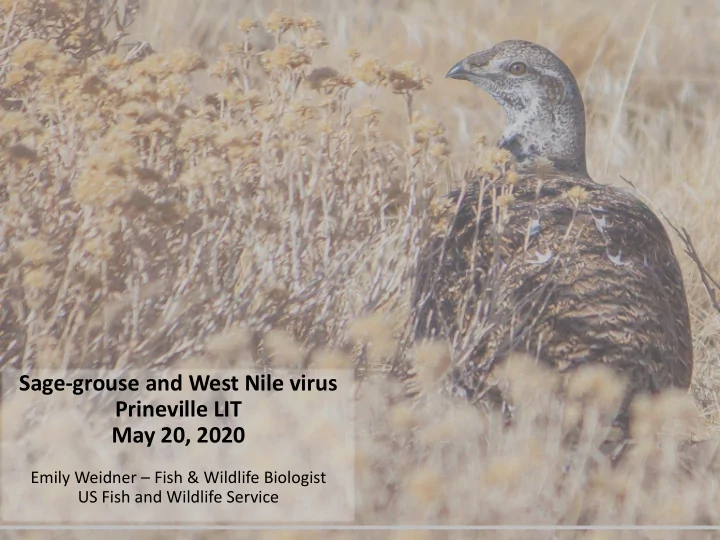
Sage-grouse and West Nile virus Prineville LIT May 20, 2020 Emily Weidner Fish & Wildlife Biologist US Fish and Wildlife Service 2 Threats Habitat loss and Recreation and Isolated/small* Predation* Disease* Disease fragmentation


slide-1
SLIDE 1

Sage-grouse and West Nile virus Prineville LIT May 20, 2020

Emily Weidner – Fish & Wildlife Biologist US Fish and Wildlife Service
slide-2
SLIDE 2

Threats

Conifers* Annual grasses* Horses/burros Urbanization Infrastructure* Energy/Mining* Fire* Invasive species Land development and conversion Habitat loss and fragmentation Predation* Recreation and hunting* Disease Disease* Grazing* Drought and mesic habitat* Isolated/small*

*Applicable threats in 2017 Brothers CFA

2

slide-3
SLIDE 3

West Nile virus (WNv)

  • Reemerging pathogen
  • Same genus as dengue, yellow fever, and zika
  • Arbovirus (ARthropod-BOrne virus)
  • Culex spp. primary vectors
  • Birds serve as primary reservoir
  • American robin likely responsible for maintenance and

transmission across the landscape

  • Causative agent of West Nile fever in humans

3

slide-4
SLIDE 4

Centers for Disease Control and Prevention (2017)

Evans et al. 2017

West Nile virus (WNv)

4

slide-5
SLIDE 5

WNv in sage-grouse

  • 2003, first documented WNv mortalities
  • Alberta, Montana, Wyoming
  • 2006, Malheur County, Oregon
  • Variable mortality and low resistance to infection
  • Affects all age classes and both sexes
  • Mortalities typically occur July though September
  • Considered an endemic stressor

Naugle et al. Ecology Letters (2004); USGS NWHC (2006); Clark et al. Journal of Wildlife Diseases (2006); Taylor et al. PLOS One (2013)

5

slide-6
SLIDE 6

Dead end/incidental hosts Reservoir Primary transmission cycle Vector

Centers for Disease Control and Prevention (2013)

6

slide-7
SLIDE 7

7

slide-8
SLIDE 8

Plowright et al. Nature Reviews: Microbiology (2017)

A B

8

slide-9
SLIDE 9

9

slide-10
SLIDE 10

10

slide-11
SLIDE 11

11

slide-12
SLIDE 12

Difficult to assess…

  • Wildlife move on large scales and are cryptic
  • Field work requires substantial time, labor, and a uniform

effort

  • Must have diseased bird in-hand or birds must survive in
  • rder for WNV to be detected
  • Potentially biased population metrics
  • Transmission and outbreaks are temporally and spatially

patchy on the landscape

  • Low occurrence and equivocal results in serosurveys

12

slide-13
SLIDE 13

Counting sage-grouse

  • Lek count data: only long-term, range-wide dataset

available for evaluating trends in sage-grouse population

  • Imperfect detection (sightability & lek attendance)
  • Counts may inaccurately reflect changes in

population abundance when detection of individuals is not constant for surveys either within

  • r among years

Fremgen et al. Journal of Wildlife Management (2016)

13

slide-14
SLIDE 14

Landscape

  • Spatial and temporal variation in WNV transmission

moderates WNV impacts on species

  • Spatial - range of habitats, and WNV transmission is

lower in one of these habitats, then this area may serve as a refuge from infection

  • Temporal - intensity of WNV transmission may

temper impacts and allow recovery in low transmission years

Kilapatrick and Wheeler, Journal of Medical Entomology (2019)

14

slide-15
SLIDE 15

Daversa et al. Proceedings of the Royal Society B (2017)

15

slide-16
SLIDE 16

Low occurrence & equivocal results

These two aspects suggest:

  • 1. Sage-grouse have not been exposed to WNV and

haven’t had an opportunity to develop antibodies

  • 2. WNV is lethal for the majority but a limited

number of birds survive infection and develop antibodies

  • 3. Sage-grouse mount an immune response other

than producing WNV-specific antibodies, thus making detection difficult

16

slide-17
SLIDE 17

TAKEAWAY While compelling, linking sage-grouse declines to WNV arrival in Oregon is correlational at best. OPTIONS

  • Continue Brothers monitoring in 2020
  • BLM implementing project at four locations
  • Expand monitoring into high-risk areas
  • Baker pilot in 2019, and continuing for 2020 and 2021
  • Assess sage-grouse habitat use in water-limited areas
  • Model WNV risk on the Oregon landscape

17

slide-18
SLIDE 18

Questions?

The Ecology of Disease, Olaf Hajek

18