Safe Harbour Statement The following presentation may include - - PowerPoint PPT Presentation

safe harbour statement
SMART_READER_LITE
LIVE PREVIEW

Safe Harbour Statement The following presentation may include - - PowerPoint PPT Presentation

Safe Harbour Statement The following presentation may include certain forward-looking statements within the meaning of the United States Private Litigation Reform Act of 1995 and applicable Canadian Securities Laws. All statements other than


slide-1
SLIDE 1
slide-2
SLIDE 2

Safe Harbour Statement

2 The following presentation may include certain “forward-looking statements” within the meaning of the United States Private Litigation Reform Act of 1995 and applicable Canadian Securities Laws. All statements other than statements of historical fact, included in the presentation, including without limitation, statements regarding potential mineralization and reserves, exploration results, and future plans and objectives of Search Minerals, are forward-looking statements. Words such as “expect”, “anticipate”, “estimate”, “may”, “will”, “should”, “intend”, “believe”, and other similar expressions are forward-looking statements. Forward-looking statements are not guarantees of future results and conditions but rather reflect our current views with respect to future events and are subject to risks, uncertainties, assumption and

  • ther factors, and actual results and future events could differ materially from those anticipated in such statements.

There can be no assurance that such forward-looking statements will prove to be accurate. We base our forward- looking statements on information currently available to us and we do not assume any obligation to update them, except as required by law. An additional Cautionary Note to Investors: In the event the we use certain terms in this presentation such as “resource”, “measured resource”, “indicated resource” and “inferred resource”. US investors are cautioned that, while such terms are recognized and required by Canadian Securities Laws, the United States Securities and Exchange Commission does not recognize them. Under U.S. standards, mineralization may not be classified as a “reserve” unless the determination has been made that the mineralization could be economically and legally produced or extracted at the time the reserve determination has been made. US. investors should not assume that all or any part of measured or indicated resources will ever be converted into reserves. In addition, “inferred resources” have a greater amount of uncertainty as to their existence and as to whether they can be mined legally or economically. Accordingly, information concerning descriptions of mineralization in the presentation may not be comparable to information made public by companies that are subject to the SEC’s Industry Guide 7. For further details of the Company’s procedures and the policies for data verification, the reader is referred to the Company’s news releases and

  • ther

material information available

  • n

the Companies website at www.searchminerals.ca or on SEDAR at www.sedar.com

slide-3
SLIDE 3

What are the Rare Earth Elements?

3

  • A Series of 17 elements including the

lanthanides and scandium and yttrium.

  • Divided into two categories: Heavy and Light

Rare Earth Elements. Heavy tend to be more valuable.

  • Rare Earth somewhat of a misnomer, aside

from promethium, they are relatively

  • abundant. Named rare due to the rare earth

minerals they were first isolated from.

  • Rare Earth Elements commonly associated

with peralkaline volcanic and plutonic rocks.

  • Elements are found together in minerals
  • Current largest producer is China. Industry

has seen supply concerns and elevated prices

slide-4
SLIDE 4

4 TSXV: SMY SEARCHMINERALS.CA

Green Energy

  • Hybrid and Electric Vehicles
  • Wind Energy
  • Energy Efficient Lighting

Military and Defence

  • Communications
  • Aeronautical engineering and Jet Engines
  • Guidance, Lasers, Sonar, Optics, and Electronic Counter Measures

Modern Technologies

  • Cell Phones and Digital Cameras
  • LCD and Plasma Televisions
  • MRI machines, X-Ray, and PET Medical imaging

The Toyota Prius is estimated to contain: 1 kg Neodymium Metal 15 kg Lanthanum Metal 0.1 kg Dysprosium Metal Sales are greater than 2 million units per annum

Rare Earth Elements: Critical for the 21st Century

slide-5
SLIDE 5

Port Hope Simpson REE District

CANADA

slide-6
SLIDE 6

Foxtrot Project

6

slide-7
SLIDE 7

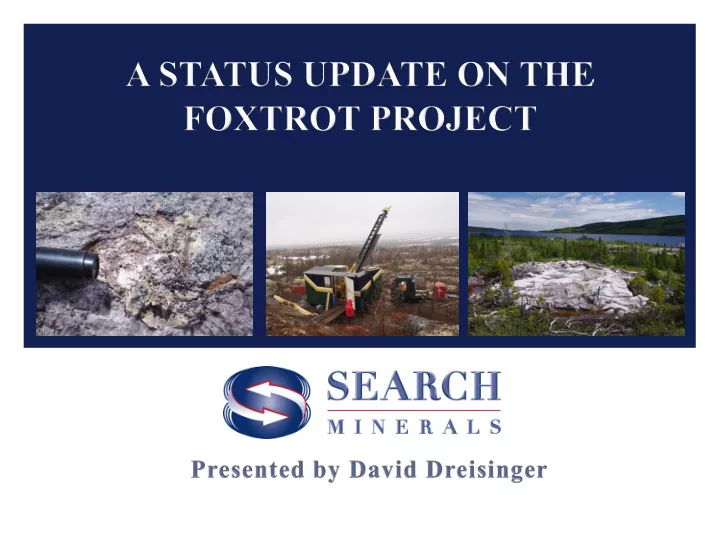
7 Fox Harbour Volcanic Belt area Cleared Outcrop at Foxtrot Project

slide-8
SLIDE 8

Foxtrot Project

8

slide-9
SLIDE 9

9

  • Resource estimate released Q4’12 – three phases of drilling, up to 450 m depth
  • 9,229,000 tonnes of indicated resource @ 1.06% TREO
  • 5,165,000 tonnes of inferred resource @ 0.93% TREO

Tonnage Dy Nd Y HREE+Y TREE+Y (in tonnes) (in ppm) (in ppm) (in ppm) (in %) (in %) Indicated Central 9,229,000 189 1,442 1,040 0.17 0.88 Indicated Extensions

  • 9,229,000

189 1,442 1,040 0.17 0.88 Inferred Central 3,291,000 178 1,339 982 0.16 0.83 Inferred Extensions 1,874,000 171 1,046 960 0.16 0.67 5,165,000 176 1,233 974 0.16 0.77 Tonnage Dy 2 O 3 Nd 2 O 3 Y 2 O 3 HREO+Y TREO+Y (in tonnes) (in ppm) (in ppm) (in ppm) (in %) (in %) Indicated Central 9,229,000 218 1,687 1,345 0.21 1.07 Indicated Extensions

  • 9,229,000

217 1,687 1,320 0.21 1.06 Inferred Central 3,291,000 205 1,567 1,247 0.2 1 Inferred Extensions 1,874,000 197 1,224 1,219 0.19 0.81 5,165,000 202 1,442 1,237 0.2 0.93 INDICATED TOTAL INFERRED TOTAL Classification Zone INDICATED TOTAL INFERRED TOTAL Classification Zone

slide-10
SLIDE 10

10

  • Channel sample taken at surface – representative
  • Extensive mineralogical work (SGS Advanced Mineralogy Facility)
  • Beneficiation by gravity, magnetic separation and flotation to

produce concentrate with recovery of +80%

  • Concentrate grade 2.15 X ore grade
  • Concentrate processing
  • Acid Bake
  • Water Leach
  • Purification by pH adjustment to 3.0 with MgO
  • Oxalate Precipitation at pH 2.0 to recovery REE’s
  • +70% recovery of Nd, Tb, Dy, Y

10

slide-11
SLIDE 11

Search Minerals (Canada) REE Project

Sample Units Indicated Resource Inferred Resource Channel Sample Mass t 9,229,000 5,165,000 1.25 Y2O3 ppm 1320 1237 1404 La2O3 ppm 1926 1669 1771 CeO2 ppm 4105 3544 4372 Pr6O11 ppm 465 400 516 Nd2O3 ppm 1687 1442 1750 Sm2O3 ppm 303 264 338 Eu2O3 ppm 15 13 16 Gd2O3 ppm 217 210 260 Tb4O7 ppm 38 35 43 Dy2O3 ppm 217 202 267 Ho2O3 ppm 42 39 50 Er2O3 ppm 118 112 140 Tm2O3 ppm 17 16 20 Yb2O3 ppm 105 103 117 Lu2O3 ppm 16 16 17 ZrO2 ppm 12985 13586 21687 Nb2O5 ppm 789 677 1015 LREO % 0.85 0.73 0.87 HREO % 0.21 0.2 0.23 TREO % 1.07 0.93 1.11

11

FOXTROT Channel Sample taken at surface has ~ the same as the indicated and inferred resource grade (2013)

slide-12
SLIDE 12

Mineralogy (Channel Sample)

The major rare earth minerals identified were – Allanite (Ca,Ce)2(Fe2,Fe3+)Al2O - (SiO4)(Si2O7)(OH) – Fergusonite (Y,Er,Ce,Fe)NbO4 – Chevkinite (Ce,La,Ca,Th)4(Fe2+,Mg)(Fe2+,Ti,Fe3+)-(Ti,Fe3+)2(Si2O7)2O8, – Monazite (Ce,La,Pr,Nd,Th,Y)PO4 – Bastnasite (Ce, La)CO3F – Zircon ZrSiO4 – Apatite (Ca,Ce,Y)5(PO4,SiO4)3(F,Cl,OH). – Fine grained with D50 particle sizes ranging from 63 µm for allanite to 22 µm for fergusonite. – Nd - allanite (66.4%), chevkinite (12.7%), monazite (10.1%), bastnasite (and synchysite) 7.9% and fergusonite (2.9%). – Dy - allanite (49.3%), fergusonite (40.5%), chevkinite (8.8%), and bastnasite (1.4%).

12

slide-13
SLIDE 13

Mineralogical Distribution of Nd

13

0.0 10.0 20.0 30.0 40.0 50.0 60.0 70.0 80.0 90.0 100.0 Mass (% Nd) Chevkinite 12.7 12.2 14.4 Monazite 10.1 6.8 21.3 Allanite 66.4 72.0 47.9 Bastnasite 7.9 7.7 8.5 Fergusonite 2.9 1.4 8.0 Combined +38um

  • 38um
slide-14
SLIDE 14

Mineralogical Distribution of Dy

14

0.0 10.0 20.0 30.0 40.0 50.0 60.0 70.0 80.0 90.0 100.0 Mass (% Dy) Chevkinite 8.8 10.3 6.2 Allanite 49.3 65.0 22.3 Bastnasite 1.4 1.6 0.9 Fergusonite 40.5 23.1 70.6 Combined +38um

  • 38um
slide-15
SLIDE 15

Early Metallurgical Work

15

Crushing, Grinding, Physical Separation

Chemical Treatment and Purification Rare Earth Precipitation Ore Ore Waste Leach Residue and Impurities Rare Earth Product Energy Chemicals Chemicals Concentrate

slide-16
SLIDE 16

Beneficiation (Gravity, Magnetic Sep and Flotation )

16 Concentrate Assay Recovery (%) Ce2O3 % 0.94 83.0 Nd2O3 % 0.38 83.0 Y2O3 % 0.31 83.7 ZrO2 % 3.71 65.9 Nb2O5 % 0.22 81.8 La2O3 g/t 3968 86.2 Pr6O11 g/t 1160 86.6 Sm2O3 g/t 741 84.3 Eu2O3 g/t 34 83.7 Gd2O3 g/t 559 82.7 Tb2O3 g/t 93 82.4 Dy2O3 g/t 543 81.4 Ho2O3 g/t 105 81.6 Er2O3 g/t 297 81.7 Tm2O3 g/t 42 81.9 Yb2O3 g/t 249 81.7 Lu2O3 g/t 37 81.8 U3O8 g/t 54 83.8 ThO2 g/t 274 86.6

slide-17
SLIDE 17

Purification and Precipitation

Element Leach Solution (mg/L) Purified Solution (mg/L) Solid Precip (ppm) Loss (%) Oxalate Precipitate La 455 392 467 0.77 % 7.8 Ce 1000 853 1280 0.96 % 18.3 Pr 121 103 170 1.06 % 2.1 Nd 437 374 687 1.18 % 8.7 Sm 78 68.5 125 1.17 % 1.24 Eu 4 3.39 6.3 1.19 ppm 759 Gd 67 55.2 86.9 1.01 ppm 11600 Tb 11 8.73 14.5 1.07 ppm 1840 Dy 62 51.7 86.6 1.07 ppm 10600 Ho 12 9.99 16.8 1.08 ppm 2020 Er 33 27.4 49.9 1.17 ppm 5430 Tm 5 3.71 7.3 1.26 ppm 735 Yb 25 20.9 49.2 1.5 ppm 4240 Lu 3 2.52 5.7 1.45 ppm 499 Y 295 255 440 1.12 ppm 50763 U 4 2.59 78.2 16.4 ppm 5.5 Th 32 1.32 2020 90.9 ppm 282

LREO 44.7% HREO+Y 10.78% TREO+Y 55.48%

17

slide-18
SLIDE 18

Early Metallurgical Work (2012)

  • Complex beneficiation flowsheet

– Crushing, grinding, multiple separation technologies

  • Modest upgrade (2.15 X) with +10% REE loss
  • Successful extraction and purification process, but….

– High acid addition to acid bake – Expensive MgO used for pH adjustment – High oxalic acid addition for REE recovery

  • Can we do better?

– Simple crush - Eliminate grinding and beneficiation – Use low acid addition – Use cheaper MgCO3 – Primary precipitation with Na2CO3 – Purification by HCl releach/pH adjustment/oxalate pptn.

18

slide-19
SLIDE 19

New Process

19

Crushing Chemical Treatment and Purification Rare Earth Precipitation Ore Leach Residue and Impurities Rare Earth Product Energy Chemicals Chemicals Crushed Ore

slide-20
SLIDE 20

Acid Bake/Water Leach Effect of Crush Size (High Acid)

20 10 20 30 40 50 60 70 80 90 100 La Ce Pr Nd Sm Eu Gd Tb Dy Ho Y Er Tm Yb Lu Sc Th U Al Fe Ti Mn Extraction, %

Effect of Crush Size (1500 kg/t H2SO4, 4h @ 200C)

Test: WLAB1, Crush size: 1/2 inch Test: WLAB2, Crush size: 1/4 inch Test: WLAB3, Crush size: 6 mesh AB10 (Feed = con)

slide-21
SLIDE 21

Effect of Acid Addition (250 -> 100 kg/t)

  • 21

10 20 30 40 50 60 70 80 90 100 La Ce Pr Nd Sm Eu Gd Tb Dy Ho Y Er Tm Yb Lu Sc Th U Al Fe Ti Mn Extraction, %

Effect of Acid Addition (6 mesh, 2h at 200C)

Test: WLAB9, A/O: 250 kg/t Test: WLAB10R, A/O: 200 kg/t Test: WLAB11R, A/O: 150 kg/t Test: WLAB12R, A/O: 100 kg/t

Rare Earths Key Impurities

slide-22
SLIDE 22

Acid Bake Feed/Product – 6 mesh, 100 kg/t H2SO4, 200 °C, 2 h

22

BEFORE ACID BAKE AFTER ACID BAKE

slide-23
SLIDE 23

Acid Bake – Water Leach Result

23

Feed PLS Residue Extraction Element Units % La 1720 144 392 76.7 Ce 3720 321 805 78.1 Pr 437 39.7 90.8 79.6 Nd 1610 148 330 80 Sm 297 27.9 63.8 79.6 Eu 15.5 1.51 3.6 79.1 Gd 244 22.6 56.1 78.4 Tb 37.3 3.59 8.5 79.2 Dy 223 20.8 54.6 77.5 Ho 43.7 4.09 11.7 76 Y 1090 107 288 77 Er 122 11.2 36 73.8 Tm 17.2 1.49 5.8 69.9 Yb 111 8.56 41.8 64.9 Lu 15.8 1.02 7.3 55.9 Sc <25 <0.07 <25 BDL Th 109 9.35 34.6 70.4 U 22.4 1.2 13.5 44.4 Si 31.32 288 32.44 0.8 Al 3.99 212 3.97 4.6 Fe 7.83 496 7.69 5.5 Mg 0.12 43.5 0.07 36.7 Ca 1.45 642 0.96 40 Na 2.13 47 2.14 2.6 K 3.36 384 3.44 9.2 Ti 0.27 4.6 0.28 1.5 P 0.01 5 0.02 33.5 Mn 0.23 82.3 0.19 27.6 Note:

BDL: Below Detection Limit

Assay (mg/L, %, g/t) g/t %

6 Mesh 200 C 100 kg/t Acid 2 h Bake 24 h Leach At 90 C And 600 rpm High REE Extraction Nd – 80% Tb – 79.2% Dy – 77.5 Y – 77% Low Impurity Extraction Al – 4.5% Fe – 5.5%

slide-24
SLIDE 24

Impurity Removal by Oxidation/Precipitation

  • Magnesium carbonate (MgCO3) was selected for bulk test.
  • ~13 L of water leach solution was heated to 75 °C and treated with

~ 0.5 g/L of H2O2 to raise the ORP to +600 mV (vs Ag/AgCl).

  • pH adjusted to 3.75 with a 15 % slurry of MgCO3 and held for 1 h.
  • The impurity precipitates were filtered and washed.
  • +90% of the iron was eliminated along with 88.4% of the thorium.
  • Significant rejection of Si, Al, Ti and P.
  • The losses of REEs ranged from 0.74 to 3.6% from La to Lu.
  • Nd-1.23%, Tb-1.76%, Dy-1.78%, Y-1.38%
  • Note that the final precipitate was analyzed at 0.018% Mg

indicating a high efficiency of MgCO3 use.

  • Excellent first pass REE/impurity separation

24

slide-25
SLIDE 25

Bulk Rare Earth Precipitation

  • The purified solution was treated with a soda ash solution

(Na2CO3) to precipitate the REEs into a mixed carbonate product for further purification.

  • A pH target of 7.25 at ambient temperature was set.
  • The precipitation of REEs approaches 100%.
  • Nd-99.9%, Tb-99.1%, Dy-99.7%, Y-99.7%
  • The co-precipitation of Th, U, Fe, Al is similarly very high.
  • The mixed REE carbonate precipitate may be further refined

by a re-leach, oxalate precipitation and calcination method to form a mixed REO for refining.

  • Rare Earth Elements Now Concentrated for Further

Processing

25

slide-26
SLIDE 26

Overall Recovery – Ore to Mixed Carbonate

La Ce Pr Nd Sm Eu Gd Tb 75.9 77.3 78.9 79.3 78.9 78.4 77.6 78.4

26

Dy Ho Y Er Tm Yb Lu 76.7 75.3 76.3 73.1 69.2 64.3 55.4

slide-27
SLIDE 27

Mixed Carbonate Purification

  • The mixed carbonate product was re-leached with 37% HCl

solution at pH 1 for 1 h at 80 °C.

  • Leach solution treated with 15 % slurry of MgO to pH 3.8 at

50 °C for 1 h to reprecipitate re-leached thorium.

  • The re-leach process was virtually 100% effective in re-

dissolving the REEs.

  • The re-leach residue and the thorium removal residue

would be returned to the water leach process to minimize any REE loss.

  • The low-thorium solution was then treated with oxalic acid to

selectively precipitate the REEs.

  • The rare earth oxalate was then calcined at 750 °C for 4 h to

produce a final mixed rare earth product.

27

slide-28
SLIDE 28

Calcine

  • +87% REO+Y
  • Low thorium - precipitate was 3.6 g/t and calcine was 6.5 g/t Th
  • The uranium content of the calcine is <50 g/t U.
  • The aluminum and iron values - 146 and 9 g/t in the precipitate.
  • Minor amounts of alkali, alkaline earth and base metals are present.
  • F content at 0.15% - higher than expected.
  • The total carbon content was very low at 0.02% indicating that the

calcination was complete.

  • Larger scale tests just completed at SGS for entire process to
  • ptimize and produce larger amounts of mixed REO

28

slide-29
SLIDE 29

Coarse Crushed Ore Sample

29

slide-30
SLIDE 30

30 30

slide-31
SLIDE 31

31 31

slide-32
SLIDE 32

32 32

10 20 30 40 50 60 70 80 90 100 La Ce Pr Nd Sm Eu Gd Tb Dy Ho Y Er Tm Yb Lu Sc Th U Extraction (%) AB18.1: 6 mesh, 100 kg/t in crucible, 4h AB at 200C, 24 h WL at 90C AB18.2: 6 mesh, 100 kg/t in crucible, 4h AB at 200C, 24 h WL at ambient AB19.1: 6 mesh, 100 kg/t in cement mixer, 4h AB at 200C, 24 h WL at 90C AB17.3: 6 mesh, 100 kg/t in crucible, 4h AB at 200C, 24 h WL at 90C

slide-33
SLIDE 33

33 33

a) b)

slide-34
SLIDE 34

34 34

slide-35
SLIDE 35

Latest Results

  • Very high purity mixed rare

earth product produced

  • 98.9% REO+Y
  • S=<0.01%, F=<0.01%
  • Th = 2 g/t. U = 97 g/t
  • Key impurities: 93 g/t Si,

0.15% Ca, 44 g/t P, 465 g/t Mn, 34 g/t Cr, 23 g/t Sr, 56 g/t V

  • This product would go to a

rare earth refinery for separation into individual rare earth elements

35

La 12.0% Ce 31.4% Pr 3.87% Nd 15.4% Sm 2.53% Eu 0.147% Gd 2.13% Tb 0.341% Dy 2.00% Ho 0.413% Y 9.80% Er 1.07% Tm 0.156% Yb 0.705% Lu 0.0887% Sc <0.004% Th 2.1 g/t (ppm) U 96.6 g/t (ppm)

slide-36
SLIDE 36

36

Compare Old and New Processes for Foxtrot

Old New

Ore Treatment Crush and grind to ~ 105μm

Crush to 3.45 mm

Ore Upgrading

Use flotation, gravity and magnetic separation None

Primary Chemical Treat

Acid Bake, Water Leach, Purification, Oxalate Precipitation Acid Bake, Water Leach, Purification, Carbonate Precipitation

Secondary Chemical Treatment

None Acid Releach, Purification, Precipitation, Calcination

Product Quality Lower Grade RE Precipitate

(55.48% TREO) Higher Grade RE Oxide (98.9% TREO)**

slide-37
SLIDE 37

37

  • New Process Developed
  • Simpler (no grinding, no beneficiation, whole ore extraction)
  • Maintain high overall recovery to final mixed REO
  • Lower reagent use (Acid, MgCO3, Oxalic Acid)
  • High quality Mixed REO Produced
  • Next Steps
  • Demonstration Pilot Plant – 40 tonne sample of ore recovered

from Foxtrot for further testing

37

slide-38
SLIDE 38

38

  • Economic studies
  • Expect lower capex and opex
  • Process can operate at modest scale
  • Costs to be verified by independent engineer study
  • Refinery discussions
  • Discussions with REO refineries commenced
  • Search Minerals believes project can move quickly to

production based on available infrastructure, simple low- risk process, 43-101 resource estimate

  • As development proceeds, exploration of the prospective

Port Hope Simpson REE district will continue

38

slide-39
SLIDE 39

39

  • Search Minerals Announces "Critical REE" Discovery in the Port Hope

Simpson REE District

  • VANCOUVER, Jan. 27, 2015 /CNW/ - Search Minerals Inc. are pleased to

announce channel sample assay results from the Deepwater Fox REE (Rare Earth Element) Prospect located in the Port Hope Simpson (PHS) REE District in SE Labrador. Both assay results and the channel length exceed those of the nearby Foxtrot Deposit.

  • HIGHLIGHTS:
  • Deepwater Fox Prospect (34m channel) is wider than the surface expression of the

Foxtrot Deposit (10-14m) and may be as large as 500m long and 34m wide;

  • Located on infrastructure – near (2 km) the deep-water, ice-free, port of St. Lewis

and the Labrador road network; 12 km from the Foxtrot Deposit;

  • Deepwater Fox represents the second major discovery in Search's wholly owned

Port Hope Simpson REE District;

  • Assays include 5.96m containing the following Critical REE: 1433 ppm Y (1820

ppm Y2O3), 2156 ppm Nd (2515 ppm Nd2O3), 48 ppm Tb (56 ppm Tb4O7) and 286 ppm Dy (328 ppm Dy2O3).

39

slide-40
SLIDE 40

40

  • Support was received from the Research & Development

Corporation ("RDC") of Newfoundland and Labrador and from the Atlantic Canada Opportunities Agency ("ACOA") for this development.

  • This support is GRATEFULLY acknowledged

40

slide-41
SLIDE 41
slide-42
SLIDE 42

42

H2O H2SO4

Foxtrot Ore Acid / Ore Mixing Acid Baking (AB) Water Leaching (WL) Washed Residue to Disposal Impurity Removal (IR) with MgO, MgCO3 or Na2CO3 Fe/Al/Th Hydroxide REE Precipitation(RP) with Na2CO3 Barren Solution to Environmental Treatment REE ReLeach and Secondary Th Removal with HCl and MgO Th Precipitate + Minor REE (potential recycle to AB) REE Precipitation (ROP) with H2C2O4 Crushing Calcination Mixed REO for refining